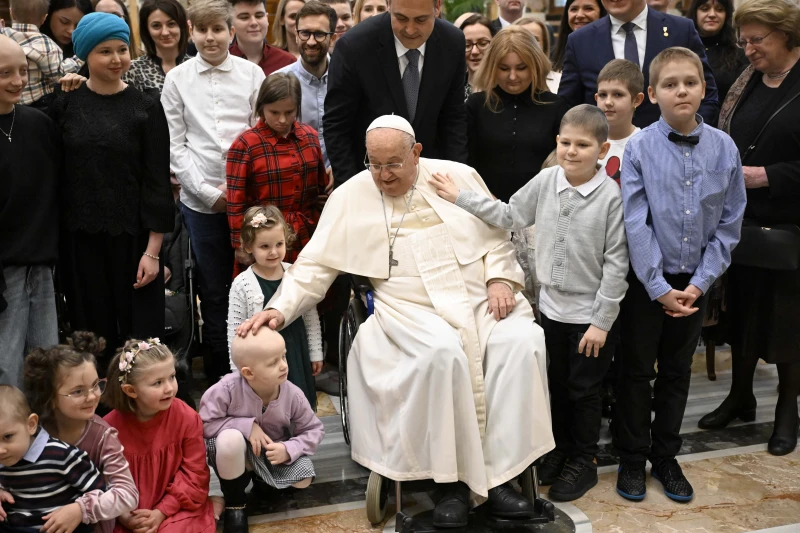
Pope Francis greets young cancer patients who are on pilgrimage from Poland to Rome during a Jan. 10, 2025, audience at the Vatican. / Credit: Vatican Media
Vatican City, Jan 10, 2025 / 12:35 pm (CNA).
Pope Francis told a group of children receiving treatment for cancer in Poland they are “witnesses of hope” to those around them.
During a Jan. 10 audience at the Vatican, the pope greeted cancer patients, ranging in age from young children to adolescents, who are on a pilgrimage from the city of Wrocław, in western Poland, to Rome.
“Thank you for coming, you are brave! And so you are witnesses of hope for us adults and for your peers,” Francis said. “I am happy that you were able to organize this pilgrimage of yours in this jubilee year focused on hope. It is a year in which God wants to grant us special graces.”
The children received by Pope Francis on Friday morning are receiving treatment at a pediatric oncology clinic, “Cape of Hope,” opened in Wrocław in 2015. It is part of the national Wrocław Medical University.
Pope Francis meets with young cancer patients who are on pilgrimage from Poland to Rome during a Jan. 10, 2025, audience at the Vatican. Credit: Vatican Media
The children were accompanied on their pilgrimage by their parents, nurses, doctors, a priest, and Honorary Consul of Luxembourg in Poland Krzysztof Bramorski.
“As I came to meet you, I felt a joy in my heart because we have the opportunity to give hope and love to each other,” the pontiff said in his remarks in the apostolic palace.
“You, dear children and young people, are signs of hope for me,” he continued. “Why? Because I am sure that Jesus is present in you. And where he is, there is hope that does not disappoint! Jesus took our sufferings upon himself, out of love, and then we too, through his love, can join him when we suffer.”
True friends share each others’ joy and pain, just as Jesus does, Francis said.
Another sign of Jesus’ friendship with the children is the love and presence of their parents and all who help take care of them, he added.
If you value the news and views Catholic World Report provides, please consider donating to support our efforts. Your contribution will help us continue to make CWR available to all readers worldwide for free, without a subscription. Thank you for your generosity!
Click here for more information on donating to CWR. Click here to sign up for our newsletter.

Bishop Robert Barron speaks to EWTN’s Colm Flynn about evangelizing the culture today. October 2023. / Credit: Word on Fire
Vatican City, Oct 26, 2023 / 14:30 pm (CNA).
Bishop Robert Barron said he regrets the Catholic Church’s “hand-wringing” in recent decades over how to share the Christian message with a secular culture.
In an exclusive interview with EWTN News this week, the 63-year-old bishop of Winona-Rochester said he wants to see the Church today embrace sharing the Gospel with the same gusto and confidence as when Sts. Peter and Paul evangelized Rome.
“Much of my adult life — and I say this with regret — the Church has been in a kind of hand-wringing mode of, ‘Well, what do we know, and who are we to tell you? And we’re here, really, to learn more from you.’ Come on!” Barron said during an interview at the North American College in Rome.
“Peter and Paul came to this town a long time ago and they weren’t here just to listen to Roman culture,” the bishop continued. “They were here with a message: ‘euangelion,’ there’s good news, and it’s good news that will change the world. And in fact it worked.”
“The fact that over there [St. Peter’s Basilica], Peter lies buried to this day, but dominating this once imperial capital is the cross of Jesus. That didn’t come welling up from Roman culture. That came from a message that these [apostles] brought. We should do our work with the same energy and the same panache and the same confidence,” Barron encouraged.
Bishop Robert Barron speaks to EWTN’s Colm Flynn in Rome, October 2023. Credit: Word on Fire
Barron, founder of the Word on Fire media apostolate, is in Rome to participate in the Oct. 4–29 session of the Synod on Synodality.
He said despite the apparent decline in faith and rise in what have been described as spiritual “nones” — people with no belief whatsoever — he still has hope in Christ and in the message of the Catholic Church.
“Being here in Rome with the synod, every day, people from all corners of the world — well, that means there’s something in Catholicism that is still very compelling to people, and that when it’s laid out in a way that’s intellectually satisfying and aesthetically pleasing and morally compelling, they respond to it,” he argued.
The bishop said he does not believe the “new atheist nonsense” will hold people’s hearts and minds in the long run.
“And the Church?” Barron added. “I look out at the city of Rome here: [The Church has] been around for a long time and we’ve been through a lot worse than we’re going through right now. So we will endure.”
“So Christ gives me hope and the Holy Spirit gives me hope,” he said. “We’ve been through a lot worse and there’s still nothing better on the table. There’s no fresher fish on the market than Christianity. It’s still the most beautiful, compelling message that we’ve got.”
The popular speaker and writer also said he does not think disagreements in the Church are worse than they were in the ’60s, ’70s, or ’80s.
People are not only critical of Pope Francis, he said, noting that Pope John Paul II and Pope Benedict XVI were also attacked during their papacies, though without social media so it may not have been as much on people’s radars.
Barron also attended the Synod of Bishops on young people in October 2018.
Practically speaking, he said, the synodal assembly this month is more comfortable than the youth synod.
Prior synods were held in the Vatican’s New Synod Hall, which has theater-like seating. Barron described it as “a somewhat claustrophobic room” and like sitting in “the middle seat on an airplane.”
He added that the larger space of the Paul VI Hall, with tables and chairs, as well as wearing suits instead of cassocks every day, is also “more comfortable, more humane … easier to get through.”
“The best part of [the Synod on Synodality]” is being with Catholics from all over the world, he said.
He recalled the “cacophonous sound” of hundreds of people speaking in different languages at the three-day retreat held ahead of the synodal assembly in a town outside Rome.
“It was the universality of the Church in all of us,” he said, “a kind of cacophonous wonder. There’s no other group or society in the world, I don’t think, that could muster that kind of international universality, and that is an extraordinary thing.”
Watch EWTN’s full interview with Bishop Barron below.
Vatican City, Sep 28, 2017 / 10:22 am (CNA/EWTN News).- On Thursday, the Vatican announced Pope Francis’ appointment of Fr. Ryszard Szmydki, a Missionary Oblate of Mary Immaculate, as the new under-secretary of the Congregation for the Evangelization of Peoples.
Fr. Szmydki, 66, replaces Fr. Tadeusz Wojda S.A.C., an official of the congregation since 2012 who was appointed metropolitan archbishop of Bialystok, Poland on April 12.
Originally from Poland, Fr. Szmydki has been secretary general of the Pontifical Mission Societies since 2014. He holds a doctorate in dogmatic theology from the Catholic University of Lublin in Poland, where he also taught for several years.
He is also the author numerous studies in the field of dogmatic theology and ecumenism.
Born in Tarebiski, Poland April 26, 1951, Fr. Szmydki entered the Congregation of the Missionary Oblates of Mary Immaculate (OMI) in 1970, making his perpetual vows on Jan. 21, 1977.
During formation with the Oblates he spent two years as a missionary in Cameroon before being ordained a priest July 2, 1978.
Before obtaining his doctorate, Fr. Szmydki received a licentiate in dogmatic theology from the Pontifical Urbanianum University in Rome.
In 1992 and 1998 he was elected assistant general in charge of mission in the OMI. He returned to Poland in 2005 and was appointed vicar provincial for the missions. In 2010 he was elected superior of the Oblate Province of Poland and was re-elected to the position Sept. 13, 2012.
In addition to Polish, he speaks Italian, French and English.
The Congregation for the Evangelization of Peoples was established by Pope Gregory XV on June 22, 1622 with the publication of the papal bull “Inscrutabili Divinae Providnetiae,” and is currently headed by Cardinal Fernando Filoni. Until 1982, it was known as the Congregation for the Propagation of the Faith or “Propaganda Fide.”
According to the Vatican, the role of the congregation “has always been the transmission and dissemination of the faith throughout the whole world.” It also holds “the specific responsibility of coordinating and guiding all the Church’s diverse missionary efforts and initiatives.”
In their last few rounds of meetings this year, Pope Francis and his Council of Cardinals have held a discussion of the possibility of restructuring the Congregation for the Evangelization of Peoples, as well as the Congregation of Oriental Churches and the Pontifical Council for Interreligious Dialogue.
So far no changes to the congregation have taken place, though they could in the future as part of ongoing reform of the Roman Curia.
Vatican City, Oct 6, 2018 / 02:00 pm (CNA/EWTN News).- At the end of the first week of the youth synod Saturday, Pope Francis and over 250 bishops spent the evening listening to testimonies from young people at an event inside the Vatican.







Leave a Reply