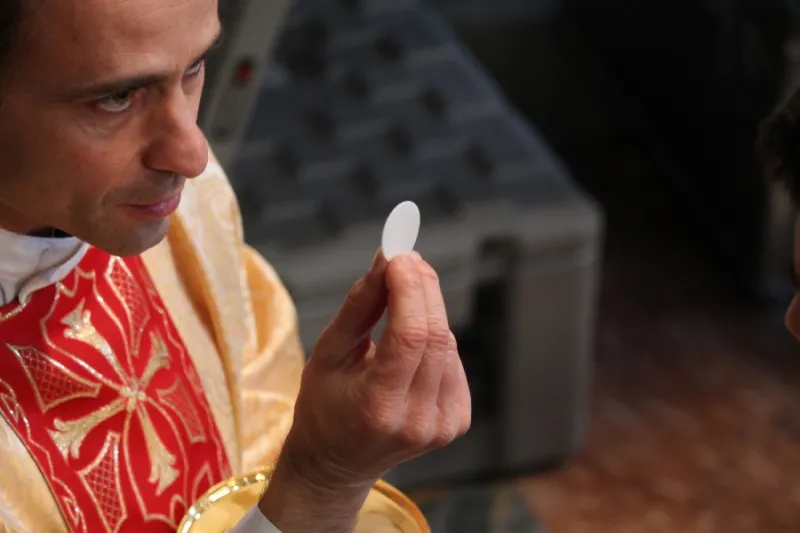
 Priest gives communion on the feast of the Holy Family in St. Peter’s Basilica on Dec. 27, 2015. / Alexey Gotovsky/CNA
Washington D.C., Jun 7, 2021 / 20:01 pm (CNA).
The U.S. bishops next week will deliberate and vote on whether to draft a teaching document on the Eucharist – despite the recent request of some bishops to delay such a discussion.
At the bishops’ virtual spring meeting scheduled for June 16-18, one agenda item that has received scrutiny is consideration of “Eucharistic consistency.” The agenda item is a “proposal to draft a formal statement” on “the meaning of the Eucharist in the life of the Church.” The proposal comes from the bishops’ doctrine committee.
In a May 22 memo to the U.S. bishops, the president of the conference – Archbishop Jose Gomez of Los Angeles – explained that the proposal for such a document came from the doctrine committee. The committee followed the administrative procedures for securing an agenda item on the matter, he said.
Further, the proposed outline of the document “reflects recent guidance from the Holy See,” Archbishop Gomez said, referring to a May 7 letter from the prefect of the Vatican Congregation for the Doctrine of the Faith, Cardinal Luis Ladaria, to Gomez and, by extension, the U.S. bishops.
Gomez added that “the focus of this proposed teaching document is on how best to help people to understand the beauty and mystery of the Eucharist as the center of their Christian lives.”
The conference will not be voting on any final text of a document, but simply on whether to begin drafting a document, he said. If the bishops approve the motion, they will still have the opportunity to deliberate and amend the document when presented in final form at a future meeting.
In its proposal, the bishops’ doctrine committee explained the two-fold need for a teaching document on the Eucharist.
First, the bishops’ three-year strategic plan – approved in November 2020 – has a Eucharistic title, “Created Anew by the Body and Blood of Christ, Source of Our Healing and Hope.” Second, a special working group of the bishops – convened in the aftermath of Joe Biden’s election to the presidency – recommended a teaching document on “Eucharistic consistency.”
That term has its roots in the 2007 closing document of the Aparecida conference of Latin American and Caribbean bishops – a document which then-Cardinal Jorge Mario Bergoglio had a hand in developing. Used in the document, the term refers to the need for Catholic leaders and legislators to defend life and the family against grave evils such as abortion and euthanasia.
Making specific reference to “legislators, heads of government, and health professionals,” the document states, “We must adhere to ‘eucharistic coherence,’ that is, be conscious that they cannot receive holy communion and at the same time act with deeds or words against the commandments, particularly when abortion, euthanasia, and other grave crimes against life and family are encouraged.”
Although individual U.S. bishops have talked about the matter of Communion for pro-abortion politicians in recent months – given that President Biden is Catholic and supports taxpayer-funded abortion – the bishops’ Eucharistic document would be “addressed to all Catholics.”
“In light of recent surveys, it is clear that there is a lack of understanding among many Catholics about the nature and meaning of the Eucharist,” the doctrine committee’s proposal stated.
In 2019, a Pew Research report found that fewer than one-third of Catholics (31%) surveyed believed in the Real Presence, and more than two-thirds (69%) believed the Eucharist to be merely a symbol. Several bishops at the time, citing the survey, emphasized the need for catechesis on the Eucharist.
A proposed outline of the Eucharistic document reveals a comprehensive catechesis on the Eucharist, covering both the sacrament itself and how Catholics must live in accord with the Commandments in their daily lives.
The outline covers teachings such as the “Real Presence” of Christ in the Eucharist, a “recovery of understanding the Eucharist as sacrifice,” “the importance of Sunday as a day of obligation,” the need for beautiful liturgies, Catholics living as a “Eucharistic people” in daily life, the Eucharist as a “call to conversion,” and the importance of practicing the works of mercy.
The third part of the document also includes a section on “Eucharistic consistency,” and “the nature of eucharistic communion and the problem of serious sin.” It cites the teaching of St. Paul in the First Epistle to the Corinthians, “A person should examine himself, and so eat the bread and drink the cup. For anyone who eats and drinks without discerning the body, eats and drinks judgment on himself.”
Some bishops had recently moved to delay the discussion on the Eucharist, citing a Vatican letter to argue against a virtual discussion of such a serious topic.
Archbishop Gomez had written to the Vatican in March, informing them of the plans for the spring meeting. On May 7, Cardinal Ladaria responded to Gomez, addressing the topic of Communion for public officials who support permissive legislation on grave evils such as abortion.
If the bishops were to issue any “national policy” on Communion in these situations, he said, they would first need “serene” dialogue among themselves to ensure unity on Church teaching. Then individual bishops should dialogue with the Catholic politicians in their jurisdictions, to better understand their positions and their “comprehension of Catholic teaching.”
Only after that, he said, should the bishops discern how best to move forward on the matter. Any action they take should ensure consensus, respect the authority of individual bishops in their own dioceses, be framed within the broader context of general worthiness to receive Communion among all Catholics, and must not appear to list abortion or euthanasia as the only grave moral issues, he said.
After the Vatican sent its letter to the bishops, Cardinal Blasé Cupich of Chicago led a letter by some bishops to Gomez, asking that the planned discussion on the Eucharist be delayed. The gravity of the issue necessitated an in-person discourse, Cupich argued, and should first be addressed by provinces or regional groups of bishops before the entire conference deliberated on it.
Gomez, in his May 22 memo, said that the discussion will take place as planned at next week’s meeting. Such a motion is in line with the administrative procedures of the conference and the requests in Cardinal Ladaria’s letter, he said.

[…]





Honor to this President for standing up for Palestinian rights and for warning our nation against the inordinate influence of Israel.
May God grant salvation to President Jimmy Carter.
Yes, let’s pray for his soul. But let’s not forget that Carter—in addition to being pro-abortion, pro-“gay marriage”, and slanderous towards pro-lifers—praised Castro and Cuba, China, Tito (“a man who believes in human rights”), Kim Il Sung, Yasser Arafat, and the PLO, Mengistu, Cédras, Assad, and Hamas. Jimmy was most inept (whereas Joe is mostly corrupt), but he was also a sanctimonious embarrassment far more often than his hagiographers (that is, the legacy media) will ever admit. For more, see my July 2009 post at Insight Scoop.
Upon Carter’s election, the astute and long-time Singapore President Lee Qwan Yew wrote (of world leaders) in his own autobiography, “we knew we would just have to put up with him for four years.”
And, on the domestic scene, we recall that it was President Carter who gave us the cabinet-level position U.S. Department of Education, surely as a reward to the teachers’ unions that helped him get elected (formed on May 4, 1980, as a result of the Department of Education Organization Act–Public Law 96-88–of October 1979; President Jimmy Carter signed the bill into law.) The gift that keeps on giving.
Educationally speaking, Shakespeare gives us a clue: “The fault is not in our ‘stars,’ but in ourselves” (“Julius Caesar”). That is, the fault is not in those who are elected but in those who elect them. The corporate Peter Principle transferred to the gummint.
Yes, the establishment of the Department of Education was foolish. Yet, who kept it going, despite, as I recall, promises to the contrary? Oh, yeah, his successor, that “great conservative” Ronald Reagan.
Bravo! Sick to death of the hagiographies popping up everywhere.
Not that Pres. Carter endorsed this policy, but something to keep in mind from the late, great Huey Long:
“I don’t know much about Hitler. Except that last thing, about the Jews. There has never been a country that put its heel down on the Jews that ever lived afterwards.”
— Huey Long
For all his faults, Huey had some wise insights. May he & Jimmy Carter rest in peace.
Palestine must earn nationhood. Terrorism must never be rewarded. For over three quarters of a century, the only thing that Palestinians have excelled in is their ability to inflict incalculable suffering on a global scale, not only on others, but also on themselves.
It will only be by a direct intervention from God Himself that the hearts and minds of radical Islam will be converted.
It is for this we must pray.
Aside from rationalizing numerous acts of Islamic terrorism, possibly to downplay and make his years of cowardice not seem so bad while president, the post-president, “great humanitarian,” Carter met with leaders of the terrorist group Hamas. He embraced Nasser al-Shaer, the man who ran the Palestinian education system, brainwashing children into believing Jews are the descendants of pigs and dogs. He laid a wreath at the grave of Yasser Arafat, the most notorious terrorist thug of the 20th century.
Oh I forgot. Francis seems to indicate the Islamic world can’t do much that is morally wrong. He once reminded us that beheading children was the equivalent of domestic abuse, which he assumed was done by Catholic men since he read it in an Italian newspaper.
Freemasons defend the reputation of fellow members. Not suggesting that is what Bergoglio is doing at all, what so ever.
Thanks for your counter-witness, Carl. I confess my (naive) views of Carter have hitherto been based on the so-called mainstream media.
If Carter was mainly inept, what does that make Francis with his (supposed) assessment of him?
I volunteered in Jimmy Carter’s campaign & he was the first president I ever voted for . (And the last Democrat.) He really was a decent & faithful man in many ways but a very incompetent president.
In the beginning we believed he was a solid Christian believer but over time he veered off in some strange directions. God rest his soul.
Good question. I think there are a few factors involved. First, Pope Francis had to say something nice; it would be uncharitable to do otherwise. Secondly, Francis (I’m guessing) knows very little about Carter’s faith, life, policies, etc. Some of that is to be expected, as the Pope isn’t supposed to be an expert on all previous and current world leaders. But, thirdly, his remarks (praising “the deep faith” of Carter) just follow the standard, mainstream line, which is par for this pope and his inner circle. Fourth, I think that Francis is so keen on politics and political gestures that he probably believes Carter was a good president of deep faith. After all, that’s what the media legacy is trying to feed us here, even though the record says otherwise. Fifth, I think both men, in real ways, are 1970s liberals who have “evolved” on certain stances. Carter (as noted already) ended up embracing a hazy form of liberal Protestantism—or, better, of Protestantized liberalism—and jettisoned core moral beliefs, which in turn meant dismissing any sort of traditional, biblical Christian anthropology.
The bottom line, for me, is that Carter was mostly a disaster as POTUS and while he did some good things afterwards, he was a pro-tyrannical, pro-abortion, pro-“gay marriage”, post-1970s liberal whose Christianity was thin at best.
Carter’s was a failed presidency and American voters rejected him and his policies. I find it amusing and laughable how the leftists (inclusing Bergoglio) are tripping over themselves to canonize this man. Some of us are not fooled by the posturing. The guy was book smart but had the leadership skills of an idiot.
Carter was not a good President. I voted against him twice. He let the Iranian Shiite fanatics push him around, that said, he did become a decent ex President with the Habitat for Humanity business. I recall seeing a picture of him years ago, after he left the White House, wearing a tool belt and hammering nails at a construction site. I thought that was nice that he found some task that he can accomplish.
🤭
Agreed on his presidency. It was, overall, a train wreck. Carter was a nice guy, and that meant that he did some nice and good things. But “nice” isn’t the same as principled or strong, and Carter (in my estimation) was neither of those.
Jimmy Carter’s single greatest accomplishment was in giving the United States of America eight years of Reagan.
👍
I took your recommendation, Carl, and read your 2009 article. I believe I am now sufficiently inocculated against the current media and papal hagiography.
I do think Habitat for Humanity does good work.
Respectful farewell to Jimmy Carter. RIP.