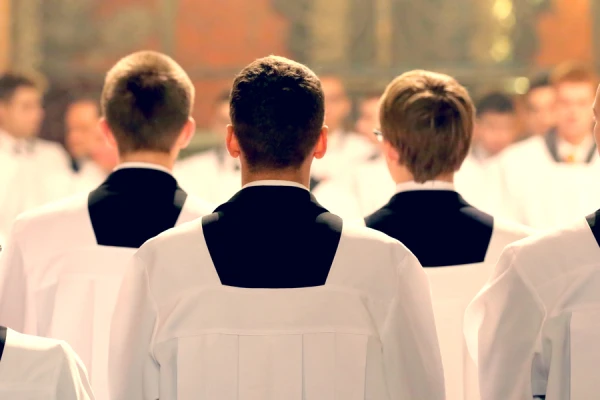
Denver, Colo., Jul 23, 2019 / 12:15 pm (CNA).- Catholic journalists know that discernment stories are popular because they give readers hope. And they often follow a pattern: They usually include a “God moment” in which the subject, through a dramatic circumstance, hears the word of God and finds with sparkling clarity, the call to become a cleric or religious. They end with ordination or follow final vows.
Jacob Hubbard’s discernment story isn’t like that.
Hubbard had multiple “God moments,” and he entered seminary because of them. But in seminary Hubbard realized that ordination wasn’t his calling. In November 2018, he discerned out of seminary.
“By our baptism, we’re all called to be priests, prophets, and kings,” Hubbard told CNA. “So although I won’t be an ordained priest, I’ll be living out my calling by being the priest of my family- the bridge between them and God, offering them Christ as much as I possibly can and relying on His Strength to do so.”
It could be easy to see Hubbard’s discernment out of seminary as a failure. In fact, many seminarians who discern out of seminary face a kind of stigma from their friends and family, and even from themselves.
But that stigma is based on a misunderstanding of seminary’s purpose, Hubbard told CNA.
As Hubbard said, “The stigma today is that when people see seminarians, they don’t see them as discerning individuals, they see them as mini-priests.”
Seminary is a “house of discernment,” he said, “not a house of mini-priests,” adding that if a man leaves seminary, it’s often a positive sign of his ongoing vocational discernment.
Fr. Phillip Brown, President-Rector of St. Mary’s Seminary and University in Baltimore, agreed.
“As a seminary faculty and as a rector, when a seminarian discerns out, and we’re satisfied that it was an authentic, good, discernment, we don’t consider that a failure. We consider that a success,” Brown explained.
“What I say to the seminarians is that in the end, the objective here is not to become a priest, but to be what God has made you to be,” Fr. Brown said.
Discerning with openness to God’s call
According to Fr. James Wehner, rector of Notre Dame Seminary in New Orleans, only about 30% of men who originally enter seminary are ordained.
“It’s not a failure,” Fr. Wehner said. “We think it’s a very healthy process of discernment where he and the Church recognize that he’s not called to priesthood.”
“But we want to give the guys an opportunity to discern and to form, and if they’re not called, they will leave here stronger, healthier, Christian men because they were totally open to the formation experience, so it’s a win-win situation.”
Even if a man leaves before ordination, Hubbard told CNA, “you can walk out a better man if you do seminary right. You could really figure out the areas you have believed lies your entire life. And then you can accept God’s love there instead.”
The difficulties and the fruits of seminary life
There are many gifts that come with entering seminary, but they come alongside trials, Hubbard said.
When he entered Holy Trinity Seminary in Dallas, Hubbard found himself face-to-face with a slew of challenges.
A strict schedule and constant obligations kept him busy, even without the additional work a full-time student must face at the school next door, the University of Dallas.
“You need structure to build your life on, and that structure needs to include self-love, so doing things that you personally love, and then of course prayer where you receive love from God,” he said regarding structure.
The routine of seminary taught Hubbard that “it’s impossible to earn God’s love by your own measures. But the routine can open you up to being able to receive it more.”
Discerning into seminary
Hubbard said he had long considered the priesthood, with encouragement from his family, and reflected on it while journaling about his prayer life while in high school, and through retreats and mission trips.
After several invitations to visitation weekends at HTS, he attended one, and after a “God moment,” he chose to apply to the seminary, entering as a sophomore in college.
Discerning out of seminary
During Hubbard’s time in seminary, he worked hard to be engaged in the community and to take the opportunities presented to him.
The summer before his senior year, his pastoral assignment was as a counselor at The Pines Catholic Camp, a summer camp in East Texas. There, Hubbard worked closely with other counselors to teach and take care of children at the camp.
Hubbard told CNA that he was struck by some of the beautiful and inspiring marriages he saw the camp directors have, and the happiness he saw that came from their relationships with their wives and children.
That summer he also participated in Trinity Cor, “a two-week backpacking journey to discover your heart,” Hubbard explained. “To really find your manly heart and discover your masculinity, and it was awesome.”
“Coming back from that, I was really feeling like I had more grasp at my heart, and really had the question of discernment lodged in me from The Pines because I saw beautiful relationships there. That experience of The Pines mixed with deepening the discovery of my heart through Trinity-Core began the questioning of my discernment,” Hubbard said.
He sought out counsel about his questions, and trusting his spiritual director to keep his best interests in mind, opened up to him about everything.
One of the biggest moments for Hubbard was when his spiritual director asked Hubbard to consider marriage.
His spiritual director asked Hubbard to imagine himself, in prayer, as a priest coming home from a good day of Confessions and Mass, and then to imagine, in prayer, being married and coming home to a wife and children.
“I felt so much more deeply my heart belonged with a family,” Hubbard explained. “There’s no way to really articulate it, except that I just felt myself more present, more human there. Even just painting the picture almost brought me to tears.”
Hubbard left seminary in November of his senior year.
“And I have not regretted it since,” he said. “It’s been a beautiful journey. Seminary was a necessary step, and so I know that God has just continued to lead me along a path which I hope one day, He will use to help heal those hurting around me. I want to still give of myself to those around me.”
Does “discerning out” mean failure?
Although seminary was helpful for Hubbard in his discernment both for the priesthood and for the married life, he found that a lot of people misunderstood the reasons he had left, and some saw it as a failure on his part.
“I think that a lot of people have the misconception that when you step out of seminary it’s a failure of sorts. Their reactions are, ‘Oh, I’m sorry,’ or things like that. The negative stigma of discerning out needs to be eradicated so that seminarians who are torn don’t have that fear that when they leave, their friends, their families, their priests back home will be disappointed.”
“The stigma holds seminarians back from being able to healthily discern. I think that’s something pretty unaddressed in today’s world: the very healthy and good option of discerning out. People see it as something entirely negative, and they shouldn’t,” Hubbard continued.
After explaining his decision to his friends they understood and supported him, he told CNA, but the initial uncomfortable or negative feelings still felt like a stigma, or at least a misunderstanding, about what he considered to be a healthy discernment.
“And I experienced that a bit with some of my friends and family, but I also had overwhelming support, especially from my father, and so it was okay,” he said. “I definitely felt supported in my decision.”
Discerning into seminary at 18, his father told Hubbard that he “was proud of Hubbard no matter what.” At the time, Hubbard wondered why his dad didn’t seem more enthused about his entrance to seminary.
“But that consistency was something that was actually beautiful in the long run, and that’s what I think parents should strive for when their kids enter seminary,” he told CNA.
“That’s the exact same thing he said to me when I discerned out of seminary, and I knew that he supported me on either side and trusted my judgement, so it was incredible. It really was,” Hubbard said.
Hubbard’s father, Brad, told CNA that his first and foremost step is to pray for his children, and says that he wanted to make sure his son was happy with the formation he was receiving while in seminary.
“For me, it’s just the importance of leaving the discernment to God. As a parent, I’m there to support and especially pray, and then God’s will be done in regards to that.”
Hubbard’s Future
Last May, Hubbard graduated from the University of Dallas with a degree in philosophy, and he now plans to attend the Augustine Institute for a graduate degree in theology.
He believes he has had many blessings throughout his time in seminary and now working, and wants to have the opportunity to impact people through an occupation in ministry after he graduates.
Hubbard finds that despite the magnitude of the decision, he does not question his choice. He told CNA that his relationship with God has grown since his departure from seminary.
And in the pursuit of marriage, Hubbard has felt more confirmed in his choice.
“If everything else were to fall apart in my life, if I questioned every other piece of discernment, that is what I could hold onto and know for a fact that I made the right decision because I have so deeply encountered God’s love incarnationally in a way that I could not have in seminary,” he said.
 […]
[…]






Well, at least the cardinal proposes that Catholics should “stand” for something…
And, now since “we all have benefited from the renewal of the Church ushered in by the Second Vatican Council”–and everyone and even the notorious Pelosi and Biden et al now files up for Communion as a prelude to coffee and donuts–why shouldn’t this be characterized as just another “procession?”
Talk about a cardinal “drawing attention to oneself…”
As a former member of the archdiocese the only comment i can make is “how dare you Cardinal” tell the faithful that they MUST stand receiving the Body Blood Soul and Divinity of Jesus Christ in the Eucharist. Apparently the cardinal does not believe bowing or kneeling before the King is appropriate, rather, stand there and just reach out your hands to receive Him. Seriously, this cardinal needs to be removed by the Pope while I pray that he comes to his senses and a true Catholic shepherd.
Didn’t someone once say, “Every knee shall bow”? . . . Oh, yes! St. Paul, but he was, no doubt, one of those rigid backwardists.
Es importante recibir la comunión de rodillas y en la boca y no de pie y no en la mano,las partículas que se desprenden contienen el cuerpo completo de nuestro Señor,el modernismo o la forma no implica ningún avance en la evangelización al contrario ,promueve una falta de respeto muy grave que recae en el sacerdote y en los fieles,y claro el que está impedido físicamente debe permanecer de pie pero no recibir en la mano la santa comunión este fondo es importante y no lo que bruscamente opine el sacerdote conciliar
That certainly won’t happen in this pontificate. The Pope only has his knives out for liturgical traditionalists.
Unfortunately, Cupich and Francis are of one mind in this.
Or lack therif!
Cardinal Cupich seems to have a need to make a pronouncement every once in a while to remind us he’s still around.
About processions and positions and such, the cardinal’s timing (Dec. 11) almost seems intended to distract American attention from further antics by the puppet masters in Rome, to improve the position, so to speak, of the LGBTQ lobby–with a Jubilee 2025 networking celebration of their own in the Church of the Gesu (also reported on Dec. 11):
https://www.catholicnewsagency.com/news/260989/organizers-and-supporters-reluctant-to-discuss-planned-lgbt-jubilee-day-in-rome
My lay comment is that this is not an outstanding comment if it’s in regards to kneeling. When I see someone kneel, which I’ve never seen take more than a few extra seconds for the able bodied, it does not appear to be drawing attention to the Communicant but to the Risen Lord Jesus in the Eucharist. (that person is not afraid to acknowledge the Savior)
Perhaps the most charitable response to reception of our beloved Jesus in Holy Communion is to follow his commandment – love God and love others. At a chapel I often attend, those who wish to receive Holy Communion while kneeling move to the front pews and kneel down signaling to the priest that there is a kneeling communion line, and the remainder of communicants form a communion line by standing. It seems to work, and honors both.
I can’t kneel due to knee issues, and I must choose to stand in line. At other churches, I’ve had several instances of almost toppling over the person in front of me as they unexpectedly kneel down. Since my knees are not the nimblest I’ve had to make a quick step back so as not to step on the kneeling person, causing me stress and pain in my knees and interrupting my prayer just before reception. Since I can’t kneel, it makes me embarrassed that others think I choose not to kneel since the person in front of me just did so (i.e., my depth of reverence is less than the one before me).
Again, there are many ways to show our deepest adoration of God, but we need to do so also being mindful of those around us. Surely, we can find a path that honors both.
Good points Sir, but don’t worry about what others think at this apex of the mass. As far as I’m concerned, they can dim the church lights and shine them only on the Eucharist reception area during communion.
The last will be first.
You don’t need to kneel because the person in front of you kneeled. It’s not being done to make a personal comment on you and the other communicants. In general, people aren’t paying as much attention to us as we imagine.
As far as the knee problems, quite a few people develop knee and/or back problems by the time they are middle-aged, and younger people who are active in sports or dance can have them too, so I would not feel too self-conscious about that. It’s a good idea to allow a little extra space in front of yourself when moving forward in a line.
When I find myself feeling self-conscious about what the people around me at Mass may be thinking about whatever I am doing–and those moments do happen– I remind myself to redirect my attention to the Lord and whether I am pleasing Him. Now, it could be that when you see someone kneeling before receiving the Eucharist, you feel inspired to make an extra sign of devotion too, although kneeling on the floor won’t work for you, so a reverent bow or slight genuflection is better. That is common at the Masses I attend.
When the hand to mouth option came along, we were taught to do as you said, bow as you near or genuflect, then step to the side, face the crucifix and eat the host, make the sign and move along.
The problem of people in front of you unexpectedly kneeling is a very good reason to provide kneelers. They aren’t particularly expensive, they allow people who are older or in poor health to kneel if they desire, and most churches already have them.
They also make it clear what the person is about to do so that the tendency to leave only a foot or less between the person ahead of you in a line is naturally reduced. You don’t have to think very hard to refrain from crowding a kneeler. It also clearly signals to everyone, priest included, that kneeling is going to happen, without the people who intend to kneel needing to remember to segregate themselves.
I’ve seen this done, and it seemed quite effective.
Of course he did. He’s a Protestant who obviously doesn’t believe in the Real Presence. God save us from wolves…..in wolves clothing.
In my youth in the 1950’s we knelt and received on the tongue from the priest’s consecrated hands. Belief in the real presence was near universal.
We now have what one priest commentator called “grab and go.” Belief in the real presence is less than 50%.
Actions have consequences.
Yes, especially the VII liturgical reform that Cardinal Cupich so endlessly idolizes.
Once again the diminutive Cardinal Archbishop of Chicago seized the opportunity to remind everyone of how truly insignificant he is in the grand scheme of things.
I’m just thinking about the insensitivity of current hierarchy figures pronouncing controversial statements during the Advent/Christmas season when people and families don’t need more stress but peace. It was also last year the Vatican came out with the homosexual blessing thing during this time. Come on! I wish they be more sensitive and consider their timing, they know what things are going to stir controversy.
I don’t understand the Cardinal’s argument
about not drawing attention to yourself or not impeding the flow of the procession.
In the local parishes I attend, some people kneel and some stand to receive Holy
Communion. So, where is the problem? It works smoothly this way. If I may speculate,
from what I observe, many who kneel are very devout and traditional – the very people the
Vatican targets. Could this be another attempt not only to wipe out the Latin Mass, but
any practice which has been associated with it?
Another fuhrerbefel from the windy city! Wonder how the Magi would feel, given that they did the right thing: They presented their gifts and knelt before Him in adoration!
The reform called for by Vatican II was to take place by everyone being more deeply educated about The Mass and other parts of the Church’s Liturgy. We have the education provided by Scripture, Tradition, and the Saints…and then everyone else all over the place. Teachings by JPII, Benedict XVI, Mother Teresa are obviously authentic, while this red-hat-wearing walks and “leads” in the way of the world, hostile to God.
It brings to mind the great words of Mother Angelica, speaking against another very worldly creature, when she said to the world, “My obedience in the diocese would be absolute zero,” (properly understood – “Do what they say, not what they do”).
She paid the price for her loyalty to our Saviour. But God Himself showed who spoke His Truth, and spoke for His Son authentically, sending the All Holy Virgin to perform the miracle of her healing before all the world.
He spoke very loudly, but few if any of our “leaders” listened.
Do what they say. But, as our Dear Savior continued, “…do NOT do what they do.”
They (may) receive the greater condemnation, teaching as doctrines the mere precepts of men…
I think this is the first salvo of the “liturgical reform” of “synodality” for a “participatory church” yada yada yada…. The closing document opened this door but left it undefined. I think Cupich is trying to fill in the lines. In other words, more Bugnini-type “liturgy from above” imposed as supposedly the will of the people and of the Spirit (with little evidence of either)
No priest or bishop can deny a person Communion if said person chooses to kneel. Roman Rite Catholics (should) have the option to do both, kneeling or standing. In the Byzantine Rite though, standing is the norm when receiving the Eucharist. Kneeling is gently discouraged. Some people might interpret it as Romans kneeling before the Cross, and Byzantines standing with the Risen Christ.
When in Byzantium, do as the Byzantines. When in Rome, do as the Romans. Standing is not our tradition, and while I always appreciate hearing and seeing what the other Churches do, I rather object to their traditions being used as an argument against ours. (I know you did not do this).
When meeting the Risen Christ, St. Mary Magdalen is typically portrayed (at least in the Latin tradition) as kneeling, often holding on to His feet. The meaning of kneeling is not restricted to penitential or sorrowful themes for us.
Cardinal Cupich long ago became a caricature of the sixties priest. Its a new century with ample ecclesial experience under our belts. Time to release youthful deceptions.
Jesus Christ is Lord and we provide Him all praise, honor, glory and joyful submission. No one with any faith or perception need provide any impediment.
Do you all realize how ironic Bishop Cupich’s Advent Declaration is? He castigates those who have the temerity to kneel while receiving the Body and Blood of Christ because by doing so they call attention to themselves. Yet, in Bishop Cupich’s Declaration he has done just that – called attention to himself. He always seems to stir the ecclesial pot with some stupid and unnecessary statement that gets him all the attention he seems to crave. I’d describe him as ‘puerile.’ Time for the episcopal nursing home.
Cardinal Cupich turned 75 earlier this year, and formally sent his mandatory letter of resignation to Pope Francis, so hopefully the Chicago archdiocese will have a better shepherd soon.
In our small parish (Liverpool diocese in England) almost one in ten choose to receive kneeling, and some more standing on the tongue, disturbance to the flow is negligible. Much more delay is caused by the two people who need low gluten hosts. I cause most problem because I currently have a balance problem and have to clutch the arm of someone else, delaying them and having to stand there while they receive. Also, as we have a narrow centre aisle obstructing the flow all the while I approach and return.
CLAPTRAP or Gobble-de-gook if you prefer!
Cupich is just another petty tyrant promoted way beyond his skill and abilities by a Pope hellbent on imposing his will on the “backwardist” and “rigid” Catholics.