




Rome Newsroom, Nov 30, 2024 / 08:10 am (CNA).
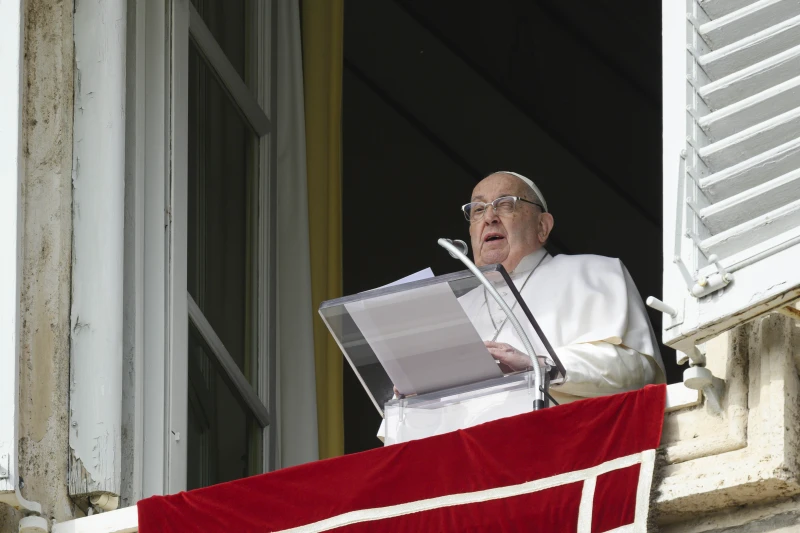
Pope Francis has proposed celebrating the 1,700th anniversary of the First Council of Nicaea together with Orthodox leaders, in a personal letter to Ecumenical Patriarch Bartholomew of Constantinople.
The letter, published by the Vatican on Saturday, was delivered by Cardinal Kurt Koch — who heads the Dicastery for Promoting Christian Unity — during a visit to Istanbul for the patronal feast of the Orthodox Church.
“The now imminent 1700th anniversary of the First Ecumenical Council of Nicaea will be another opportunity to bear witness to the growing communion that already exists among all who are baptized in the name of the Father and of the Son and of the Holy Spirit,” Francis wrote in his message dated Nov. 30.
Reflecting on six decades of Catholic-Orthodox dialogue while looking ahead to future possibilities for unity, the pope acknowledged the progress made since Vatican II’s Unitatis Redintegratio decree marked the Catholic Church’s official entry into the ecumenical movement 60 years ago.

Speaking to EWTN News about this anniversary on Nov. 21, Cardinal Koch emphasized that unity efforts must focus on “the innermost center of self-revelation in Jesus Christ.”
The Swiss cardinal also highlighted what he called an “ecumenism of blood,” noting that “Christians are not persecuted because they are Catholic, Lutheran or Anglican, but because they are Christians.”
Building peace in a time of war
While celebrating the “renewed fraternity” achieved since Vatican II, Pope Francis noted in his message that full communion, particularly sharing “the one Eucharistic chalice,” remains an unfulfilled goal.
In a pointed observation about contemporary global tensions, the pontiff connected ecumenical efforts to peace-building.
“The fraternity lived and the witness given by Christians will also be a message for our world plagued by war and violence,” he wrote, specifically mentioning Ukraine, Palestine, Israel, and Lebanon.
The pope also highlighted the recent participation of Orthodox representatives in October’s Synod on Synodality.
The traditional exchange of delegations between Rome and Constantinople occurs twice yearly, with Catholic representatives traveling to Istanbul for St. Andrew’s feast on Nov. 30, and Orthodox delegates visiting Rome for the feast of Saints Peter and Paul on Jun. 29.
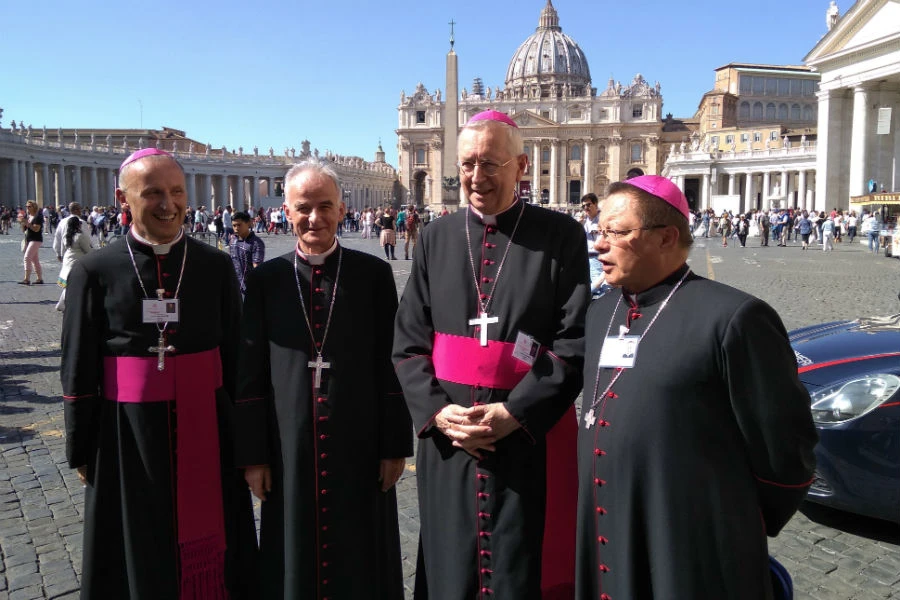
Cardinal Koch led this year’s Vatican delegation. He was accompanied by Archbishop Flavio Pace, Secretary of the Dicastery, Monsignor Andrea Palmieri, Undersecretary, and Archbishop Marek Solczyński, Apostolic Nuncio to Turkey.
The delegation participated in the Divine Liturgy at the Patriarchal Church of St. George, Phanar, and held discussions with the synodal commission charged with relations with the Catholic Church.
If you value the news and views Catholic World Report provides, please consider donating to support our efforts. Your contribution will help us continue to make CWR available to all readers worldwide for free, without a subscription. Thank you for your generosity!
Click here for more information on donating to CWR. Click here to sign up for our newsletter.


As long as we remain apart from communion as a body fully united in doctrine and practice, we belie the unitive element of the Eucharist, if we simply engage in intercommunion for sake of a conceptual unity understood as friendship we divest the reality of unity realized in specificity, that which distinguishes one baptism, one faith, one Church.
Insofar as the Orthodox with whom we are so close in belief and practice, the theological solution of one faith cannot be the mitigation of key doctrine, in specific, that centers on one specific belief, the identity of the Person of Christ who shares full and complete divinity with the other two persons of the Holy Trinity. That contentious doctrine is the Filioque clause, which clearly and unambiguously defines the co-equality of the three Persons. To remain in denial of that doctrine is to diminish the divinity of the Person Jesus of Nazareth.
Fr, all three Persons in the Trinity are one in substance and undivided. You are correct in stating that the Orthodox churches reject the Filioque.
However, many Eastern Catholic Churches in full communion with Rome, such as Ruthenian Byzantines, omit the Filioque clause when they recite the Creed. Byzantine Catholics most certainly do not diminish the divinity of the Person Jesus of Nazareth. Rather, they emphasize His divinity by focusing on the Resurrection.
Here’s a good article I found. https://www.google.com/url?sa=t&source=web&rct=j&opi=89978449&url=https://east2west.org/sp_faq/filioque/&ved=2ahUKEwiluvyC84aKAxWwIjQIHX1qDbYQFnoECDMQAQ&sqi=2&usg=AOvVaw2j4MQaCEWh7lt4Eh1OHKlK
Right. In addition, the Orthodox separate themselves from Roman Catholicism by taking different positions on issues other than the Filioque…1) Peter’s Primacy, 2) Priestly celibacy, and more.
Yes. Thanks for your response. Eastern Rite Catholics remain united with the Church on the basis that they do not repudiate the long held doctrine that the Holy Spirit proceeds from the Son as well as the Father. Unfortunately, the Orthodox do not simply refuse to state explicitly that Christ imparts the Holy Spirit. They effectively deny it.
For a background of that explicitly stated doctrine within Catholicism I list the following: Tertullian 216 AD against Praxeas. Origen 229. Maximus the Confessor 254. Gregory Thaumaturgus [the wonder worker] 265. Hillary of Poitiers 357. Basil the Great 375. Ambrose of Milan 371. Gregory of Nyssa 382. The Athanasian Creed 400. Augustine 408. Cyril of Alexandria 424. Gregory the Great 447. Toledo 447. At Toledo Spain’s hierarchy contested Arians who denied the procession of the Holy Spirit from Christ. There should be no objection whatsoever to the attachment of the Clause to the Nicaean Credo.
Correction: Pope Gregory the Great affirmed the filioque in his Dialogues dated 593.
Yes, as an Eastern Orthodox I also find it quite amazing (and sad) when Roman Catholics attack Orthodox theology/ tradition like the Filioque issue, married priests etc. while having their own Byzantine CATHOLICS who do just what we do.
I am quite sure it would be very enriching, for the Roman Catholics, to learn more about their Byzantine brethren.
Anna, the issue with the Orthodox is not that the Latin Church seeks to impose the Filioque Clause. Rather it’s that certain Orthodox refuse to accept Rome’s decision to include the clause. Even if it relates solely to the Latin Church. This was addressed by John Paul II:
“In 1995 the Holy Father asked the Pontifical Council for Promoting Christian Unity to reconsider the issue. At his request, they issued a marvelous document entitled: ‘The Father as the Source of the Whole Trinity – the Procession of the Holy Spirit in Greek and Latin Traditions’. This document acknowledged the Eastern understanding of the Father as the source of the Trinity as being definitive for the Catholic Church. The Orthodox were concerned that Catholics claimed that the Father and Son BOTH were the source of the Trinity. This document puts that fear to rest” (Dr Anthony Dragani).
While a monarchical understanding of the Father is acceptable, we cannot presume the Person of Jesus of Nazareth is not co-equal with the Father.
I read somewhere that Romans interpret it as the Holy Spirit proceeding from the Father and the Son, whereas Byzantines look at it as the Holy Spirit proceeding FROM the Father THROUGH the Holy Spirit. I do NOT know if that is actual, official Eastern Catholic doctrine/teaching though. Nevertheless, the Filioque clause issue is not the main source of division between the Orthodox and the Catholic Church, both East and West. It’l seems to be the Immaculate Conception and the Papacy.
I meant to say Holy Spirit proceeding FROM the Father THROUGH the Son, not thru the Holy Spirit. My error. Like I said, I don’t know if it’s official Eastern Catholic Churches doctrine or not.
Ultimately Anna in respect to the Trinity there is only one God, be he the Father, or the Son, or the Holy Spirit.
Fr Peter,
You are saying nothing new to me.
PS After worshiping with Roman Catholics for ten years I recognize the old myself in you (by “you” I mean not just you but many Roman Catholics). Years ago, I was sure that Roman Catholics are somewhat heretical/incorrect. After years within the Roman Catholic Church (but remaining an Orthodox) I can see how presumptuous I was. Even if I still do not think some things are not necessary/disagreeable, I can see their logic. My point is that many Roman Catholics are full of false ideas about Orthodoxy just as most Eastern Orthodox – about Catholics. Not all ideas are entirely false but they somehow are perceived differently when one is inside. You cannot understand what our (Orthodox) thoughts are unless you worship with us for some time.
I think I expressed this thought before, of a necessity to understand the other via participating in the Liturgy/Mass of the other tradition. When one is worshiping God, he cannot exercise his pride and think “oh, it is all wrong”. Thus, he perceives the other tradition from a lower point and it enables him to understand better. It is only when one begins loving the other tradition he begins perceiving its truth.
Thoughtful and kind Anna.
Nicaea is perceived as the definitive profession of the faith. Christ’s divine identity is defined in the words, God from God, Light from Light, True God from True God. That definition was broken when it was declared in the East that the Holy Spirit proceeds exclusively from the Father, not from the Son. And the reason why it was absolutely required to restore its meaning.
Although John’s Gospel confirms Everything that the Father has, has been given over to the Son, and everything that the Son has, is possessed by the Father. Repudiate that and we repudiate that the Son reveals the Father in his fullness, that we might seek elsewhere to find the fullness of who the Father is. Thus, we experience today in the Synod the search, listening for a new revelation from the Holy Spirit. That is the compounding error.
Nicaea (325 A.D.), Constantinople (381 A.D.), and then Chaldcedon (451 A.D.) were about the nature of the Triune One and the fully divine and human nature, both, in the Person of Jesus Christ. After one and a half millennia, the stress test today is about the nature of Man–and winking at the Secularist zeitgeist. Whereupon, and about a joint celebration, the Orthodox Churches are already incensed by Fiducia Supplicans.
From an Anglo Catholic convert: “Between the idea and the reality, between the motion and the act, falls the shadow” (T.S. Eliot).
True regarding the successive Councils Peter. Although in light of that is the Filioque Clause a red herring? Should the Latin Church remove it from the Credo?
My comment is not about the filioque, one way of the other.
In any event, the filioque was added long after the earliest councils, maybe in in the 6th century (says Wikipedia). The filioque (the Holy Spirit proceeds from the Father “and from the Son”) was present in the ancient texts and–I have read–put forth by the Synod of Aachen in 809, and introduced in Rome in 1014. It was adopted by the Greeks and the Latins at the Councils of Lyon (II, 1274), and Florence (1438-1445) where it was initially agreed that the Greek “through the Son” did not differ essentially from “from the Son”, but the Greeks have since disagreed, spurred in part by the earlier destruction of Constantinople by the Latin Crusaders in 1204…
As theologian Henry Ford has remarked, “History is just one damn thing after another.”
Hmm. Celebrating a 1,700-year anniversary.
Isn’t that the very definition of backwardist? I thought that Bergoglio said Synodolatry was supposed to eliminate all that ancient stuff and replace it with now-a-go-go Catholique hipness.
Oh, Holy Father, do you hear yourself to any degree? Being with Fiducia Supplicans, and begin numbering everything else to understand how your personal efforts have destroyed any hope of a “unity” at this time with our Eastern brothers and sisters.
Father, I have followed the old advice to observe your actions rather than listen to your words. Your path is one of purposeful confusion and eventual destruction.
I will hold the Church instituted by Jesus Christ and ignore all those that think they can destroy the Son of God’s work.
A fine article defending the Filioque was published by Tim Staples in the Catholic Answers website in 2016. It’s a very worthwhile read.
Over and above the “Filioque Controversy,” what I find very troubling about the Eastern Orthodox Church is its rejection of Our Lord’s teaching on the indissolubility of marriage. While paying some lip service to indissolubility, this sacred teaching is viewed and taught only as a highly recommended ideal, and the sinful practice of divorce and remarriage, even multiple times, is permitted in the Eastern Orthodox Church.
The Eastern Orthodox claim that the Pope did not have the authority to approve of the Filioque, which is wrong but at least debatable to some degree. At the same time, the Eastern Orthodox do not have any authority to reject Jesus’ teaching on the indissolubility of marriage, which is not debatable, yet the Eastern Orthodox continue to act in defiance of what Jesus teaches and the Catholic Church upholds. This is even a larger stumbling block to reunification, and there can be no compromise or word manipulation that might occur regarding the Filioque when it comes to the necessity of prohibiting marriage and divorce.
What is the likelihood at the present time that the Eastern Orthodox will admit the glaring error of their rationalizing Jesus’ teaching on the indissolubility of marriage, and also accept what the Catholic Church rightly upholds? And if they will not do this, reunification without it should not even be considered.
Tom Flanders: A most critical point. Why? Because the Pauline corpus tells us that marriage is a reflection of Christ’s relationship with His Church. It is a spousal relationship that, like marriage, is permanent (unto death), faithful, and meant to be fruitful. Christian marriage is not a secular institution; it is part of the Divine plan for man to live out his vocation. Christ and His Church are one. In it, there is no division. The marital partners are one and cannot be separated once united.
Deacon Peitler: Thanks for providing an unnecessary description of our Church’s basic teaching on indissolubility. The critical point is not the teaching per se, but that the Eastern Orthodox view with favor the same thing we teach, including some of the basics you provided, but only as a highly recommended ideal that allows for some exceptions not recognized by our Church.
In fact, you could provide a detailed thesis on the Catholic Church’s teaching on indissolubility and the Eastern Orthodox Church would accept all or most of it, but only as the ideal and not definitive so as to permit exceptions, and this also makes reunification problematic, which is, once more, the critical point.
Regarding your last paragraph, the Orthodox rightly point out that the abuse of the Roman Catholic “marriage tribunals” points out our hypocrisy in claiming adherence to the Gospel. (I have a family member who has had no fewer than THREE Catholic “marriages.”) And to that, we can now add Fiducia Supplicans and official approval for blessings of homosexual “couples.” And this has been going on for a long time. I remember a priest telling my high school class (in the 1970s) that he blessed homosexual couples. Why should the Orthodox take us seriously when we talk about marriage and sexual morality?
The Eastern Orthodox do not rightly point out any hypocrisy in Church teaching when some abuses of the teaching take place. This is the Protestant argument in support of the Reformation (i.e. rebellion) regarding abuses involving indulgences that you have now adopted and promoted as well regarding any abuses in marriage tribunals.
There cannot be 3 Catholic “marriages” if the first 2 were rightly declared null and void, though your anecdotal example is a sad one because it has led to you adopting a false understanding that there was abuse in the tribunals, and if so, this means a teaching is wrong or not to be taken seriously. Even if precisely the case as you point out, if a marriage tribunal fails to do its job, it is NOT the fault of Church teaching; it’s a failure of the individuals in not properly exercising their office. Also, such failures do not make the teaching hypocritical or wrong, nor do they lend any credence for any group to separate itself from our Lord’s Church.
Fiducia Supplicans is a bad document and rightly condemned by the Eastern Orthodox and others, but once again, this has nothing to do with our Lord’s teaching on the indissolubility of marriage that the Catholic Church gets right while the Eastern Orthodox gets woefully wrong, and officially approves of adultery in the form of divorce and remarriage. And this has been going on in the Eastern Orthodox Church for a very long time.
Lastly, the Orthodox should take the Catholic Church seriously because they are outside the One True Church, and we teach the truth about the indissolubility of marriage while the Orthodox continue to defy our Lord and defend their sinful ways by not correcting their sins. And then apologists for the Eastern Orthodox Church will, in prideful Lutherian fashion, point out some abuses of Church teaching and jump to the sinful conclusion that because there is abuse in the Catholic Church, the Orthodox have every right to ignore the correct teaching on the indissolubility of marriage and promote adultery in the process.
I am not sure which of your paragraphs is more laughable. The second? Or the third? John Senior used to say “If Rembert Weakland is inside the Church, how can we positively declare that anyone else is outside the Church?” Jorge Bergoglio has taken that observation to another level. I would listen to most Orthodox bishops on a matter of importance to Christians before I would listen to Pope Francis. That is how bad things are.
When do you plan to disobey Jesus and join an Orthodox Church? I hope you won’t do this, but rationalizations and irrelevancies abound in your comments, all for the purpose of promoting the Orthodox over Christ’s One True Church. Because of your rationalizing approach that also features adolescent dismissals instead of more serious engagement, unless the good Lord provides you with some better reasoning skills and wisdom in general, you are pathetically deluding yourself into soon effectuating the more problematic rationalization of wrongly leaving our Lord’s Church for the schismatic Orthodox. That is truly how bad things are.
Bartholomew is constantly looking for ways to assert himself and his agenda and party, all partly shrouded, already seen to be full of misgivings and their own promotions; and, I believe, this is not the way for the Church to follow.
At the Second Vatican Council (1962-65) the Orthodox Churches (and Western “ecclesial communities”) were invited as OBSERVERS. In 2025 at a joint celebration with the Orthodox, should we wonder who else might be invited, now—vaguely synodally?
Might we compare with the different World Congress of Religions (convened in Chicago on 9/11!) at which were delivered 124 papers of all sorts, even “Extracts from the Koran”. And, including six Catholics, especially CARDINAL GIBBONS with his “Needs of Humanity Supplied by the Catholic Religion,” from which:
“The religion of Christ imparts to us not only a sublime conception of God, but also a rational idea of man and of his relations to his Creator. Before the coming of Christ man was a riddle and a mystery to himself. He knew not whence he came nor whither he was going. He was groping in the dark. All he knew for certain was that he was passing through a brief phase of existence. The past and the future were enveloped in a mist which the light of philosophy was unable to penetrate. Our Redeemer has dispelled the cloud and enlightened us regarding our origin and destiny and the means of attaining it. He has rescued man from the frightful labyrinth of error in which paganism had involved him.” (As with Gibbons, the very same message reaffirmed by VATICAN II: “Christ the Lord…by the revelation of the mystery of the Father and His love, fully reveals man to himself and makes his supreme calling clear,” Gaudium et Spes, n. 22).
NICAEA in 325 A.D., the first of 21 ecumenical councils, was convened to examine—and then clearly exclude (non-inclusive!)—Arianism as the opening wedge in those days for reintroducing pagan broadmindedness into the sacramental Mystical Body of Christ, himself.
SUMMARY: With Nicaea, Gibbons and Vatican II—how to clearly proclaim Christ in the Church universal, but without rendering ambiguous its defining contours? The Apostolic Succession and “hierarchical communion,” valid Holy Orders, the unity of faith and reason, and that sort of stuff.
World Congress of Religions in 1893 (September 11), at the same time and place as the World’s Columbian Exposition in Chicago (May 5 to October 31).
The neopagan “Mayan Rite” – or whatever you want to call it – is just Bergoglio’s latest assault on the Faith. Pope Francis has set back ecumenism for centuries. No self-respecting Orthodox would take him seriously in any theological or dogmatic discussion. One of my Orthodox friends just laughs and rightly mocks the entire Roman circus we are sadly witnessing.
“Pope” Francis + World Ecumenism + Synodal Church + Roman Catholicism
= One World Religion
Do the math.
Hyper Ecumenism by Francis is just another contrivance for him to prove he’s the greatest pope in history, willing to take bold steps that no one ever did before because they were not as great as he is.
And the statement of the Cardinal:
“Christians are not persecuted because they are Catholic, Lutheran or Anglican, but because they are Christians.”
Not true historically and especially not true in present times. Francis persecutes Catholics for being Catholic.
Ultimatly the Valtorta debate is secondary…there are too many bi bles..Christians need to sort this And as regards translations the Holy Spirit needs to be involved and the faithful need to know it. The language you think in changes your thinking so what is the best language to think like God? While you ponder attend to the 7 Mercies.
There is a wicked part of me that sometimes hopes one of the many Hollywood celebrities that get special treatment for a private audience will convert the great ecumenist to scientology prompting his resignation from the papacy.
I would point out to Flanders and Williams, above, also to Anna, Orthodox can not justify their defections on faith on any basis, whether by reference to hypocrisy and/or weaknesses, etc., of members of the Roman Church on indissolubility of marriage. Or unhappy parts of history. And so on. Getting your back up, turning 2 wrongs into right, going round in circles, gratuitous jamming of the other side, leap-frogging – are among the varied problems blocking reconciliation.
That’s like one person arguing with himself in a mirror to try on different animated expressions so everything looks just right and sustains pleasant memory.