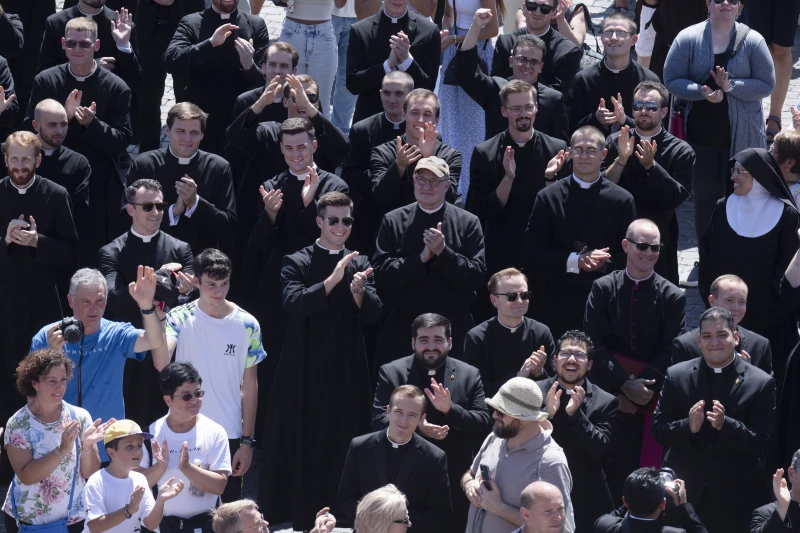
Pope Francis greets new seminarians from the North American College present in St. Peter’s Square, encouraging them to live their vocations with joy “because true prayer gives us joy.” / Credit: Vatican Media
Washington, D.C. Newsroom, Nov 11, 2024 / 16:35 pm (CNA).
The Knights of Columbus announced Friday that its local councils have surpassed $100 million in financial support for seminarians, postulants, and novices through its Refund Support Vocations Program (RSVP).
“For more than 40 years, RSVP has supported tens of thousands of men and women as they answer the Lord’s call to serve the Church and the people of God,” Supreme Knight Patrick Kelly stated in a Nov. 8 release. “Our support for vocations speaks to the love Knights of Columbus have for the Eucharist, our parishes, and the Church.”
Founded in 1981, RSVP provides aid to seminarians and entrants into religious life so they can continue to discern their vocations despite financial burdens such as outstanding student loan debt.
The Knights encourage local councils and parishes to raise money for seminarians in the area — for every $500 a local council distributes to an individual, the Supreme Council refunds the local council $100.
Additionally, local councils are required to provide nonfinancial support to seminarians and religious, whether through personal visits, correspondence, or invitations to council events.
Financial support for vocations is a special cause for the Knights, whose founder, Blessed Michael McGivney, had almost been forced to leave the seminary due to financial pressure in the wake of his father’s death. Had it not been for the “crucial financial support” from the bishop of Hartford, Kelly pointed out, “the Knights of Columbus would not exist.”
“RSVP and our other vocation scholarships are really our way of paying that forward and supporting the next generation of priests and religious,” Kelly stated.
The Connecticut-born priest and founder of the Knights was beatified in October 2020. Pope Francis wrote in an apostolic letter at the time that McGivney’s “zeal for the proclamation of the Gospel and generous concern for his brothers and sisters [had] made him an outstanding witness of Christian solidarity and fraternal assistance.”
McGivney originally founded the Knights of Columbus in 1882 as a small fraternal benefit society to serve his community in New Haven, Connecticut, which was largely composed of working-class immigrant families.
Today, the Knights have more than 2.1 million members in over 16,800 local councils around the world.
If you value the news and views Catholic World Report provides, please consider donating to support our efforts. Your contribution will help us continue to make CWR available to all readers worldwide for free, without a subscription. Thank you for your generosity!
Click here for more information on donating to CWR. Click here to sign up for our newsletter.
Robert W. McElroy, Archbishop of San Diego speaks with participants through the fence during the 23rd Posada Sin Fronteras where worshipers gather on both sides of the US-Mexican border fence for a Christmas celebration, at Friendship Park and P… […]
Washington, D.C. Newsroom, Jul 31, 2020 / 01:28 pm (CNA).- A Hawaiian Catholic catechist said that St. Damien of Molokai is a “hero” to the Hawaiian people, after a prominent congresswoman claimed the statue honoring him in the U.S. Capitol is part of colonialism and “patriarchy and white supremacist culture.”
St. Damien “gave his life” serving the isolated leper colony at Kalaupapa peninsula on the Hawaiian island of Molokai, said Dallas Carter, a native Hawaiian and a catechist for the diocese of Honolulu, in an interview with CNA.
“Any Hawaiian here who is aware of their history–which most Hawaiians are–would absolutely, Catholic or not, defend the legacy of Damien as a man who was embraced by the people, and who is a hero to us because of his love for the Hawaiian people,” Carter said.
“We did not judge him by the color of his skin. We judged him by the love that he had for our people,” Carter told CNA.
In an Instagram story on Thursday, Rep. Alexandria Ocasio-Cortez (D-N.Y.) asked why there were not more statues honoring women historical figures, at the U.S. Capitol’s National Statuary Hall Collection. The collection includes statues honoring historical figures from all 50 states.
“Even when we select figures to tell the stories of colonized places, it is the colonizers and settlers whose stories are told – and virtually no one else,” Ocasio-Cortez posted, with a picture of Fr. Damien’s U.S. Capitol statue in the background.
In 1969, Hawaii chose to honor St. Damien alongside Kamehameha I in the National Statuary Hall Collection in the US capitol.
Ocasio-Cortez noted on Thursday that Hawaii’s statue was of Fr. Damien and not of “Queen Lili’uokalani of Hawaii, the only Queen Regnant of Hawaii,” implying that it was an example of “colonizers” being honored instead of historical figures who are native to states.
“This isn’t to litigate each and every individual statue,” she said, arguing that “patterns” among the “totality” of the statues in the Capitol reveal they honor “virtually all men, all white, and mostly both.”
“This is what patriarchy and white supremacist culture looks like!” Ocasio-Cortez said. “It’s not radical or crazy to understand the influence white supremacist culture has historically had in our overall culture & how it impacts the present day.”
Ocasio-Cortez’s office told CNA that “it’s the patterns that have emerged among all of the statues in the Capitol: virtually all white men. Each individual could be worthy, moral people. But the deliberate erasure of women and people of color from our history is a result of the influence of patriarchy and white supremacy.”
St. Damien of Molokai was a religious priest of the Congregation of the Sacred Hearts of Jesus and Mary who spent the last 16 years of his life caring for lepers in the Hawaiian Kingdom.
He was born Jozef De Veuster in Belgium in 1840, and he entered the Picpus Fathers in 1859, taking the name Damien. He was sent to the mission in Hawaii in 1864, and was ordained a priest that May.
Shortly after that, the Hawaiian government and King Kamehameha V passed a law mandating that lepers quarantine themselves in an isolated colony on the island of Molokai. The local bishop asked for volunteers to minister to the leper colony, and Fr. Damien presented himself, beginning his work there in 1873.
Carter noted that the Hawaiian government of the time “did not know how to deal with leprosy,” and that “no one wanted to deal with Kalaupapa [colony].”
Damien himself was afraid to go and minister to the lepers, Carter said, but “over a period of time—his journal is very clear, and the writings of the Hawaiian people in that town are very clear—that he fell in love with the people.”
Eventually, Damien was given an ultimatum by his religious superior to either leave the colony or remain there permanently. He chose to stay.
The priest served the colony for the rest of his life, attending to both spiritual and temporal needs of the lepers. By 1884 he had contracted leprosy, and he continued to minister until his death in 1889.
St. Damien is beloved by native Hawaiians, Carter said, and then-princess Lili’uokalani—who Cortez implied should be given a statue instead of Damien—made Fr. Damien a Knight Commander of the Royal Order of Kalākaua in 1881, for his “efforts in alleviating the distresses and mitigating the sorrows of the unfortunate.”
Damien is also the only priest-saint in the Hawaiian martyrology “that spoke the native Hawaiian language,” Carter said. “He loved the Hawaiian people, he embraced our culture,” he said, and in turn “he was part of our kingdom. he was one of us.”
The priest was canonized Oct. 11, 2009 by Pope Benedict XVI, who said that “his missionary activity, which gave him such joy, reached its peak in charity.”
On the occasion of the canonization, U.S. president Barack Obama expressed his “deep admiration for the life of Blessed Damien De Veuster.”
“Fr. Damien has also earned a special place in the hearts of Hawaiians. I recall many stories from my youth about his tireless work there to care for those suffering from leprosy who had been cast out,” Obama, who was born on the Hawaiian island of Oahu, said.
“Following in the steps of Jesus’ ministry to the lepers, Fr. Damien challenged the stigmatizing effects of disease, giving voice to the voiceless and, ultimately, sacrificing his own life to bring dignity to so many.”
Volunteer drivers in Ukraine, working with the Vulnerable People Project evacuate vulnerable populations from war-torn areas of Ukraine. / Courtesy of Vulnerable People’s Project
Boston, Mass., Mar 10, 2022 / 06:52 am (CNA).
Jason Jones has a saying he often repeats to his staff at the humanitarian organization he founded, The Vulnerable People Project.
“The vulnerable are not weak people,” he says. “They’re strong people that have been placed in impossible situations.”
The Vulnerable People Project (VPP), which Jones describes as a Catholic apostolate animated by Catholic social teaching, was launched last year to respond to one such “impossible” situation: the humanitarian crisis that erupted after the U.S. military pulled out of Afghanistan, which quickly fell to the Taliban.
Now VPP is helping people escape another dire emergency: the Russian invasion of Ukraine.
“We’re seeing the people of Ukraine stuck between these two powerful actors, the same way the people of Afghanistan were trapped between the United States and Taliban,” Jones, a Catholic film producer, speaker, author and activist, told CNA.
VPP is still helping to evacuate Christians and other minorities from Afghanistan every week, Jones said.
Now the organization is doing similar work in Ukraine, where Jones says it has transported thousands of people away from the fighting and destruction.
Many of them have Aleksi Voronin to thank for that.
The 35-year-old native of Kyiv manages a team of drivers, himself among them, who voluntarily take residents of Kyiv and Kharkiv, major Ukrainian cities now in the crosshairs of Russian forces, to the relative safety of western Ukraine or across the border into Poland.
Volunteer drivers in Ukraine, working with the Vulnerable People Project evacuate vulnerable populations from war-torn areas of Ukraine. Courtesy of Vulnerable People Project
The drivers are mostly driving vans but some passenger vehicles, as well. With the vans, Voronin said, up to a dozen passengers can be evacuated. He told CNA he’s working on getting a bus which could evacuate 50 people.
The vans are tightly packed, but Voronin says that he tries to provide the people with blankets to at least give them “minimal comfort.” He estimates that he’s helped evacuate more than 200 people, so far.
“I cannot find the right words to explain the condition of people when I pick them up,” Voronin told CNA, fighting back tears.
Providential connections
Because of VPP’s success in Afghanistan, a Ukrainian friend of Jones asked him to help rescue some family members from the Ukraine following the invasion. As a result, VPP’s newest humanitarian effort, Hope for Ukraine, was born.
Jones doesn’t speak Ukrainian, though. So getting in touch with Ukrainians on the ground posed difficulties, he said.
But as providence would have it, one of Jones’ friends is Los Angeles comedian Irina Skaya, a Ukrainian-born American.
“Jason said, ‘Look, we’ve been working with Afghanistan, but now this is a crisis.’ So he knew that I was super connected in Ukraine on the ground and we started evacuations,” Skaya, who is leading Hope for Ukraine, told CNA.
Irina Skaya temporarily put aside her stand up comedy career in order to volunteer full time for the Vulnerable People Project by leading Ukraine for Hope. Vulnerable People Project
Skaya, who speaks Russian, Ukrainian, and English fluently, has about 200 relatives in Ukraine. Through her contacts, she was put in touch with Voronin.
Skaya had a comedy show planned in Kyiv Feb. 25-26, but that was canceled due to the Russian invasion on Feb. 24. She was supposed to be the opening act for Louis C.K. a popular American comedian.
Skaya said she always thought her purpose in life was to do comedy.
“Comedy is great. I love comedy. And when this is over, I’m gonna perform in Ukraine and try to bring as many American comedians into Ukraine as I can,” she said.
But war has reordered her priorities. “My absolute life purpose now,” she said, “is to defend my country, to save my country, to save my people.”
How to help
Jones says that Hope for Ukraine has about 100 Ukrainian volunteers, with other volunteers coming from Poland, Ireland, the United States, and elsewhere.
Even a volunteer-driven humanitarian effort is expensive, however. Keeping Aleksi Voronin’s passenger vans and other vehicles on the road gets more costly by the day, due to rapidly rising fuel prices.
Jones told CNA that VPP has raised $15,000 for Hope for Ukraine, but has spent about $50,000 buying resources.
The organization’s response to the invasion will soon include an ambulance and a trauma team of four Emergency Medical Technicians, or EMTs, one critical care paramedic, and two ambulance drivers.
Leading the team will be Andrew Hamilton, 23, a Virginia resident who has worked as an EMT at a construction site and has served as a combat medic while he volunteered with Kurdish military units in northern Syria.
Hamilton, a devout Christian, told CNA his mission is to support the Ukrainian people and if a wounded person needs his care, “they’ll receive the best medical treatment possible.”
Donations to VPP’s Hope for Ukraine initiative can be made online at TheGreatCampaign.org. Jones said he has secured a $200,000 matching gift grant, if the organization can raise $200,000 on its own.
Somehow, Jones said, VPP will meet that goal. “We seek to stand with those who have been abandoned because it’s dangerous to serve them, or because it comes at a social cost,” he said. “When everyone else flees, that’s when we show up.”
Leave a Reply