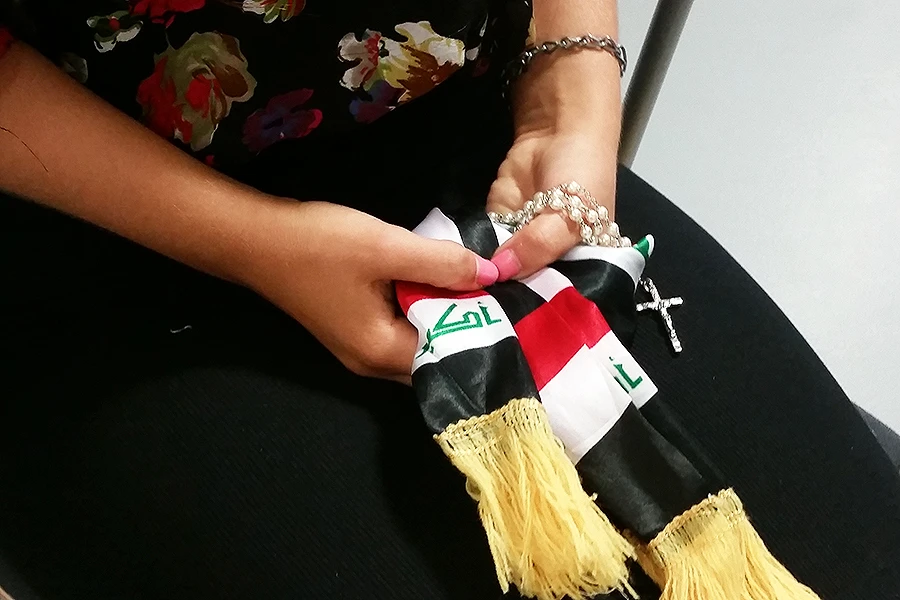
Washington D.C., Nov 3, 2017 / 06:08 am (CNA/EWTN News).- This Halloween marks the seventh anniversary of when my parents’ church in Baghdad was held hostage by the Islamic State in Iraq, a little known group at the time.
After a few tense hours, the Iraqi army moved in to try and save the hostages held up in the Syriac Catholic Our Lady of Deliverance Cathedral located in the heart of Baghdad. The standoff led to the death of 58 worshipers, including three priests, children, and a baby who was beheaded on the altar. 78 worshipers were severely wounded or maimed, losing legs, arms and requiring months of operations to remove shrapnel or heal other injuries. For many Iraqi Christians, this massacre answered the question that many had asked themselves throughout the almost 10 years of bloody sectarian civil war that engulfed Iraq: “Are we still welcome in this country anymore?” Sadly, many could no longer look at their children and promise them a good future while they remained in Iraq. In the ensuing few months, a mass exodus of Christians from Baghdad started which brought down the population of Christians from 20 percent to only several thousand.
My parents, having witnessed on TV the horror that befell Iraq with the onset of the civil war, lost hope for any future for Christians in Iraq, because while the Shia had Iran and the Sunnis had the Gulf and Turkey, nobody was willing to stick up for the Christians. They watched as their ancestral city of Mosul saw a growth in Salafi activity and mourned as Christians, Yezidis, Shabaks and Mandeans were ethnically cleansed from the city. With the onset of the war in Syria, more reports of Christians being killed, tortured and taken as slaves on account of their faith came to the forefront and painted a dark picture for the future of Christianity in the region.
Exploding out of the Syrian crisis, ISIS burst onto the stage in Iraq and put one-third of the country under its control. During their blitzkrieg in the northern part of the country, ISIS attempted to wipe out all followers of the ancient Yezidi faith historically concentrated in the Sinjar region of the Nineveh Province. However, they did not stop there, and moved to destroy the ancient Christian heartland of Iraq found in the Nineveh Plains region northeast of the city of Mosul. Over 100,000 Christians fled overnight as ISIS swarmed in and killed dozens of people and took many others as sex slaves. The dead included my mother’s elderly nanny, Naeema, who had raised her and her brothers since they were children. Naeema taught my mom how to pray, tucked her in to bed every night and greeted her with coffee and freshly ironed cloths every day. Her death made them feel powerless and numb with pain as she was thrown into an unmarked grave and forgotten.
My parents’ Muslim neighbors mourned the destruction brought upon their Christian brothers and sisters, but despite their goodwill, they were powerless to do anything. The ISIS invasion of Mosul brought more pain to my family, as my grandfather’s grave was likely destroyed along with hundreds of others as ISIS tried to destroy as much of Mosul’s Christian history as they could. The monastery of Saint Behnam and his sister Sarah that my grandfather was named after was blown up and recorded in a spectacular video. My family mourned the destruction of so much of what was near and dear to them and became distressed as depressing updates continued to come out of Iraq. Hundreds of Christian properties in Mosul were ruined or given to ISIS fighters. These homes had belonged to these families for generations, and losing them was tantamount to losing their entire history and several lifetimes of work.
In my current capacity as a Special Assistant for the non-profit In Defense of Christians, I was lucky to be given the opportunity to help an organization prepare for their annual summit. IDC’s summit focuses on a cause I care about deeply: the plight of Christian minorities in the Middle East. This year, IDC decided to focus on a five-point policy agenda which works to stabilize Lebanon and Syria, deliver desperately needed aid to victims of genocide in Iraq and Syria, correct a historic injustice by recognizing the Armenian genocide, hold American allies who persecute Christians and other minorities accountable and identify individuals or groups who supported ISIS’ campaign of terror and genocide against Christians. As the fate of the Christian communities in the Middle East hangs in the balance, this sort of work is imperative to preserve the existence of an ancient community from going extinct.
One of the most exciting aspects of the summit was having the Vice President of the United States Mike Pence come and deliver the keynote address at our annual Solidarity Dinner. In the lead up to the dinner, the air was crackling with excitement as we were all waiting for the Vice President to take to stage and deliver remarks. When he arrived, the dinner attendees clapped then quickly turned quiet as they waited to hear what he would say. It was almost inconceivable that somebody of this stature would be addressing a crowd of people passionate about the plight of persecuted Christians in the Middle East.
During his keynote address, the Vice President noted that “In Iraq, the followers of Christ have fallen by 80 percent in the past decade and a half…but tonight, I came to tell you: Help is on the way.” I had to wipe away the tears that last phrase brought to my eyes. It seemed too good to be true that after all of these years of hardship Iraqi Christians have suffered that the Vice President of the United States would stand there and announce that help was coming for a people the international community had done nothing for in the past 14 years. The Vice President held no punches in his speech and cut through over careful dancing around of words to state that “Christianity is under unprecedented assault in those ancient lands where it first grew.”
In a moving moment for many in the room, Vice President Pence noted that “In the mountains of Syria, the valleys of Lebanon, on the plains of Nineveh, the plateaus of Armenia, on the banks of the Tigris and Euphrates, the delta of the Nile, the fathers and mothers of our faith planted seeds of belief. They’ve blossomed and borne fruit ever since.” Acknowledging the ancient roots of Christianity in the region and invoking the names of the areas where they still exist today moved not just me, as almost all Middle Eastern attendees I spoke with afterwards mentioned the use of this imagery.
As somebody who has been tracking and writing about the reconstruction efforts of Christian villages on the Nineveh Plains, my anxiety over the massive reconstruction challenges were eased over almost instantaneously by the Vice President’s announcement that the US would work with faith-based groups and private organizations through USAID to help genocide victims. This one action has the ability to remove the most pressing issue facing Christians who want to return to their homes and not immigrate to Europe: rebuilding their homes targeted for destruction by ISIS.
Returning home much later that night, I called my mother and woke her up to tell her the news. She could not believe me when I told her that Mike Pence had spoken about our community’s issues and worked to ensure they would be able to rebuild their homes. When I told her that he remarked that “In Iraq, we see monasteries demolished, priests and monks beheaded, the two-millennia-old Christian tradition in Mosul clinging for survival,” neither could she nor my father restrain their tears of joy. The fact that he mentioned the plight of oft-forgotten Mosulawi Christians and alluded to the destruction of the Mar Behnam monastery brought out a happiness in them that they had long contained. That happiness came from regaining a sense of hope again. For the first time, it seemed like somebody had finally responded to our pleas of help at the 11th hour and acknowledged our pain.
For the first time in seven years, my family and I slept peacefully on Halloween.
Yousif Kalian is an analyst who focuses on Iraq, Syria, Kurdish issues and religious minorities. He currently works for In Defense of Christians, and was previously a Research Assistant at the Washington Institute for Near East Policy. He has been published in the American Interest, the Washington Institute for Near East Policy, the International Centre for Counter-Terrorism and elsewhere.
 […]
[…]



The bishops are correct but I wish they’d pay a little more attention to the reasons that blue collar folk in flyover country feel so underserved & disrespected in the first place. Our leaders have mostly become disconnected from the working class people they’re supposed to serve.
I think an edited version might be more appropriate:
“As the residents of Springfield, Ohio, struggle with violent threats and life disruptions fueled by undocumented illegal aliens, we exhort the Catholic faithful and all people of goodwill to report all illegal and potentially harmful activities to their local police precincts and encourage them to administer the full consequences of the law,” read a letter signed by bishops in all six Catholic dioceses in Ohio.
If the bishops really cared about Haitians there would have been a massive outpouring of support immediately after the earthquake there around 2010. There was little financial support and no massive presence of Catholic boots on the ground. I know; I was there and saw the immediate aftermath of that catastrophe. And, please, don’t anyone tell me about Catholic Relief Services as an adequate response.
The bishops are quick to engage when Haitians are the subject for politics but when it comes to sustained and substantive assistance, the bishops are busy synodaling to Francis’ tune. Haiti is the poorest country in the Western Hemisphere…and a Catholic one at that. I want to hear from the USCCB and the Vatican what they’re doing to alleviate the poverty there. And don’t tell me that the solution to Haiti’s poverty is to allow that entire country to emigrate to the USA. Do you know what happens to a country like Haiti when the most industrious and able-bodied emigrate to the USA? They don’t look back and the country of origin becomes even more impoverished. Men come to the USA to find work and left behind are the women and chikdren to fend for themselves. I challenge every bushop who is weighing in on this matter of eating cats to hop on a plane and spend a few weeks touring Haiti and then return with ideas about what their diocese is going to do to lift that country out of poverty.
Bishops call for “compassion”, while making a terse reference to the evils of the perpetrators. At a critical time with the presidential elections just weeks away, our Catholic fathers fail to send a strong moral message specifically to Trump and Vance. The Haitian migrants have legally entered the country. Vance still calls them illegals. Their vial position reeks with bigotry.
Trump and Vance’s inflamitory rhetoric has caused their criminal minions to threaten Springfield residents with bombings. Parents are afraid to send their kids to school.
Not to to far into the Trump weeds, BUT, this year the disgraced SCOTUS freed Trump from all his federal crimes by voting for immunity. Then they thru the implementation to the district court causing confusion and havoc. Does anyone remember any former president asking for immunity? Not even Nixon.
This week the Georgia Republican legislature passed a bill that forces all votes to be MANUALLY counted. Ironically, Trump’s threats frightened poll workers that they are afraid to go to work.
Another mind-numbing move is Trump’s support of NC Lt. Governor Mike Robinson. Robinson calls himself a “Black NAZI”. He has said “some people deserve dying”.
I’m a ‘perv’ too!. “bring [slavery] back” and “buy a few” slaves”.
Trump said at a rally, “”We have to cherish Mark … he’s like a fine wine,” Trump said in the video. “He’s an outstanding person.”
The absence of the Catholic hierarchy’s firm rejection of this amoral and criminal creature could make this election “a day that will live in infamy”.
Someday you need to take a retreat and meditate on the meaning of the Eighth Commandment. It applies to more than one’s next door neighbor.
I had retreated from my duty to protect our constitution and democracy. No more. Eighth Commandment? Your vague retort tags me with ignorance of the eighth commandment. How dare you! Accusing me of stealing? Or violate God’s establishes a principle of honesty and integrity, essential for building community trust.
I try not to respond to frivrolous diatribe. I couldn’t resist.
When did I accuse you of stealing? Look up the Commandments. The Eighth refers to bearing false witness, and this includes public figures and public events. Haitians in this country are both legal and illegal, and Vance was truthful in his statements that addressed the tragedy of unleashing millions of desperate people into this country with no place to go. Do you care about them other than as political showboating? You are venomous in calling anyone perpetuating violence as “minions” of Trump and Vance. Your off the wall quoting of ironically intended rhetoric out of context illustrates that you have no interest in “honesty and integrity” as you’ve demonstrated continuously at this site with your left-wing talking points.
“Criminal minions ” seems a bit inflammatory to me Mr. Morgan. Just saying.
Perhaps we should pull the plug for the weekend and take a break from the media foolishness.
I’m going out to mow the grass and get some fresh air. God bless.
I’ll second Deacon Peitler’s comments above.
Why are we taking the young and able out of poor countries that need them so badly?
In the case of Haiti, Miss Cleo you can hardly blame them.
But it’s a good point that it hasn’t been just the poor & oppressed who are migrating away from their countries but the professional classes, too.
If you look at eastern Europe & regions around the globe that’s something going on.