Denver Newsroom, Aug 22, 2020 / 03:34 am (CNA).- As wildfires rage across California, scorching more than 700,000 acres of land in multiple dioceses and killing at least four people, Catholics are asking for prayers and offering resources to the displaced.
“In our diocese alone the CZU, River, Carmel Valley and Dolan fires have already caused profound damage to property, persons and the environment,” Bishop Daniel Garcia of the Diocese of Monterey said in a message to Catholics on Thursday, Aug. 20.
“Hundreds of people have already fled their homes fearful of the unknown. Likewise, several of our parish sites have been evacuated due to the close proximity of the fires,” he added.
Over the past several days, a heat wave coupled with excessive lightning strikes sparked most of the blazes now raging in the state. At least 60,000 people in the state have evacuated their homes to escape the path of the blazes. Two of the fires, the SCU Lightning Complex fire located to the east of San Jose, and the LNU Lightning Complex, located to the northeast of San Francisco, have already burned roughly 220,000 acres each, placing them in the top 10 fires ever recorded in the state, CNN reported.
“Although it may not be clear to us, it is at times like these that we are called to not lose sight that the Lord is with us even amidst the uncertainty of the moment,” Garcia said in his message. “You and I are called to come together as the Body of Christ, to pray for each other, even if we cannot physically gather in each other’s presence.”
Erika Yanez, director of media relations with the Diocese of Monterey, told CNA that a number of their parishes had already been evacuated.
“All of Dalton, Boulder Creek, Davenport,…the entire community of Scotts Valley has been evacuated,” she said. “There’s a huge portion of Carmel Valley that’s been evacuated, we have a parish there.”
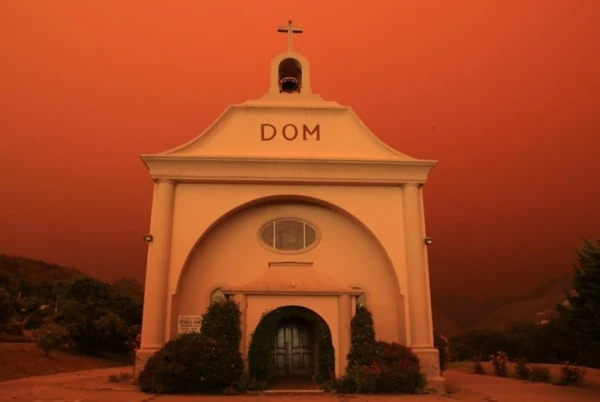
A photo of St. Vincent de Paul Catholic parish in Davenport, taken by a community member, shows the air around the church glowing bright orange as the flames encroached.
Yanez said there is a retreat center in San Juan Bautista, Calif., that has opened up to shelter families – though in a slightly restricted way, because of COVID-19 – and that the diocese will be coordinating with Catholic Charities to offer further assistance.
“I just wanted to make sure that everyone knows that our prayers are with the families that are being impacted right now. It’s just so difficult,” Yanez said.
Fr. Blaise Berg is the pastor of St. Mary Parish in Vacaville in the Diocese of Sacramento, which evacuated on Tuesday and Wednesday. Some residents of the town told CNN that screams woke them up in the middle of the night – a jarring alert that the fires were near.
“Presently, we are reaching out by phone to our parishioners who live in the fire’s burn zone. A number of homes were spared, but a few of our parishioners’ homes were not,” Berg said. By Friday, he noted, many people had been allowed to return.
“Our parochial vicar, Fr. Steven Wood, visited a nearby evacuation center and many evacuees were grateful to see the presence of the Church,” Berg said.
The priest asked for prayers, noting that the community was expecting more possible lightning storms this weekend, and that they had to be prepared to evacuate again.
“At a time like this, we see the importance of prayer, and so we ask all our brothers and sisters to keep in their daily prayers those affected by these fires across the entire state of California,” he said.
Cynthia Shaw, director of communications for the Diocese of San Jose, said the diocese was surrounded by the wildfires.
Some parishioners were located in evacuation zones, and more could be evacuating in the coming days. Shaw said the diocese, in cooperation with Catholic Charities, St. Vincent de Paul, and local food banks, will continue to monitor the situation and will work to provide food and shelter and to keep people updated on evacuation zones and other resources.
She added that people are being asked to stay inside and wear masks now not only because of the coronavirus pandemic, but because of the poor air quality caused by smoke, which could also disrupt plans for outdoor Masses this weekend.
“We’re just praying mightily also for the firefighters and the first responders. They have a great amount of work to do and we just pray that no one else loses their lives or gets injured in all of the fires,” Shaw said.
Poor air quality was one of the biggest concerns for the Diocese of Stockton as well, Chandler Marquez, the director of communications for the diocese, told CNA.
“There’s a lot of migrant farm workers and those farm workers are already heavily impacted by COVID-19,” Marquez said. “So on top of that…it’s harvest season for a lot of the crops out here and they’re taking in these conditions (and) it’s only going to make matters worse for them,” he said.
Greg Kidder knows a little too well what it’s like to survive a large wildfire – his home in Paradise, California was destroyed in the massive 2018 Camp Fire, which caused at least 85 deaths and destroyed most of his hometown. Kidder’s parish, St. Thomas More in Paradise, also burned down – except for the sanctuary.
“Our sanctuary survived. But we did lose 50% of our buildings, mainly our social hall and rectory, and youth house,” Kidder told CNA.
“But more importantly, we lost two-thirds of our parish. We had 733 families here. And then after the fire, we were down to about 150 people,” he said.
Most of those were evacuees who lost their homes and left the community, but four parishioners died due to the fires. Kidder estimated that another 20 to 30 died after the fire, due to the stress it caused, which exacerbated preexisting conditions.
“The church really consists of people, not so much buildings,” Kidder said. “The human loss, in that respect, was pretty high, even for a little parish like ours.”
After the initial fires, Kidder said the parish community was faced with the question: “What do we do now?”
He said recovery efforts first focused on people’s safety and basic needs, like food and shelter. The community thought they’d rebuild within a month, Kidder said. But it’s been a year and a half, and they’re still rebuilding.
Coronavirus has made it harder, he added. Supply chains were disrupted; the cost of building supplies went up due to high demand. Kidder and his wife are planning on moving into their new home in November.
Paradise so far is not being burned by the current wildfires, but they can smell the smoke from a fire nearby, and the thought of another fire can trigger traumatic memories for some people, Kidder said.
“It gets discouraging for a lot of people,” he said.
“You have the fire. Then you have the corona(virus), and now you have the escalating costs. You have this real discouragement. And then also being a political year, everything gets politicized. And so that whole level of discouragement kind of settles in,” he said.
Kidder, who has worked for his parish for more than 25 years, was assigned as the parish steward after the Camp Fire – their previous pastor suffered from PTSD after the fire and had to be transferred. They are still waiting on getting another full-time pastor.
“So the mission for us as a parish is to keep that light, keep that sign of hope, that we will get through this. It won’t be on our time, but we will. And we’ve stayed together. We’ve managed to gather about 300 families that are still attached to St. Thomas More. Some are living in various areas with the intent of moving back. And so, there’s hope there,” he said.
Even through the loss of his home, Kidder said he tried to remain hopeful and trusting in the plan of God.
“I trust in God in everything else in my life. And so even with my home being destroyed and going through that, my wife went through a lot of grief over that,” he said.
“But I’m a very hopeful person, and I knew that things would get better. And that’s what I preach. That’s what I teach. That’s what I believe in.”
He encouraged those going through similar disasters now with the current wildfires to maintain hope, by relying on God, by staying together as a community, and by “putting one foot in front of the other.”
“We’re not the first person, the first group of people that have experienced this, and we won’t be the last,” he said.
“There will always be another disaster. We just have to recognize it for what it is and not let that discourage us.”
 […]
[…]






Of course Francis would lend his blessing to anything that celebrates disorder and perversity. It just reinforces just how worthless Francis’ blessing is.
As has been said by so many others, a “blessing” which is associating God’s Good Name to that which is being blessed, is a blasphemy when it is attached either directly or by inference to acts that are intrinsically disordered and sinful. Do this, Francis, at risk of your own peril.
Deacon, begs the question, “That which is loosed on earth will be loosed in Heaven?”
Stop playing silly mind/power games Holiness.
Anything to say about the Paris blasphemy?
The supposed focus of Catholic unity is divisive, seemingly by design.
Am I the only one getting nervous that Pope Francis may weigh in on the Olympic Opening Ceremonies?
But the Pope couldn’t say anything about the Olympics outrage or bother to meet brave Cardinal Zen while the Vatican continues to protect Rupnik. Shouts rather than speaks where they stand on issues, eh what?
The only thing that raises Bergoglio’s ire is faithful Catholics praising and adoring our Lord through the same Mass that’s been used for many centuries.
*That* simple fact shouts volumes about who Bergoglio is and what spirit he serves.
Inimicus Massae Latinae est procurator Satanae.
Why does the Holy Father or anyone else need to describe a human being by one aspect of their inclinations and behaviors.? We are all souls in need of salvation and some respects are all disordered as a consequence of the fall. We are called to live a chaste life no matter our desires and inclinations. Help people who have disordered inclinations. Yes. Defining them by these inclination, regardless of their self-definition. No.
You’re absolutely right, Russell. I wouldn’t want anyone characterizing or categorizing me by my foibles, imperfections, sins, physical appearance, etc. etc.
Fr. Martin identifies the people he serves as “queer,” which is a red flag that his vision of the human person and human sexuality is distorted. His Jesuit-sponsored Outreach website promotes all sorts of filth and degradation, including acceptance of sodomy, (aka “same-sex and marriage) and the misogynistic ideology behind transgenderism. I’m not sure why Pope Francis endorses it…
We read: “The 2024 Outreach conference was organized for “LGBTQ laypeople, clergy, scholars, artists, educators, students, and family members to build community, share best practices, and worship together.”
And what might be some of the current “best practices”?
In 1985 anti-binary sexual behavior among gays was found to be “an average several dozen partners a year” and “some hundreds in a lifetime” with “tremendous promiscuity.” Practices much changed, certainly, since the scourge of AIDS….but, then, still this:
“In one recent study of gay male couples, 41.3% had open sexual agreements with some conditions or restrictions, and 10% had open sexual agreements with no restrictions on sex with outside partners. One-fifth of participants (21.9%) reported breaking their agreement in the preceding 12 months, and 13.2% of the sample reported having unprotected anal intercourse in the preceding three months with an outside partner of unknown or discordant HIV-status.”
Source: Neilands, Torsten B.; Chakravarty, Deepalika; Darbes, Lynae A.; Beougher, Sean C.; and Hoff, Colleen C. [2010], “Development and Validation of the Sexual Agreement Investment Scale,” Journal of Sex Research, 47: 1, 24 — 37, April 2009); Cited in: Joseph Nicolosi, Ph.D., “An Open Secret: The Truth About Gay Male Couples.” https://www.josephnicolosi.com/collection/2015/5/28/an-open-secret-the-truth-about-gay-male-couples)
Surely, Fr. James Martin, SJ and the aligned (?) 2024 synodal relator-general, Cardinal Hollerich, include such research in their “scientific and cultural foundations” for overturning moral theology, human sexual morality, and the traditional family.
You ask what might be some of the current best practices. I don’t want to know. I am not interested in the least. I AM curious to know about the worship these people plan. WHO will they worship? Perhaps Francis will being in a new PAPAmama and all will be free to dance about a table or altar channeling pagan Paris 2024.
I wonder how they may reconcile themselves to the God of Abraham, that same God who created man and woman, commanding them to be fruitful and to multiply. How do they understand the God of Life, Jesus born of Mary and of the Father God. How do they understand Christ as the Bridegroom joined to the Church as His Bride? How do they interpret Jesus’ words in scripture about lust, eunuchs, divorce, Sodom, and Paul’s words on who will inherit the Kingdom?
Then again, I’ll let Francis do the listening. I’ll read the Word.
The words “repent” and “chastity” will never pass the lips of the Pied Piper of Sodomy James Martin LGBTQSJWXYZ during this gabfest of the intrinsically disordered.
Something wicked this way comes. A line borrowed from a Francis X Maier doomsday prognostication rarely voiced by a staid Catholic apologist.
Maier darkly chides a Mickey Jagger song Sympathy for the Devil the theme the inversion of good and evil. Maier along with the many have noticed this markedly so for over a decade. Heads would have exploded several decades past if it were known that in the near future sodomy would be celebrated as a good, what is more, a moral good by the Catholic Church. If not formally nonetheless de facto.
Pope Francis affirms the perversion as acceptable practice by offering his blessing. What the world has come to embrace, once considered a severe insult, despicable perversion is now celebrated by the Church. Not the whole Church. The Church that lives in the shadows.