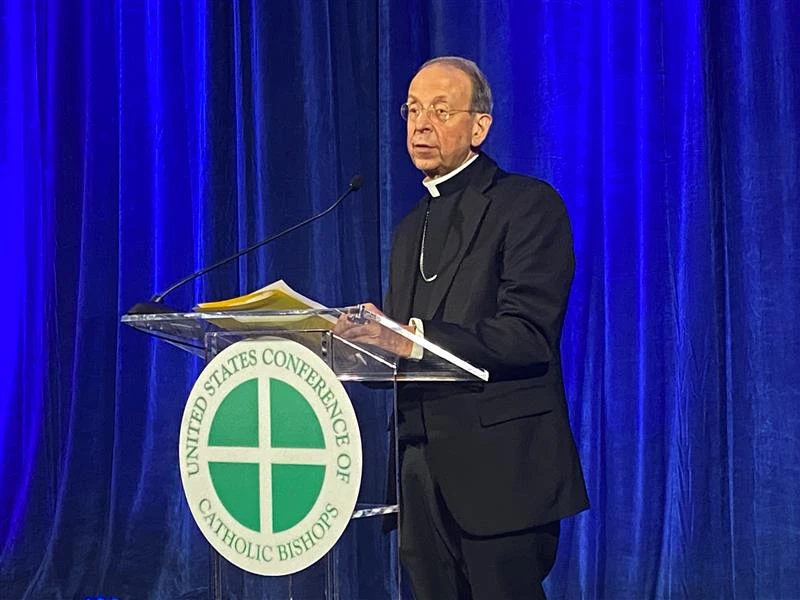
 Archbishop William Lori of Baltimore, vice president of the United States Conference of Catholic Bishops, at the USCCB’s fall meeting Nov. 15, 2023. / Credit: Joe Bukuras/CNA
CNA Staff, Jan 31, 2024 / 13:25 pm (CNA).
The bishops of Maryland have written an open letter denouncing state legislators’ decision to consider an assisted-suicide bill and calling for “a better path forward.”
“We are deeply disappointed to learn that once again the Maryland General Assembly will debate whether to legalize physician-assisted suicide,” the Jan. 30 letter from the Maryland Catholic Conference said.
Assisted-suicide bills have been considered in Maryland since the 1990s — and most recently in 2023 — but have never passed.
Signed by Baltimore Archbishop William Lori, Washington archbishop Cardinal Wilton Gregory, and Wilmington Bishop William Koenig, the letter said that the bill “puts our most vulnerable brothers and sisters at risk of making decisions for themselves that are manipulated by factors such as disability, mental instability, poverty, and isolation.”
“Maryland has accurately recognized that suicide is a serious public health concern in the general population and has offered substantial resources to address the concern,” the letter said.
“At a time when our nation is grappling with how to address a frighteningly high suicide rate it is deeply illogical for the state of Maryland to be seeking ways to facilitate suicide for those with a terminal illness, all the while claiming such preventable and unnecessary deaths are somehow dignified,” the bishops continued.
The bill, titled the End-of-Life Option Act, was introduced in both the House and Senate in mid-January.
The legislation would allow individuals with a terminal illness to request assisted suicide from a physician.
Terminal illness is defined in the bill as “a medical condition that, within reasonable medical judgment, involves a prognosis for an individual that likely will result in the individual’s death within six months.”
The process for requesting “aid in dying” consists of making an oral request to one’s physician and then submitting a written request. The individual must then make another oral request to the physician at least 15 days after the first oral request and 48 hours after the written request. No one can request assisted suicide on behalf of the patient.
According to Death with Dignity, 11 states have legalized the practice: California; Maine; Oregon; Colorado; Montana; Vermont; Washington, D.C.; New Jersey; Washington; Hawaii; and New Mexico.
“For all legal rights and obligations, record-keeping purposes, and other purposes governed by the laws of the state, whether contractual, civil, criminal, or otherwise, the death of a qualified individual by reason of the self-administration of medication prescribed under this subtitle shall be deemed to be a death from natural causes, specifically as a result of the terminal illness from which the qualified individual suffered,” the legislation says.
In their letter, the bishops said: “The central tenet guiding our opposition to this deadly proposal is that all human life is created in the image and likeness of God and therefore sacred.”
They cited modern “medical advancements” that can be used to help individuals with terminal illnesses to be “comfortable and improve the quality of the remainder of their lives without them feeling the need to reluctantly choose a ‘dignified death.’”
The bishops called on Marylanders to improve end-of-life care, writing that “it is incumbent upon each of us to ensure that those at the end of their lives can experience a death that doesn’t include offering a form of suicide prescribed by a doctor.”
“We believe our elected officials should work to improve access to the network of care available to Maryland families by increasing access to palliative and hospice care, enhancing end-of-life education and training opportunities for physicians, and ensuring that there is appropriate diagnosis and treatment for depression and other mental and behavioral health issues,” the letter said.
They also pointed to the lack of “safeguards” in the bill.
“The proponents of this legislation claim that this policy offers an ‘option’ to a very small set of individuals who are suffering from a terminal illness with less than six months to live, claiming this option will help them maintain control and dignity during their final days on earth,” the letter said.
“This legislation ignores the reality facing many in such conditions and is woefully lacking in the types of meaningful safeguards that would prevent this unnecessary and drastic option,” the letter said. “Such safeguards include mandated mental health assessments, reporting requirements, safe disposal of unused medication, or prohibitions against expansion of this program.”
The letter said that in every state where assisted suicide has been legalized, “grave abuses and expansion have occurred,” which makes the lethal practice “available to far more people and not just those facing imminent death.”
“There is a better path forward for the people of Maryland, and it does not involve suicide,” the letter said.
“We urge all people of goodwill to demand that our lawmakers reject suicide as an end-of-life option and to choose the better, safer path that involves radical solidarity with those facing the end of their earthly journey,” the letter said.
In recent weeks, residents of Massachusetts and New York were also urged by bishops and pro-life advocates to oppose assisted-suicide bills upcoming in their states.
In Massachusetts, the “End of Life Options Act” says that “a terminally ill patient may voluntarily make an oral request for medical aid in dying and a prescription for medication” if the patient is a “mentally capable adult,” a resident of Massachusetts, and has been determined by a physician to be terminally ill.
In New York, the “Medical Aid in Dying Act” would also allow a terminally ill patient to request medication that would put an end to his life.
“Lawmakers need to hear from their constituents if we hope to avoid yet another assault on human life here. Assisted suicide is dangerous for patients, caregivers, and vulnerable populations such as the elderly and people with disabilities,” the New York State Catholic Conference said.
In Massachusetts, the pro-life group Massachusetts Citizens for Life told supporters that “the bill clashes with cultural, religious, and philosophical beliefs against intentionally ending human life.”
According to Death with Dignity, 16 other states are considering assisted suicide legislation in 2024.
[…]






Would that it were so.
He deserves canceling like few ever have.
On so many grounds:
Moral. Artistic. Religious.
Even digestive — since every reference to him is utterly revolting.
Digesting “digestive” at breakfast. 🤮 There can be no doubt that Rupnik’s abuse “art” is revolting. It is wicked to put money and art before victims. Justice is inadmissible in Rome.
By defending Rupnik’s vile oeuvre, Ruffini and the rest of the Dark Vaticanners are showing what they really are. And which spirit they serve.
The whole affair makes me want to Rupnik.
Except that “Rupnick’s art” is no art at all.
The choice being offered by the woman running Centro Aletti is the same choice offered by the Pontiff Francis: “You can choose us, or choose Jesus.”
Sharp insight, in tbe sense of “cutting”.
I hoped that there would be news about the nine-month investigation of Marko Rupnik by the Dicastery of the Doctrine of the Faith but there is none. (Guess everyone did.). However, Maria Campatelli’s letter to Centro Aletti patrons and donors reminds us of the enablers who have helped Rupnik elude charges of abuse for years and years. There always are enablers and the small group of women, like Campatelli, who followed Rupnik from the Loyala Center over thirty years ago are among his most reliable supporters. So much for believing that women always help other women who have been abused.
Rupnik himself is the subject of serious scrutiny. If his product is being subjected to “cancel culture” it should be primarily because of its derivative, unimaginative, vacuous character. That it was produced by a con artist and a serial rapist does not contribute any redeeming value to it aesthetically or financially.
Let it be gone.
So, they rehashed an old story verbatim, but tack on a PR release from Rupnik studio at head, giving it air time when many readers never get past first paragraph or two…the Rupnik studio thanks the author for this “news”…and for me a wasted click…all that was missing was a string of tweet quotes expressing “disappointment” at the Rupnik studio PR release.
I have a problem with the discussion of the quality of art. What changed in this art from before and after. The artwork is the same – I happen to not enjoy his art and never have enjoyed it. The point, for me, is that it is clearly obvious that a great number of individuals found the quality of this artwork worthy of being placed on a great number of sacred structures. Who is evaluating the artwork and who is approving its placement. How and why did this style gain such precedence when there was a host of other sources for artwork I would deem worthy of being on sacred structures.
Nothing changed, in the sense that there were also plenty of people who thought the mosaics, or at least Rupnik’s contribution to them (the illustrations) were overrated and mediocre. Those people just never got a vote or a voice. Artwork for churches is rarely chosen by laypeople or parishioners. A small group of people usually select the art, including architects,donors, pastors and priests. Anyone else gets shut out, so you’d never know that anyone disliked it. One of the ways in which Rupnik’s reputation as an artist was propped up and inflated. (I also suspect that Rupnik has been handing out sweetheart deals to prominant prelates with influence but can’t prove that.)
Rupnick’s work has been chosen not because of his expertise as an artist, but because he was a Jesuit priest. While he regretfully remains in active ministry he continues to be nothing more than a privledged amateur artistically. Those absent training in the visual/fine arts are easily impressed by anyone who can produce an image of any sort, particularly if its big. The like big. We also have the critical circumstance that his financial impact upon his clients was regarded an “inhouse” expense. If you want to get a “picture” of what can be accomplished in contemporary ecclesiastical mosaic do an image search for “mosaic of our Lady of Knock.” The work is within the interior of the Basilica at Knock. You’ll immediately recognize the deficiency of Rupnik’s confections and those of his studio across the range of craft, aesthetics, and devotion.
There is nothing there, there in Rupnik’s work. It nothing more than filler — bastardized formula confections gleaned from Byzantine masterpieces. Sherwin-Williams flat latex white would substitute in more appropriately suit any “worship-space.”
I was going to tell you how Rupnik began his career but I have done it several times here already so here is the link to an article about it in Italian, you can use Google translate option.
https://amargipress.com/2023/11/
Two images above: on the left is ‘Christ Pantocrator’ by the Russian Orthodox mosaic artist Alexander Kornoukhov in the Vatican Capella ‘Redemptories Mater’. It was destroyed, together with the whole ceiling and parts of the wall, by Rupnik who then put there his own work like the image on the right, his own rendition of ‘Christ Pantocrator’.
I think the wok of two artists speaks volumes.
Hence, if you want to see the work of Kornoukhov here is a printed book with photos of his (mostly) destroyed art
https://www.kornoukhov.com/_files/ugd/2181c1_2c93aa63b56640c68ae385544491d6e6.pdf
I think the story of lies and deception will answer your question, of why Rupnik’s art is everywhere.
Anna, I have been meaning to thank you for bringing up the distressing story of the “Heavenly Jerusalem” mosaics by Alexander Kornoukhov at the Redemptoris Mater chapel several months ago. After that, I did more investigating but I did not find the book with complete images of his work that was subsequently removed and replaced by Marko Rupnik and Centro Aletti staff. Thank you so much for sharing it. (I am being deliberately calm as I write this because I might get taken over by rage otherwise.). The replacement mosaics reportedly put Rupnik on the map and led to Centro Aletti’s first series of major commissions.
If anyone wants to see the current state of the walls, there is a virtual 365 degree display but anyone looking at it may want to pray beforehand, in case you respond like I did, It is to weep: https://www.vatican.va/content/dam/vatican/virtualtour/redemptorismater/index.html
I do not know who was responsible for the narrative on this page but it is substantially at odds with some of what I read when I first started looking for information about the creation of the mosaics. I do not have any English-language sources to share but used the Google translation feature that Anna mentioned.
Maybe a skilled, diligent journalist will some day be able to put the entire story together.
Psychopaths and narcissists can get pretty good at flatly denying reality. Sane people do not listen to them.
I get that there are problems with “believe all women” when it’s a case of he said, she said. But when it’s he said, she said, and she said, and she said, and she said, and she said, and she said, and she said, and she said, and she said…. with no political reason for a takedown…
Casting Rupnik as a ‘victim’ – I must admit that I didn’t see that one coming.
Nice touch.
Anna you have provided the most illuminating evidence for not only the character of Rupnik, but the contrast between his inadequacy and the warmth and artistry of Alexander Kornoukhov. Many thanks. It seems to me the case is now closed. God reward you.