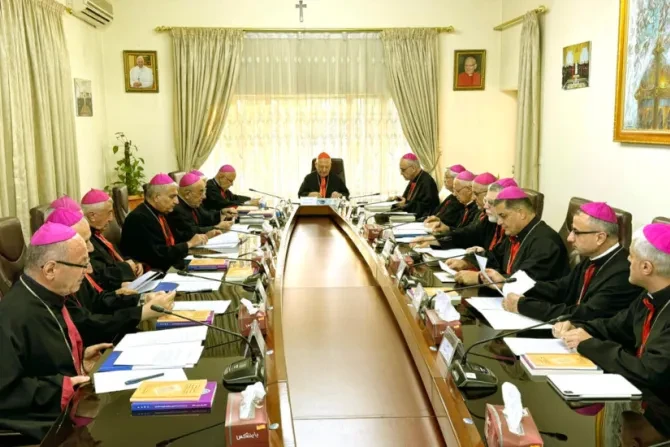
The 2024 Synod of the Chaldean Church in Baghdad, Iraq. / Credit: Chaldean Patriarchate
Baghdad, Iraq, Jul 25, 2024 / 16:30 pm (CNA).
The bishops of the Chaldean Synod on July 16 issued a statement declaring their position on the blessing of same-sex unions as well as the necessity of protecting children from sexual abuse.
The synod emphasized “the necessity of protecting children from sexual harassment and raising awareness among priests about its dangers,” stressing the importance of priests participating in child protection programs and obtaining certification from the local ecclesiastical authority.
The statement also clarified the position of the Chaldean Church — both in Iraq and worldwide — “regarding the union of two people of the same sex.” The synod asserted that the Chaldean Church does not recognize same-sex unions as marriage, as the legitimate and correct form of marriage for them is one that unites one man and one woman to form a family.
The 2024 Synod of the Chaldean Church in Baghdad, Iraq, July 16, 2024. Credit: Chaldean Patriarchate
The statement concluded by firmly rejecting the blessing of same-sex unions in order “to preserve the sanctity of marriage” as one of the seven sacraments of the Church.
The Vatican previously issued directives allowing Catholic priests to bless same-sex couples. These directives were framed as an expression of pastoral closeness without condoning sexual relations between people of the same sex.
These directives sparked controversy, prompting the Vatican to issue a subsequent clarification, especially after the misunderstanding led the Coptic Church to suspend dialogue with the Latin Church.
The 2024 Synod of the Chaldean Church in Baghdad, Iraq. July 16, 2024. Credit: Chaldean Patriarchate
The clarification stated that the nonliturgical form of the blessing is not a marriage, nor is it an endorsement or approval of same-sex relationships, but “merely a response from the pastor to two people seeking God’s help.”
This article was first published by ACI Mena, CNA’s Arabic-language news partner. It has been translated and adapted by CNA.
If you value the news and views Catholic World Report provides, please consider donating to support our efforts. Your contribution will help us continue to make CWR available to all readers worldwide for free, without a subscription. Thank you for your generosity!
Click here for more information on donating to CWR. Click here to sign up for our newsletter.
Cardinal Wilton Gregory of the Archdiocese of Washington, D.C., blesses the newly unveiled “National Life Monument” on the campus of The Catholic University of America’s Theological College on May 17, 2023. / Peter Pinedo|CNA
Washington D.C., May 17, 2023 / 15:58 pm (CNA).
The new “National Life Monument,” a larger-than-life bronze sculpture depicting the Blessed Virgin Mary pregnant with the Christ Child, was unveiled and dedicated today on the campus of The Catholic University of America’s Theological College in Washington, D.C.
According to the Canadian artist Timothy Paul Schmalz, the statue, titled “Advent,” is meant to be a symbol of beauty, a celebration of new life, and a bold pro-life statement in the nation’s capital.
Schmalz was present at the dedication ceremony along with the archbishop of Washington, Cardinal Wilton Gregory, and Canadian Cardinal Marc Ouellet. Gregory prayed over the monument, giving a special blessing to the statue and those present for the dedication.
Gregory praised the monument, saying, “Advent, as a pregnant Madonna, transcends bronze, revealing a deeper significance, deeper truths of God and of us, and his love for each of us, graced as we are in his image and likeness.”
The statue is entirely bronze except for the Blessed Virgin’s womb, which is made of reflective stainless steel. The Virgin Mother lovingly cradles her womb in which Jesus is depicted as an unborn baby. Our Lady is portrayed with a serene and peaceful countenance as she holds the Christ Child in her womb. The steel, which Schmalz describes as a “mystical material,” forms a type of halo around the unborn Christ Child.
“Advent: The National Life Monument,” a larger-than-life bronze statue by Canadian Catholic artist Timothy Paul Schmalz, depicts the Blessed Virgin Mary pregnant with an unborn baby Jesus. Peter Pinedo|CNA
“The hope with this sculpture is bringing a permanent, physical symbol that says ‘yes’ to life, that says life is great,” Schmalz told CNA. “To have it here in the nation’s capital is making a powerful statement. It’s saying that we have to celebrate all human life, and all human life is splendid and wonderful, and it’s mystical.”
Crafting a pro-life sculpture was something like solving a riddle, Schmalz said. For years he pondered how to create something that would send a bold pro-life message that wasn’t just “about the horror of abortion.”
“The idea is very difficult within a culture that, as Pope John Paul II said, we’re in a culture of death,” Schmalz said. “So, to put a sculpture called life in the center of Washington, D.C., is in a sense a peaceful weapon to persuade.”
By placing the monument in a high-traffic, public setting in Washington, D.C., Schmalz hopes his statue will not just “preach to the choir” but also touch the hearts of nonbelievers and even those who may be abortion supporters.
“Ideally, I’ll have people coming across here that might be ambiguous about their ideas of abortion, but they will come take a look at this and they will say, ‘You know, I have to say, that sculpture is beautiful,’ and if they’re saying the sculpture is beautiful, what it’s expressing is also beautiful,” Schmalz said. “If it touches one person, I think it’s done its job.”
To Schmalz, each sculpture he makes is a form of prayer that serves a specific function. As a Catholic artist, he believes that the work of faithful artists is about creating “visible ambassadors” of the faith to witness “in a culture that’s trying to remove Christianity.”
When it comes to his Life Monument, Schmalz’s depiction of the Madonna as a young, pregnant woman sends a very intentional message.
“If you look at the amount of positive life symbols out there, like even paintings of pregnant women or a new family, they’re becoming rare,” Schmalz said. “I’ve noticed over the last decade or so that we’re seeing less babies, less baby carriages, and less symbols around that. Our culture used to be filled with it. But now it’s becoming absolutely minimalized.”
This cultural shift, Schmalz believes, has led many young women to believe that having a child is something negative to be dreaded. The result of this anti-life mindset, Schmalz said, is having a devastating impact on society.
“Pope Francis said we’ve got to stop having pets and start having babies,” Schmalz said. “Elon Musk was basically suggesting the same thing, that we’re going to be in serious trouble if we don’t have babies.”
“We have to celebrate human life and that’s what this sculpture is saying,” Schmalz explained.
Schmalz is one of the most renowned Catholic artists of today. His work is displayed across the world from his “Angels Unawares” piece displaying immigrants at the Vatican to his “Homeless Jesus” in the Holy Land to a multitude of other works, religious and nonreligious, in the U.S. and beyond.
A smaller version of the National Life Monument is also on display in Rome’s Church of San Marcello al Corso. According to the statue’s website, Schmalz has plans to place life-sized copies of the National Life Monument in every state across the U.S.
“Angels Unawares,” another work by Schmalz on The Catholic University of America’s campus, depicts 140 immigrants. Peter Pinedo|CNA
A second casting of Schmalz’s “Angels Unawares,” pictured above, is also on display on Catholic University’s campus.
Father Daniel Moore, provincial superior of the U.S. Society of St. Sulpice, who presided over the dedication ceremony, explained that he hopes Schmalz’s statues will help people realize the sacredness of life and the obligation to help pregnant women, mothers, and those in need.
Schmalz, Moore said, “is using his gift of sculpting, his artistry much like the masons did when they built the great cathedrals, and then the stained glass within the cathedrals. They have become ways of communicating God’s message to us, God’s love to us, the story of how much we are cherished by God.”
Archbishop Arthur Roche at a Vatican press conference on Feb. 10, 2015. / Bohumil Petrik/CNA.
CNA Newsroom, Mar 30, 2023 / 13:30 pm (CNA).
The Vatican’s liturgy czar has intervened against the implementation of resolutions of the German Synodal… […]
Why might the inventive blessing of same-sex couples–as “couples”–remind us of the Crowdstrike “blue-screen” computer security meltdown?
Millions of computers were paralyzed by a system upgrade and a glitch that went sideways. As with COVID or the China virus, it’s almost as if a computer “virus” species-jumped from the backroom labs of the computer world! And, coincidentally, just as in June (gay pride month!) when personal computers were infected with an intrusive rainbow screenshot from puppet-master Microsoft boasting of its gay agenda dating back to 1989.
Do we see a pattern here?
The language of anti-binary unilateralism cross-dresses itself and spreads into many idioms. Something like the 1980s when AIDS jumped from the male homosexual population and penetrated the general population, surely through bisexuals. And then, the 1990s when anti-binary and broadened alphabetical tribalism began crowding out complementary human sexuality and the natural family (as Pope Paul VI also warned of contraceptive culture). And, now, infecting the ubiquitous internet world—with unilateral, amorphous and very front-to-back software homogeneity from the personal desktop to the near-infinite cloud. Just a penetrating click away—self-cancelling computer security plus equally ubiquitous and subliminal rainbow-flag propaganda!
In all domains, flat-universe entropy obsolescing “viva la difference”?
In yet another system upgrade and glitch—in the verbiage of Fiducia Supplicans (“couples”)—to what degree do we have a “blue-screen” gradualist obsolescence of moral theology and Humanae Vitae?
Clarity from the Chaldean Church. Where can I sign up?
Why might the inventive blessing of same-sex couples–as “couples”–remind us of the Crowdstrike “blue-screen” computer security meltdown?
Millions of computers were paralyzed by a system upgrade and a glitch that went sideways. As with COVID or the China virus, it’s almost as if a computer “virus” species-jumped from the backroom labs of the computer world! And, coincidentally, just as in June (gay pride month!) when personal computers were infected with an intrusive rainbow screenshot from puppet-master Microsoft boasting of its gay agenda dating back to 1989.
Do we see a pattern here?
The language of anti-binary unilateralism cross-dresses itself and spreads into many idioms. Something like the 1980s when AIDS jumped from the male homosexual population and penetrated the general population, surely through bisexuals. And then, the 1990s when anti-binary and broadened alphabetical tribalism began crowding out complementary human sexuality and the natural family (as Pope Paul VI also warned of contraceptive culture). And, now, infecting the ubiquitous internet world—with unilateral, amorphous and very front-to-back software homogeneity from the personal desktop to the near-infinite cloud. Just a penetrating click away—self-cancelling computer security plus equally ubiquitous and subliminal rainbow-flag propaganda!
In all domains, flat-universe entropy obsolescing “viva la difference”?
In yet another system upgrade and glitch—in the verbiage of Fiducia Supplicans (“couples”)—to what degree do we have a “blue-screen” gradualist obsolescence of moral theology and Humanae Vitae?
