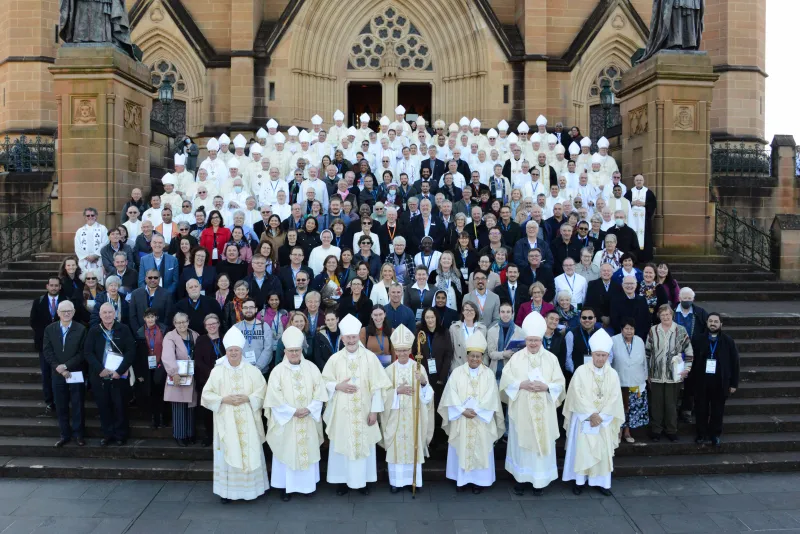
 Participants in the Church in Australia’s Plenary Council in Sydney, July 9, 2022. / Australian Catholic Bishops Conference
Denver Newsroom, Jul 12, 2022 / 10:09 am (CNA).
The Catholic Church in Australia has concluded its Fifth Plenary Council. After months of debate and discussion on Church governance and pastoral priorities, Archbishop Timothy Costelloe of Perth declared the council closed on Saturday.
“There will be no renewal of the Church if we put ourselves above Christ or in some perverse way push him to the margins,” he said in his homily at the closing Mass in Sydney July 9. The plenary council, in his words, tried to “reimagine the Church in Australia through a missionary lens.” The archbishop encouraged members of the plenary council to continue to ask themselves what the Holy Spirit is saying.
The final session was held in Sydney over six days.
A plenary council is the highest formal gathering of all particular Churches in a country. It has legislative and governing authority. Laypeople were invited to participate in council sessions, and they joined bishops to vote on binding resolutions to be sent to the Vatican for approval.
All members signed a concluding statement. Council members characterized the council as an expression of synodality.
“Synodality is the way of being a pilgrim Church, a Church that journeys together and listens together, so that we might more faithfully act together in responding to our God-given vocation and mission,” the statements aid, adding that in their deliberations “the Holy Spirit has been both comforter and disrupter.”
Members of the plenary council also confirmed the plenary council’s decrees, which all Catholic bishops present then signed. The decrees will be sent to the Holy See after the November meeting of the Australian Catholic Bishops Conference. Six months after the Holy see receives this notice, formally known as a “recognitio,” the decrees will become law of the Catholic Church in Australia.
The plenary council formally recognized a duty to care for the Earth as a common home and to promote and defend human life from conception to natural death. It encouraged the Church to join Pope Francis’ “Laudato Si’” Action Platform and to develop existing action plans in the spirit of the pope’s 2015 encyclical on God’s creation and care for the environment.
The plenary council backed more use of general absolution, an alternative to individual confession generally only used in emergencies. It also endorsed an effort to seek a new translation of the 2011 Roman Missal.
Defeated proposals included one to allow lay people to preach at Masses.
On July 6 more than 60 of the 277 members protested the failure to pass motions on women in the Church, including the defeat of a motion to support the ordination of women as deacons if Rome agrees. The lay members voted for the proposals, but there were not enough votes from the bishops to pass the measures.
After some controversy, the council passed a motion to reconsider proposed language on women in the Church, which later passed in a slightly modified form.
“Much has been made of the division and drama of the week and that might frighten some and delight others,” Archbishop Anthony Fisher of Sydney told The Catholic Weekly. “But I think the remarkable thing is that it did not break the Church. It did not lead to a walkout or schism or an alternative assembly being set up down the road as we’ve seen at different times in history.”
“In the end with more prayer and reflection we ended up with a much improved chapter on the dignity and roles of women,” he said.
The council decrees include the establishment of diocesan pastoral councils across Australia, diocesan synods to be hosted within the next five years, and broad consultation about the creation of a national synodal body for Church collaboration.
The plenary council’s closing statement said members “sought to be faithful to their commission to listen to and hear ‘what the Spirit is saying to the churches’.” It acknowledged the disruptions to daily life caused by the Covid-19 pandemic, natural disasters, and war.
Some moments during the council’s final week were “calm and harmonious” while others were “tense and difficult,” the closing statement said, adding, “every moment has been blessed; the entire week has been grace-filled, though never a cheap grace.” The statement praised “practices of listening and discernment” as “essential dimensions of the implementations of this plenary council.”
“They will re-shape our engagement with the world, our evangelizing mission and our works of service in a rapidly changing environment,” said the statement, adding, “the work has only begun.”
The implementation will be reviewed by the Bishops Commission for the Plenary Council. Interim reports will be published in 2023 and 2025, with a final review report set for 2027.
Archbishop Fisher reflected on the plenary council’s achievements and possible shortcomings in remarks to The Catholic Weekly.
“There’s been a direct engagement with some of the really ‘hard’ issues, like Indigenous issues, child sexual abuse and the place of women in the Church,” he said. “Those discussions were sometimes very emotional and potentially very divisive. Yet in the end there was a high level of agreement on most of them.”
“It’s much better that such matters were confronted directly rather than presenting a kind of faux unity by avoiding the hard issues,” the archbishop continued.
He praised the assembly’s work to offer “some good thoughts on liturgy, marriage catechumenate, youth ministry, formation programs for lay leaders including those in rural and remote areas, and stewardship of the earth.” He also welcomed its appreciation for the place of the Eastern Catholic Churches in Australia.
However, Fisher worried there was not enough content dedicated to the “missionary impulse” and to “a passion for bringing people to Christ, to conversion and new life in Him.” He thought there was too little attention paid to people on the margins and there were “no practical proposals” to promote religious freedom at a time when it is “clearly threatened.”
He worried that “ordinary” priests and lay Catholics, including those born overseas, were underrepresented in the assembly, and this might have had a distorting effect on the proceedings.
Still, he said, most proposals had “a very high rate of acceptance among the lay members and the pastors.”
“Everyone will find some good things in the final decrees when they come out, and people should look for those, look for inspiration and encouragement in their own missionary discipleship,” said Fisher.
People will also find gaps and subjects they think should have been addressed, Fisher said. He wondered why so little attention was given to lay men, mothers, vowed religious, or “Catholics whose principal vocation is in the world.”
“There’s very little that speaks to the crisis of vocations to marriage and parenting, and to priestly and religious life,” he added.
While there is a whole chapter on the importance of the liturgy, especially the Eucharist and the sacrament of Penance, Fisher said, he had wanted to see “positive proposals” on how the Church can secure the priests who can celebrate those sacraments.
In late 2021, Fisher said he hoped the council would focus on priorities like responding to a culture of secularism and declining religious practice.
Last year he told the Catholic Weekly that currently only 1 in 10 Catholics in Australia regularly attends Mass. The Church in Australia is experiencing a vocations crisis, not only to the priesthood, but also to marriage and religious life.
In addition to a culture of secularism, the Church continues to respond to sexual abuse scandals. A 2017 royal commission report found that the Catholic Church and other institutions in the country showed serious failings for decades in protecting children from abuse.
[…]






Sadly, The Times signed their names erroneously. The 1971 letter listed them properly. These “Lords” (peers) are members of the upper chamber of British parliament but not one is an aristocrat. All appointed due to their service in arts, culture, commerce, social justice, etc. and especially music and drama.
entitling the article “British lords” just compounds the error.
I think it’s disgusting that CNA gives traction to ANY statement regarding the Catholic Church and its liturgical expression to the British who turned apostate almost to a man 500 years ago.
Just to illustrate the cultural and moral absurdity of paying attention to anything the British House of Lords has to say about the Catholic Church, the lead-in to the CNA article refers to them as: “A distinguished cadre of British public figures.” Bianca Jagger is distinguished? Now really! I think the folks over at CNA who write such nonsense ought to be fired.
The ears of the Vatican have been deaf to the voices of Catholics who desire the Latin Mass to continue. Perhaps they’ll experience an “ephphatha” moment, however, if non-Catholic celebrities desire it to continue. The current regime seems big on celebrities.
I confess I don’t know what to make of this.
What to make of this? Well, there might be another shoe to fall. Try this…
One of the signatories to the letter is the Catholic Julian Fellowes, writer of the “Downton Abbey” popular TV series—where the last lines of the last episode effectively cast the entire series on British social change as an apologetic for inevitable social and cultural acceptance of the homosexual lifestyle. As with possible further quarantining of TLM, even binary human sexuality and marriage (and Humanae Vitae?) are already secularly redefined and scripted as just another museum piece.
So, as a possible Vaticanista response to the British House of Lords, TLM as just another “‘magnificent’ cultural artifact” for the museums…very synodal, that.
The simple fact that Francis is trying to abolish a form of worship that has been with us for almost 2,000 years – Need anything more be said?
Stop this “Mass of Ages” nonsense. Be more nuanced. Take the difference between “essence” and “form.” The Mass in its “essence” (meal, sacrifice, real presence) is unchanged for 2,000 years. Through this span of time it has undergone reforms in its “form” (ritual order, ceremonial flow, languages). The essence of the Novus Ordo (1969 Missal) is the same as that of the Vetus Ordo (1962 Missal). The form of the Vetus Ordo is not 2,000 years old.
Why, may I ask, do people get up at 5 in the morning EVERY SUNDAY and set out for the Latin Mass 100 miles away, on the way passing by a church – only 5 miles from their home – where the Novus Ordo is celebrated?
What is the ‘Vetus Ordo’?
In conclusion – “This is a painful and confusing prospect, especially for the growing number of YOUNG CATHOLICS, WHOSE FAITH HAS BEEN NURTURED BY IT.” (EM)
I noticed you placed meal before sacrifice. The mass is first and foremost the same sacrifice that Christ went through but in a non physical way. The old mass express that clearly, the new mass subdues it for ecumenical consideration. By the way, the two liturgies are not the same.
Good for Tom Holland and God bless him. I’ve enjoyed listening to his podcasts: The Rest is History.
What’s the point? Is it to achieve uniformity, to dispose the faithful to a new hermeneutic of Gospel perspectives? Or is it more, that the TLM is emblematic of an inadmissible past destined for annihilation, as are doctrines condemning homosexuality, the requirement to bear the cross for repentance of sins, conversion of manners for reception of the holy Eucharist, the essential nature of the Mass as sacrifice?
Why doesn’t His Holiness speak clearly on this straining issue within the universal Church? We are dismayed, we are cast into darkness while a Roman pontiff presides at a distance as if possessed of superior knowledge while the sacrifice of the Mass is offered [was the same when presiding during the Vatican lawn worship of an Amazonian idol a portent of this moment?]. Is the doctrine of Christ’s bloody sacrifice a retention of an expired past?
Pope Francis possesses the authority to eliminate what is emblematic of a long, sacred history of worship, witness by the blood of our martyrs. But he has zero authority to change the hearts of the faithful from authentic worship of our crucified Lord.
MIND-BOGGLING TRAGEDY OR CRIMINALITY (for which we must thank God)
Can we be honest?
The whole history of the Church since the early 1960s (excepting a few saintly, heroic individuals who are widely disparaged or forgotten) is one big mind-boggling tragedy, or moral crime.
Only the decades-long Communist domination of Russia and Eastern Europe is comparable, in my mind.
Well, I can think of one other comparable situation in U.S. history:
In the 1940s and 1950s, Congressional and FBI investigations into covert Communist influence in Hollywood lead to hundreds of Communist screenwriters, actors, and directors being blacklisted (meaning none of the movie studios would hire them).
But by the 1960s, all the formerly blacklisted Communists were welcomed back into Hollywood as heroes and martyrs, and Hollywood began producing an endless stream of films that inspire immorality, godlessness, rebellion against moral authority, unrestrained violence, unrestrained lust, sex outside of marriage, divorce, unrestrained greed, etc.
But I guess this is all happening as per divine “permissive will.”
As such, following the Little Flower, I guess we should thank God even for these tragedies and crimes.
We should get one with seeking and touching the all-pure God in the little chapels of our souls.
Just to add a discursive footnote:
Humiliated and discredited after his 1950-53 accusations, Senator Eugene McCarthy (“McCarthyism”) also was subject to a minutely researched and different narrative (William F. Buckley, Jr. and L. Brent Bozell, “McCarthy and his Enemies: the Record and its Meaning,” Regnery, 1954/1961). Lots of attention to names, maneuverings and personal histories, to hearing transcripts, and to a few other key hearings curiously never conducted.
My summary recollection is that the new Senator McCarthy was seen as simply too green in his rhetoric, and that he miss-stepped by charging personalities as card-carrying communists, rather than more accurately as demonstrated serious security threats. Usually not full-blown Communists, but soft-headed “anti-anti-Communists.”
At one point (for one example) we learn that between 1948 and 1952, the period overlapping the McCarthy hearings (1950-1953), the State Department did in fact release 15 security risks, but it is not clear to the authors how many of these were among those named by McCarthy. A contrarian narrative, incisive and scholarly.
Back to Hollywood–As president of the screen actors guild, Ronald Reagan detected and resisted that domain of influence/infiltration (as a result, he switched political parties in 1962), and later as President of the United States was key to cutting the head off the snake–the collapse of the Soviet Union in 1991.
The corruption of Hollywood might claim that ironic benefit to civilization.
Well, it is not as if Pope Benedict, and all The Popes after Vatican lI did not recognize The Latin Mass is a Treasure.
Pray for the restoration of The Papacy as instituted by Christ.