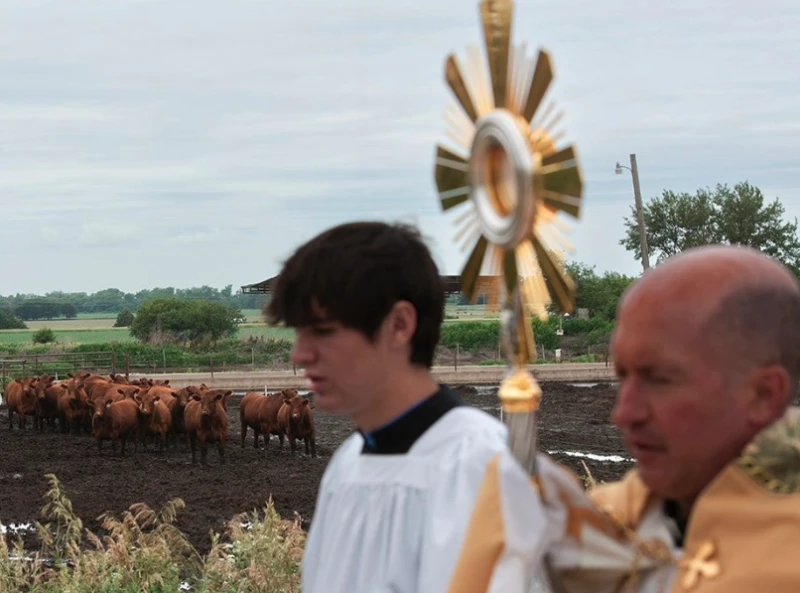
Cows in Nebraska watch as the Eucharistic Jesus passes by. / Credit: Jeffrey Bruno
CNA Staff, Jun 20, 2024 / 16:45 pm (CNA).
Amid a brutal heat wave in the Midwest and Northeast this week, the pilgrims on each of the four legs of the National Eucharistic Pilgrimage have all passed what is roughly the halfway point on their journeys to Indianapolis.
The four pilgrimage groups — currently in Wisconsin, Pennsylvania, Alabama, and Nebraska — will converge in Indianapolis on July 16 in time for the National Eucharistic Congress from July 17–21. A cohort of 30 young men and women have committed to walking the entirety of the routes, encouraging people to join along the way as they process with the Eucharistic Jesus. The processions have attracted thousands of participants in many areas.
“We have definitely spent a lot of this week in the heat, in the mid-90s,” said Marina Frattaroli, one of the pilgrims on the eastern Seton Route, at a Wednesday press conference. Much of the eastern U.S. is baking in unseasonably warm spring weather, with Pittsburgh under an excessive heat warning until Saturday evening.
“On Monday, I believe that we walked 15, 16 miles in the mid-90s. And so the team definitely is feeling the heat wave … it’s another opportunity to bring out those big prayer intentions, as we unite ourselves in Christ,” she said.
The Eucharist makes its way through Beaver County, Pennsylvania. Credit: Juliana Lamb
Frattaroli mentioned that despite the heat, the pilgrims have been able to act as “ambassadors” several times and explain the purpose of the processions to non-Catholic onlookers.
“There has always been a crowd with us. And even Monday, over 15 miles … there were well over 100 people, even at the smallest, and probably closer to 200 in the crowd at all times. So people are coming out, and people are even enduring the hard days together,” she said.
Marian Route pilgrim Matthew Heidenreich told about a boat procession the group took on Shawano Lake in Wisconsin and a walk to nearby Camp Tekakwitha, where a large number of kids at the summer camp greeted the pilgrims. On Sunday, the group visited the National Shrine of Our Lady of Champion near Green Bay, the site of the only approved Marian apparition in the United States.
The National Eucharistic Pilgrimage continues from the National Shrine of Our Lady of Champion near Green Bay, Wisconsin, the site of the only approved Marian apparition in the United States. Credit: Emma Follett
Heidenreich said it has been a blessing to engage in service projects for the poor during the pilgrimage as well. The Marian group will soon reach Milwaukee, where dozens of events are planned.
As told by Serra Route pilgrim Jaella Mac Au, a procession at a lake in Nebraska included an unexpected surprise — one of the vans that occasionally carries the Eucharist and the pilgrims got stuck in some sand.
“We were just like, oh, my gosh, like, what are we gonna do, Lord? … We asked for the prayers of St. Anthony, and praise God, our van got out. And it was just such a beautiful team bonding moment where we were digging out the van and pushing together, and it was just so beautiful to also include Our Lord in it.”
Bishop James Conley of Lincoln carries the Eucharist through Nebraska. Credit: Jeffrey Bruno
On the southern Juan Diego Route, which began in Texas, the pilgrims endured extreme heat near the start of the route but have found respite at a retreat the last few days at the Shrine of the Most Blessed Sacrament in Hanceville, Alabama.
As in past weeks, the pilgrims praised the hospitality of the people they encountered on the route and said they have been well-fed with local food at almost every stage.
Mac Au said her favorite food so far has been tacos and other Hispanic food provided to them when they went through Sacramento, while Frattaroli praised the authentic Italian food they were given while passing through Brooklyn.
Catholics throughout the U.S. are encouraged to register to join the pilgrims in walking short sections of the pilgrimages and joining in numerous other special events put on by their local dioceses. To read ongoing coverage about the National Eucharistic Pilgrimage and National Eucharistic Congress, visit the National Catholic Register.
If you value the news and views Catholic World Report provides, please consider donating to support our efforts. Your contribution will help us continue to make CWR available to all readers worldwide for free, without a subscription. Thank you for your generosity!
Click here for more information on donating to CWR. Click here to sign up for our newsletter.
Ottawa, Canada, Mar 11, 2021 / 03:01 pm (CNA).- The Catholic bishops of Canada wrote this week on whether certain COVID-19 vaccines are morally preferable for Catholics, if given a choice.
“[W]hen provided with a choice between receiving differe… […]
The Catholic faithful gathered in the Cenacle in Jerusalem for the Mass of the Lord’s Supper that the Franciscan friars celebrated on Holy Thursday, March 28, 2024. The Cenacle is at the center of strong tensions and disputes regarding ownership and rights of access and celebration. An ancient tradition places King David’s tomb here and over the centuries Jews and Muslims have leveraged this to first expel the Franciscans and then to prevent Christian worship, which they deemed sacrilegious. / Credit: Marinella Bandini
Jerusalem, Mar 28, 2024 / 17:15 pm (CNA).
On Holy Thursday, the doors of the Cenacle in Jerusalem were opened to welcome the Franciscans of the Custody of the Holy Land. In this “Upper Room,” called the Cenacle in the Holy Land, Jesus had his Last Supper, washed his apostles’ feet, and instituted the Eucharist.
It was here that the Franciscans celebrated the Mass of the Lord’s Supper, reenacting those same gestures. (At the Basilica of the Holy Sepulcher, however, the celebration is held on Thursday morning due to the Status Quo. Here is Cardinal Pierbattista Pizzaballa’s homily from that Mass.)
Cardinal Pierbattista Pizzaballa, the Latin Patriarch of Jerusalem, kisses the feet of a Franciscan friar during the “Washing of the Feet” ritual at the Mass of the Lord’s Supper celebrated at the Holy Sepulchre on Holy Thursday. The celebration is held on Thursday morning due to the Status Quo. March 28, 2024. Courtesy of the Custody of the Holy Land
The custos of the Holy Land, Father Francesco Patton, presided over the Eucharistic celebration at the Cenacle. In his homily, before washing the feet of six teachers and six students from the Terra Sancta School in Jerusalem, he emphasized the value of the “new commandment” that Jesus gave to his apostles here: “As I have loved you, so you also should love one another” (Jn 13:34).
“To love means to give oneself and to serve,” he said. “In this celebration, we want to nourish ourselves with Jesus because if he is alive within us, then we too will become capable of loving one another as he loved us. And we also want to learn from Jesus not to be served but to serve.”
Some students from the Terra Sancta School in Jerusalem who took part in the “Washing of the Feet” ritual during the Mass of the Lord’s Supper celebrated at the Cenacle in Jerusalem on Holy Thursday, March 28, 2024. Addressing them specifically in his homily, the Custos of the Holy Land emphasized the value of the “new commandment” that Jesus gave to his apostles here: “As I have loved you, so you also should love one another” (John 13:34). Credit: Marinella Bandini
Holy Thursday is the only day, along with Pentecost Sunday, when the Franciscans have the right to gather in the Upper Room to pray. Usually, it is a liturgy of the word, but since 2021 they have celebrated Mass. Outside, Israeli Army personnel ensure security.
The Cenacle is at the center of strong tensions and disputes regarding ownership and rights of access and celebration. An ancient tradition places King David’s tomb here, and over the centuries, Jews and Muslims have leveraged this place to first expel the Franciscans and then to prevent Christian worship, which they deem sacrilegious.
Father Narciso Klimas, historian and archivist of the Custody of the Holy Land, explained to CNA: “The Custody has all the documents confirming our ownership of Mount Zion.” Even today, traces of Christian presence are visible, both in the architecture of the place and in some symbols.
“The presence of the Franciscans at the Cenacle,” Klimas explained, “dates back to 1342, but as early as 1333, the rulers of Naples, Robert of Anjou and Sancha of Majorca, acquired the land and donated it to the friars. This was the first headquarters of the Custody of the Holy Land.” To this day, the official title of the Custos of the Holy Land is “Guardian of Mount Zion and the Holy Sepulchre.”
Father Francesco Patton, custos of the Holy Land, incenses the altar at the beginning of the Mass of the Lord’s Supper that the Franciscan friars celebrated inside the Cenacle in Jerusalem on Holy Thursday, March 28, 2024. This is the only day, along with Pentecost Sunday, that the Franciscans have the right to gather here to pray. Usually, it is a liturgy of the word, but since 2021 they have celebrated Mass. Credit: Marinella Bandini
In 1421, a rabbi submitted a petition to the local emirs, claiming the right for Muslims and Jews to this place due to the presence of King David’s tomb. One hundred years later, Klimas continued, “the Ottomans used this argument to gradually expel the Franciscans, until in 1551 the sultan decreed the total expulsion of the Franciscans from Mount Zion.” The Cenacle first became a mosque and later, in the lower part, also a synagogue.
“Since then,” Klimas recounted, “the Franciscans have never stopped attempting to regain possession of the Cenacle. The friars have always tried to ensure a presence, at least on Holy Thursday and Pentecost, sometimes even with methods that are not exactly orthodox (such as bribing the local guardian).”
Something began to change in the 19th century, during the time of the Ottoman Sultan Abdülmecid. Since then, the Franciscans have had the right to pray at the Cenacle on Holy Thursday and Pentecost. After a failed attempt in the 1930s to regain control of it, the friars managed to purchase adjacent land where they built the convent of San Francesco “ad Coenaculum” (next to the Cenacle).
In 1948, with the founding of the State of Israel, the entire Mount Zion came under Israeli control, and until today, the Israeli state owns the entire complex of the Cenacle. The neighborhood has a strong Jewish religious character and is characterized by the presence of synagogues and rabbinical schools.
The Franciscan friars and the faithful in the Armenian Cathedral of St. James in Jerusalem after the Mass of the Lord’s Supper celebrated at the Cenacle. Here, the friars commemorate the hospitality they received here in the 16th century. After being expelled from the Cenacle, the Franciscans were welcomed by the Armenians for seven years while the convent of St. Saviour was purchased, to this day the headquarters of the Custody of the Holy Land. March 28, 2024. Credit: Marinella Bandini
“Even if the Cenacle cannot return to our hands,” Klimas explained, “we ask at least to celebrate regularly, even with pilgrims, without the need for special permits.”
Negotiations on these matters (taxation and property) have been ongoing for over 25 years between the Holy See and the State of Israel, following the signing of the Fundamental Agreement in 1993 and the agreement recognizing the legal personality of the Catholic Church in Israel in 1997.
Despite the slow pace of diplomatic negotiations, some practical progress can be observed informally. The ability to celebrate Mass on Holy Thursday at the Cenacle is among these developments. Permissions to access the site on other special occasions are usually granted without significant issues as well.
After the Mass at the Cenacle, as tradition dictates, the Franciscans proceeded in a procession to three churches in two other symbolic places: the Armenian churches of St. James and of the Holy Archangels (of the Armenian Apostolic Church), and the Syro-Orthodox Church of St. Mark.
The Franciscan friars and the faithful in the Armenian Church of the Holy Archangels in Jerusalem after the Mass of the Lord’s Supper celebrated at the Cenacle on March 28, 2024. Friars and faithful pray together and receive the blessing from the representative of the Armenian Apostolic Church. Credit: Marinella Bandini
This yearly visit commemorates the hospitality the friars received in the 16th century. After being expelled from the Cenacle, the Franciscans were welcomed by the Armenians for seven years while the convent of St. Saviour was purchased, to this day the headquarters of the Custody of the Holy Land. Friars and faithful prayed together and received the blessing from the representative of the Armenian Apostolic Church.
The Syriac Orthodox Church of St. Mark is said to be built on the house of Mary, the mother of the evangelist Mark. According to Syriac tradition, this is the place where Jesus had the Last Supper. Here as well, those present prayed together and were able to listen to the Lord’s Prayer sung in Aramaic by one of the monks, who then gave a blessing.
The Franciscan friars and the faithful in the Syro-Orthodox church of St. Mark in Jerusalem after the Mass of the Lord’s Supper celebrated at the Cenacle on March 28, 2024. According to Syriac tradition, this is the upper room where Jesus had the Last Supper. Here as well, those present pray together and listen to the Lord’s Prayer sung in Aramaic by one of the monks, who then gives the blessing. Credit: Marinella Bandini
New Orleans’ Jackson Square. / And_Ant / Shutterstock.
New Orleans, La., Nov 15, 2021 / 15:24 pm (CNA).
The Archdiocese of New Orleans will pay more than $1 million in a settlement related to allegations of fraud in the wake of Hurricane Katrina, the Department of Justice announced Nov. 15.
According to the DOJ, the settlement “resolves allegations” that the Archdiocese of New Orleans “knowingly signed certifications for FEMA funding that contained false or fraudulent damage descriptions and repair estimates that were prepared by AECOM, an architecture and engineering firm based in Los Angeles,” from a period lasting from 2007 through 2013.
A former project specialist for AECOM first brought the allegations in a 2016 federal lawsuit, which alleged that the Archdiocese of New Orleans, as well as two historically black New Orleans universities, improperly applied for and received millions of dollars in federal funds in the wake of Hurricane Katrina.
According to the DOJ press release, among the many allegations of fraud received were claims of damage to a central air conditioning unit that never existed, as well as inaccurate reporting of the number of square feet in a facility.
The Archdiocese of New Orleans declined to comment on Monday after the settlement figure was released, but has in the past denied any wrongdoing.
Katrina, which hit New Orleans during August 2005, killed at least 1,800 people and devastated much of the city. In the years since Katrina and Rita, which hit the region the month after, the Federal Emergency Management Agency has paid out nearly $20 billion in relief.
“FEMA offers critical financial support when natural disasters strike,” said Acting Assistant Attorney General Brian M. Boynton of the Justice Department’s Civil Division in a statement released by the department Monday.
“The Department of Justice is committed to ensuring that these taxpayer funds are properly spent to help disaster victims rebuild their communities,” he said. The release noted that the claims alleged in the lawsuit “are allegations only, and there has been no determination of liability.”
During the 2007-13 period, the archdiocese was led by Archbishop Alfred Hughes and Archbishop Gregory Aymond. Aymond, the current archbishop, succeeded Hughes in Aug. 2009.
The settlement, which is based on the Archdiocese of New Orleans’ financial condition, required final approval of the U.S. Bankruptcy Court for the Eastern District of Louisiana, which approved the settlement on Oct. 26. The Archdiocese of New Orleans filed for Chapter 11 bankruptcy on May 1, 2020 amid a number of lawsuits related to historical sexual abuse of minors.
“Federal disaster funds are an instrumental component in the effort to assist disaster victims with their recovery,” said the U.S. Attorney’s Office for the Eastern District of Louisiana in the Department of Justice’s press release.
“The favorable resolution of this False Claims Act matter illustrates the collaborative efforts and firm commitment by our federal partners to use all available remedies to address signs of fraud, waste and abuse,” they said.
Robert Ramero, the former AECOM Project Specialist-turned-whistleblower, alleged in his lawsuit that several entities in New Orleans, including Xavier University, the archdiocese, and Dillard University, defrauded FEMA after the hurricane.
As of 2018, FEMA had obligated nearly $184 million to the Archdiocese of New Orleans for Katrina-related recovery work. At least 32 archdiocesan facilities sustained damage in the storm, FEMA says.
Xavier University, which is Catholic, previously agreed to pay $12 million as part of a settlement related to these allegations.
The Archdiocese of New Orleans denied any sort of fraud in a statement issued in June 2020, after the AECOM employee’s lawsuit was unsealed.
“Our finance office worked diligently and relied upon the knowledge and expertise of FEMA and their designated agencies and field representatives,” said representatives from the archdiocese.
“Our staff was committed to working responsibly and being good stewards of the money received, and our documentation reflects that.”
The archdiocese claimed in June 2020 that they were surprised by the questioning, and that “Every dollar of FEMA funds received has gone back into the restoration of parish, school and other properties to serve the people of the Greater New Orleans community.”
“We deny the allegation that the Archdiocese of New Orleans knowingly conspired to submit false information. We have cooperated with the federal government’s investigation and will continue to work with them as we resolve this claim,” they said.
Leave a Reply
