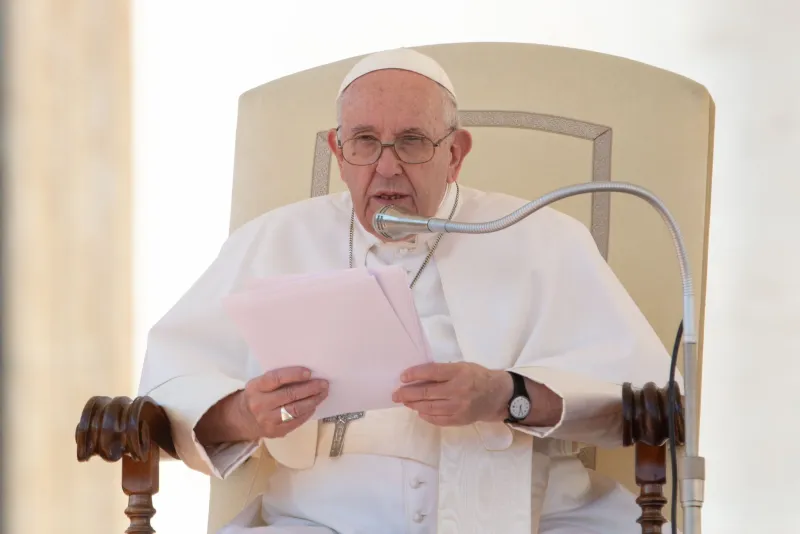
 Pope Francis speaks in St. Peter’s Square Oct. 15, 2022. / Daniel Ibanez/CNA
Rome Newsroom, Nov 22, 2022 / 12:30 pm (CNA).
Why did Pope Francis dismiss the entire leadership of the Church’s worldwide charity arm Tuesday?
What role will Pier Francesco Pinelli play as temporary administrator of Caritas Internationalis, appointed by papal decree on Nov. 22?
A key date to understanding the move and how it aligns with the pope’s broader reforms is Oct. 15, 2022.
On that day, Pope Francis received in audience at the Vatican Father Giacomo Canobbio and delegates of Bain Capital. The financial investment firm is where Pinelli previously worked. And Canobbio is the priest who, without announcement, was appointed by Pope Francis to the role of commissioner of the Pontifical Lateran University.
Both appointments are typical for the pontiff and his preferred modus operandi: Pope Francis sends an inspection or appoints a commissioner whenever he wants to reform something.
The papacy of commissioners
There were no apparent reasons for appointing a commissioner to Caritas Internationalis — just as there were no apparent reasons for appointing a commissioner at the Pontifical Lateran University.
However, Pope Francis has previously ordered a number of inspections.
Bishop Claudio Maniago was made the inspector of the Congregation for Divine Worship and the Discipline of the Sacraments, after which the pope appointed Archbishop Arthur Roche as prefect of the dicastery. Next, Bishop Egidio Miragoli inspected the Congregation of the Clergy, which was still in progress when the pope appointed the Korean bishop Lazzaro You Heung-sik — later created cardinal— as prefect of the dicastery.
At the beginning of his pontificate, Pope Francis appointed several commissions.
One such body was the commission of reference on the administrative-economic structures of the Holy See, known by its Italian acronym COSEA. Another was CRIOR, the commission for studying the Institute of Works of Religion reform, commonly known as the Vatican Bank.
Their work, once completed, resulted in the extensive overhaul of the Vatican’s financial departments and the new Institute of Works of Religion statutes, promulgated in 2019.
However, the appointment of a commissioner in Caritas Internationalis has another clear precedent: the inspection of the Dicastery for the Promotion of Integral Human Development.
The inspection took place in July 2021 and was led by Cardinal Blase Cupich, the archbishop of Chicago. The team also included Sister Helen Alford, vice-rector of the Pontifical Angelicum University, an ordinary member of the Pontifical Academy of Social Sciences; and Pinelli, the new administrator of Caritas Internationalis.
Pinelli’s profile
A trained engineer and experienced manager, Pinelli has worked with several institutions as well as a consultant for management and investment firms.
According to Vatican rumors not officially confirmed but provided to CNA from multiple sources, Pinelli was also involved in restructuring what is now the Dicastery for Integral Human Development.
A press release from the dicastery said Pinelli was an engineer “with a more humanist than technical way of proceeding” and that he was “formed in Ignatian spirituality,” a man who “from an early age was active as a volunteer working with recovering drugs addicts, in development cooperation, support for missionary works, and catechesis.” The statement also noted that he is married with three children and three grandchildren.
The release also emphasized that “in 33 years of work,” Pinelli had gained managerial experience in different sectors, including a large energy company.
Having worked both as a project manager for energy companies and as a management consultant for Bain, Pinelli also has experience working with religious and secular works and institutions, according to the release.
Obviously, his formation and positions in some Jesuit institutions may have played a role. It seems likely that Cardinal Michael Czerny, SJ, the current prefect of the dicastery, had a word in involving him and others.
However, it is still hard to assess which issues are at stake. It seems clear that the pope wants to reform Caritas Internationalis, including its statutes and bylaws.
Founded in 1951, the Catholic confederation is made up of 162 charitable organizations based in 200 countries around the world. Its headquarters are located on Vatican territory in Rome, and the Vatican oversees its activity.
According to Czerny’s dicastery, “no evidence emerged of financial mismanagement or sexual impropriety”; however, “deficiencies were noted in management and procedures, seriously prejudicing team spirit and staff morale.”
Pinelli’s task
The reform of the statutes will be the first task of the new commissioner.
Pinelli will be assisted by Maria Amparo Alonso Escobar, Caritas Internationalis’ head of advocacy, and by Jesuit Father Manuel Morujão, who will provide personal and spiritual accompaniment to Caritas employees, according to Pope Francis’ decree.
In May 2023, the next Caritas Internationalis general assembly is expected to be held in Rome, with the appointment of the new president, general secretary, and treasurer. By then, the reform process will likely be completed.
Caritas Internationalis will undergo a review “in order to improve its management norms and procedures — even while financial matters have been well-handled and fundraising goals regularly achieved — and so better to serve its member charitable organizations around the world.”
However, a reform of the statutes already took place in 2019 and was approved by the pope with a rescript of Jan. 13, 2020.
As for the change of the statutes of Caritas Internationalis, it was simply a matter of passing the competencies from the Pontifical Council Cor Unum, which no longer exists, to the Dicastery for the Promotion of Integral Human Development, which has absorbed its functions.
As for the rules of procedure, these changes were not communicated. But they generally accepted some of the requests approved by the Caritas General Assembly, which envisaged encouraging the presence of women within the highest representative bodies and including two young people in the same representative bodies.
In particular, there was talk of the Representative Council of the federation, abbreviated with the name RE.CO., the acronym for Representative Council. These indications have now been implemented and will become operational.
The structure of Caritas Internationalis was thus “adjusted” and adapted to the reform of the Curia.
However, the statutes of Caritas Internationalis remained confirmed in the structure as Pope Benedict XVI reformed them in 2012. Those statutes strengthened the collaboration between Caritas Internationalis and the Holy See and clearly outlined the competencies of the Vatican Secretariat of State.
Not only that: the new structure of Caritas Internationalis gave greater coordination to departments and bodies connected to the Holy See, which also concerned doctrinal aspects.
The rationale behind Benedict XVI’s reform
It is noteworthy that the 2012 reform was part of a more extensive project by Benedict XVI to accomplish Pastor Bonus’s provisions fully.
Pastor Bonus was the apostolic constitution that regulated the functions and tasks of the Curia offices, and Praedicate Evangelium now replaces that.
However, the reform came after a governance crisis. In 2011, the Secretariat of State did not approve the renomination of the former secretary general, Lesley-Anne Knight. (However, her work was praised by the president of Caritas Internationalis at the time, Cardinal Oscar Andrés Rodriguez Maradiaga.) As a result, she was replaced by Michel Roy, a Frenchman who worked with Secours Catholique — the Caritas in France.
Knight’s non-confirmation also stemmed from the new approach given with the subsequent reform of Caritas Internationalis.
It was an approach that derived from the formulation of Benedict XVI’s encyclical Caritas in Veritate. In the encyclical, Benedict XVI stressed that human development and foreign aid could not be separated from the demand for truth. The encyclical also pointed to the fact that many international organizations were promoting abortion, contraception, sterilization, and euthanasia.
This was an approach that Knight did not fully share, as she publicly explained to the media at the time.
While some approved of Knight’s departure, others were disappointed. Despite a robust generational change in Caritas Internationalis in recent years, these divisive feelings may have lingered in the background and fueled some complaints about “management and procedures.”
What will the new reform look like?
The tone of the dicastery’s press release suggests that the reform will be more managerial. But, above all, it is a substantial change in philosophy from the reform of Benedict XVI.
In short, it could be another paradigm shift by Pope Francis, comparable to some degree to his restrictions of the Traditional Latin Mass.
From this point of view, Pope Francis has identified several people to help complete his changes to the Church’s structure.
In carrying out the reform, the pope does not hesitate to demote someone like Cardinal Luis Antonio Tagle, current president of Caritas, who now finds himself mandated to “liaise” with Pinelli and his staff for the upcoming general assembly.
Tagle was rumored to be appointed the next prefect of the Dicastery of Bishops. Even if these rumors were to be confirmed, Tagle’s public image has now been compromised by the Caritas decision. This will also weigh in a future conclave.
Pope Francis, however, is completing his goals. As he said in one of his homilies in the days of the COVID-19 lockdown of 2020 — and also in a meeting with the Candia Foundation in April — he remains critical of humanitarian organizations that do good work but spend 60% of their budget on wages. The pope called on them to keep costs to a minimum, “so that most of the money goes to the people.”
[…]






Nothing appears set in stone to this Jesuit. Where does he get his inspirations? Perhaps Tucho should sit down with him for a bit of probing.
Look. Let’s be honest.
If Rupnik is acceptable priestly material — as Bergoglio’s acquiescence indicates he clearly is— then who isn’t?
Women? I say, bring ‘em on!
Illegal immigrants? Why not?
High school dropouts? Home remodeling contractors? Attorneys? Professional sports figures?
On what basis can we say no to anyone, so long as Rupnik remains a clergyman in good standing?
And, thus, Hollerich’s and Bergoglio’s ‘New Catholique Church’ lurches inexorably — indeed, progressively — into its post-Christian future.
I.e., the past.
Briney. There you go again. Dispagaging women. “Women? I say, bring ‘em on!
Illegal immigrants? Why not?”. Holy Catholic women??? Walk in their shoes!
He wasn’t disparaging women. Clue in.
More code language of gradualism from the clericalist Hollerich!
The contrived question before the study groups and the Synod is about female deacons. But, Hollerich, in counseling small steps, already maneuvers much more broadly. Says he: “…we will also work toward this. I don’t know if that necessarily has to include ordination to the priesthood. You can’t tie everything to the priesthood alone. That would be clericalization.”
The endgame of a female priesthood already waiting in the wing?
Such that the cover story for ordained deaconesses, itself, is the small-step already—on the path to an equally invalid female “priesthood”? Two points of clarification:
FIRST, the historical documentation does support an ordained role for so-called deaconesses. Instead, the ordained diaconate is an integral part of the threefold ordination established by Jesus Christ: bishops and priests, and their deacons. It’s neither culturally based nor separable. Moreover, the role of Lay Ecclesial Ministers exists already (!), by virtue of their baptism and confirmation.
SECOND, in his view of things male and female, why does the perplexed Hollerich remind us of the Anglican chauvinist cleric in the movie “Shadowlands”? The clericalist explains menfolk as intelligent versus womenfolk as only emotional. The “feeling” thingy…
As he dialogues (!) with C.S. Lewis’ new American friend, Joy Gresham (played by Debra Winger), Gresham first allows that different cultures might “have different manners of discourse”—and then wonders aloud: “Are you trying to be offensive, or merely stupid?”
Hollerich’s patronizing theology: “I am in favor of women feeling [!] fully equal in the Church.”
said the prohibition against ordaining women was “not an infallible doctrinal decision” and could be changed over time with arguments.(sic)
Incorrect, Jean-Claude, you goofy Jesuit.
Wherefore, in order that all doubt may be removed regarding a matter of great importance, a matter which pertains to the Church’s divine constitution itself, in virtue of my ministry of confirming the brethren (cf. Lk 22:32) I declare that the Church has no authority whatsoever to confer priestly ordination on women and that this judgment is to be definitively held by all the Church’s faithful.
Guess what? Scratch below the surface and so often you’ll find homosexuality.
Lay men and women are completely equal in the Church. Laywomen and laymen have the exact same rights and can be involved in as much as any layman can. This is so tiresome. If he’s talking power…well that isn’t what ordination is about.
Can you imagine how much worse the Church would be if the contraceptive theology of this pontificate had come immediately after St. Paul VI? The pontificates of St. John Paul II and Benedict XVI providentially provided a post-Vatican II floor to build the Church back up after the category 5 hurricane Francis.
Praise be Jesus Christ, now and forever! This too shall pass. “Hold fast” to the One, Holy, Catholic and Apostolic Church, the Body of Christ!
Let the Church decide.
It already has
Why do women need to be priest? Some of my women friends want so badly to have the Catholic Church to allow women priest. My women friends believe this will give women power and a say in the Church. Our Mother Mary had little say in the Gospels, yet she was exalted to Queen of Heaven and assumed into Heaven.
As Hollerich said, “When sneaking up on dose cwafty infawwible teachings, you must be vewy vewy quailfuwl.”
Gradualism, or precarious careening? As we struggle with what is the Church to become after Fiducia Supplicans, we awaken to the spectacular reality of an occultist priest, serial rapist of nuns protected by His Holiness afforded all the faculties and respect of a priest in good standing.
Female priests and John Paul’s formal declaration that they cannot be priests?Simply clericalist formality from an age locked into static conceptualizations of the Church. Francis is the new age. Hollerich the court jester entertaining His Holiness with naive suggestions apparently already affixed in our Pope’s supple ever inventive intellect. “You have to be open to everything. The Church is like that: Everyone, everyone, everyone”, His Holiness in response to Norah O’Donnell’s 60 Minutes interview subtly inserting everything. Our Pontiff cannot jettison tradition and literally replace Christ by inferring everything to himself.
These wonderful modernizers, imagining change will bring in new market shares of consumers and better support for their own retirements, miss one crucial point every time…
If the Church has been wrong about something for 2000yrs, and only now discovers the mistake, then how can it be right about anything? If its infallible teachings are now judged fallible, did it get anything right at all, to include the resurrection, and how can one know?
Why would anyone believe anything it teaches when it likely then all a farce?
Roma locuta est; causa finita est.
Good exorcism session of Msgr Rossetti – that also mentions how wounding words and such can lead persons to make (negative ) ‘inner vows ‘ – how one would not love/ trust etc: and how to break such – (at the 1.36 mark , for those short on time )
– https://www.youtube.com/watch?v=OB8uzH582Z8
Such negative inner vows against The Cross/ suffering or parental figures, as the urge /decision to destroy – Papacy ,The Church, own identity / each other in wrong choices – the discords and issues !
Good marriage preparation along with sessions such as above, to help families to discern these areas , spouses making good inner vows – such as in critical areas of chastity , to help restore dignity of women – all such to add to the help needed in our times ! Mercy !
I have had concerns with women clerics. However, my research and dialog with the CWR editor has caused further dilemma.
Excerpts: John Paul II’s rejection of the priesthood of women was binding for the Church. St. John Paul did not explain why the church is “bound”. Why does anyone care? The edict has been “cast in concrete”. Cardinal Hollerich… Citing the example of blessing homosexual unions after Fiducia Supplicans, Hollerich warned of a potentially “HUGE BACKLASH” if the Vatican were to introduce the ordination of women to the priesthood.
Amazing! Comparing homosexual marriage to women ordination is an abomination.
All that I have read on female ordination has been founded largely in mythology… Holy mother church is female, so women can’t be included. Jesus chose only males as his apostles.
Just what would ordained women offer to the church?
CNA: Church definitively said “no” to priestly ordination for women in the 1970s, they closed the door to half of the population of the Church. St. Augustine said that the soul does not have a sex. How can the church not be anti-women…if women are not part of the decision making? (Magesterium)
Was Christ, a Rabbi, concernned with the status of holy women? Would he accept today’s female rabbinical?
Lets not forget women are the most loved and productive nurturers of MANKIND. Today’s plagued male clerics, priest pedophilia, have placed many other ordained under scrutiny. A fresh air infusion of holy women must help a church in visible decline.
“St. John Paul did not explain why the church is “bound”.”
Good grief. Read the actual document. It’s shorter than most of your comments here.
Carl. No, the read of Pope Paul’s words are many and the complexity, “Declaration Inter Insigniores” may confuse the average uninitiated Catholic. And, I see his reason for not ordaining still what I observed in my earlier readings. There may have been a condition for men only… Wijngaard Institute for Catholic research: “the decision by the Swedish Lutheran Church in September of that year to admit women to the pastoral office. This caused a sensation and occasioned numerous commentaries”.
Pope Paul: “the Catholic Church from the beginning always been reserved to men alone”. That translates into the exclusion of 1/2 of the Catholic population. “God’s plan”? Cardinal Hollerich says there will be a BACKLASH in the church if women are ordained. He did not elaborate on WHOM the backlashers are. A bunch of old men?
No question the Church has made many changes to allow women more power. However, I would give a high mark of BLAND.
Thank you for your guidance.
I’ll sum it for you: “Jesus said and did it, we believe and follow it.”
Now, there are a host of theological reasons. An excellent guide is Women in the Priesthood? A Systematic Analysis in the Light of the Order of Creation and Redemption (Ignatius Press) by Manfred Hauke.
By the way, should I, as a man, be angry that God only “allows” women to bear and have children?
“God said it, I believe it & that settles it for me…”
🙂
Does it mean anything that the Redeemer assumed human nature as a male? After all, God could have assumed human nature as a woman. God didn’t. Are you upset about that? Perhaps it has a significance that’s eluded you.
Peeling an onion, layer by layer, results in No Onion ; the Marxist Deconstructivism of the McCarrick Legacy Band must be stopped while there is still an onion to be saved.
‘At the same time, the Jesuit cautioned against pushing too hard for changes, noting that “if you push too much, you won’t achieve much. You have to be cautious, take one step at a time, and then you might be able to go very far.”’ The cardinal could not have spoken more clearly the progressive manifesto! That has to be one of the most eye-opening statements of a left-wing prelate. “Dialogue” has nothing to do with the path of reason and faith toward the attainment of the truth, but with the slow and steady approach toward a present and predisposed, misshapen, human desire.
Pushing for female priesthood means those who do so put themselves above Christ, the reality of His presence in the Eucharist and also the reality of the Last Supper here and now.
Jesus Christ is a Man; each Eucharist is the Last Supper; a priest is an icon of Christ Who is a Man hence he can only be a man. A female priest conveys a lie and the Church cannot accept that lie. This is enough to end the calls for “a dialogue” (sounds like a dialogue with oneself is envisaged here and this is probably it is endless).
Speaking of “empowering women”. The most exalted service typically does not have any power. I mean not an earthly understanding of “a power” which the proponents of female priesthood seem to employ. For example, a prophet has no earthly power and no recognition but he has plentiful rejection and hatred and often a violent death. Yet a prophetic vocation is one of the most exalted in the Church. God can choose a woman for this vocation and the examples are abundant. The truth is that the power which is given to a person by God is very different from that power that proponents of a female ordination speak about. They appear to speak of a power given by men – more precisely, by themselves.
And so, any woman (or a man) right now can prophecy and chastise priests including the Bishops and Popes – if God calls them to do so. A woman can write theology, teach, be a spiritual director, even be (in an Orthodox tradition) “a spiritual mother”, even to a Patriarch. A woman can only not be a priest because God didn’t give her a power to do so – just like He did not give men a power to fall pregnant and to give birth.
Hence, I perceive those “dialogues” – about anything really – to be the attempt to swap God-given power with man-given power, in essence to usurp God’s ability to bestow a power upon those He chooses. I.e., narcissism again.
Women cannot be ordained. MorganD is wrong. The Catholic Church, unlike the protestant faiths, doesn’t change to keep aligned with the current world view on homosexuality, and women “priests”. Sorry to break MorganD’s heart, but a few days ago on that CBS 60 minutes interview, Pope Francis reaffirmed that women cannot be ordained to the priesthood or the diaconate.
This is not discrimination against women. This is preserving divine law, while giving women the opportunity to respectfully admire the office of priesthood, which is reserved for chaste, straight men who are acting In Persona Christi.
“while giving women the opportunity to respectfully admire the office of priesthood”
I don’t think Our Lord would say to St Mary Magdalene: “Via choosing males for priesthood I am giving you an opportunity to admire the office of priesthood” because it sounds condescending and… meaningless. Our Lord would simply say as a matter of fact “priesthood is for men only”, that is it.
Curiously, your phrase omits men. Let’s be equal here and say “while giving men and women the opportunity to respectfully admire the office of priesthood”. Or even better “the office of priesthood is worthy of respect”. But, if it is universally (i.e. by men and woman alike) worthy of respect, there can be no such a thing as “giving women the opportunity to respectfully admire the office of priesthood”.
Thanks for pointing that out Anna. Yes, everyone should respect the office of priesthood, both male and female. Looking back over my comment, I also realized that preserving the male priesthood hopefully will give both men and women the opportunity to witness what a pure, honest man is, and take his (and Christ’s) example as you’re living out your own vocation. Also I like your comment above my old one. This constant push for a female priesthood is ridiculously futile. God bless. ☦️
Jesus Christ served and suffered humiliations. He died a painful death but rose again. A desire to humbly serve as Christ did is a noble intention. A genuine aspiration to be Christ-like deserves careful and utmost attention.
And this comment relates specifically and directly to the content of the article how?
The greatest and most perfect human person ever created by God is a woman. She is a singularity. For a time, even God Himself was her unborn Child!
“Hail, O Lady, Holy Queen, God’s Holy Mother Mary! You have been made the Virgin Church and chosen by the most Holy Father in heaven.
You has he consecrated with His most holy beloved Son and the Holy Spirit the Paraclete.
In You there has been, and is, all fullness of Grace, and all that is good.
Hail His Palace! Hail His Tabernacle! Hail His Dwelling Place! Hail His Garment! Hail His Handmaid! Hail His Mother!
And (hail) all you holy Virtues [in her] which by the grace and enlightenment of the Holy Spirit are poured forth into the hearts of the faithful, that from faithless souls you virtues may make them faithful to God!”
The Salutation to Our Lady by St. Francis of Assisi