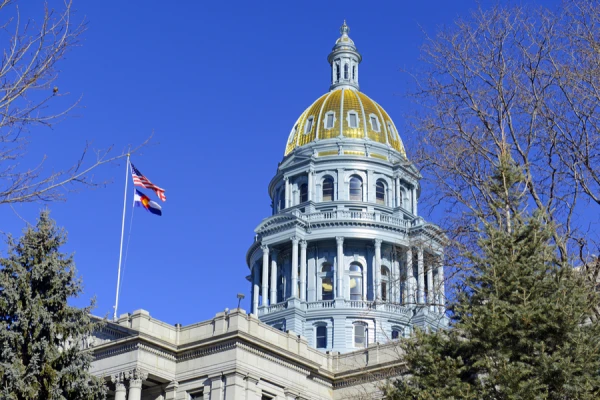
Denver, Colo., Feb 3, 2020 / 07:01 pm (CNA).- The Catholic bishops of Colorado have backed a bipartisan bill to repeal the death penalty that appears set to become law, after five previous attempts failed.
“I urge all Coloradans to support the effort to repeal the death penalty and help bring about a culture in our state that respects all life,” Bishop Stephen Berg of Pueblo said in a statement to the Pueblo Chieftain newspaper.
“The Catholic Church has long taught that every person, whether they are unborn, sick, or sinful, has a God-given dignity that cannot be erased or taken away. Yes, it can be marred, but it cannot be blotted out in the eyes of God,” Berg said.
On Jan. 31 the Colorado Catholic Conference said its bishops have been “active in their support for this bill.” The conference praised the State Senate for passing the repeal bill.
S.B. 20 is expected to pass the Democrat-controlled House of Representatives and be signed into law by Democratic Gov. Jared Polis. The legislation would end capital punishment for crimes committed on or after July 1.
The bill would not affect the death sentences for the three inmates currently on death row, but Polis has said he would commute their sentences if the bill passes, the Colorado Sun reports.
A key preliminary vote of 19 to 15 on Jan. 30 was split largely along party lines. Republican State Sens. Kevin Priola, Jack Tate, and Owen Hill, all co-sponsors of the bill, voted in favor. Democratic Sens. Rhonda Fields and Jessie Danielson voted against it.
The final vote, held Jan. 31, passed 19 to 13.
Tate said he thought the death penalty is ineffective and expensive and risks “executing an innocent person.” Priola cited the principle of “protecting life from conception to natural death,” Colorado Public Radio reports.
Other co-sponsors of the bill were Democrats Sen. Julie Gonzales and Reps. Jeni Arndt and Adrienne Benavidez.
In his comments to the Pueblo Chieftain, Berg cited his experience as a priest in Texas and Colorado ministering to prisoners.
“Indeed, I have witnessed the return to the faith of the most hardened criminals,” he said. “The death penalty, while it might offer a sense of short-term justice, only adds to the cycle of violence and takes away this opportunity for conversion.”
Berg also cited Pope Francis’ revision to the Catechism of the Catholic Church in 2018.
“Today there is an increasing awareness that the dignity of the person is not lost even after the commission of very serious crimes… Consequently, the Church teaches, in the light of the Gospel, that the death penalty is inadmissible because it is an attack on the inviolability and dignity of the person,” the pope said.
In spring 2019 the Democrat-controlled Senate was set to debate a bill to repeal the death penalty, but backers appeared to lack enough votes and asked the bill to be withdrawn.
Previously, state legislators have tried to repeal the death penalty five times since 2000. There has not been an execution under Colorado law since 1997.
Auxiliary Bishop Jorge Rodriguez of Denver, speaking for the Colorado Catholic Conference, testified in favor of the repeal at a Jan. 27 hearing of the Senate Judiciary Committee.
“The Catholic Church, many other Christians and many other people of faith believe that human life is sacred from conception until natural death,” he said. “We believe that, because God made us in his image and likeness, it is not possible to lose the dignity that confers to our lives. We are, as Jesus said, his brothers and sisters, even if we have committed great crimes or sins.”
Rodriguez told the Senate committee the death penalty “only adds to the cycle of violence.”
“If we as a society accept the idea that it’s possible for someone to lose their human dignity and be executed, then it is only a short step to say that certain classes or types of people belong to this less-than-human group,” he said. “History has shown that this is not outside the realm of possibility.”
Rodriguez cited the Christian imperative to visit those who are in prison, adding: “even those who committed horrible crimes and are in prison are not outside of Christ’s mercy.”
The inmates now on Colorado’s death row are Nathan Dunlap, who murdered four people at a children’s restaurant, and Sir Mario Owens and Robert Ray, who both had been involved in the murder of a young engaged couple, Javan Marshall Fields and Vivian Wolfe. Fields was set to testify against Ray in court on charges Ray was an accomplice in a murder case.
The murders of Fields and Wolfe helped inspire Fields’ mother, Aurora Democratic Sen. Rhonda Fields, to become active in public life. Fields was one of the strongest critics of the bill in 2019, objecting to the speed with which it passed through committee consideration.
She was again critical in Jan. 30 debate on the bill.
“What side of history do you want to be on? Who are you serving? Who are you protecting?” she said. Fields detailed her son’s murder and the court case that followed, the Denver Post reports.
“My son was innocent!” she said.
“Either we’re for public safety, or we’re not,” she added.
Rodriguez and Berg both discussed crime victims and their families.
“It is understandable that the family of a victim might feel like justice is being served by the murderer being executed, but the reality is that only God can offer true justice in eternity,” Rodriguez said.
Berg said victims and their families also can have “conversion and healing.”
“It is tempting to hold on to hatred for those who hurt you so deeply, but it consumes the lives of those who let it remain in their hearts,” he said. “Instead, when the cycle of violence is interrupted by forgiveness and faith, the opportunity exists for healing and growth in charity for victims and their families. God is able to take a great evil and transform it into an even greater good.”
Some defenders of the death penalty sought other ways to oppose repeal.
Sen. Bob Gardner, R-Colorado Springs, proposed an amendment to send the death penalty repeal to the voters. The amendment failed to pass. State Rep. Dave Williams, R-Colorado Springs, has said he would do whatever he could to block the bill without a popular vote, including legislative obstruction tactics like filibustering and asking bills to be read at length.
There are 21 U.S. states and the District of Columbia that have abolished the death penalty. The governors of California, Oregon, and Pennsylvania have placed moratoria on executions, according to the Death Penalty Information Center.
Both Pope Francis and his immediate predecessors have condemned the practice of capital punishment in the West.
St. John Paul II called on Christians to be “unconditionally pro-life” and said that “the dignity of human life must never be taken away, even in the case of someone who has done great evil.” He also spoke of his desire for a consensus to end the death penalty, which he called “cruel and unnecessary.”
And Benedict XVI exhorted world leaders to make “every effort to eliminate the death penalty” and told Catholics that ending capital punishment was an essential part of “conforming penal law both to the human dignity of prisoners and the effective maintenance of public order.”
In August 2018, the Congregation for the Doctrine of the Faith issued a new draft of the catechism’s paragraph regarding capital punishment.
Quoting Pope Francis’ words in a speech of Oct. 11, 2017, the new paragraph states, in part, that “the Church teaches, in the light of the Gospel, that ‘the death penalty is inadmissible because it is an attack on the inviolability and dignity of the person,’ and she works with determination for its abolition worldwide.”
Reasons for changing the teaching, the paragraph says, include: the increasing effectiveness of detention systems, growing understanding of the unchanging dignity of the person, and leaving open the possibility of conversion.
Fr. Thomas Petri, O.P., a moral theologian at the Dominican House of Studies in Washington, D.C., told CNA at the time that he thinks this change “further absolutizes the pastoral conclusion made by John Paul II.”
“Nothing in the new wording of paragraph 2267 suggests the death penalty is intrinsically evil. Indeed, nothing could suggest that because it would contradict the firm teaching of the Church,” Fr. Petri continued.
 […]
[…]






Having matriculation from the Mr McCarrick school of pink collegiate, His Eminence, McE is the last one to speak about creating an atmosphere of polarization…
Nothing says “PLEASE UNDERSTAND WE ARE NOT TO BE TAKEN SERIOUSLY” any better than having a panel discussion on “civil discourse” involving His Eminence Cardinal McElroy, a man who asserts that he is a Christian Shepherd, and denounces all Christians who accept the teaching of Jesus and his apostles as tantamount to being “deplorables,” simply motivated by what McElroy declares to be nothing other than “animus.”
So if anyone fails to conform to the sexual revolution ideology held by His Eminence Cardinal McElroy and His Holiness Pontiff Francis, and dares instead choose to obey the Son of God, it is because such people are motivated not by devotion to Our Lord and The Truth and the well-being and salvation of others, including their own family and friends, but are simply “haters” (to quote their mutual spokesman Rev. Martin) and “backwardists” and “children” and “stupid” (to conjure just a few labels employed by the Pontiff Francis).
As to taking sides in matters where some “new-office-holding-members” of the CHURCH DIVERGE from “the mind of Christ,” a quote from one of the Pontiff’s earlier predecessors comes to mind:
“Whether it is right for us to obey men rather than obey God, you be the judge.”
Interesting “weather” we’re having, isn’t it?
It’s REMARKABLE that the very men who spent the last 10 years showing their contempt for those who would remain “united” in Christ, and reject the alternative on offered to “unite around them instead,” are now looking to the near future, and are suddenly concerned about “unity.”
What could possibly motivate such a course change? Are they looking ahead and worried they’ll be out-voted on something coming up soon?
It’s a pity that, not only do the above men fail to appreciate the divine word, but they even fail to voted appreciation for mere irony.
But Eminence McElroy does have the consolation that some of his audience reading Harvard Magazine this month will esteem him for “distancing himself” from Christ.
More dialogue? How about just stop persecuting us for wanting the Traditional Latin Mass, and leave us the hell alone? Would that work for you guys?
Tim, amen brother!
Very gutsy (or not?) to place Bishop Barron and Cardinal McElroy at the same table–actually two parallel and different universes, like the collision between matter and antimatter. And what do we get from this encounter? The ideological harmony of “dialogue”!
Good so far as it goes, but the missing ingredient, even more than mutual respect, is fidelity.
Barron is too bland and McElroy is too much of a company man. For both to suggest that what divides the Church today is only “ideological differences” seems an ideological attempt at some sort of middle ground.
So, yes to “civility,” and “dialogue” and “love” . . . but as the realist Fr. Werenfried van Straaten said, in reference to the mid-20th-century Vatican, and of such a dance step during the geopolitical Cold War: “No peace without justice, and (!) no justice without truth.”
Was it the clericalist balm of “fraternal collegiality” that enabled the spreading and unchecked Sexual Abuse Scandal?
More dialogue? How could there be more dialogue when, in fact, at least 70% of those who claim a Catholic identity don’t believe in Catholicism?
What about more catechesis? Accurate catechesis by faithful accurate catechists. If an exchange is required during that process well and good. What are we to “dialogue” about otherwise? Premarital intimacy? Divorce? Same-sex attraction? Abortion? Beyond accurate catechesis those issues are proper to the Sacrament of Reconciliation, to spiritual direction, or simply an exchange and counsel between a parishioner and their parish priest.
What actually requires dialogue? The reality of the Incarnation? The Divinity of Christ? The nature of the Most Holy Trinity? The Immaculate Conception? The Assumption? I’m unfamiliar with too many individuals, ordained or otherwise, who can plumet these Mysteries beyond what we have from the perennial Magisterium and the reflections of the saints.
Or shall we dialogue regarding the proper role of the papacy, the episcopate and the clergy class in their role to be evangelists, upholding the perennial Magisterium? Or are they to be the primary agents of the deconstruction of Roman Catholicism as they appear to regard themselves? At least the ones not hiding under their desks.
Why not just do your jobs — ecclesiastics and academic “theologians” — and otherwise be still? No one requires your sophomoric speculations. Just be and model utter fidelity to our Lord and Master Jesus Christ. We don’t require too much beyond utter fidelity, total conviction and genuine piety.
Very good, James. The only element missing is virtue—authentic virtue. Most dialogue would benefit by guardrails (also provided by the Magisterium) based on good and evil, virtue and vice, and how to imitate Christ. If Christian life were still the pursuit of holiness instead of the quest for affirmation and self-expression, the dialogue would open a world of beauty to the confused masses.
Accurate comprehensive catechesis inherently addresses the abandonment of vices and the acquisition of the virtues. The content of catechesis not directly bearing upon moral behavior in light of the Decalogue and the Beatitudes is provided to support the individual — the child, the adolescent, the adult — in conversion — in adopting a Roman Catholic perspective on human existence and its purpose. Catechesis is evangelization, it is the call to conversion and provides the rationale for such a life stance.
Both Bishop Barron and Cardinal McElroy, though distant on some mutual issues, have much in common insofar as intelligence and repartee. Fireworks are unexpected. Endless discussion on options is. Synodality in its ordinary table talk form is always the choice to end conflict and achieve unity when the players, at least these two know well east is east and west is west and the twain shall never meet. Not until the majority of the Church agrees on one baptism and one holy Catholic doctrine.
For that to occur at this stage of mutual polarity on the key issues, disordered sexuality, marriage and family, sin and repentance, personal sanctification v secularization there will be no peace since reconciliation is too incompatible. It cannot be done incrementally. There must be complete conversion. We’ve become two distinct churches within the Church united by name only. A reunification cannot be achieved by civil discussion as one bishop suggests. A strong willed pontiff firmly dedicated to Christ might succeed.
I wonder if Catholicism will fracture like Judaism, with Orthodox, Conservative and reform versions? Yes, we are polarized, but cracking the whip and issuance of ultimatums will not work. When you employ ultimatums, people might take you up on them. And not in the way you want. Do you really want for half the laity to walk?
Will, I think half the laity in the West have mentally walked away already. But that’s much more a First World issue. Elsewhere,the Church is growing and flourishing. And more orthodox.
If half of the laity are progressives, then yes, they should walk and not let the church door hit them on the way out. Then the church could get back to the business of being the church.
So we can all hold hands and sing Kumbaya.
Although I respect Bp Barron, I must demur when he says that theological differences in previous eras were carried on in a civil manner.
Let us consider the “dialogue” between Polycarp and Marcion: Marcion asked the bishop of Smyrna, “Do you recognize me?” Polycarp answered, “I recognize you as the first-born of Satan.”
Or, what is one to think of St Nicholas whacking Arius?
In eras when Christians took doctrine seriously, everybody didn’t always play nicely in the same sandbox.
Yo, Fr. Stravinskas, why so negative? Here, have a smiley button for your lapel!
And, more about Arius…Yes, the ecumenical Council of Nicaea (A.D. 325) was about faithfully evaluating and then excluding (!) his contradictory ambiguity and doctrinal reductionism, not about syndodal inclusivity and forwardism…
A clarifying moment for the 1700th anniversary of Nicaea in 2025 and, likewise today, discerning truly the ambiguity of ecclesial and moral reductionism. But, who are we to judge? Or dialogue, or monologue, or whatever?
Don’t forget St. Jerome, especially to Pelagius!
Dear Fr. Stravinskas,
I agree with Bishop Barron’s desire for greater civility in theological discourse. You are correct, though, that there are many examples in Church history of uncivil theological exchanges.
The example of St. Nicholas whacking Arius at the Council of Nicaea is probably a legend as this article explains: https://aleteia.org/2021/12/06/did-st-nicholas-punch-arius-at-the-council-of-nicea/
Professor Christian D. Washburn, however, described a memorable example of uncivil discourse from the Council of Trent in his article, “Transformative Power of Grace and Condign Merit at the Council of Trent,” published in The Thomist 79 (2015), 183–184. Here’s the incident:
“From July 15th to the 23rd [1546], the council fathers discussed the issues dealing with the second and third stages of justification in eight general congregations. As they did, the theological battle among the council fathers over justification and merit became increasingly antagonistic, as illustrated in the infamous behavior of two bishops. Already in late June, Dionisio de Zanettini, known by his nickname Grechetto, the Franciscan Bishop of Chironissa, had accused the entire Augustinian Order of being infected by the teachings of Luther. Then during a speech to the general congregation of July 17th, 1546, Tommaso Sanfelice, the Bishop of La Cava, reasserted the theory of double justification and explicitly denied the value of merit. This only confirmed some of Zanettini’s suspicions about the extent of the infection. As the council fathers were preparing to leave, Zanettini insulted Sanfelice to another bishop, muttering under his breath that ‘he is either a knave or a fool.’ This sentiment was encouraged by the Bishop of Bertinoro, who added that he had often told Sanfelice that he ‘does not understand these things at all.’ Sanfelice overheard these remarks and reproached his insulter by asking, ‘What are you saying?’ Zanettini repeated his words: ‘Yes, you are either a knave or a fool.’ Sanfelice grabbed Zanettini’s beard, shaking him so violently that he was left with a handful of hair. Zanettini, unruffled by the violence done to his person, shouted, ‘I have said that the Bishop of La Cava is either a knave or a fool, and I shall prove it!’ Sanfelice had struck a bishop, a crime punishable by excommunication, and was immediately imprisoned in a local monastery.”
A colorful account of dialogue during Trent. And I think I get your surprising meaning…
Surely we are to notice how, instead of overly-demonstrative dialogue in centuries past, the equivalent today–instead of beard-pulling and imprisonment and possible excommunication–is banishment from the Vatican. As with Cardinal Burke. Or maybe Cardinal Muller when he was still Prefect for the CDF, and who was told to fire three of his best priests for no stated reason except that “I’m the Pope, I don’t need a reason.” Some dialogue! Some civility! “Backwardists” begone! As the adage goes: “Shut up, he explained!”
As you say, “there are many examples in Church history.” Thank your for this tutorial!
Well…considering some of those involved have been at the heart of spreading division and and even depend on it. How many times has McElroy demonized groups of the faithful? And America mag. routinely does the same. And the Jesuits? And Purvis is becoming a Catholic Al Sharpton, fomenting the narrative there is “systemic racism”, including in the church. (With no data to back it up with.) She basically has carved a niche for herself as self-appointed activist in this regard and it depends on furthering such narratives no matter what. It also includes now frequently inferring people who disagree with her are racist, etc. That’s not divisive right? Good luck with that! How about discussing the basics such as heterodox vs. orthodox, the most basic source of division.
I used to enjoy listening to Gloria Purvis on EWTN radio. I don’t know what happened but whatever the reason it’s a shame. She shared some really important things about her faith.
Everything isn’t about racism and “race ” isn’t even real science. But people really can treat each other differently according to our ancestry. If my ethnic make up was more apparent I don’t think I would have been hired for a single one of the jobs I’ve held. And I wouldn’t have had an opportunity to hear the sort of really distressing comments about “race” that people say when they think it’s safe to do that.
“Race” is bogus but racism is not. However it’s becoming generational. Young people care less and less about that. Thankfully.
On the contrary, I believe people of my generation care very little about race. We expect life to be a meritocracy. But the “woke” young people of today are obsessed with race and any other difference or identity they can twist into a rationalization for their failure to cope and succeed.
I see many young people today marrying folks of other ancestries and having families. No one seems to pay much mind to it except the elderly. And I live in the Deep South. Things change.
I hear what you say about Wokeness but that’s not as much a concern here and it’s seen as a separate issue I think.
I remember once while at the University I brought my composition to my teacher. My concern was a technique. She said “Anna, when you really have something to say, you will find the way how to say it – even if crudely it will be convincing”. My composition was empty and this is why it was unconvincing. I learnt that lesson and I believe it is universal. Rephrasing it, one does not need to proclaim “we need a dialogue in the Church”. It is as stupid as my composition because it has real substance. If one is desperate to discuss the matter he does, in whatever way.
I do not recall that iconoclasts (people who destroyed the holy imaged out of wrong theology) wanted to have a dialogue with those who defended the imaged. The first camp removed the icons and burnt them, the second hid them, often ricking own lives. Both caps believed they did the right thing. It took the Ecumenical Council to settle the matter via proclaiming that it is right and proper to depict Our Lord and that such images must be venerated.
From here follows that there is no such a thing as a vague “dialogue” and even worse “mutuality with synodality” (or synodality with mutuality, whatever you prefer) but the disagreements are examined in the light of truth (revelation). For example, there is no need for the opposite camps to engage in “a dialogue” about a possibility of ordination of women because we have an answer, in the revelation. There is nothing to discuss here! It is all about determining who is right and who is wrong via applying the objective measure, of the Person of Jesus Christ and the revelation.
But this is precisely what most people do not wish to do, i.e. to surrender own view to the examination against the revealed Truth. To surrender to the truth means losing all that this world esteems so highly – own “nicety” and own significance. The revealed Truth makes everyone very small and this is unbearable.
This is why when I hear the words like “we must engage in a dialogue” I feel like throwing up. For Christ’s sake, engage if you want, stop talking about that engagement.
They are now disturbed by the problem of division in the Church that they themselves created by tinkering with the perennial Teaching of the Church as well as its Tradition? These are the ones eho ought to be looking in a mirror: Bergoglio, McElroy, the USCCB, the Jesuits, America magazine, etc. Hypocrites all.
Bingo!
In my simple terms, the cultural divide is over the definitions of evil and sin, what is Right and what is wrong hence the Church must define the definition of Kingdom Building to either conform the world to God or conform their god to the World.
The TLM was and is the “loving” dialogue. Maybe some of those attending were ideologically harsh, but so what? The obvious problem for the other side of the “dialogue” is that the TLM was quietly, and one might say lovingly, taking over. The relative youth of the participants with their large families and children have been such a stark contrast with the septuagenarian-and-up attendees at the “ordinary form” masses that the handwriting was on the wall for anyone with eyes to see. Suppression was their last, withered gasp, a death rattle, and it won’t last.
What a nice, lukewarm panel. They are inadmissible. Revelation 3:16
At least the Pope still has a bit of the old bouncer: http://popefrancisbookofinsults.blogspot.com/
A fish rots from the head…
What a boring thing to cover with a story, more bishops talking dialog. If they are talking political divisions, politics has no business being discussed, past reinforcing teachings of past 2000yrs and telling people to vote for the candidate they see as aligning closest with those teachings. And reminding them no party can be trusted to not turn on a dime for votes and power.
As for dialog with those within the Church who disagree with the same 2000yrs of constant teaching, they can dialog all they want from outside the Church until they can accept those teachings and be readmitted. Dangerous species are best studied and possibly tamed outside the home. To bring them inside has predictable results which we see in the Church today.
Dialogue. Smh.There can be no dialogue in re: chastity, sin, damnation. These things are clear and have been clear since the beginning.
The fault lies in all of us, but it is up to the bishops to teach the fullness of the faith.
They haven’t done it, not for decades.
Also, lex orandi, baby. What happened to the lex orandi? Vatican 2.
“Suppression was their last, withered gasp, a death rattle, and it won’t last.”
It all depends on the next conclave. Could be interesting!
We’ve spent 50 years in “dialogue,” which is why we are in the mess we are in: the failure to teach clearly because that’s “rigid,” so let’s fudge everything. A Francis-McElroy specialty in “discourse,” but not in practice, where it’s VERY CLEAR where they are.
Being nice is not enough to achieve unity. Being charitable is not enough to achieve unity. We can be (and hopefully are) charitable even to enemies with whom we never reconcile.
Unity comes from One Lord, One Faith, and One Baptism.
If you reject One Lord by allowing syncretism and Pachamamas and admitting other religions as equivalent means of pursuing God, you won’t have unity.
If you reject One Faith through heresy (a.k.a. cafeteria Catholicism), intercommunion, and ambiguous teaching on faith and morals, you won’t have unity.
If you soften the need for One Baptism by speaking and acting as though the unbaptized are as likely to be saved as those baptized Catholics seemingly in a state of grace, you won’t have unity.
If you have that framework, then all the liturgy wars and disagreements can be worked through rationally and charitably and with a lot of liberty in diversity. If we don’t agree on that framework, there is no means but force and tyranny.
Only Bishop Barron has the ears of the Gen Z Catholics and non-Catholic Christian youths, the rest of this motley crew of ex-hippies can sing “Kumbahyah” all they want but in 20 years it will be as if they never existed. The rallying song of my Gen Z kids and their peers is, “And They’ll Know We Are Christians by Our Love”.
One of the great quips, made about “dialogue,” came from Joseph Ratzinger, in an aside to a friend when Rev. Rahner was holding court at another interminable meeting or conference:
“More monologue about dialogue.”
Newsmax tickertape reports Bergoglio says: “US Catholic conservatives “have a suicidal attitude.”
Dialogue?
With who?
The process of constant discussion on doctrine, praying for spiritual discernment, questioning perennial doctrine, never reaching a just revelation based resolution is in effect the Protestantization of the Catholic Church. Since the Roman pontiff supports this process, Synodality, bishops and cardinals are obliged to speak the truth of the faith for sake of the faithful, and press His Holiness on what’s occurred and continues to deteriorate the faith. That the Roman pontiff has with the office of the Chair the commission to defend and uphold the faith.
The choice of words needs a little correction.
When they say “polarization,” they should say “alienation.” When something is polarized, like a magnet, there is still a basis for unity and fruitful interaction.
When they say politics, they should say defined doctrine, or sacred teachings. Politicians may compromise on debatable policies. Apostles give the truth in it’s fullness.
When they say ideology, they should say the Catholic Faith.
When they insist upon civility and dialogue, I think of the example of Jesus cleansing the Temple, or the prophet Elijah meeting with the 400 prophets of Baal.
Bishop McElroy is a divisive presence in the Church because of his philosophies that are polar opposites of Church teaching.Ms Purvis show on EWTN was taken off air because of her stances on BLM.Bshp Barron is controversial in his teachings as well.They are part of the problem.
Bergoglio has striven hard to polarise the Church for political gain and to advance his Synodal Superlodge project for NWO, unhindered by Catholics.
How?
1) Bergoglio initiated the German Synodal Disaster with his C9 left-hand man Cardinal Rainbow Marx. Bergoglio is entirely responisible for millions of Germans fleeing the Rainbow Synodal Madness.
2) Bergoglio iniated a purge on Freedom to Worship for Catholics attending TLM first in China and then shortly after, the China-Deal went world-wide with Traditionis Custodes.
Bishop Daniel Flores got it wrong – he “emphasized the need to remember what Christ would do” he should have emphasized, what did Jesus teach us to do in the Gospels? Jesus is the Teacher, we are the students, it is up to us to get it right.