Rome, Italy, Jun 25, 2017 / 04:00 pm (CNA/EWTN News).- Discernment is one of the words Pope Francis repeats most, especially when speaking to priests and seminarians.
He often expresses his desire for greater formation in discernment – a concept that may seem obscure without an understanding its importance to the Pope’s Jesuit formation.
“When a Jesuit says ‘discernment,’ they’re employing a term that has a very rich spiritual tradition within the Society of Jesus, so you can presume a lot in that,” Fr. Brian Reedy, SJ, told CNA in an interview.
Fr. Reedy is a US Navy Reserve chaplain and is pursuing a doctorate in philosophical theology from the Pontifical Gregorian University. He holds a licentiate in theology from Boston College.
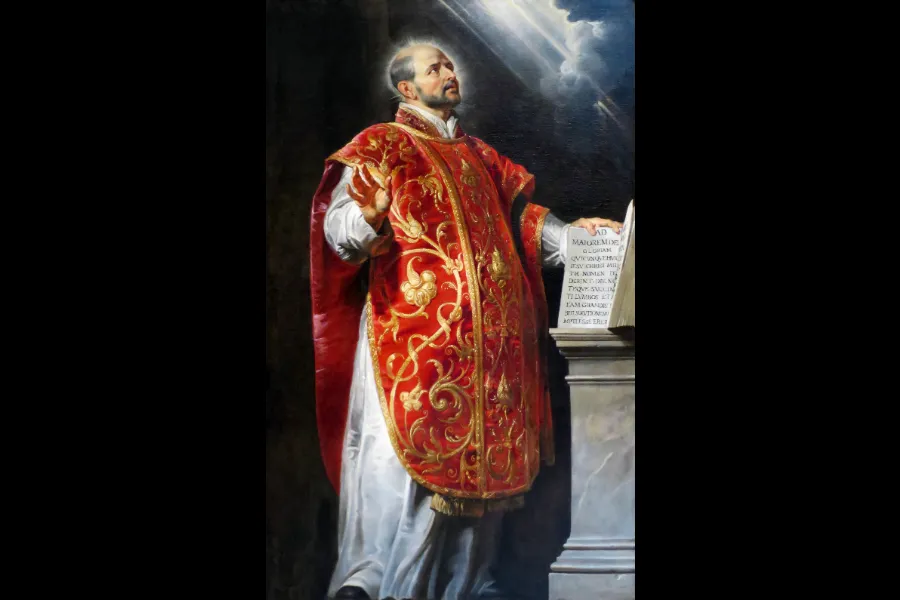
He explained that discernment is something St. Ignatius of Loyola, founder of the Society of Jesus, emphasized profoundly in his Spiritual Exercises, which form the “backbone” of Jesuit spirituality.
In fact, St. Ignatius twice in the spiritual exercises has an extended discourse on how to carry out discernment properly: what it means, what its limitations are, and the rules that govern it.
“One of the things that’s very interesting about discernment is that while it does have a very polyvalent meaning, you can usually presume that when a Jesuit uses the term, when they launch it, it has these rules at least playing the background in their mind,” Reedy said.
So when it comes to Jesuits and discernment, what are the governing rules, and how can we use them to understand Pope Francis?
Rules of Ignatian discernment
One of the first things to keep in mind when it comes to discernment is St. Ignatius’ distinction between categories of people, Fr. Reedy said, explaining there are different rules for people take the faith seriously, and those who do not.
“If you are somebody who is living a life where God is not really on the scene and the teachings of the Church aren’t really important you have one set of rules. But the reverse situation for somebody who does take their faith life very seriously and God is at least sought after … then we have a completely different set of rules,” he said.
Another distinction, he said, is between proper and improper objects of discernment, meaning that “some things you can discern and other things you can’t.”
When it comes to the current discussion on marriage, Fr. Reedy noted that in his spiritual exercises, St. Ignatius himself speaks specifically about discerning marriage after you have contracted marriage “as an example of one of the things you can’t legitimately discern.”
This, he said, is because “after you are married, you can no longer legitimately discern being married or not, because you’ve made the decision; it’s not a proper object.”
What can be discerned, by a tribunal, is whether or not the marriage is valid.
“That’s a different question than discerning whether you want to be in a marriage still,” Fr. Reedy said. “For Ignatius that question doesn’t make any sense; in fact, it’s offensive to the process that you would discern changing a state of life that you have already committed yourself to.”
The same thing goes for priesthood and the religious life, he said, explaining that St. Ignatius uses that example because “once you’ve made that commitment, what you discern is how to live the commitment.”
“That’s what you would actually be discerning, because discernment is, fundamentally in Jesuit spirituality, the application of doctrine and teaching to the practical applications in somebody’s life. So it’s making practical that which is theoretical.”
There are then certain “guiding rules” that help in the carrying out of proper discernment.
One of St. Ignatius’ rules Fr. Reedy cited is that sin can never be discerned, using the example of committing murder.
“You can’t discern to murder,” he said. “In fact, it’s offensive to the process that you are pretending to discern choosing an absolute evil.”
What can be legitimately discerned is whether or not to kill, because “if you and your family were under immediate threat from somebody, then the father could in the moment discern whether it was possible for him to take lethal action. That’s permitted.”
In terms of Catholic moral theology, Fr. Reedy said it exists between the camp of what is “permitted” and what is “transformative,” and that beyond the permitted sign lies what is “forbidden.”
Things that are forbidden cannot be discerned, and “you only ask to be free from them,” he said. From there, the spectrum goes from what is simply permissible on one side, all the way to what is deeply transformative and engages the world like Christ on the other.
“In that realm, between what is permitted to what is transformative, there’s a lot of discernment of legitimate possibilities of things that are not against reason or against God or the Church,” he said, adding that one can never really discern between good and evil, but “only between relative goods.”
One key rule of discernment that is often forgotten is the guiding principle of “thinking with the Church,” Fr. Reedy said. This means that “whatever you discern, you’re not only thinking about the moral law and how that functions, but also specifically thinking with the Church.”
Francis is a man ‘steeped’ in Jesuit tradition
Pope Francis “is completely steeped in Jesuit tradition and is a man completely of the exercises,” Fr. Reedy said, explaining that one of the first things he tells people when he speaks about the Pope is that “you can hear the spiritual exercises active in what he says.”
In listening to Pope Francis “you can hear a Jesuit who has contemplated the life of Jesus,” the priest said, noting that Francis’ pedagogical or didactic style “is very much patterned on Jesus’, who often gave very oblique and obscure answers to questions.”
Christ did this, he said, “to specifically avoid a kind of legalism that just wants a solid answer that can then be manipulated in some way,” whereas true discernment means “you’re not interested in rules for the sake of rules, (or) tools that can be manipulated or used as weapons; what you’re interested in is finding the best, the truest, the most holy, the most transformative.”
In essence, “you’re always looking for what is the spirit of the law: why does the law exist, what it is, what is it trying to do?”
What can be done is to “have people trained in what the rules are, why they exist, and how to help these people engage that system in a way that can contribute toward their holiness, to their growth in conforming to Christ.”
Fr. Reedy said that for him, one problem he sees in the Church right now is that some people, in their interpretation of the Pope’s actions, are “trying to put on the table, calling under the umbrella of discernment, the actual consideration of sins, of evils.”
“I’ve never gotten the sense that that is what Francis is saying,” he reflected, explaining that in his view, given Francis’ background, what he is is trying to do is to “train people in this: in the proper camp of moral reasoning, which extends from permitted all the way to transformative, how to help people function there in a way that can be messy, but also prevent them from crossing the line into what is forbidden.”
But what about Francis’ ambiguity? Is that a Jesuit thing?
Part of the confusion surrounding Pope Francis’ sayings and writings is that his language can frequently be ambiguous and imprecise, leaving people scratching their heads trying to figure out what he actually meant.
But for Fr. Reedy, this isn’t a Jesuit quality so much as it is a personal limitation of the Vicar of Christ.
“Francis is a complicated character. He’s not a precise theologian, so I think some of the ambiguity and imprecision just comes from his own training and background, which the Church just has to be patient with,” he said.
Secondly, the priest said that if we reflect on scripture, we see that the Pope uses a style that is very similar to what Christ himself often used, especially when he senses a “Pharisaical attitude.”
“When he senses that somebody’s asking a question in order to pin something down in a way he fears is going to hurt somebody else” Francis gets obscure, he said, explaining that the Pope is “very sensitive” to having doctrine “turned into a weapon of sorts.”
And so was Christ, he said, noting that “Jesus had very harsh words for those people.” Even though the Pharisees were technically faithful, upstanding Jews, “they also had a problem in the way that the viewed law; they saw the law first and the needs of the people second, and Jesus challenged that and so is Pope Francis.”
“I think people should stop pretending that Jesus was crystal-clear when he said things all the time,” Fr. Reedy said, noted that Christ “specifically said at times that he was intentionally being confusing. He would say that he was using parables so those other people over there wouldn’t understand – he would say that.”
However, even though Christ could at times speak cryptically, he was clear when pressed on important topics, such as the Eucharist and the meaning behind his words “this is my body,” and that to enter eternal life his disciples must “eat my flesh and drink my blood.”
So when it comes to Pope Francis, Fr. Reedy said people have to take into account “the Jesus-like way he teaches,” which he said is often at play in the Pope’s speeches.
But there is also an element of manipulation when it comes to the Pope’s ambiguity which must be addressed.
“I think (the Pope’s) ambiguity is being manipulated,” Fr. Reedy said, explaining that in these cases, “I think we need to continue to push for greater clarity.”
This doesn’t mean we’ll get the clarity immediately, he said, but when it comes to particularly problematic issues “we need clarity. We need a line to be drawn saying we’re not talking about Catholic divorce.”
This isn’t referring to somebody “who was in a valid marriage just rupturing that marriage, pretending it’s dissolvable against the explicit words of Jesus, and just starting a new one and saying that’s okay.”
“We’re not talking about that … I don’t think we are, I don’t think the Pope is,” he said, because if we look to the rules of discernment of St. Ignatius of Loyola, “I don’t think we can legitimately discern that.”
“So I’m confident that that’s not what the Pope is saying and I think that we should continue to ask for clarity, but not rush to clarity so that we can feel good about ourselves.”
What is needed, he said, is “to defend the truth so that we can become good.”
 […]
[…]






A sad event for an outstanding witness to innocent life. At times an act of presumed compassion can offend justice, as it seems here. The tension between compassion and justice in its current application is dividing the Church. For the Church and world the balance is uniquely found in the words of Christ.
It’s too bad the journalist didn’t consider it important to ask or answer the question of why the pardon was issued. That makes all the difference in the world.
You raise the issue I too thought of. Taking her words in consideration, “I decided in favor of clemency in April of last year in the belief that the convict did not abuse the vulnerability of the children entrusted to him”, Katalin Novák may have had further information as frequently happens in such cases, such as hysteria, when abuse incites others to make exaggerated accusations. The ‘convict’ person who sought to change their testimony was not the director found guilty of sexual abuse.
Novak was a champion of the innocent, but not the sexual predator. I feel that Hungry’s autocratic PM Viktor Orban had a hand in her decision.
“On Feb. 8, two days before Novák’s resignation, Orbán had announced via his Facebook page that he had submitted a constitutional amendment on behalf of his government, making it impossible to pardon the perpetrator of a crime committed against minors”. Interestingly, any US President can pardon any criminal without cause. History doesn’t bode will for Orban.
During his FOURTH term in office Orbán’s march toward autocratic rule had been largely unopposed—at least publicly—by the leaders of the other national parties that with Fidesz made up the European People’s Party (EPP). Moreover, his increasing overtures to Russia’s Vladimir Putin did not sit well with some of Orbán’s EPP colleagues.
After winning Hungary’s 2010 election, prime minister Orban systematically dismantled the country’s democracy – undermining the basic fairness of elections, packing the courts with cronies, and taking control of more than 90 percent of the country’s media outlets. He has openly described his form of government as “illiberal democracy,”
Amazingly, our democratic form of government will face something similar in the 2024 presidential election!
I ask, how does the church view Viktor Orban and the future of Hungary and the domestic threat to our precious democracy in 2024?
God save our constitition.
“Amazingly, our democratic form of government will face something similar in the 2024 presidential election!”
No, it actually will face no such thing.
Oh? (autocratic)
I will be a dictator on day one.
I want absolute immunity, even though I did nothing wrong.
I will expand the power of the presidency.
I will clean house in the DOJ (FBI), DOD.
I will remove the US from NATO.
I expect Pence will do the right thing, or I won’t like him so much.
I am your retribution. Go home in peace, we love you, I know your pain
I will supress any nonviolent gatherings by using the military. (Marshall law).
I think Hitler did some good. I never read Mien kampf.
I see Putin, Xe and Un as brilliant men
I want to know where Nikki’s husband is? Michael Haley is a major in the South Carolina Army National Guard, which he joined in 2006. This upcoming tour in support of U.S. Africa Command marks his second active-duty overseas deployment. WOW!
And there is so much more exteme idiocy.
Hope this helps. God bless.
Oh! Don’t mention my name for fear of retrubition against my family!
Well Morgan, I wish we did have someone like Mr. Orban to choose from in our coming election but I guess we’ll just have to do the best we can with what’s available.
I don’t expect the current candidate choices will look the same by November but who knows?
Mscracker. Please read the following I clipped and reply.
Former U.S. President and Republican presidential candidate Donald Trump speaks during the National Rifle Association (NRA) Presidential Forum at the Pennsylvania Farm Show Complex & Expo Center, in Harrisburg, Pennsylvania, U.S., February 9, 2024. REUTERS/Leah Millis.
BRUSSELS, Feb 12 (Reuters) – Former U.S. President Donald Trump raised a storm of criticism from the White House and top Western officials for suggesting he would “NOT DEFEND NATO allies who failed to spend enough on defense and would even ENCOURAGE RUSSIA to attack them”.
Add to that Trump’s tirade during his tenure demeaning our WWII heroes who died in combat “they are suckers and losers”. Imagine from a man who spent not an hour in the service of his country. Instead, he cowered behind a “heel spur” as reason for not serving!!!
Orban is traitor light.
Trump is a mentally deranged tyrant!