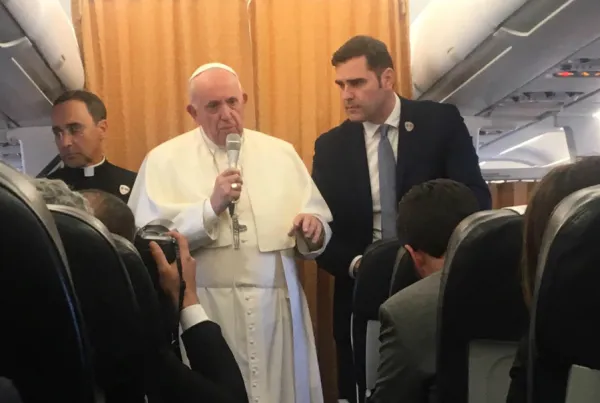
Aboard the papal plane, May 7, 2019 / 04:30 pm (CNA).- Please read below for CNA’s full transcript of the pope’s May 7 in-flight press conference from Skopje, North Macedonia to Rome:
Alessandro Gisotti:
Good evening Holy Father, thank you after such intense days for being here to share a thought about this journey that was so intense and so beautiful. A short trip, inevitably a short press conference, I will not add words other than these: Holy Father you have already walked in the footsteps of Mother Teresa, a great witness of Christian love, and we have all been struck today, as you know it, by the death of Jean Vanier, another friend, brother of the least of these, another great witness. Here, before the questions I wanted to ask if you wanted to share a thought about Jean Vanier.
Pope Francis:
Yes, I knew of the illness of Jean Vanier. His sister, Geneviève Jeanningros, informed me on a regular basis. One week ago, I called him on the phone, he listened to me, but could hardly speak. I would like to express my gratitude for this testimony. He was a man who knew how to read the Christian existence from the mystery of death on the cross of illness, from the mystery of those who are despised and rejected in the world. He worked, not only for the least of these, but also for those who before birth face the possibility of being sentenced to death. He spent his life like this. I am simply thankful to him and thankful to God for giving us this man with a great witness.
Gisotti:
Thank you, Holy Father, the first question will be from Biljana Zherevska of TV Macedonia.
Biljana Zherevska, MRT: [In English] Your Holiness, it is a great pleasure to have you in our country. We feel honored by your visit. What is interesting for us is to hear from you what is your greatest impression from the two countries, what touched you the most? The persons, objects, atmosphere. What will you remember of these two countries when you go [back] to the Holy See?
Pope Francis: They are two totally diverse nations. Bulgaria is a nation of a tradition from centuries ago. Macedonia, on the other hand, has a tradition from centuries, but not as a country: as a people, that ultimately rose to form as a nation… It is a beautiful fight! For us Christians Macedonia is a symbol of the entrance of Christianity in the East. Christianity entered in the East through you all.. those Macedonians that appeared to Paul in a dream: “come to us, come to us.” He was leaving for Asia, it is a mystery that call… And the Macedonian people are proud of this, they do not lose the opportunity to say that Christianity entered Europe through us, through our door, because Paul was called by a Macedonian.
Bulgaria has had to fight so much for its identity as a nation. The mere fact that in the 1800s, I believe 1823, more or less, 200,000 Russian soldiers died to regain independence from the hands of the Turks … we think of what 200,000 means. So much struggle for independence, so much blood, so much mystique to find consolidation of identity.
Macedonia had the identity and now it has come to consolidate it as a people, with small, big problems, like its name, and this we all know. Both have Christian, Orthodox, Catholic and Muslim communities. The percentage of Orthodox is very strong in both with a small amount of Muslims and even fewer Catholics, in Macedonia more so than Bulgaria. A thing I saw in both nations is the good relationship between the different faiths. In Bulgaria we saw it in the prayer for peace. This is a normal and beautiful thing for Bulgarians, because they have a good relationship, each person has the right to express his own religion and has the right to be respected. This touched me. Then the dialogue with Patriarch Neophyte was a beauty… he is a man of God, a great man of God. In Macedonia I was struck by a phrase the president told me: “Here there is not religious tolerance, there is respect.” They have respect. In a world like this respect is missed very much. Respect for human rights, we miss respect for so many things, respect for children, for the elderly, that the mystique of a country would be respect is striking. I do not know if I answered more or less briefly.
Gisotti:
Holy Father, the next question will be asked by Peter Nanev from Bulgarian television.
Peter Nanev, BTV: Good evening. Peter Nanev, BTV Bulgaria. [In English] It is more of a personal question, as Your Holiness, you’re like a human being, from where do you find strength in your body, in your spirit in cases when you have to give even more strength for a heavily sick child?
Pope Francis: First of all I would like to tell you that I do not go to the witch… [laughs]. I do not know. I do not know, really. It is a gift from the Lord. When I am in a country, I forget everything, but not because I want to forget it, I forget it, and I am only there. And then this gives me perseverance, I don’t know, but [when] I am on the trip I am not tired! Then I am tired! After! But where do I take the strength from? I believe that the Lord gives it to me, there is no explanation. I ask the Lord to be faithful, to serve him in this work of travels, that the trip will not be tourism. I ask. All is his grace. Nothing else comes to me to say. But then I do not do so much work, huh? Thank you.
Gisotti:
He will now address a question. We remain in Eastern Europe, Silvije Tomasevic of Croatian press and television, Vecernij List.
Silvije Tomasevic, Vecernij List: The national Orthodox Churches are not always in agreement among them, for example, they have not recognized the Macedonian Church. But when they have to criticise the Catholic Church they are always in unison, for example the Serbian Church does not want Cardinal Stepinac to be canonized. Your comment on this situation?
Pope Francis: In general, the relationships are good, they are good and there is good will. I can tell you sincerely that I have met men of God among the patriarchs. Neophyte is a man of God, and then him that I carry in my heart, a favorite, Ilia II of Georgia is a man of God, that has been good to me, Bartholomew is a man of God, Kirill is a man of God. They are great patriarchs that give witness. You can tell me. But everyone, we have defects. Everyone. But in the patriarchs I have found brothers and some… I do not want to exaggerate, but I would like to say the word ‘saints’ and this is important.
Then there are historic things between our Churches, some old things, for example today the president was saying to me that the Eastern schism began here in Macedonia.
Now the pope comes for the first time, to mend the schism I do not know, but to say we are brothers, because we cannot adore the Holy Trinity without hands united as brothers. This is not only my conviction, also the patriarchs’, everyone.
Then there is a historic world… you are Croatian? It was seeming to me I sensed the aroma of Croatia. The canonization of Stepinac is a historic case. He is a virtuous man for this Church, which has proclaimed him Blessed, you can pray [through his intercession]. But at a certain moment of the canonization process there are unclear points, historic points, and I should sign the canonization, it is my responsibility, I prayed, I reflected, I asked advice, and I saw that I should ask Irenej, a great patriarch, for help. We made a historic commission together and we worked together, and both Irenej and I are interested in the truth. Who is helped by a declaration of sanctity if the truth is not clear? We know that [Stepinac] was a good man, but to make this step I looked for the help of Irenej and they are studying. First of all the commission was set up and gave its opinion. They are studying other sources, deepening some points so that the truth is clear. I am not afraid of the truth, I am not afraid. I am afraid of the judgment of God.
Gisotti: There is time for another question. Joshua McElwee.
Josh McElwee, National Catholic Reporter: Thank you so much, Holy Father. In Bulgaria you visited an Orthodox community that has continued a long tradition of ordaining women deacons. In a few days you will meet with the International Union of Superiors General*, that three years ago requested a commision for women deacons. Can you tell us something you have learned from the report of the commission on the ministry of women in the early years of the Church? Have you made some decision?
Pope Francis: I did not hear the first part of your question.
McElwee: [repeats a part of the question.]
Pope Francis: The commission was made, it worked for almost two years. They were all different, all toads from different wells, all thinking differently, but they worked together and were in agreement until a certain point. But each of them then has her own view that does not agree with that of the others. And there they stopped as a commission and each is studying [how] to go forward.
For the female diaconate, there is a way to imagine it with a different view from the male diaconate. For example, the formulas of female deacon ordination found until now, according to the commission, are not the same for the ordination of a male deacon and are more similar to what today would be the abbatial blessing of an abbess. This is the answer of some of them. I’m speaking a little from the ear, from memory.
Others say that it is a female deacon formula, but they argue that it is not clear. There were female deacons, but was it a sacramental ordination or not? And that is discussed, it is not clear. That they helped in liturgy, in Baptisms by immersion, when the woman was baptized the deaconesses helped, also for [unclear] the woman’s body. Then a document came out where diaconesses were called by the bishop when there was a matrimonial argument for the dissolution of the marriage or divorce or separation. When the woman accused her husband of beating her and the bishop called the deaconesses to look at the woman’s body for the bruises and so they testified in the judgment. These are the things I remember.
But fundamentally, there is no certainty that it was an ordination with the same form, in the same purpose as male ordination. Some say there is doubt, let’s go ahead and study. I am not afraid of studying, but up to this moment it does not proceed.
Then it is curious that where there were deaconesses it was almost always a geographic zone, especially in Syria. And then in another part, it does not touch or nothing. All these things I received from the commission. Each one continues to study, and [they have] done a good job, because up to a certain point [they were] in agreement. And this can be an impetus to go ahead and study and give a definitive answer, yes or no, according to the characteristics of that time.
An interesting thing. Some theologians of a few years ago, 30 years ago for example, said that there were no deaconesses because women were in the background in the Church, not only in the Church. Always women… But it is a curious thing: in that period there were so many pagan priestesses, the female priesthood in pagan cults was ordinary in that day. As it is understood as a female priesthood, a pagan priesthood in women, it was not done in Christianity. This is being studied also. They have arrived at a point, now each of the members is studying according to her theory. This is good. Varietas delectat.
Gisotti: Holy Father, thank you for your availability. The press conference finishes here, at this point, because in a little while they will serve the dinner. And so, thank you to you all. Especially during this trip when we woke up at night to move [from place to place].
Pope Francis: I would like to say one thing about the trip: Something I found much consolation in and which has touched me profoundly during the trip. Two extreme experiences. The experience with the poor today here in Macedonia at the Mother Teresa Memorial. There were so many poor people, but to see the meekness of those sisters: they were caring for the poor without paternalism, but as children. But a meekness, the ability to caress the poor, the tenderness of these sisters. Today, we are used to insulting each other. One politician insults the other, one neighbor insults the other, even in families they insult each other. I cannot say that it is a culture of insult, but the insult is a weapon in the hand, even to speak ill of others, slander, defamation, and to see these sisters that care for every person as Jesus. It hit me, a good young man approached and the superior told me, ‘this is a good boy’ and caressed him and she said it with the tenderness of a mom and made me feel the Church a mother. It is one of the most beautiful things to feel the maternity of the Church. Today I felt it there.
I thank Macedonia for having this [inaudible]. Another extreme experience was the First Communion in Bulgaria. I was moved because my memory went back to October 8, 1944, to my First Communion, when they sang [the hymn] ‘O santo altare custodito dagli angeli’ (who here remembers it?), I saw those children that open themselves to life with a sacramental decision. The Church guards the children, they are limited, they have to grow, I am promised, and I lived it very strongly, I felt in that moment those 249 children were the future of the Church, they were the future of Bulgaria. These are two things that I lived with much intensity I wanted to communicate. Thank you very much, pray for me. I do not want to leave without speaking about these days, the centenary of trips. They are roses from Bulgaria, a small thought to mark the 100th trip.
They tell us that now there will be whiskey.
 […]
[…]






When Bergoglio opens his mouth, confusion pours out. It seems beyond him to speak clearly, concisely, and with power what is and what is not sin. More importantly, when he gets wand up in this side issues, the centrality of Jesus Christ crucified and resurrected is lost; he is excluded from the conversation. I view that as the first sign that when Christ is flagrantly ignored, then evil is afoot.
Saints protect us and may the will of God be done.
The name is not Bergoglio, it’s Pope Francis. You violate the fundamental truth, respect and devotion that is owed to him and his office. Just because we are not used to the ways of this pontificate, that does not mean his is wrong. Nor does it mean that he ceases to be Christ’s vicar and one moved by the Spirit of God. Please pray to Mary for insight into Pope Francis. I truly believe that Pope Francis will be vindicated in the years to come.
Please. His blatant heresies, which are numerous, are not simply idiosyncratic “ways of his pontificate”. And the support he has given for crimes against humanity entitle any observer to disrespect him as a man no matter what his status or title he holds inside or outside the Church.
Given the strongly encouraging trend that the priesthood is becoming more “conservative”, i.e., orthodox with each incoming generation, it is quite likely that someday Bergoglioism will be defined as a heresy and anathemized by either a future Supreme Pontiff or Ecumenical Council. Pope Francis is our first bad pope in something like two centuries so it’s really hard for ultramontanists to recognize the evidence. Of course, he is very machiavellian, so that helps him hide the hypocrisy behind a pastoral facade.
Patrice: We pray for Bergoglio whenever we attend Holy Mass.
Amen, sister, and Amen.
Pictured. El Hombre Jorge in his former cantina bouncer mode [prior to the ferments] exhorting a wainful Card Parolin. Now the cardinal perceives these ferments [useful deprecation for outrages] as deserving attention. Even the previously thought progressive African Card Ambongo issues a sharply worded rebuke.
What next? Who would have thought at the Vatican war room that for a change ballistic missiles would be incoming. Dare there be papal investigations like at Tyler and oustings. Likely not. Too messy. Expect lots of platitudes, thoughtful observations.
Africans en masse, handfuls of Europeans and Americans, armfuls of S Americans and Asians are prepared for battle, commander Ambongo holding high the dreadful banner “We bless people, not sin”.
However we may agree that FS is a well crafted document completely in line with tradition, as Fr Robert Gahl assoc Prof Ethics at the Pontifical U of the Holy Cross in Rome would argue, it nevertheless is read by the majority world audience that Fiducia is an approbation of homosexual relationships [as Fr Gahl also agrees]. Why, if so well crafted? Aquinas correctly held as a major premise that it’s the act that determines its morality not the intent per se. People generally perceive the act as determinative, in this instance the act of blessing as affirmative of homosexuality, whether as a double blind, as explained below by Anna, for good or for evil.
Father, with all do respect, paragraph 25 that insults the a pastoral approach informed by the application of doctrine as necessarily the product of elitist narcissism is in line with tradition?
Edward, I’m quoting Fr Gahl on his assessment of FS, not my approval. FS is filled with double meaning, or what psychology terms as double blind comments. “Thus, when people ask for a blessing, an exhaustive moral analysis should not be placed as a precondition for conferring it” (FS 25).
This can be interpreted as either making little of no precondition or going too far in examining the request. So if the texts are read positively as Fr Gahl implies, it would be considered acceptable. I would not because of the seeming purposeful double blind wording. But hasn’t that been a modus operandi of this pontificate?
That so many clergy, priests and bishops are interpreting the texts as a green light to bless unrepentant deviants is consistent with the early interpretations of Amoris Laetitia, which virtually all bishops and cardinals inclusive of conservatives believed the texts including ch 8 were theologically orthodox. It wasn’t until opposite, well thought out opinions appeared that the same approving prelates reread the texts more intelligently and came to opposite conclusions regarding their previous assessment. Nevertheless, even if the wording was perfectly clear and orthodox the act itself of blessing would be interpreted as an endorsement of homosexual relationships.
Edward. The double blind is seen in the previous sentence of FS 25, “instead of opening the door to grace, one exhausts his or her energies in inspecting and verifying”, which suggests the priest forgo interrogation and simply offer a needed blessing. Although if I confer the blessing for that need I’m also blessing a homosexual relationship. Now it must also be understood Edward that there is no canon law requirement that I should interrogate any and all who ask for a blessing. I do not ask, Are you homosexuals?, or are you adulterers?, and so forth. I don’t do impromptu inquisitions. I examine persons when appropriate in the process of reconciliation. If I were to enquire, the persons would have to be known, or give indication of irregular behavior. Not a facile task and certainly a delicate one.
Correction: I meant a double bind, not blind. A double bind in psychology is a dilemma in communication in which an individual or group receives two or more reciprocally conflicting messages. For example, the proposition in FS that we may bless a couple as persons rather than their homosexual behavior, actually contains two conflicting messages. 1. That you may bless two persons only. 2. That in doing 1, you also bless two homosexuals living together.
A double blind in psychology is when neither the examiner nor the two participants are aware of who is being tested.
Among other questionable items, Cardinal Fernandez published an account of his erotic conversation with a 16 year old girl. It’s going to be difficult for the DDF to operate under the leadership of a man who needs to be investigated as a child predator.
Looks like Pope Francis is testing himself, not the sinners, to see how far he can fall?
““This document has aroused very strong reactions; this means that a very delicate, very sensitive point has been touched; it will take further investigation,” Cardinal Parolin said on Friday, Jan. 12 during a conference held at the Accademia dei Lincei in Rome.”
This is a fine example of the real evil that feeds the current situation and has been feeding other similar situations. Blessing homosexual couples (unions, whatever) came as a result of the use of murky and deceitful language when speaking of God’s matters.
What we have here: cardinal Parolin states that the reason for “very strong reactions” to ‘FS’ is that it “touched a very sensitive point”. No, it is not the real reason. The real reason “for very strong reactions” is that ‘FS’ is heretical, contrary to our faith and God’s design. People react strongly not because they are “homophobes” or “latent homosexuals” or “sensitive” but because they know the apostolic teaching on the particular matter which ‘FS’ violates. A heresy coming from Vatican is shocking indeed. Could anyone imagine apostle Paul blessing “a homosexual couple”? – If not then it is the end of the story and a heresy must be called plainly “a heresy”.
However, it appears to be difficult to do so for many because the document in question is so well crafted. ‘FS’ sets a double bind: we bless a couple but without approving their activity together. “A double bind” in psychology is a term for two contradictory messages given simultaneously, one cancels another so a mind is trapped (a double mind is believed to be responsible for some mental disorders). “They bless a homosexual couple” – “they do not approve it” sounds like madness so those who are pro- such blessings embrace the first part while those who are against them are supposed to embrace the second part – and some manage to embrace both, including some priests. The solution here is to ask “if the Church already blessed homosexual persons before why do we need a new document?” The response is usually “but not a couple” and then a person gives a blind stare; there is hope for them waking up and seeing for what purpose ‘FS’ was written. Or not.
I was told by a good Roman Catholic priest that to become holy means “to become a whole person”, in Christ. Clearly the force which is growing within the Church now is the vector opposite to becoming a whole person or whole Church but towards the disintegration of the persons making a disintegrated anti-church, with its peculiar documents, language and so on.
“This document has aroused very strong reactions; this means that a very delicate, very sensitive point has been touched; it will take further investigation.”
“Sensitive point”? “Investigation”? But wait, we did both steps . . . we spoke unilaterally and now are counting “one, two, three”!
Meanwhile, is (endangered?) Cardinal Fernandez either wising up or standing down? “I must say that I don’t think I will be in the news in the foreseeable future because in the dicastery we don’t foresee topics that could be very controversial, like the last ones.” The last line in: https://www.ncregister.com/news/vatican-s-doctrinal-office-preparing-very-important-document-on-human-dignity-cardinal-fernandez-says
About the universal scourge of siloed BUREAUCRACY, and worse, might we suppose that the Vatican might convene at least a few cardinals in the same room at the same time and with the same and living Magisterium in mind? Beginning to “listen” with both ears?
Such an “investigation” (visitation?) is very HEARTENING of course. And, hopefully even part of a trend, given the recent warning issued by the same Cardinal Parolin and Pope Francis to Germania (with mention of possible excommunication) to stand down on female ordinations or any Anglican-style perpetual synodalish thingy. https://www.catholicworldreport.com/2023/11/24/vatican-draws-line-on-womens-ordination-and-homosexuality-in-new-letter-to-german-bishops/
Sometimes and over the long term, the Holy Spirit “writes straight [double entendre intended] with crooked lines.” Might the next conclave even elect an African as the next pope? These are Apostolic times, and the 5th-century St. Augustine was a Berber from North Africa.
I believe we’ve had at least two African popes in the past and many African saints.
God bless Africa.
The pope says “We bless people,not sin.” Really? It sure doesn’t look like that to the rest of the world. It is one thing to bless an individual, separate and apart from others. It is quite another thing to bless couples, two people together at once, who deliberately embrace and celebrate a sinful lifestyle.
The “bless people, not sin” phrase fails. The couple heading for an abortion want a blessing before the premeditated murder. The two teens want a blessing before committing sodomy. The mafia hit-couple want a blessing before the kill. The boss and secretary want a blessing before committing adultery. In each case, the priest has been asked for the blessing and it is self-evident that the couple are going to do the sin. Yet, the Pope is saying, “bless the people, not the sin” … and keep it under 15 seconds!
Theater of Pontiff Francis: the Secretary of State, played by Eminence Parolin, takes the stage to “groom” the faithful with “diplo-prop.”
Perhaps a “secret accord” confected by the “ever-so-faithful-Secretariat-of-State-bureaucracy” can satisfy this “delicate” situation.
Yes, Yes says “the-monarch-Pontiff” Francis: “a man of delicacy” is “our man” for “this our moment.”
Here is a “non-diplomatic dispatch,” from a “a non-delicate” apostle, who died for the Gospel, rather than “hand-it-over” to the empire: “Woe to you if you do not preach the Gospel…. If for this life only you have hoped in Christ, you are of all men most to be pitied.”
And the last word to “The Pontiff Francis Players” is from The Man Crucified by the empire: “You cannot serve both God and Mammon.”
Good explanation of “double bind.” It perfectly explains Fiducia Supplicans and every statement and document that has come from this confused papacy: a papacy—which by now should be evident– is intentionally contradicting 2,000 years of Christ’s revealed truth and scandalizing the world! But they try to cover their rear ends and hoodwink the faithful with double-speak, nonsensical documents like Fiducia Supplicans.
Parolin has a convincing grasp of the obvious. Christs Catholic Church is being “governed” by complete idiots. And we’re being played for fools by agents of Satan. God, please help us.
“This document has aroused very strong reactions; this means that a very delicate, very sensitive point has been touched; it will take further investigation” …
It will take further revocation.
In 1966 the bishops removed the requirement to abstain from meat on Friday. However, there was a Part B: Catholics were highly encouraged to continue some form of penance on Friday. But what we heard was “Whoo-hoo, hamburgers on Friday!” When, if ever, did you hear a priest mention Part B? And at the moment Catholics/non-Catholics are hearing “Whoo-hoo, the Catholic Church approves of same sex relationships, and soon same sex couples will be able to get married in the Church.” And the corollary is “If the Church changed this teaching, then it can change anything.” Women priests, birth control, abortion, sex outside of marriage (well, that is now a given), euthanasia, pornography, etc. are now all on the table.
I think the teaching on birth control/contraception has already been de facto changed, and that is a large part of the reason we are where we are.
The point it touched is note other than the rejection of Sacred Scripture, the Apostolic Tradition and the perennial Magisterium by a reigning pontiff. Cardinal “China” has the temerity to sell Chinese Catholics into the hands of genocidal maniacs but he can’t challenge “the boss.”
We are led by faithless morons and cowards.
The problem is that Cardinal Parolin and his Vatican pals love having a “very sensitive point” touched.
That is the truth, as we are counseled by the Secretary-of-Paradigm-Shift, that his “apparatus” is fostering a shift, which we can all now recognize is away from Jesus and his apostles, to a new paradigm, and “this their reset” requires diplomacy…to “pull it all off.”
Nausea! Eternally wrong if one believes two people pleasuring themselves physically is love. It’s selfish thrill. No bond. Many involved. Such would be the consequences of surruptitously giving the green light through tangential blessings. Am afraid the cat’s out of the bag now. Time will tell. Always does. Then it ends.