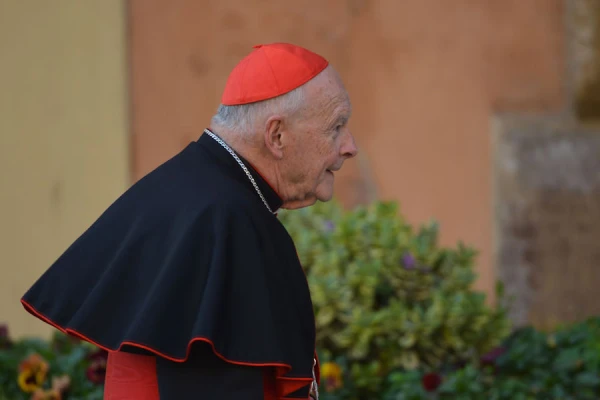
Vatican City, Nov 10, 2020 / 10:30 am (CNA).- The Vatican’s report on Theodore McCarrick released Tuesday includes a letter written by an American cardinal in 1999, who objected to McCarrick’s potential appointment to higher office, on the basis of existing allegations of misconduct, including incidents involving sharing a bed with seminarians at a New Jersey beach house.
On Oct. 28, 1999, Cardinal John O’Connor of New York wrote a letter to the U.S. apostolic nuncio, Archbishop Gabriel Montalvo, after the cardinal learned that McCarrick was under consideration to be appointed his successor as archbishop of New York. That letter was shared with Pope John Paul II shortly thereafter, the Vatican’s McCarrick Report states.
“With deep regret, I would have to express my own grave fears and those of authoritative witnesses cited above, that should Archbishop McCarrick be given higher responsibility in the United States, particularly if elevated to a Cardinatial See, seem[] sound reasons for believing that rumors and allegations about the past might surface with such an appointment, with the possibility of accompanying grave scandal and widespread adverse publicity,” O’Connor wrote.
He added that “while charity must prevail and the benefit of the doubt always given to the ‘accused,’ the good of souls and the reputation of the Church must be seriously considered and the potential for scandal given equally serious consideration.”
“I can not, therefore, in conscience, recommend His Excellency, Archbishop McCarrick for promotion to higher office, should this be the reason for your inquiry concerning him at this time. On the contrary, I regret that I would have to recommend very strongly against such promotion, particularly if to a Cardinatial See, including New York.”
O’Connor wrote in 1999 that authoritative sources had told him that stories about McCarrick frequently arranging for seminarians to visit a New Jersey beach house circulated in the dioceses of Newark and Metuchen, specifically that “the arrangement was for seven seminarians, six of whom shared the guestrooms and one of whom shared the bed with the Archbishop.”
He said that a key authority had informed him that he believed “that some problem did occur involving at least one person, perhaps a priest, and that Bishop Hughes handled that personally and secretly.”
O’Connor said that he had personally asked a priest psychologist of New York archdiocese to speak with the psychiatrist who was treating a priest involved.
“Both the priest psychologist and the psychiatrist seem convinced that the priests or priests (sic) in treatment were victimized, willingly or unwillingly, in their inappropriate relationship with the then Bishop McCarrick, while Bishop of Metuchen,” O’Connor wrote in the letter. He added that he did not find these findings “definitely persuasive,” but could not dismiss their findings “because of the gravity of the allegations.”
O’Connor also raised concerns about McCarrick’s “seemingly incessant need to travel outside of the archdiocese to different parts of the world,” saying that he questioned whether there could be “any relationship between this seeming need to travel outside the archdiocese and his apparently having put his former alleged inclinations behind him.”
Cardinal O’Connor led the Archdiocese of New York from 1984 until his death on May 3, 2000. He was a major figure of American Catholicism and an outspoken defender of the faith and Catholic moral teaching.
The report notes that O’Connor conducted “the first known inquiry related to concerns over McCarrick’s conduct.” In the early 1990s, O’Connor investigated anonymous complaints against McCarrick ahead of a potential papal visit to Newark. He concluded that allegations of possible misconduct with adults would not present an issue if the pope were to visit Newark.
In 1997, McCarrick was being considered to lead the Archdiocese of Chicago. While he was generally praised as a strong candidate, O’Connor questioned whether he would provide the “firmness necessary to ‘compensate’ for the prevailing permissiveness” following the tenure of Cardinal Joseph Bernardin, the report said. However, it added that O’Connor “admitted” that McCarrick could be effective in addressing theological abuses. McCarrick was ultimately not selected for the role.
The 1999 letter from O’Connor is included in the 449-page McCarrick Report on pages 131-140. The report indicates that “it is reasonable to infer” that Bishop James T. McHugh, the former auxiliary bishop of Newark, and Bishop Edward T. Hughes, the bishop emeritus of Metuchen, were O’Connor’s sources of information regarding these allegations.
O’Connor wrote that John Paul II had made clear to him in a meeting early in the summer of 1999 that he was considering appointing McCarrick to another diocese, potentially as O’Connor’s successor in New York.
After this, O’Connor expressed concern to the nuncio Montalvo in late July, saying that he was aware of “some elements of a moral nature that advised against” McCarrick’s consideration. Montalvo requested that O’Connor put his concerns in writing.
O’Connor’s letter is dated Oct. 28, only weeks after the cardinal’s release from hospital following surgery to remove a brain tumor. O’Connor died from this tumor the following May.
In the letter, O’Connor wrote that he was concerned by events related to him by “absolutely impeccable authorities as occurring in the Archdiocese of Newark during this past year.”
Among these is that “after Archbishop McCarrick was appointed as Ordinary, it was said that he would frequently invite male visitors for dinner and to stay overnight. Usually they shared a bed, although there were sufficient guestrooms … This did not become known outside the house, but it was a cause of concern for those who live there.”
Cardinal O’Connor also recommended to the nuncio several people that he could follow up with for further information regarding McCarrick, including Bishop McHugh and the attorney of the Archdiocese of Newark, Thomas Durkin, noting that the lawyer had “spoken with him [McCarrick] very forthrightly about rumors and allegations cited above.”
Upon receiving the letter, Montalvo forwarded it to the Congregation for Bishops and to the Secretariat of State. Archbishop Giovanni Battista Re, at that time the Substitute of the Secretariat of State, informed Pope John Paul II of Cardinal O’Connor’s letter, according to the report.
Montalvo left it to Re to “inform the Holy Father as to the matter in the manner you deem appropriate,” according to a handwritten note sent to Re.
O’Connor’s letter was sent the day after a letter sent by Nuncio Montalvo to the Congregation for Bishops describing Washington Cardinal James Aloysius Hickey’s endorsement of McCarrick as his first choice for the New York see, and acknowledging concern from Cardinal Bernard Francis Law that “vague allusions are enough to damage the position of a person.”
At the request of John Paul II, in response to the allegations recorded in O’Connor’s letter, separate but “substantively identical letters” were sent to Bishops Vincent Breen and Edward Hughes of Metuchen, Bishop James McHugh of Rockville Centre, and Bishop John Smith of Trenton on May 12, 2000, asking for the truth about McCarrick.
“Three of the four American bishops provided inaccurate and incomplete information to the Holy See regarding McCarrick’s sexual conduct with young adults,” the report concluded.
The bishops presenting false information were Hughes, Smith, and McHugh.
The letter of Bishop Hughes, who succeeded McCarrick in Metuchen, told the Holy See that: “I have no factual information that would clearly indicate any moral weakness on the part of Archbishop McCarrick.”
Hughes’ letter dismissed the accounts of some priests who had reported to him being molested or abused by McCarrick, even when, in one case, a psychologist affirmed that the priest had been McCarrick’s victim. Hughes noted moral lapses on the part of the priests accusing McCarrick, while dismissing their claims against the archbishop.
In fact, the bishop’s letter did not mention at all some incidents of sexual abuse or coercion that had been reported to him by Metuchen priests, according to the report.
While in O’Connor’s letter written months before, O’Connor wrote that Hughes, then bishop of Metuchen, had handled the problem by the New Jersey beach house “personally and secretly.”
O’Connor added: “I, myself, recall talking with Bishop Hughes by telephone very privately, regarding this same case, which did in fact involve at least one priest, and perhaps two. As I recall, both where (sic) in psychiatric treatment.”
Smith, who had been an auxiliary bishop in Newark, told the nuncio that “I have never heard anyone make a substantiated accusation of immoral behavior against Archbishop McCarrick nor have I any evidence of ‘serious moral weakness shown by Archbishop McCarrick.’”
But according to the report, Smith himself had in 1990 witnessed McCarrick groping the groin of a young cleric during a dinner with several officials from the archdiocese of Newark. Smith’s letter made no mention of that incident.
McHugh, then auxiliary bishop of Newark, was present at the same 1990 dinner and also saw the groping, but he wrote in his letter that he “never witnessed any improper behavior on the part of Archbishop McCarrick.”
The misinformation presented by those bishops was part of what may have informed Pope John Paul II’s decision to appoint McCarrick archbishop of Washington in November 2000, the report said.

[…]






As established by Christ, let’s do away with His call to action for evangelization.
Why, if the Church does not represent truth by way of the Deposit of Faith, then let’s form ‘moral’ people without an objective reference.
And continue to let China be ‘China’…body counts notwithstanding.
What has Francis wrought? A Christ-less Church. Maybe we ought to just concede and now call ourselves “unitarian-universalist” or “The Society of Ethical Culture.”
Good one. Following the trajectory of Fancis’ logic, both “evil” proselytizing (evangelization that accompliches its purpose) and evangelizing can be done away with since all future synods will enable all three Persons of the Trinity to permanenty settle into their well-earned retirement since the synods will now run the universe.
It will not be long before we have a CCP appointed prelate elevated to Pope. Francis is doing his best to bring it about.
Go forth and make disciples of all nations. Does he believe this?
That would be rigid or something.
The bishop is correct. Our mission is to bear witness to the Gospel while trusting that the Lord will help with the rest.
Which Gospel? The Lord’s or the CCP’s.
Does he even know what the actual Gospel is because if memory serves me right Jesus was quite clear that we must make disciples of all nations and that includes communist countries, baptising them in the name of the Father and of the Son and of the Holy Spirit.
This bishop/deludes himself
Considering he’s a cardinal-elect who was approved by atheists and the CCP – and that he has their blessing to do their bidding at the upcoming Synod Synoodle thing – I suppose he could have done worse. But, yes, that’s praising with faint damnation. He’s no Cardinal Joseph Zen by the remotest stretch of the imagination.
Will no one free us from these vexatious Bishops?
Francis’ reign of error continues unabated.
“without the agenda of turning them into Catholics”
Maybe we should have the agenda of turning this guy into a Catholic.
What? I had to read some of this twice. There is a huge difference between hammering people with dogma, striking fear in their hearts if they reject a “force feed” and sharing with joy the Truth in Love. Rightful evangelization declares the gift of Faith, the conveyance of Hope (eternal life with God, and the assurance of unconditional Love that embodies perfect justice and Divine Mercy. Catholicism is a fusion of all three and necessarily points to Jesus Christ as the way, the truth, and the life. Why would we hide our (the) lamp, or worse, deny there is one? Come Holy Spirit!
“Go forth and make acquaintances of all nations.”
An idiot with a red zucchetto is still an idiot.
You hit that right on the head.
But let’s not forget who put the red zuchetto on this idiot.
As a retired Pastor, our efforts to reach people groups for Jesus as the only true on God and Creator Savior of the Universe should be to preach Jesus and not some denominational citation. Jesus is not interested in greeting Methodists, Anglicans but born again Christians of all races, colors and faith in Him. Churches since the Reformation should have learned that.
Jesus did not establish denominations. He established one Holy, Catholic and Apostolic Church.
Read the history of Christianity beginning with the earliest accounts, the Church Fathers. The church founded by the apostles was not Protestant.
What happened in the 16th century was not a reformation but a revolution and a deformation. Had Luther not been terribly proud he would have been a force for good. But instead, hubris got in the way.
John Henry Newman was so right: to be deep in history is to cease to be Protestant.
And while you may eschew denominations, it all amounts to yourselves being the authority. Not the Bible. No, you are the authority as far as you are concerned. One could say that you are your own Pope.
And as we have free will, you are free to do that.
Do study the history of Christianity beyond the nailing of the 95 thesis all the way back to the 1st century.
Words like “Reformation”, “counter reformation” etc are vestature adopted by a desire to justify differences and the backlash from the establishment. Jesus was radical. He offered freedom to worship His Father without the mill-stone of heritage.
It could be said that the human condition, itself, is in a dynamic state of evolution. Within generations we see changes in attitudes and values. Jesus’ apostles had to iron out individual differences in opinions and interpretations to lay the foundations of the Church. When Thomas refused to believe, he was not chastised by Jesus, but, was offered a reason to believe. Today (unfortunately) there is no one Catholic and Apostolic Church. I could go further than that and say,”Thank God”.
Therefore, I believe that it is not hubris that divides us. But, a genuine desire to understand and worship God. We need to worship Him through a community – with a deep-seated personal devotion.
Christ established a church. And that aint the ever increasing number of denominstions and it aint your version either.
Read scripture and study history.
When people talk about Jesus they need to remember that He came to institute a New and Everlasting Covenant upon which the Catholic Church is founded. In the early years of the Church there was a need to establish the relationship between the Old and New Covenants, which started at the Council of Jerusalem. The coming of Jesus and His New and Everlasting Covenant were predicted in the Old Testament. The New Testament contains warnings to hold fast to the faith.
*
To me the Protestant Revolt/Reformation resembles the division of King Solomon’s kingdom because of his faithlessness in caving into his foreign wives. Martin Luther’s role was like that of Jeroboam, who was allowed to divide the kingdom to punish King Solomon for his worldly faithlessness. At the time of the Protestant Revolt/Reformation the Church hierarchy had fallen into worldly faithlessness similar to that of King Solomon when his heart was turned from God by his foreign wives.
Catholic bishops are obliged to teach the Catholic faith and make disciples of all nations. Reading between the lines, it should be obvious what a “code” message or “showing of true colors” is happening here.
“Reading between the lines”, I see a lot of blank space. Each of us exercises basic freedom to read “codes’ and “colours” where others may see nothing. God bless those with eyes to see!
But, when preceded by the desire to see all things as God sees them, we may unearth the valuable gem.
One can understand the distinction of proselytism; yet evangelization is about the love of God, good will, but its spiritual force is the preaching of the Good News for the salvation of souls, and ultimately the love of God as expressed in the Catholic Faith, as Christ founded. This is freedom. Not “restrictive.”