Vatican City, May 15, 2018 / 02:08 pm (CNA/EWTN News).- This week 34 Chilean bishops are meeting with Pope Francis to discuss the country’s clerical sexual abuse scandal, which involves at least one of the bishops attending the meeting. The meeting is significant, but not unprecedented.
Francis summoned Chile’s bishops to Rome in an April 8 letter admitting he had made “serious mistakes” in judgment of the nation’s abuse crisis, and which was a follow-up to the results of an in-depth investigation into accusations of abuse cover-up carried out by Maltese Archbishop Charles Scicluna, the Vatican’s top prosecutor on clerical abuse.
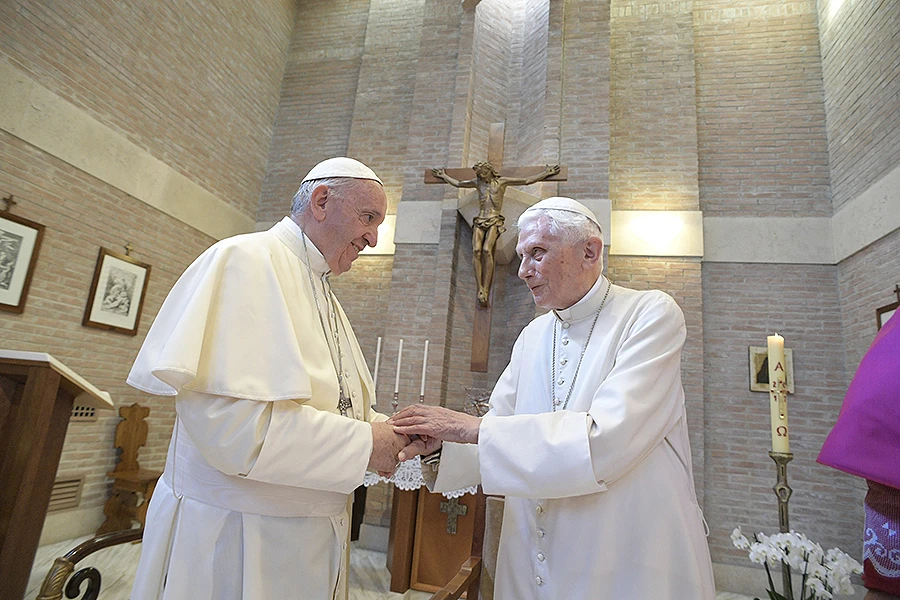
In April 2002, Pope St. John Paul II called 13 U.S. cardinals and bishops to discuss a large-scale clerical sexual abuse crisis. Benedict XVI followed suit when the abuse crisis in Ireland came to light in 2009, inviting high-ranking Irish prelates and members of the Roman Curia to meet at the Vatican in February 2010.
It is practically unheard of, at least in recent history, that the pope would summon an entire bishops conference – or even the leading bishops and cardinals of a country – to Rome for a previously unplanned emergency visit. But sexual abuse, and cover-ups within ecclesial environments, seems to have merited that treatment more than other issues.
While John Paul was the first of the three most recent popes to make such a drastic request, Vatican observers say that a letter sent by Benedict XVI to the Catholics of Ireland in March 2010 set the tone for the Vatican’s approach to sexual abuse crises around the world.
The letter, which was published after Benedict met with Irish prelates, is still widely read, taught, and referenced as a clear example of how the Vatican should respond to instance of abuse and cover-up.
According to veteran Vatican journalist John Allen, when the American bishops came to the Vatican in April 2002 to discuss the abuse crisis exploding in the U.S., the final results of the meeting were a mixed bag.
On one hand, John Paul II’s declaration that “people need to know that there is no place in the priesthood and religious life for those who would harm the young” empowered American bishops to develop the June 2002 “Dallas Charter,” which set national standards in place for the prevention and reporting of child abuse.
On the other hand, Allen says, the documents outlining resolutions made by US bishops and the Vatican going into the future were rushed, and were considered by most in both the U.S. and Vatican delegations to be an inaccurate account of the discussion, and the plans that had been made.
In all, it would seem that the Vatican communiques following the meeting were a missed opportunity for the Church to send a strong, unified message to the world on the issue of clerical abuse.
However, Benedict XVI, who was present for the meeting with U.S. bishops in his capacity as prefect of the Congregation for the Doctrine of the Faith, got a first-hand account of the scope of the problem, the failures that allowed the abuse, the steps that needed to be taken in the future, and the damages done to individuals and to the credibility of the Church in an entire nation.
He likely drew from the experience when dealing with Ireland’s abuse scandal in 2009, and his insights seemed to guide his own discussion with Irish prelates, his handling of the conclusions of their meeting, and his 2010 letter to Irish Catholics.
During a May 14 press conference ahead of the meeting with Pope Francis to discuss their own country’s abuse crisis, Chilean bishops Fernando Ramos and Juan Ignacio González said they and their brother bishops had recently read Benedict’s 2010, and that it provides essential guidelines for them to follow in their own country.
In the letter, Benedict addressed Catholics in Ireland not only with the concern of a father, but also “with the affection of a fellow Christian, scandalized and hurt by what has occurred in our beloved Church.”
He divided the letter into sections addressed to particular groups of people, including victims and their families, parents, priests and religious guilty of abusing children, children and youth from Ireland, priests and religious from Ireland, Irish bishops themselves, and Irish Catholics on the whole.
Benedict apologized to victims, saying that nothing could undo the wrongs they had endured, and that it was understandable if they were unable to forgive and reconcile with the Church.
“In her name, I openly express the shame and remorse that we all feel. At the same time, I ask you not to lose hope,” he said.
Among other things, Benedict urged greater formation on the issue of abuse for priests and religious, which was echoed by the Chilean bishops during their press conference.
He also highlighted several factors he said were causes in the abuse crisis. In addition to a rapidly changing and secularized cultural landscape, he said the procedures for finding suitable candidates for the priesthood and religious life were “inadequate,” and cited “insufficient human, moral, intellectual and spiritual formation in seminaries and novitiates” as one of the causes of institutional failure.
Also a problem, he said, was clericalism and an exaggerated respect for those in authority, as well as a “misplaced concern for the reputation of the Church and the avoidance of scandal, resulting in failure to apply existing canonical penalties and to safeguard the dignity of every person.”
In terms of concrete action, Benedict proposed a number of concrete initiatives, the first of which was to do penance.
He asked Ireland’s bishops to dedicate Lent of that year, 2010, as a time “to pray for an outpouring of God’s mercy and the Holy Spirit’s gifts of holiness and strength upon the Church in your country.”
Benedict also asked that Irish Catholics offer their Friday penances for that intention for a year – from Lent 2010 to Easter 2011 – requesting that they offer their regular prayer, fasting and acts of charity for healing and renewal for the Church of Ireland, and that they go to confession more frequently.
He said special attention ought to be paid to Eucharistic adoration, especially in parishes, seminaries, religious houses and monasteries in order to “make reparation for the sins of abuse that have done so much harm” and to ask for the grace of a renewed sense of their mission.
Benedict also announced that he would carry out an apostolic visitation to certain dioceses, seminaries and religious congregations and said he would implement a mission for bishops, priests and religious from Ireland.
The hope for the mission, he said, was that by access to holy preachers and with a careful rereading of conciliar documents, liturgical rites of ordination and recent pontifical teachings, consecrated persons would “come to a more profound appreciation of your respective vocations, so as to rediscover the roots of your faith in Jesus Christ and to drink deeply from the springs of living water that he offers you through his Church.”
During the press conference Monday with Chilean bishops, Ramos and González called Benedict’s letter “a precious and beautiful text full of guidelines that we will follow or are following.”
They also made comments reminiscent of the sentiments voiced by Benedict XVI, saying they are coming into the meeting this week with “shame and pain,” but they also voiced hope that the discussion will be a fresh start for the bishops, and will provide a decisive direction going forward.
However, while they have Benedict’s guidelines in mind, the bishops said that as far as this week goes, they are in Rome at the beckoning of Pope Francis, and their task “is to listen to Peter, to listen to the pope.”
“Conclusions will come, new paths will come out,” González said, adding that “the pope gives us light” indicating the path to be taken.
Meetings between Pope Francis and the Chilean bishops began early in the afternoon Monday, and will continue through Thursday, May 17. Unlike the 2002 meeting, the Vatican has already said there will be no communique or press release after the meeting, in order to keep the discussion confidential.
 […]
[…]






As established by Christ, let’s do away with His call to action for evangelization.
Why, if the Church does not represent truth by way of the Deposit of Faith, then let’s form ‘moral’ people without an objective reference.
And continue to let China be ‘China’…body counts notwithstanding.
What has Francis wrought? A Christ-less Church. Maybe we ought to just concede and now call ourselves “unitarian-universalist” or “The Society of Ethical Culture.”
Good one. Following the trajectory of Fancis’ logic, both “evil” proselytizing (evangelization that accompliches its purpose) and evangelizing can be done away with since all future synods will enable all three Persons of the Trinity to permanenty settle into their well-earned retirement since the synods will now run the universe.
It will not be long before we have a CCP appointed prelate elevated to Pope. Francis is doing his best to bring it about.
Go forth and make disciples of all nations. Does he believe this?
That would be rigid or something.
The bishop is correct. Our mission is to bear witness to the Gospel while trusting that the Lord will help with the rest.
Which Gospel? The Lord’s or the CCP’s.
Does he even know what the actual Gospel is because if memory serves me right Jesus was quite clear that we must make disciples of all nations and that includes communist countries, baptising them in the name of the Father and of the Son and of the Holy Spirit.
This bishop/deludes himself
Considering he’s a cardinal-elect who was approved by atheists and the CCP – and that he has their blessing to do their bidding at the upcoming Synod Synoodle thing – I suppose he could have done worse. But, yes, that’s praising with faint damnation. He’s no Cardinal Joseph Zen by the remotest stretch of the imagination.
Will no one free us from these vexatious Bishops?
Francis’ reign of error continues unabated.
“without the agenda of turning them into Catholics”
Maybe we should have the agenda of turning this guy into a Catholic.
What? I had to read some of this twice. There is a huge difference between hammering people with dogma, striking fear in their hearts if they reject a “force feed” and sharing with joy the Truth in Love. Rightful evangelization declares the gift of Faith, the conveyance of Hope (eternal life with God, and the assurance of unconditional Love that embodies perfect justice and Divine Mercy. Catholicism is a fusion of all three and necessarily points to Jesus Christ as the way, the truth, and the life. Why would we hide our (the) lamp, or worse, deny there is one? Come Holy Spirit!
“Go forth and make acquaintances of all nations.”
An idiot with a red zucchetto is still an idiot.
You hit that right on the head.
But let’s not forget who put the red zuchetto on this idiot.
As a retired Pastor, our efforts to reach people groups for Jesus as the only true on God and Creator Savior of the Universe should be to preach Jesus and not some denominational citation. Jesus is not interested in greeting Methodists, Anglicans but born again Christians of all races, colors and faith in Him. Churches since the Reformation should have learned that.
Jesus did not establish denominations. He established one Holy, Catholic and Apostolic Church.
Read the history of Christianity beginning with the earliest accounts, the Church Fathers. The church founded by the apostles was not Protestant.
What happened in the 16th century was not a reformation but a revolution and a deformation. Had Luther not been terribly proud he would have been a force for good. But instead, hubris got in the way.
John Henry Newman was so right: to be deep in history is to cease to be Protestant.
And while you may eschew denominations, it all amounts to yourselves being the authority. Not the Bible. No, you are the authority as far as you are concerned. One could say that you are your own Pope.
And as we have free will, you are free to do that.
Do study the history of Christianity beyond the nailing of the 95 thesis all the way back to the 1st century.
Words like “Reformation”, “counter reformation” etc are vestature adopted by a desire to justify differences and the backlash from the establishment. Jesus was radical. He offered freedom to worship His Father without the mill-stone of heritage.
It could be said that the human condition, itself, is in a dynamic state of evolution. Within generations we see changes in attitudes and values. Jesus’ apostles had to iron out individual differences in opinions and interpretations to lay the foundations of the Church. When Thomas refused to believe, he was not chastised by Jesus, but, was offered a reason to believe. Today (unfortunately) there is no one Catholic and Apostolic Church. I could go further than that and say,”Thank God”.
Therefore, I believe that it is not hubris that divides us. But, a genuine desire to understand and worship God. We need to worship Him through a community – with a deep-seated personal devotion.
Christ established a church. And that aint the ever increasing number of denominstions and it aint your version either.
Read scripture and study history.
When people talk about Jesus they need to remember that He came to institute a New and Everlasting Covenant upon which the Catholic Church is founded. In the early years of the Church there was a need to establish the relationship between the Old and New Covenants, which started at the Council of Jerusalem. The coming of Jesus and His New and Everlasting Covenant were predicted in the Old Testament. The New Testament contains warnings to hold fast to the faith.
*
To me the Protestant Revolt/Reformation resembles the division of King Solomon’s kingdom because of his faithlessness in caving into his foreign wives. Martin Luther’s role was like that of Jeroboam, who was allowed to divide the kingdom to punish King Solomon for his worldly faithlessness. At the time of the Protestant Revolt/Reformation the Church hierarchy had fallen into worldly faithlessness similar to that of King Solomon when his heart was turned from God by his foreign wives.
Catholic bishops are obliged to teach the Catholic faith and make disciples of all nations. Reading between the lines, it should be obvious what a “code” message or “showing of true colors” is happening here.
“Reading between the lines”, I see a lot of blank space. Each of us exercises basic freedom to read “codes’ and “colours” where others may see nothing. God bless those with eyes to see!
But, when preceded by the desire to see all things as God sees them, we may unearth the valuable gem.
One can understand the distinction of proselytism; yet evangelization is about the love of God, good will, but its spiritual force is the preaching of the Good News for the salvation of souls, and ultimately the love of God as expressed in the Catholic Faith, as Christ founded. This is freedom. Not “restrictive.”