A cardinal holds his biretta as Pope Francis celebrates Mass with new cardinals in St. Peter's Basilica at the Vatican in this Nov. 29, 2020, file photo. (CNS photo/Gregorio Borgia, Reuters pool)
Vatican City, Jul 9, 2023 / 05:15 am (CNA).
Pope Francis said on Sunday that he will create 21 new cardinals, including the Vatican’s recently appointed doctrinal chief Archbishop Víctor Manuel Fernández, at a consistory on Sept. 30.
The 86-year-old pope made the announcement from a window overlooking St. Peter’s Square after reciting the Angelus prayer on July 9.
This is the full list:
Archbishop Robert Francis Prevost, prefect of the Dicastery for the Clergy (United States)
Archbishop Víctor Manuel Fernández, prefect of the Dicastery for the Doctrine of the Faith (Argentina)
Archbishop Christophe Pierre, Apostolic Nuncio to the U.S. (France)
Patriarch Pierbattista Pizzaballa, Latin Patriarch of Jerusalem (Italy)
Archbishop Emil Paul Tscherrig, Apostolic Nuncio to Italy (Switzerland)
Bishop Stephen Chow Sau-yan, S.J., Bishop of Hong Kong (China)
Archbishop José Cobo Cano, Archbishop of Madrid (Spain)
Archbishop Stephen Brislin, Archbishop of Cape Town (South Africa)
Archbishop Claudio Gugerotti, prefect of the Dicastery for the Oriental Churches (Italy)
Archbishop Ángel Sixto Rossi, Archbishop of Córdoba (Argentina)
Archbishop Luis Rueda Aparicio, Archbishop of Bogotá (Colombia)
Archbishop Grzegorz Ryś, Archbishop of Lodz (Poland)
Archbishop Stephen Ameyu Martin Mulla, Archbishop of Juba (South Sudan)
Archbishop Protase Rugambwa, Coadjutor Archbishop of Tabora (Tanzania)
Bishop Sebastian Francis, Bishop of Penang (Malaysia)
Bishop François-Xavier Bustillo, Bishop of Ajaccio (France)
Bishop Américo Emanuel Alves Aguiar, Auxiliary Bishop of Lisbon (Portugal)
Father Ángel Fernández Artime, Rector Major of the Salesian Order (Spain)
Archbishop Diego Rafael Padrón Sánchez, Archbishop Emeritus of Cumanà (Venezuela)
Father Luis Pascual Dri, OFM Cap., Confessor at the Shrine of Our Lady of Pompeii in Buenos Aires (Argentina)
Since his election in 2013, Pope Francis has created 121 cardinals from 66 countries at eight consistories.
The last consistory to create new cardinals took place on Aug. 27, 2022. The new cardinals included Cardinal Robert McElroy of San Diego and Cardinal Arthur Roche, prefect of the Dicastery for Divine Worship and the Discipline of the Sacraments.
Ten members of the College of Cardinals have turned 80 since the last consistory, thus losing their chance to participate in a future papal election. Seven more cardinals will turn 80 before the end of the year, including Cardinal Angelo Camastri and Cardinal Leonardo Sandri.
Immediately following the 2020 consistory, Pope Francis had appointed 83 of the members of the College of Cardinals eligible to vote in a future conclave. Benedict XVI had named 38 of the cardinal electors and John Paul II had appointed 11.
Ahead of the upcoming consistory, there are currently 121 cardinal electors, 81 (67%) of whom have been appointed by Pope Francis.
If you value the news and views Catholic World Report provides, please consider donating to support our efforts. Your contribution will help us continue to make CWR available to all readers worldwide for free, without a subscription. Thank you for your generosity!
Click here for more information on donating to CWR. Click here to sign up for our newsletter.
Archbishop Andrzej Dzięga of Szczecin-Kamien, Poland. / Credit: Wikimedia Commons
Rome Newsroom, Feb 26, 2024 / 00:01 am (CNA).
Pope Francis has accepted the resignation of Polish Archbishop Andrzej Dzięga, who has faced allegations that he ign… […]
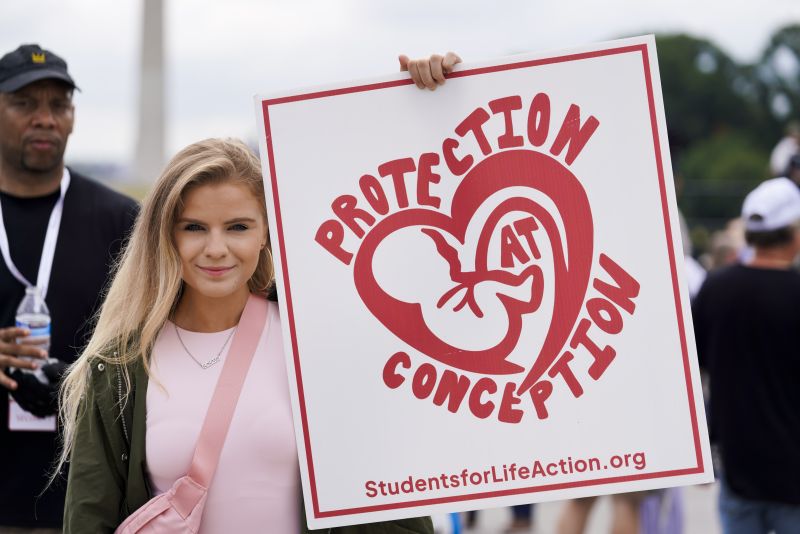
A young woman holds a pro-life sign during a rally in front of the Lincoln Memorial in Washington, D.C., on June 24, 2023, marking the first anniversary of the Supreme Court’s Dobbs decision that overturned Roe v. Wade. / Joseph Portolano/CNA
Washington D.C., Jun 25, 2023 / 06:40 am (CNA).
Marking the first anniversary of Roe being overturned, a group of pro-life leaders rallied hundreds to the steps of the Lincoln Memorial Saturday with the message that they were united around the fight for full, legal protection for the unborn from the moment of conception in all 50 states.
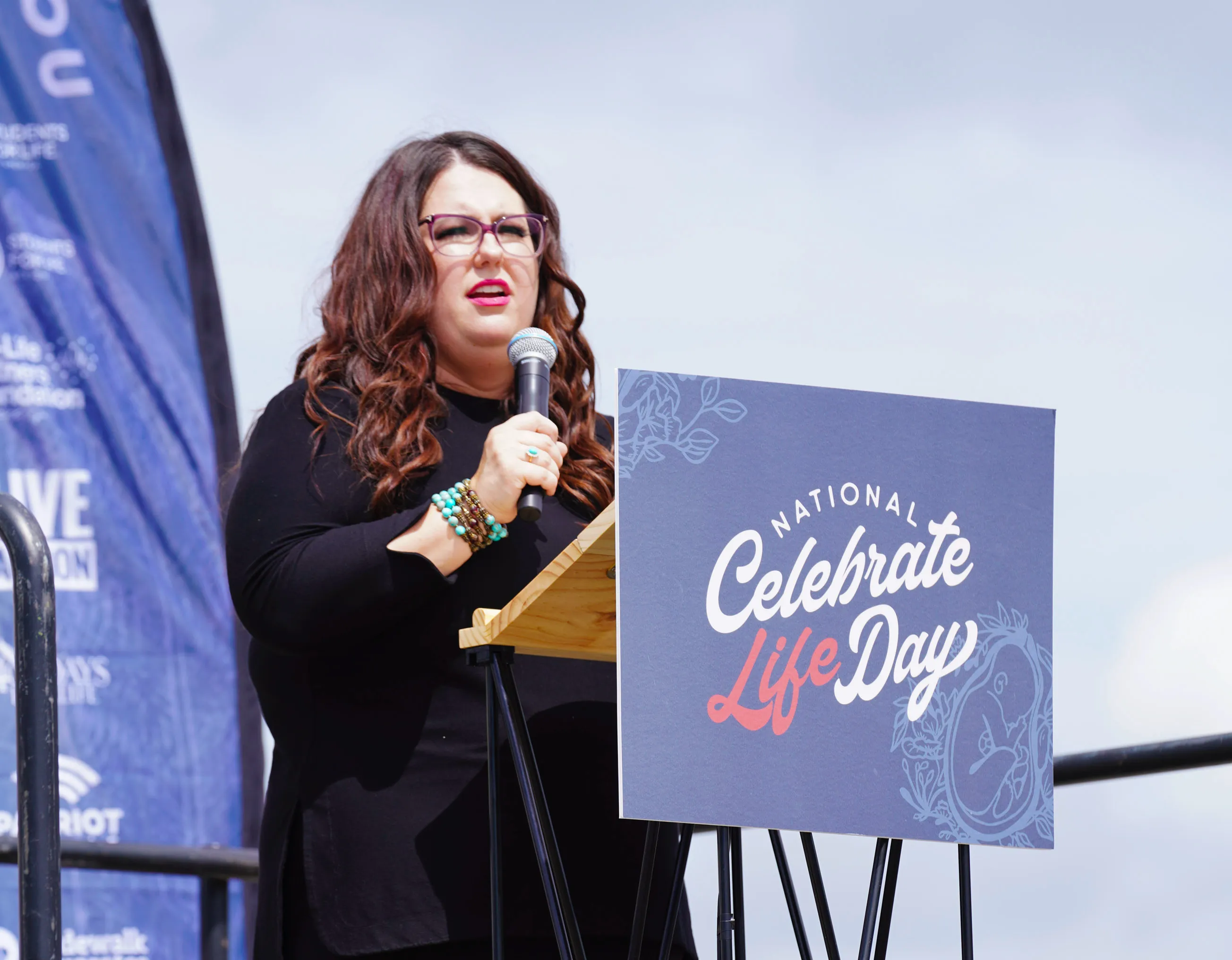
Kristan Hawkins, president of Students for Life of America, told those gathered on a sunny, hot summer day that while she celebrated the 25 states that have passed strong pro-life laws, “we are in fact living in a divided states of America” where “a person’s location determines if they will survive the abortion gauntlet as we did.”
Hawkins said the country must become “an America where every human being is recognized as the unrepeatable person as they are with equal rights and equal protection under the Fourteenth Amendment guaranteed, not because of what state their mother resides in or if they are perceived to be convenient or the circumstances of their conception.”
Kristan Hawkins, president of Students for Life of America, addresses the crowd at a pro-life rally in front of the Lincoln Memorial on June 24, 2023, marking the first anniversary of the U.S. Supreme Court’s Dobbs decision overturning Roe v. Wade. Joseph Portolano/CNA
Hawkins told CNA that pro-life leaders are uniting around the belief “that every human being is a human person at conception” and that the Fourteenth Amendment’s equal justice clauses should be equally applied to persons in the womb.
“At a very minimum if you’re running for federal office, you should be able to acknowledge that abortion is a federal issue,” she said. “We want to see every presidential contender join with us to acknowledge what is so clearly written in the Fourteenth Amendment: that all human beings are human persons and deserve equal protection of our laws.”
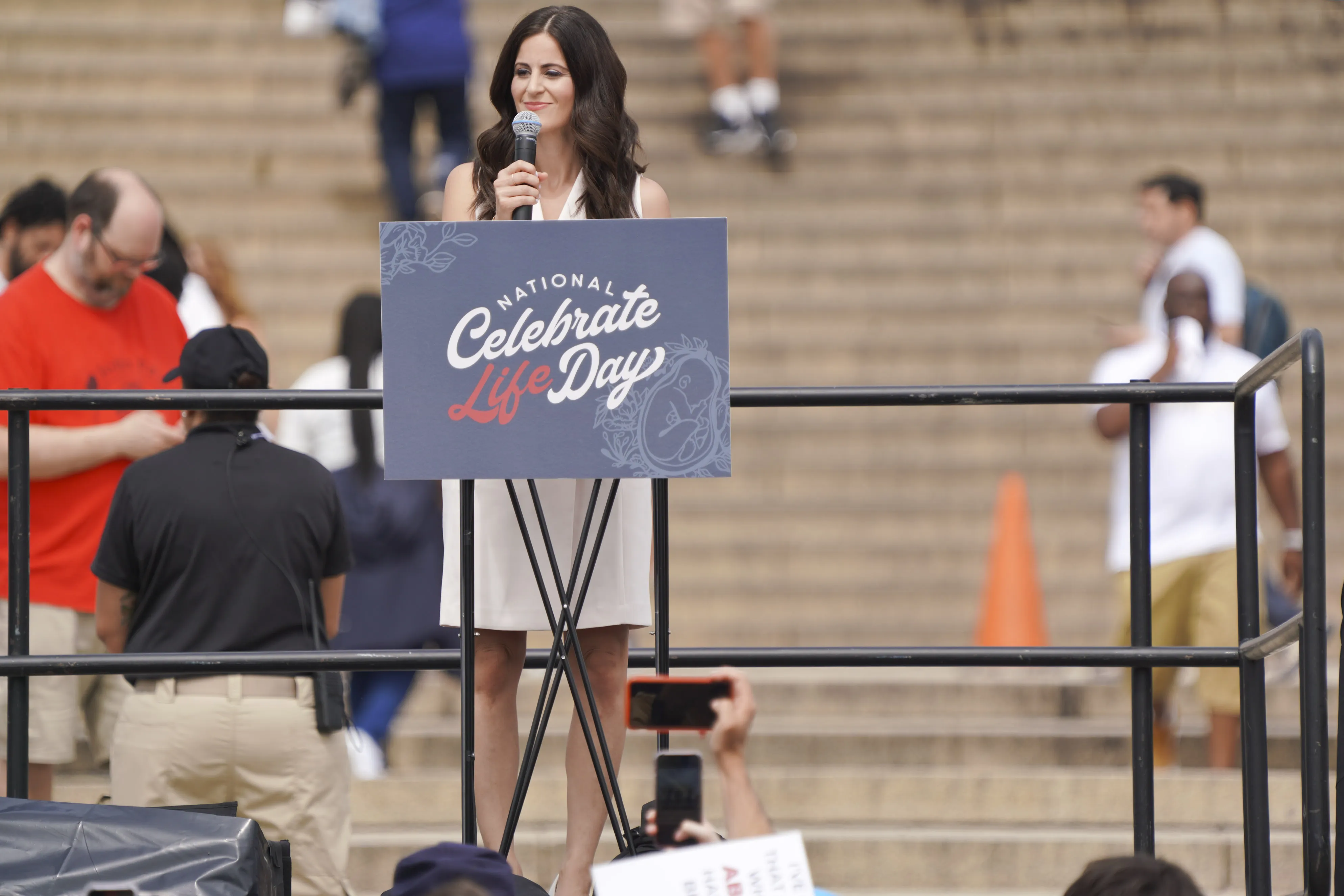
Lila Rose, president of the pro-life group Live Action, called the Fourteenth Amendment “one of the most beautiful notes in our national song” and lamented that “when it comes to preborn children we have failed to extend these protections.”
Speaking at a rally in front of of the Lincoln Memorial on June 24, 2023, Lila Rose, president of the pro-life group Live Action, called it a “tragic contradiction” that “while our society celebrates advancements in prenatal care and technology, we simultaneously deny personhood and rights, the personhood and rights of these very same children.”. Joseph Portolano/CNA
Rose called it a “tragic contradiction” that “while our society celebrates advancements in prenatal care and technology, we simultaneously deny personhood and rights, the personhood and rights of these very same children. It is inconceivable that we would selectively deny these rights to one group of human beings solely based on their location: the womb.”
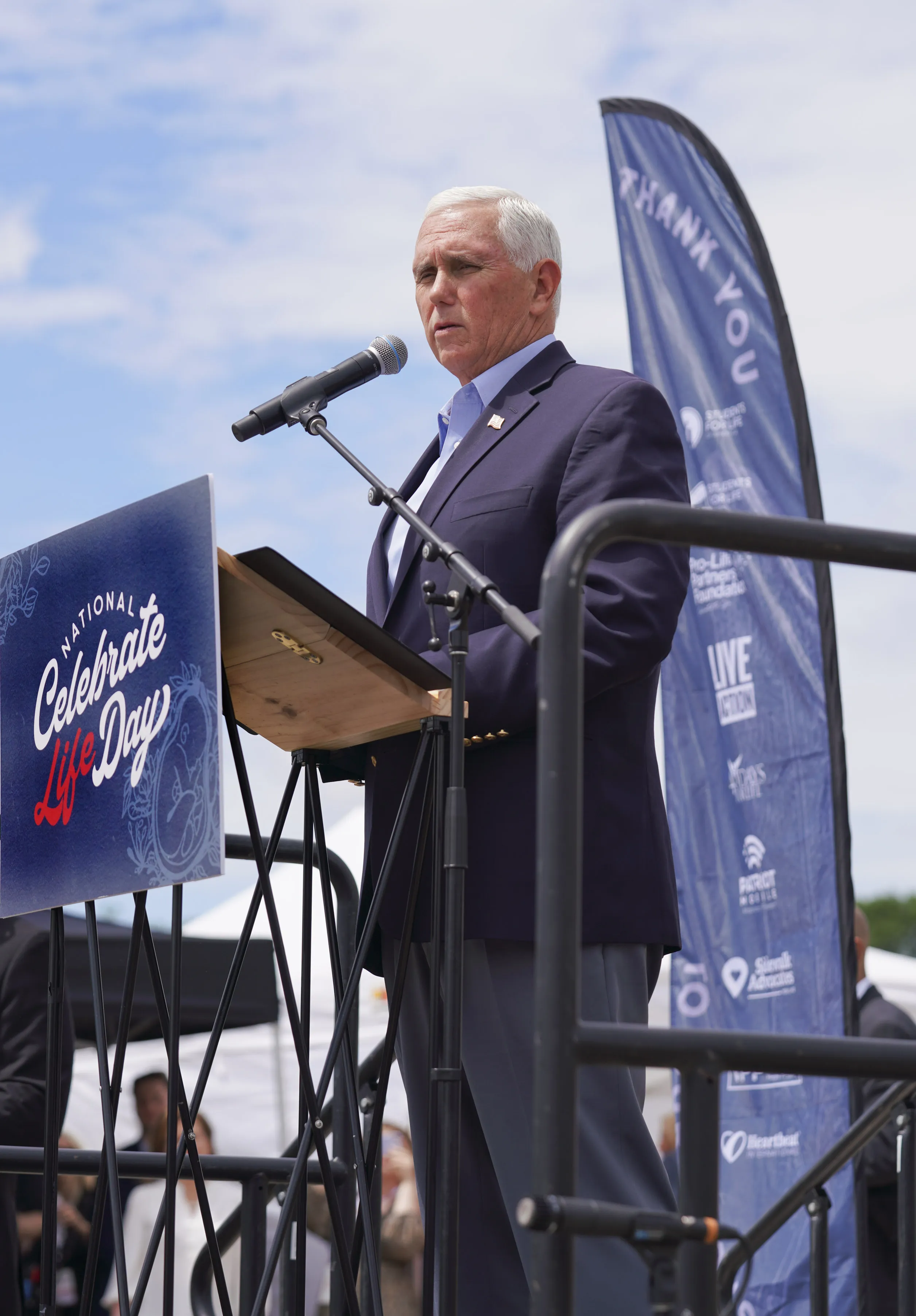
Republican presidential candidate and former Vice President Mike Pence, who recently called on his fellow GOP presidential candidates to join him in backing a “minimum” nationwide 15-week abortion limit, made an appearance at the rally.
“As we celebrate this anniversary, let us here resolve that we will work and we will pray as never before to advance the cause of life in the laws of the land in every state in America. That we will support women in crisis pregnancies with resources and support for their care, for the unborn, and for the newborn as never before,” Pence said.
Former Vice President Mike Pence, a 2024 GOP presidential candidate, addresses the crowd at a pro-life rally in front of the Lincoln Memorial on June 24, 2023, marking the first anniversary of the U.S. Supreme Court’s Dobbs decision overturning Roe v. Wade. Joseph Portolano/CNA
“We stand for the babies and their unalienable right to life,” he said, pledging that he and his family “will never rest and never relent until we restore the sanctity of life to the center of American law in every state in the land.”
Marjorie Dannenfelser, president of SBA Pro-life America, shared words of advice for the growing list of 2024 presidential candidates: “Get your act together. Figure out what you’re for and advance it. Don’t wait,” she urged.
“We have consensus in this country,” she added. “Start with that and be the president you’re called to be in justice and love for moms and justice and love for their babies.” Consistent Gallup polling shows that the majority of Americans would prefer to limit abortion to the first three months of pregnancy.
There were many young people in the crowd at the Lincoln Memorial, including Katriel Nyman, a 17-year-old from Washington state who is with Students for Life Tri-Cities. She told CNA that it was “really encouraging to see a bunch of people who believe in rights from conception.”
She said she’d “like to see more pro-lifers continue to persevere through this” post-Dobbs fight because “even if abortion isn’t legal in your state, you should be fighting for the rights of infants that are soon to be born in other states.”
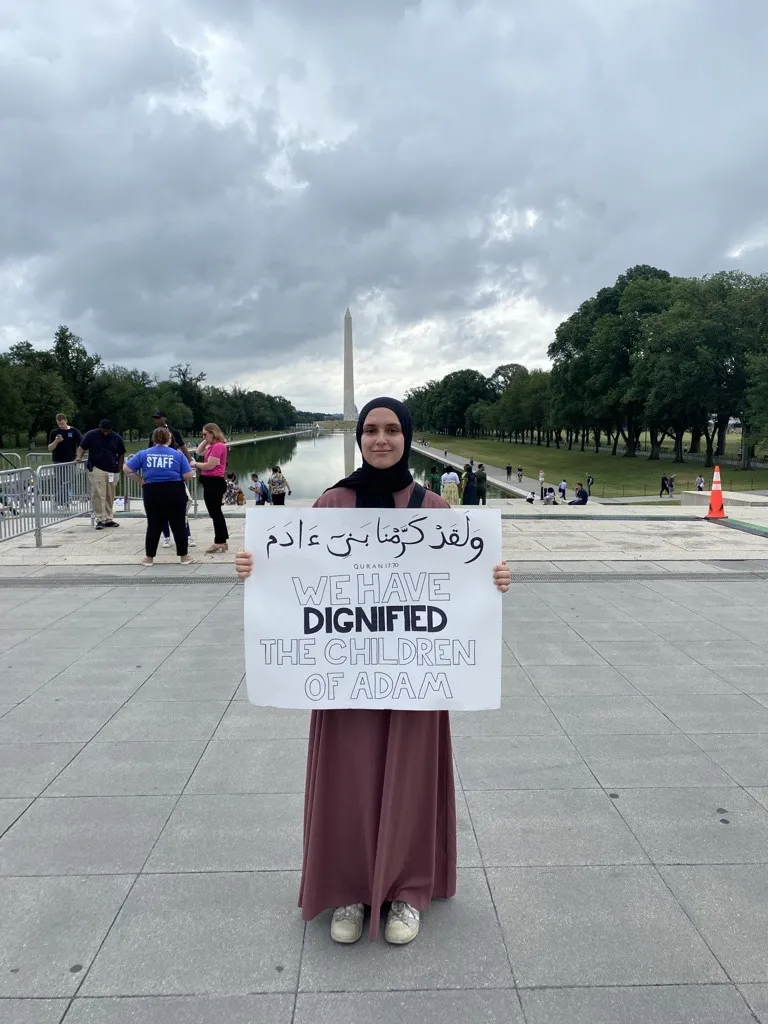
Sameerah Munshi, a recent graduate of Brown University who is interning with the Religious Freedom Institute, holds a sign with a verse from the Quran about the sanctity of life that reads “We have dignified the children of Adam,” at a pro-life rally at the Lincoln Memorial on June 24, 2023. Lauretta Brown/CNA
Sameerah Munshi, a recent graduate of Brown University who is interning with the Religious Freedom Institute, held a sign with a verse from the Quran about the sanctity of life that read “We have dignified the children of Adam.”
She told CNA that she wanted to make her voice heard as a Muslim who believes, based on her faith, that abortion is wrong in most cases. She said many Muslims followers feel, as she does, that life begins “in the first couple weeks after conception.”
Munshi said that in the year since the Dobbs decision, “a lot of people that I know who don’t have strong opinions on abortion have been coming out either in favor or against” abortion. She sees it as valuable that there’s more discourse about the abortion issue and people are “coming to more conclusions for themselves as opposed to maybe rhetoric that they’ve seen in the news or rhetoric that they feel has been a part of their political platform.”
Jessica Newell, a Catholic student who is interning with Live Action and entering her third year at Coastal Carolina University, told CNA that “it’s so important for people who are indoctrinated by this culture to learn the truth about biology and the truth about God and that they’re made in the image of God.”
She emphasized that the pro-life movement still has so much to do and part of that work is “letting people know that they’re loved, that is a big step in changing the culture to a culture of life.”
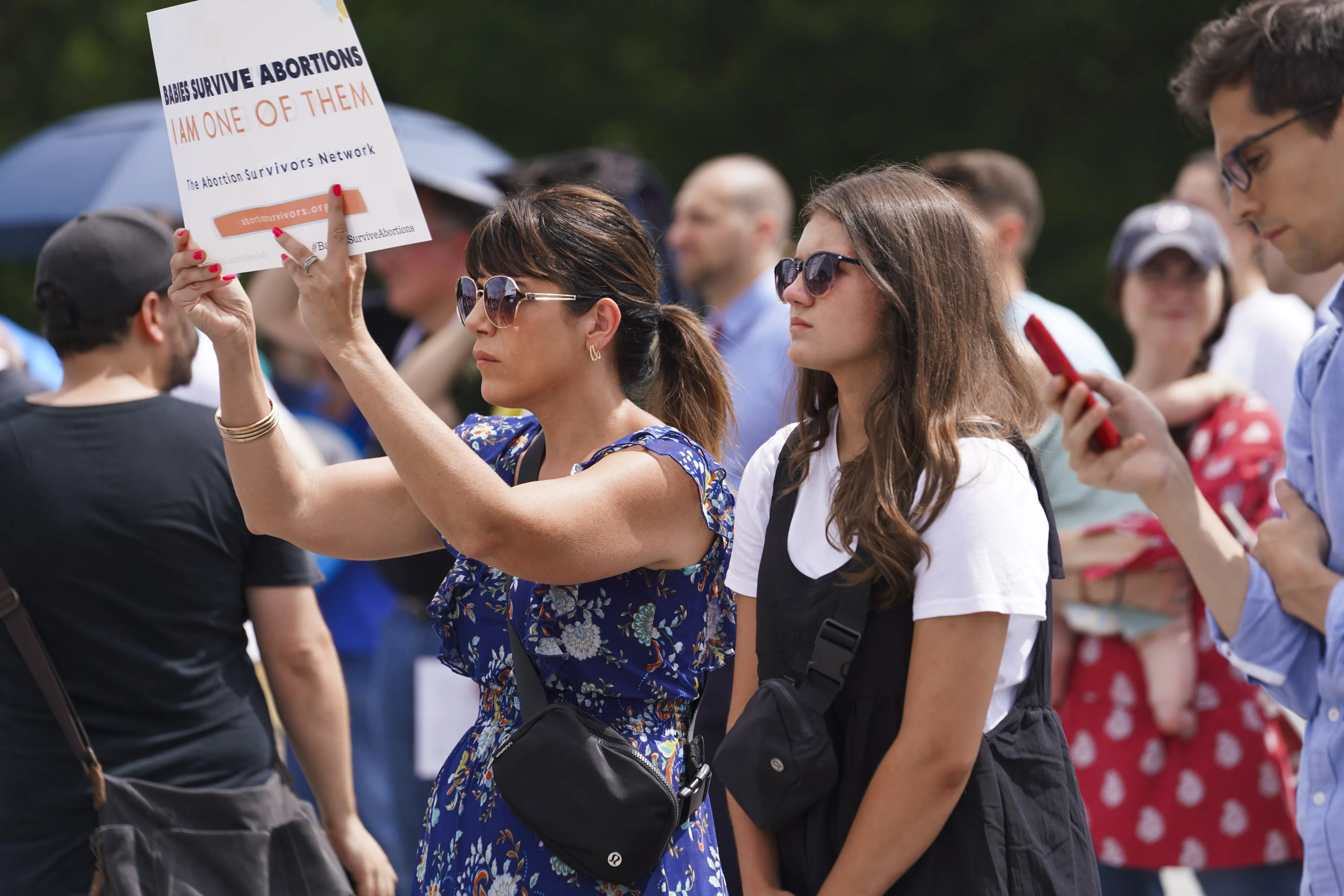
Melissa Ohden, who survived a saline-infusion abortion at 31 weeks gestation, stands alongside her oldest daughter Olivia, 15, at a pro-life rally at the Lincoln Memorial in Washington, D.C., on June 24, 2023. Joseph Portolano/CNA
Melissa Ohden, who survived a saline-infusion abortion at 31 weeks gestation, stood at the rally alongside her oldest daughter Olivia, 15, and a sign which read “Babies survive abortions. I am one of them.”
“This was a very personal thing for Roe to be overturned,” she told CNA, “It is a day that we can celebrate, but it has not been a chance to pause, take our breath, it has been a time of continuing to hit the ground running.”
In her work heading the Abortion Survivors Network, Ohden said that since the Dobbs decision she’s heard from “more women than ever reaching out to us after their chemical abortions have failed.” She said it’s important to reach moms who are vulnerable to chemical abortions which make up the majority of abortions in the country.
Ohden said that since Dobbs the pro-life movement “has continued to be the side that is providing resources and support whether it’s in communities, at the state level, pushing for federal policy that supports mothers and children and families in a greater way.”
Her daughter Olivia said it was “amazing” to be at the rally with her mom and called the issue an emotional one because “people like my mom should be protected no matter who they are, where they are.”
Yah, soon we will have Cardinal Fernandez. Perhaps the next Pope Francis II? Then Tucho can heal us all with his poetry! This will develop our understanding of the kiss of peace. What an Amoris it is to synodal.
I’m sad and angry my favorites among the “anti-Pope Francis Catholics” are not included here: San Francisco Archbishop Salvatore Cordileone, Los Angeles Archbishop Jose Gomez, and “America’s Bishop” Joseph Strickland.
The spasmodic appointments of the last week are like watching the death throes of some baby boomer ideology. It is as if we are witnessing Arius burst a gut in the streets of Constantinople. It is asi if an old man is screaming at the end: I’ll make this permanent!”. “All will know that 2+2=5!” “I am the god of gravity; it’s laws are suspended; we are all now free to jump off buildings.” Yada yada yada. What a bother. It puts me in such a theological bad mood.
Speaking of permanency. Francis’ attempt to make a church in his image and likeness reminds me of Peter wanting to erect tents at the Transfiguration. Remember what happened after Peter impetuously spoke such ridiculous words? God spoke from the cloud: “Listen to Him!” (Jesus).
God the Father, the Son and their Spirit will have the final word…as to what becomes Francis’ legacy. In that we may rest assured.
Here’s what I think is a relevant standard by which to judge any cleric – but especially bishops and that includes the one in charge of the Rome diocese. The mission of the Church is the salvation of souls carried out by the evangelization of peoples. A rating of A+ should be assigned to a cleric who is so effective in proclaiming the Gospel that the culture is converted – including its values, morals and lifestyle such that they reflect those of Christ. An “F” is assigned to those clerics who, rather than converting the culture by their teaching, preaching and orthopraxis are instead converted by the culture. Clerics who deserve an “F” reflect in their preaching, teaching and witness the values and morals of a secular, atheistic culture.
Now, I invite Catholics to rate those prelates who have been invited to participate in this Sinod on Synodidolotry – especially the recently-named cardinals.
The new and unscheduled cardinal appointments might be more about stacking a future conclave than about the two synods (2023, 2024). It might be that there’s more anxiety than we know—and that the momentum behind the dark side in the two synods is vulnerable to the real Holy Spirit.
After all, it was probably momentum more than sober consensus that led to the so-called “Trinity” nuclear bomb test at Alamogordo, New Mexico, and that cratered two cities within three days (!) in 1945 Japan.
Is the perennial Catholic Church to be cratered by the momentum of two synods? In 1945, the long-term and warned result was a half century nuclear arms race with all the chips on the table. Likewise, with the momentum of “walking together,” as if the momentum of ersatz and backside religion can really dispose of the perennial Catholic Church and the natural law. And, as if we can simply edit away the fact that “philosophy always buries its undertakers” (Etienne Gilson, a lay theologian!).
About which, the Second Vatican Council: “The Christian dispensation, therefore, as the new and definitive covenant, will never pass away, and we now await no further new public revelation [!] before the glorious manifestation of the Lord Jesus Christ (cf 1 Tim 6:14, Tit. 2:13)” (Dei Verbum, n. 4).
And, about the welcomed (!) wedding guest who then showed up without a wedding gown, see Matt 22:13.
Just in case the Holy Spirit can’t hear the “listening” church well enough, it’s best to make sure that the next enclave is in the bag for the “progressives”, eh? There’s a 67% chance that the next pope will carry on the current pope’s “legacy”. But wait. There’s more! You, too, can show your support for the current pontiff! Get thee to a Latin Mass Community or Chapel. Stay there. Enjoy Catholicism while you still can. O, and don’t bother calling this “pope” the Vicar of Christ, and don’t dare kiss his ring, unless you wish to unleash his wrath. Come, Lord Jesus!
I also have named a number of Bergoglio’s new appointees. And the names I have given them are both amusing and descriptive, especially the one for Archbishop Fernandez.
(Yes, it absolutely does reference his best known work on theology, ‘Heal Me With Your Mouth: The Art of Kissing’.)
Unfortunately, in light of the standards enunciated by CWR governing comments by readers — specifically, “comments containing obscene language or personal attacks, or those that are deemed by the editors to be needlessly combative or inflammatory, will not be published” — I will not be able to share those amusing names here.
Except for the fact that Trump was NEVER invited to meet with the Pope; meanwhile, Obama/Clinton/Pelosi/Biden/Kerry all have. Let’s keep the LEFTIST pro-paganda OUT of the religion section in the news, shall we?
Mongolia has a cardinal with less than 5 thousand Catholics, Australia has over 5 million Catholics and no cardinal. I guess Archbishop Fisher of Sydney is too orthodox for the Vatican.
Wishing Archbishop Víctor Manuel Fernández and his brand new fellow colleagues – wisdom, inspiration, strength, stamina, and divine blessings in the challenges ahead.
It’s amazing that, even with the death of Cdl. Pell, Australia is not worthy of a cardinal. If pope Francis should pass away before any further consistory, them Australia will have no vote for a new pope. but smaller places like Tonga an Papua New Guinea will.






Yah, soon we will have Cardinal Fernandez. Perhaps the next Pope Francis II? Then Tucho can heal us all with his poetry! This will develop our understanding of the kiss of peace. What an Amoris it is to synodal.
I’m sad and angry my favorites among the “anti-Pope Francis Catholics” are not included here: San Francisco Archbishop Salvatore Cordileone, Los Angeles Archbishop Jose Gomez, and “America’s Bishop” Joseph Strickland.
The spasmodic appointments of the last week are like watching the death throes of some baby boomer ideology. It is as if we are witnessing Arius burst a gut in the streets of Constantinople. It is asi if an old man is screaming at the end: I’ll make this permanent!”. “All will know that 2+2=5!” “I am the god of gravity; it’s laws are suspended; we are all now free to jump off buildings.” Yada yada yada. What a bother. It puts me in such a theological bad mood.
Speaking of permanency. Francis’ attempt to make a church in his image and likeness reminds me of Peter wanting to erect tents at the Transfiguration. Remember what happened after Peter impetuously spoke such ridiculous words? God spoke from the cloud: “Listen to Him!” (Jesus).
God the Father, the Son and their Spirit will have the final word…as to what becomes Francis’ legacy. In that we may rest assured.
Here’s what I think is a relevant standard by which to judge any cleric – but especially bishops and that includes the one in charge of the Rome diocese. The mission of the Church is the salvation of souls carried out by the evangelization of peoples. A rating of A+ should be assigned to a cleric who is so effective in proclaiming the Gospel that the culture is converted – including its values, morals and lifestyle such that they reflect those of Christ. An “F” is assigned to those clerics who, rather than converting the culture by their teaching, preaching and orthopraxis are instead converted by the culture. Clerics who deserve an “F” reflect in their preaching, teaching and witness the values and morals of a secular, atheistic culture.
Now, I invite Catholics to rate those prelates who have been invited to participate in this Sinod on Synodidolotry – especially the recently-named cardinals.
The new and unscheduled cardinal appointments might be more about stacking a future conclave than about the two synods (2023, 2024). It might be that there’s more anxiety than we know—and that the momentum behind the dark side in the two synods is vulnerable to the real Holy Spirit.
After all, it was probably momentum more than sober consensus that led to the so-called “Trinity” nuclear bomb test at Alamogordo, New Mexico, and that cratered two cities within three days (!) in 1945 Japan.
Is the perennial Catholic Church to be cratered by the momentum of two synods? In 1945, the long-term and warned result was a half century nuclear arms race with all the chips on the table. Likewise, with the momentum of “walking together,” as if the momentum of ersatz and backside religion can really dispose of the perennial Catholic Church and the natural law. And, as if we can simply edit away the fact that “philosophy always buries its undertakers” (Etienne Gilson, a lay theologian!).
About which, the Second Vatican Council: “The Christian dispensation, therefore, as the new and definitive covenant, will never pass away, and we now await no further new public revelation [!] before the glorious manifestation of the Lord Jesus Christ (cf 1 Tim 6:14, Tit. 2:13)” (Dei Verbum, n. 4).
And, about the welcomed (!) wedding guest who then showed up without a wedding gown, see Matt 22:13.
Just in case the Holy Spirit can’t hear the “listening” church well enough, it’s best to make sure that the next enclave is in the bag for the “progressives”, eh? There’s a 67% chance that the next pope will carry on the current pope’s “legacy”. But wait. There’s more! You, too, can show your support for the current pontiff! Get thee to a Latin Mass Community or Chapel. Stay there. Enjoy Catholicism while you still can. O, and don’t bother calling this “pope” the Vicar of Christ, and don’t dare kiss his ring, unless you wish to unleash his wrath. Come, Lord Jesus!
I also have named a number of Bergoglio’s new appointees. And the names I have given them are both amusing and descriptive, especially the one for Archbishop Fernandez.
(Yes, it absolutely does reference his best known work on theology, ‘Heal Me With Your Mouth: The Art of Kissing’.)
Unfortunately, in light of the standards enunciated by CWR governing comments by readers — specifically, “comments containing obscene language or personal attacks, or those that are deemed by the editors to be needlessly combative or inflammatory, will not be published” — I will not be able to share those amusing names here.
Sorry.
This papacy reminds me of the Trump administration, perhaps with a pinch of Kim Jung Un.
Actually the Trump administration appointed PRO LIFE JUDGES to the Supreme Court. BTW, those judges overturned R V W
Doesn’t prove anything. Over turn and eventually turn back again.
and he actually talked to some nuns on the White House lawn
Wokester:)
Funny. This papacy reminds me more of the Biden administration.
Except for the fact that Trump was NEVER invited to meet with the Pope; meanwhile, Obama/Clinton/Pelosi/Biden/Kerry all have. Let’s keep the LEFTIST pro-paganda OUT of the religion section in the news, shall we?
It’s possible that he is throwing boomerangs.. The Holy Spirit has a sense of humor! 😂
Mongolia has a cardinal with less than 5 thousand Catholics, Australia has over 5 million Catholics and no cardinal. I guess Archbishop Fisher of Sydney is too orthodox for the Vatican.
Wishing Archbishop Víctor Manuel Fernández and his brand new fellow colleagues – wisdom, inspiration, strength, stamina, and divine blessings in the challenges ahead.
It’s amazing that, even with the death of Cdl. Pell, Australia is not worthy of a cardinal. If pope Francis should pass away before any further consistory, them Australia will have no vote for a new pope. but smaller places like Tonga an Papua New Guinea will.
Who stood for what in the COVID-vaccination impostures.