Veteran Affairs health clinic in Eugene, Oregon. / Shutterstock
Denver, Colo., Apr 20, 2023 / 16:00 pm (CNA).
The U.S. Senate on Wednesday voted not to overturn a new rule adding abortion to the health benefits of veterans and their dependents, prompting objections from leaders of the United States Conference of Catholic Bishops (USCCB), who called the vote “a gross failure.”
“Our heroes and their dependents deserve quality health care services instead of policies to end the lives of their own children,” read a joint statement Thursday from the USCCB’s president, Archbishop Timothy Broglio, and Bishop Michael Burbidge, chair of the U.S. bishops’ Committee on Pro-Life Activities.
The bishops said it is “inhumane” to provide taxpayer-funded abortion as “a so-called solution to pregnancy” and not “resources needed to welcome a child and flourish as a family.”
“We continue to urge Congress to prevent implementation of this harmful policy and to provide instead real support for our military veterans and their loved ones,” Broglio and Burbidge said.
Broglio heads the Archdiocese for the Military Services, USA, while Burbidge heads the Diocese of Arlington, Virginia.
On Wednesday the Senate voted 51-48 against a Congressional Review Act resolution to overturn the interim final rule put out in September by the Department of Veterans Affairs that added abortion. Previously, the VA banned abortion and abortion counseling in its programs.
The bishops’ conference on Sept. 21, 2022, submitted comment on the VA regulation change. The comment noted that the VA policy to provide abortion when a pregnant woman’s “life or health” is endangered in effect allows abortion through all nine months of pregnancy.
The bishops also noted that Congress has not authorized elective abortion in VA programs.
“But even if it had, such a practice would be poor public policy because it involves the intentional killing of unborn children and harm to women who undergo the abortion procedure,” the 2022 statement said.
On Thursday, the bishops also spoke about the importance of improved health care for veterans.
“Many veterans face tremendous life challenges, especially as the active-duty experience too often involves significant mental health traumas and can be followed by a difficult readjustment to civilian life,” they said.
The new VA rule could face legal challenges. The Hyde Amendment restricts federal funding of abortions to include only those cases involving rape, incest, or a maternal mortality risk; and, notably, the Veterans Health Care Act of 1992 prohibits abortion for military veterans or retirees, according to Politico.
If you value the news and views Catholic World Report provides, please consider donating to support our efforts. Your contribution will help us continue to make CWR available to all readers worldwide for free, without a subscription. Thank you for your generosity!
Click here for more information on donating to CWR. Click here to sign up for our newsletter.
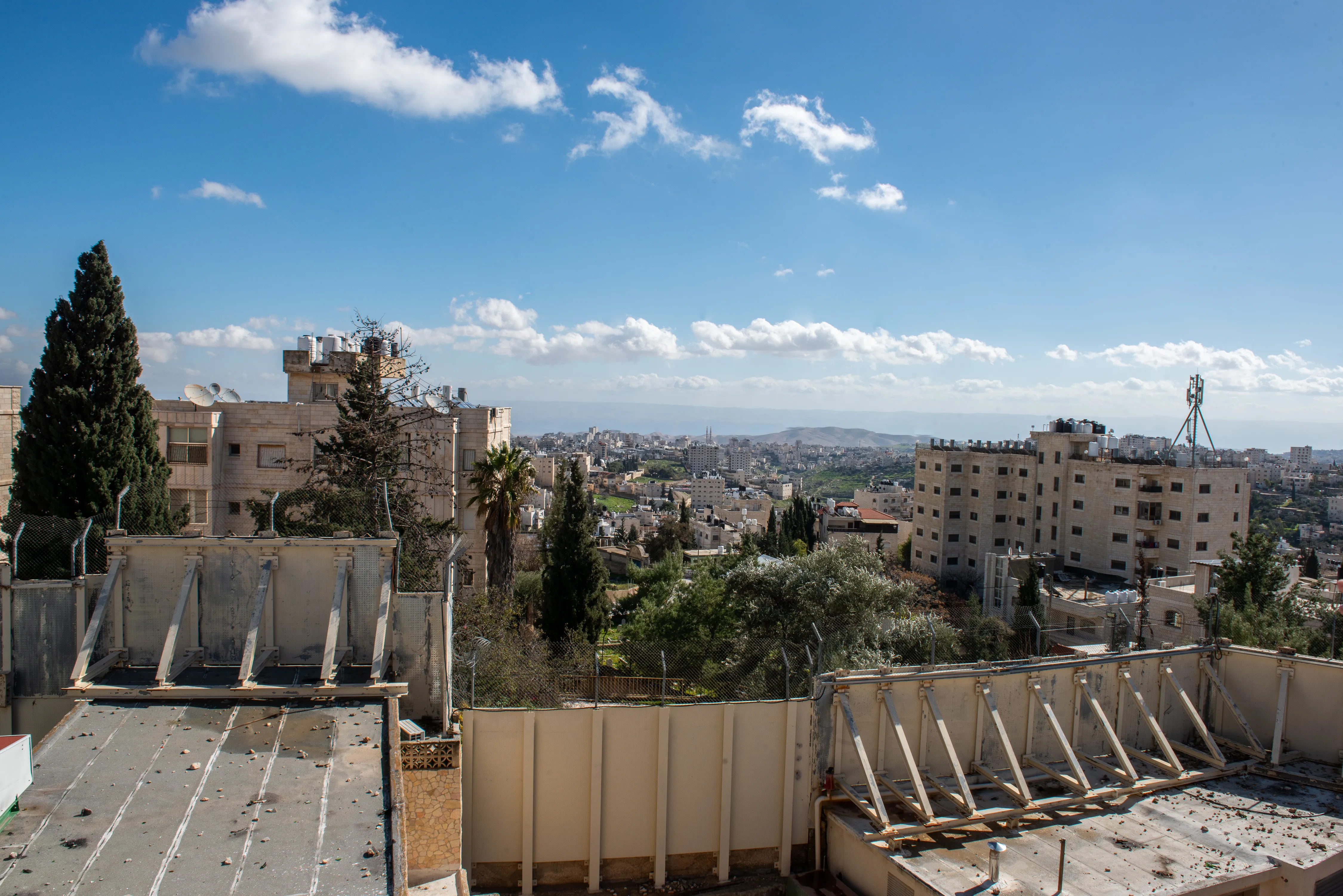
A view of the separation wall between Israel and the Palestinian Territories from behind a window in the Comboni Sisters’ house in East Jerusalem. / Credit: Marinella Bandini
Jerusalem, Feb 17, 2024 / 06:00 am (CNA).
The Comboni Sisters have been living on the border of East Jerusalem since 1967. Running along the border of their property is a wall, constructed by the Israelis in 2009, dividing the village of Bethany/al-Eizariya — renowned as the site of the resurrection of Lazarus. The sisters’ residence remains on the Israeli side, while the church and the tomb of Lazarus are on the Palestinian side, on the other side of the wall.
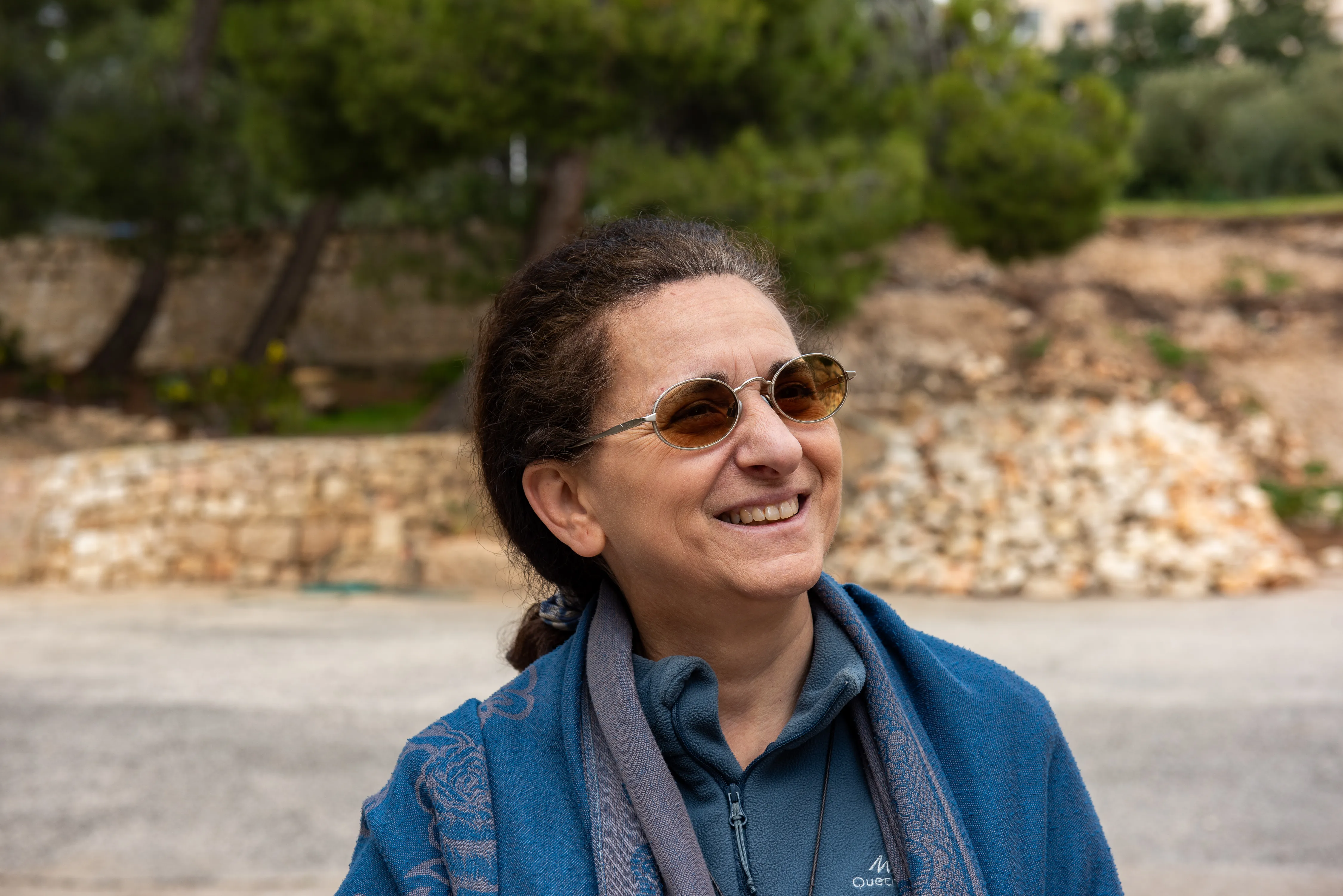
“For us, the passage from Scripture that says ‘in Christ the wall of separation between peoples has been broken down’ is very powerful [Eph 2:14], especially when there is a physical wall in front of us that clearly indicates this separation,” Sister Anna Maria Sgaramella, provincial councilor and coordinator of the Middle East Zone for the Comboni Sisters, told CNA.
Sister Anna Maria Sgaramella, provincial council and coordinator of the Middle East Zone for the Comboni Sisters. Credit: Marinella Bandini
Sgaramella arrived in Jerusalem for the first time on Sept. 26, 2000. The very next day, the second intifada — a major uprising by Palestinians against Israeli occupation — erupted. She witnessed the siege of the Basilica of the Nativity in Bethlehem, where she taught theology.
Later, she was transferred to Egypt, where in 2011, she witnessed the uprising known as the “Arab Spring.”
Since 2013, Sgaramella has permanently returned to Jerusalem and now faces another long and bloody conflict. “I have always been struck by the deep sense of hope and determination to move forward among the Palestinian people. With this war, I see it weaker; people are more exhausted,” she said.
A view of the separation wall between Israel and the Palestinian Territories from the terrace of the Comboni Sisters’ house in East Jerusalem. The wall, constructed by the Israelis in 2009, runs along the border of their property, dividing the village of Bethany/al-Eizariya in two, believed to be the site of the miracle of the raising of Lazarus. The sisters’ residence remains on the Israeli side, while the church and the tomb of Lazarus are on the other side of the wall. Credit: Marinella Bandini
There are currently six Comboni Sisters in Jerusalem and each is involved in a specific ministry. They usually come together for morning Mass and evening vespers as well as for meetings and reflection. Their community house is open to religious individuals seeking periods of study or discernment and serves as a center of spirituality for both the congregation and the local Church. The sisters host educational workshops and spiritual exercises as well as welcome pilgrims.
The Comboni Sisters in Jerusalem in a recent photo at the Jordan River. The Comboni Sisters’ community in Jerusalem currently consists of six sisters and each is involved in a specific ministry. Credit: Photo courtesy of Sister Anna Maria Sgaramella
Sgaramella shared with CNA what it’s like to live on the border.
“With the construction of the wall, we found ourselves in the middle, between Palestinians and Israelis,” she explained. “The Palestinians attempt to bypass the wall — especially to pray at the Dome of the Rock — while the Israelis try to repel them in an endless game.”
“Being in the middle is a physical position that has also become a spiritual one,” Sgaramella continued. “We had to reflect and decided to ‘stay in the middle,’ between these two peoples, to serve as a bridge between them. By placing ourselves in the middle, we listen to the injustice faced by the Palestinians and also to the fears of Israeli families.”
For this reason, the religious community has chosen to maintain a small presence in the Palestinian area. Two sisters reside in an apartment beyond the wall, about 100 feet from the Comboni Sisters’ residence.
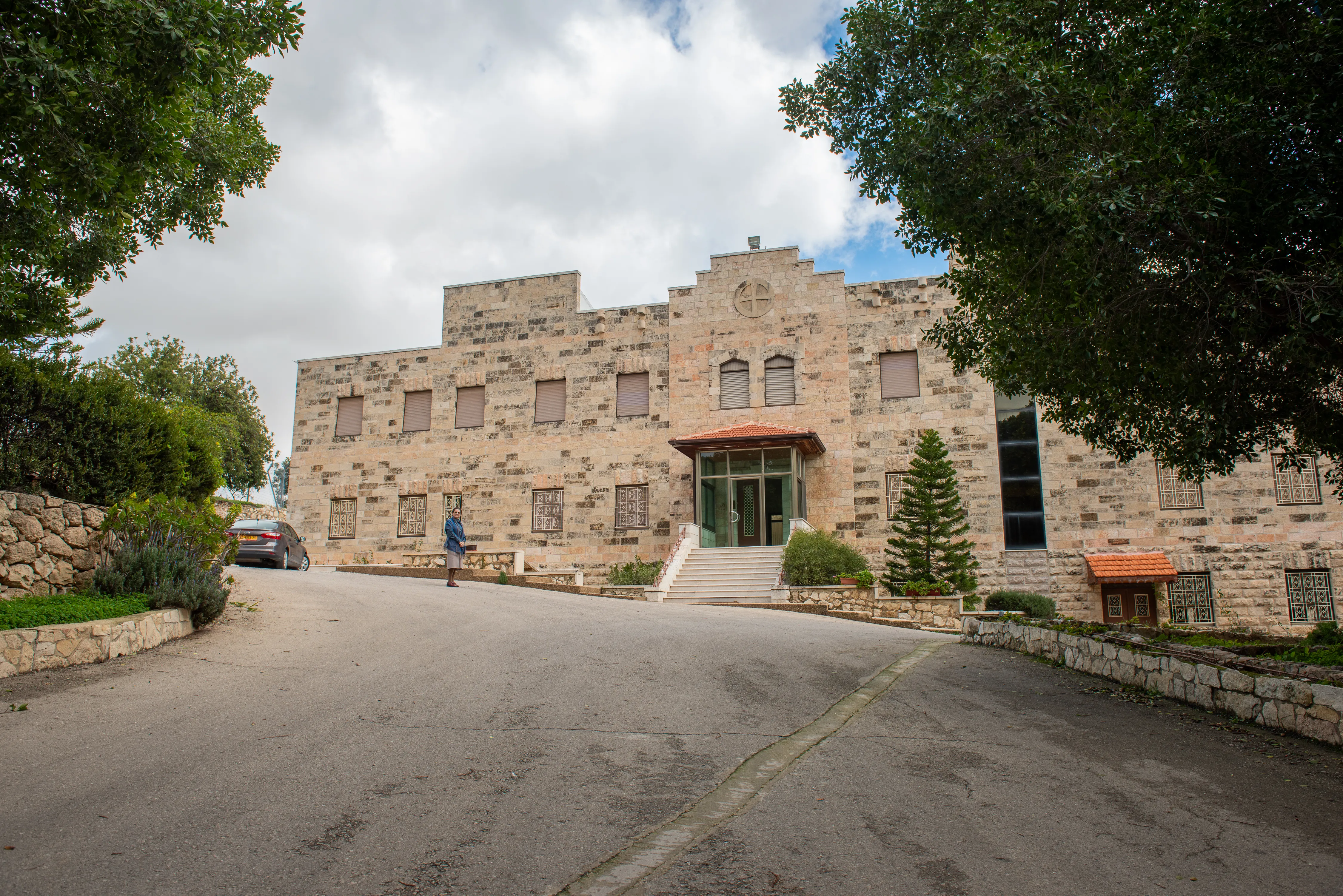
The exterior of the Comboni Sisters’ house in East Jerusalem where the Comboni Sisters have been living since 1967. Credit: Marinella Bandini
“We desired to stay and share the lives of those people and accompany the small remaining Christian community there. Every time they need to reach the community, they have to travel 18 kilometers [about 11 miles] passing through the Israeli checkpoint,” Sgaramella explained.
The sisters do not do this simply in the spirit of altruism, explained Sgaramella, who is also involved in ecumenical and interreligious dialogue. “We understood from the beginning that being in the middle comes at a cost. It often means getting hit from both sides. On one hand, there are stones and Molotov cocktails from the Palestinians that land on our property; on the other hand, we are under the smoke of tear gas launched in response by the Israelis,” she said.
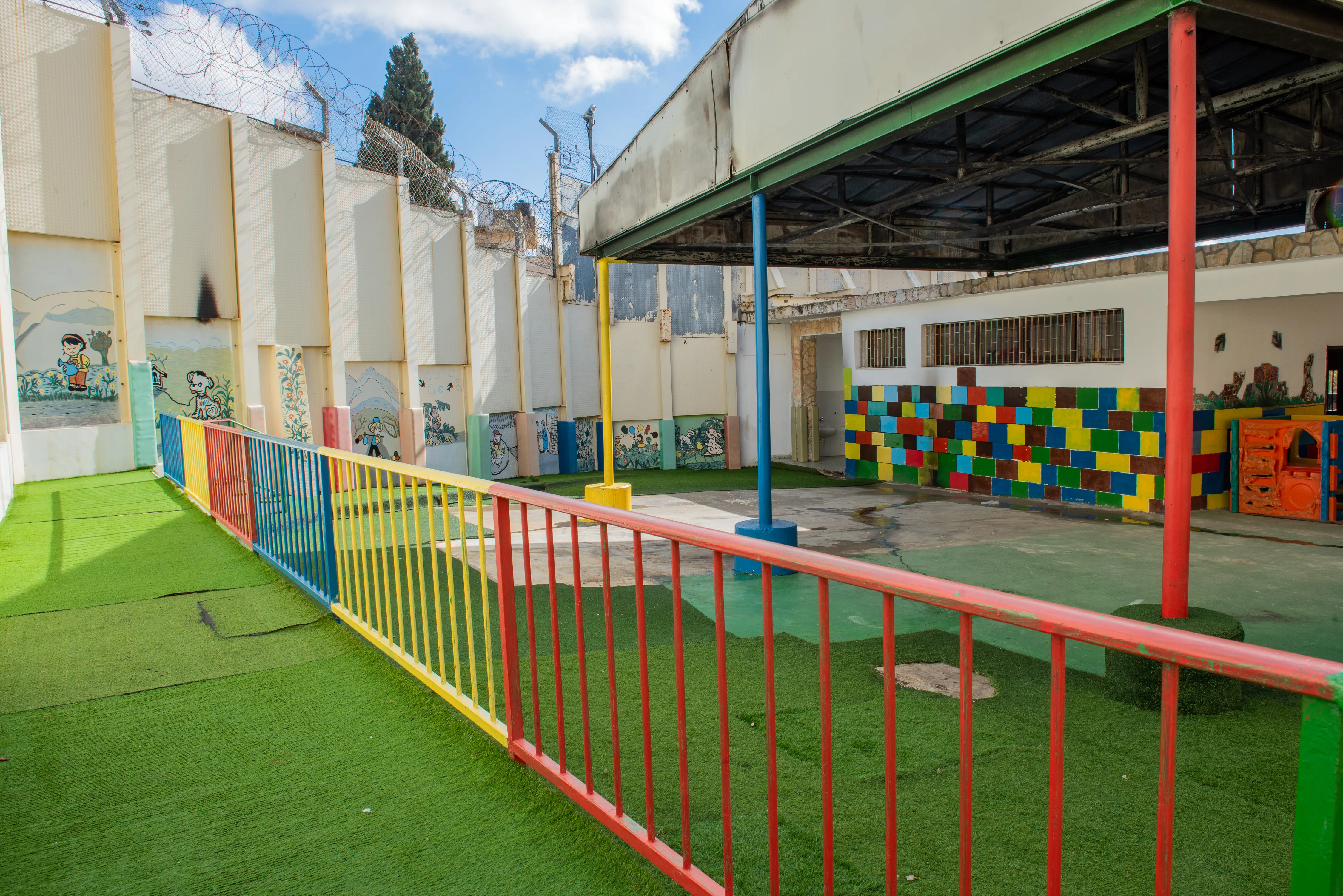
One incident happened the night of Oct. 6, just hours before the Hamas attack on Israel. Some Molotov cocktails landed on the synthetic grass in the part of the property that houses the kindergarten, causing a fire — the signs of which are still visible today. The fire destroyed the grass, playground equipment, and blackened the recently painted wall.
The exterior of the kindergarten, housed on the Comboni Sisters’ property. In the background is the separation wall that was erected on the edge of the Comboni Sisters’ property in 2009.
The kindergarten is a work that the Comboni Sisters have been carrying out since their arrival and today it serves as an important point of connection with the surrounding community. This significance has grown, especially after the construction of the wall.
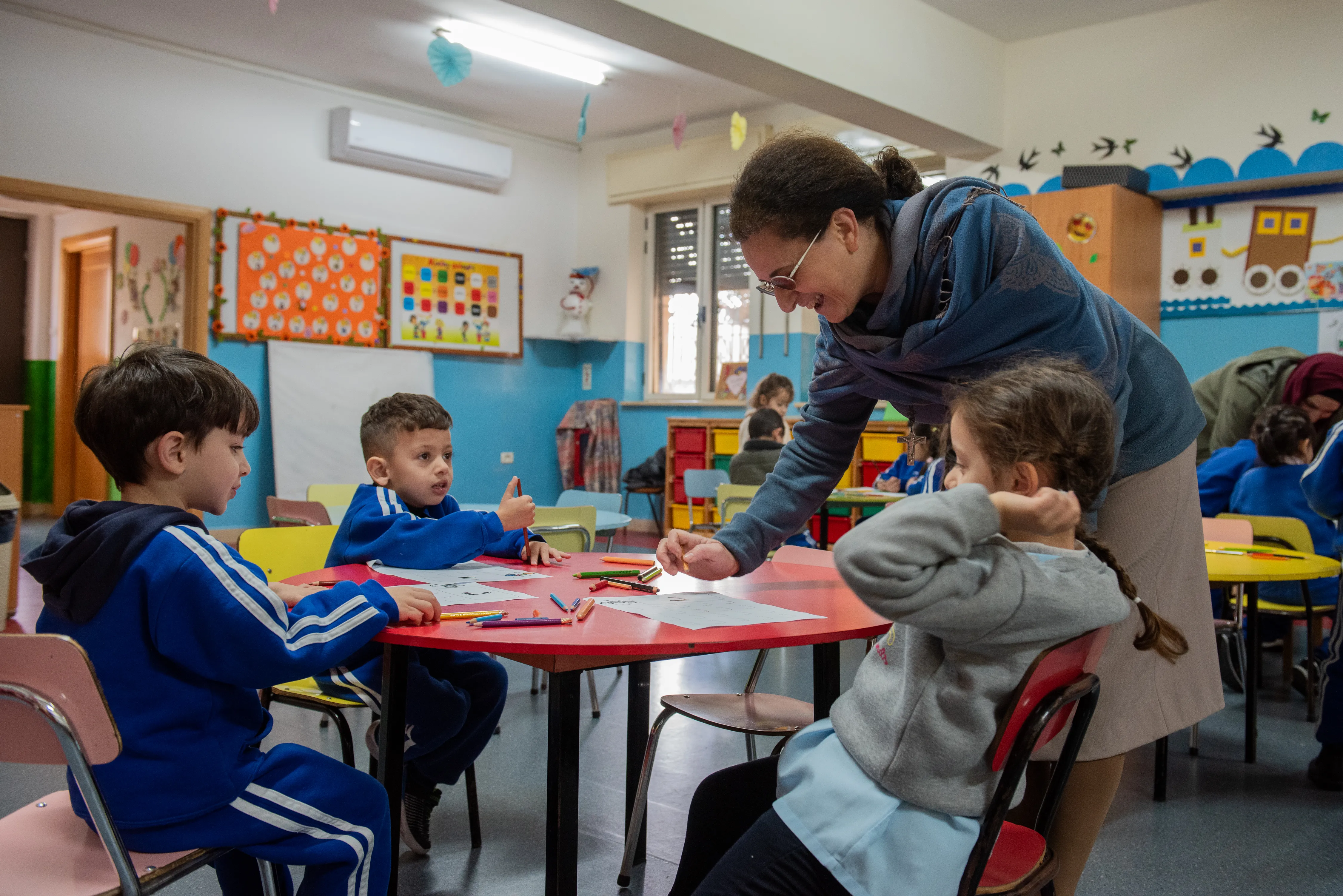
“The presence of the kindergarten has never been questioned, neither with the wall nor with the war,” said Sgaramella, who is the director. The kindergarten is attended by approximately 40 children, all of whom are Muslims, divided into two classes. Formally, it is under the jurisdiction of the Palestinian Ministry of Education. “It is a project that meets the needs of the people; furthermore, episodes of violence never occur during the day when the children are present,” she added.
Sister Anna Maria Sgaramella of the Comboni Sisters talks with the children in one of the kindergarten classes hosted at their home in East Jerusalem. The presence of the kindergarten has never been questioned, said Sgaramella, the director. Credit: Marinella Bandini
Every morning, the children begin with a prayer. “We tell the parents right from the start,” Sgaramella explained. “It’s a prayer of thanksgiving for what God has created, for the day, for life, a blessing for parents, neighbors, friends, and also for children who suffer. We pray for peace in the world and in this country.”
Regarding the families, she shared: “There is great trust and respect. They usually choose to send their children here, especially for moral education and English-language instruction.”
Most of the children come from East Jerusalem, but some also come from al-Eizariya. One of the two teachers, Nihal Hashmime, who is also the vice director, has to pass through the checkpoint every day to get to work.
“With the war,” the sister told CNA, “we faced some educational challenges because initially, some children were absent. The work we do with them is to impart certain values, such as peace, friendship, love, and respect for differences.”
Play is also an important aspect. “Children here do not find toy weapons, and they are not allowed to bring them from home,” Sgaramella said.
“Our attempt in education and all other activities is to break down this wall that leads to seeing the other as an enemy,” Sgaramella said. “Sometimes it is difficult to recognize the universality of salvation. We know that Jesus died for everyone, but in certain conflict-ridden contexts, it is challenging to acknowledge the other as a brother. Personally, the field of teaching theology provides me with the space to build bridges among believers. Because in every religion, there are sincere believers seeking truth.”
New York City, N.Y., Aug 2, 2018 / 03:18 am (CNA/EWTN News).- Today’s feast of Our Lady of the Angels of Porziuncola and its associated indulgence is a way to focus on the importance of Mary and the Franciscan tradition in the Church, said one friar.
The Aug. 2 feast is found in the Franciscan tradition, and marks the dedication of the parish church, called Porziuncola or “little portion,” which is one of those Italy’s St. Francis of Assisi rebuilt in obedience to Christ’s command to “rebuild my church.”
“The Porziuncola is at the heart of the Franciscan journey,” Father David Convertino, the development director for the Holy Name Province of the Observant Franciscans, told CNA.
“For Francis, it was his most beloved place. He lived near it with the early followers … and he loved the Porziuncola, as it was part of his devotion to Our Lady.”
The Catholic Church teaches that after a sin is forgiven, an unhealthy attachment to created things still remains. Indulgences remove that unhealthy attachment, purifying the soul so that it is more fit to enter heaven. Indulgences are either plenary (full) or partial.
A plenary indulgence also requires that the individual be in the state of grace and have complete detachment from sin. The person must also sacramentally confess their sins and receive Communion up to about 20 days before or after the indulgenced act.
Anyone who visits a Catholic church with the intention of honoring Our Lady of the Angels and recites the Creed, the Our Father, and prays for the Pope’s intentions, may receive a plenary indulgence on Aug. 2.
“Any kind of a prayer form that helps people come closer to God is obviously a good prayer form, and certainly an indulgence is one way,” Fr. Convertino said.
“It helps us focus on, in this case, the meaning of the Porziuncola and the Franciscan tradition, how it’s situated in the greater idea of the Church.”
Porziuncola located inside the Basilica of Santa Maria degli Angeli near Assisi. Credit: emmav674 via Flickr (CC BY_NC_SA 2.0)
The Porziuncola was built in honor of Our Lady of the Angels in the fourth century, and by St. Francis’ time had fallen into disrepair. The church, which was then located just outside of Assisi, became the “motherhouse” of the Franciscan orders.
“Although Francis realized that the kingdom of heaven is found in every dwelling on earth … he had learned nevertheless that the church of Saint Mary at Portiuncula was filled with more abundant grace and visited more frequently by heavenly spirits,” says the life of St. Francis written by Friar Thomas of Celano, read today by Franciscans.
“Consequently he used to say to his friars: ‘See to it, my sons, that you never leave this place. If you are driven out by one door return by the other for this is truly a holy place and God’s dwelling.’”
Fr. Convertino added that the Porziuncola “was the place he chose to lie next to on his deathbed, and at that time of course you could have looked up to the city of Assisi, which he also loved so well.”
The Porziuncola, a rather small chapel, is now located inside a large basilica which was built around it, to enclose and protect it.
“You have this large basilica built over this teeny tiny little chapel,” Fr. Convertino reflected. “If that chapel wasn’t there then the basilica wouldn’t be there, but if the basilica wasn’t there, the chapel probably wouldn’t be there either, given 800 years of war, weather, and turmoil.”
For Fr. Convertino, the duality of the big church and the little church is a reflection of the relationship between the world-wide Catholic Church and the smaller communities which make it up.
“We feel the Franciscans kind of convey, we’re the ones at the heart of the Church, the little church there.”
He said that each time he visits Assisi, the “experience” of the Porziuncola is “compounded more and more,” and added that “it’s such a magnificent place, and the friars there are wonderful.”
Fr. Convertino also discussed the fresco now painted around the entrance of the Porziuncola, which shows St. Francis, together with some of his followers, receiving the indulgence from Christ and Our Lady.
“The idea behind the story is that Francis is asking Jesus for a Porziuncola indulgence, and Jesus is saying to Francis, ‘Well, you really better ask Mary, ask my mother.’”
This article was originally published Aug. 2, 2013.
Former U.S. postal worker Gerald Groff believes his religious freedom was violated when he was reprimanded for refusing to work on Sundays. / First Liberty Institute
Washington D.C., Apr 12, 2023 / 14:30 pm (CNA).
The Supreme Court will hear or… […]
3 Comments
Can we has a list of who voted and how they voted in the Senate? I thought 2 Senators are absent? So how can threy get 51 votes?
This is my only question
Imagine how fast abortion would be back on the table if taxpayers were required to support all orphans, indigent mothers and homeless/ unwanted children from conception through high school.
“A gross failure… A harmful policy… A harmful public policy.” The bishops are supposed to be our moral leaders. What exactly would it take for them to say, “ you are endangering your eternal salvation.”





Can we has a list of who voted and how they voted in the Senate? I thought 2 Senators are absent? So how can threy get 51 votes?
This is my only question
Imagine how fast abortion would be back on the table if taxpayers were required to support all orphans, indigent mothers and homeless/ unwanted children from conception through high school.
“A gross failure… A harmful policy… A harmful public policy.” The bishops are supposed to be our moral leaders. What exactly would it take for them to say, “ you are endangering your eternal salvation.”