Pope Francis in St. Peter’s Square on March 8, 2023. / Daniel Ibáñez/CNA
Rome, Italy, Mar 30, 2023 / 04:47 am (CNA).
Pope Francis will continue to receive treatment after being hospitalized for a respiratory infection on Wednesday, a Vatican spokesman said Thursday.
“His Holiness Pope Francis rested well overnight. The clinical picture is progressively improving and he is continuing his planned treatment,” Holy See Press Office Director Matteo Bruni said in a brief statement issued just after 12:30 p.m. on March 30.
“This morning after having breakfast, [Pope Francis] read some newspapers and resumed work,” Bruni added. “Before lunch, he went to the chapel of his private apartment, where he spent time in prayer and received the Eucharist.”
On March 29 the Vatican announced that Pope Francis was expected to remain in a Rome hospital for a few days due to a respiratory infection. It had been announced earlier in the day that he was in the hospital for previously scheduled medical checkups.
As of Thursday morning, the pope’s agenda lists no appointments for the day for March 30. He is still scheduled to preside over a Mass in St. Peter’s Square on April 2 for Palm Sunday and to give the usual Sunday Angelus address.
“In recent days Pope Francis has complained of some difficulty breathing and this afternoon went to [Gemelli Hospital] to carry out some medical tests. The results of these tests showed a respiratory infection (a COVID-19 infection was excluded) that will require some days of opportune medical treatment in the hospital,” Holy See Press Office Director Matteo Bruni said Wednesday evening.
“Pope Francis is touched by the many messages he received and expresses his gratitude for the closeness and prayer,” Bruni added.
Bruni had issued a brief statement earlier in the afternoon of March 29 to say the pope was at Gemelli Hospital “for some previously scheduled checkups.”
Gemelli is the same hospital where Pope Francis was hospitalized in July 2021 when he underwent surgery on his colon for diverticulitis, or inflammation of the intestinal wall.
In an interview with the Associated Press in January, Pope Francis disclosed that the diverticulitis had “returned.” At the time, the 86-year-old pontiff — who traveled to South Sudan and the Democratic Republic of Congo in late January — insisted he was in relatively good condition.
The pope has also suffered since last year from a problem with his right knee, making it necessary for him to rely on a cane and a wheelchair to move around. But Francis told the AP that a fracture had healed without surgery after laser and magnet therapy.
If you value the news and views Catholic World Report provides, please consider donating to support our efforts. Your contribution will help us continue to make CWR available to all readers worldwide for free, without a subscription. Thank you for your generosity!
Click here for more information on donating to CWR. Click here to sign up for our newsletter.
Douglas Ernst’s “Soulfinder” series of graphic novels follows the adventures of combat vets-turned-exorcists. / ICONIC Comics
Washington, D.C. Newsroom, Mar 20, 2022 / 05:00 am (CNA).
Father Patrick Retter kept his wits about him as he faced the giant, red-eyed cobra slithering out of the possessed woman’s mouth.
“In nomine Patris et Filii et Spiritus Sancti,” he chanted the Sign of the Cross in Latin, as he thrust a bottle of holy water at the demon.
The woman bit his hand with her teeth — emitting a loud crunch — but the priest kept going. Clutching his wooden cross, he declared, “I cast you and every satanic specter out — in the name of the Lord Jesus Christ! It is he who commands you.”
So begins one of the many action-packed scenes in the “Soulfinder” graphic novel series about a fictional “special forces of exorcists” within the Catholic Church.
“‘Soulfinder’ is about a major order of combat veteran exorcists who are recruited to engage in spiritual warfare with a demon called Blackfire until the end of time,” Douglas Ernst, the writer and creator of the seriestold CNA.
The 42-year-old writer began the series to fill a void in today’s comic-book world — and in the culture.
“The heroes that I grew up reading are often unrecognizable because the creators at Marvel and DC are activists posing as serious storytellers,” he explained. “I created ‘Soulfinder’ because I wanted to give people solid stories and artwork that also imparts something good, true, and beautiful.”
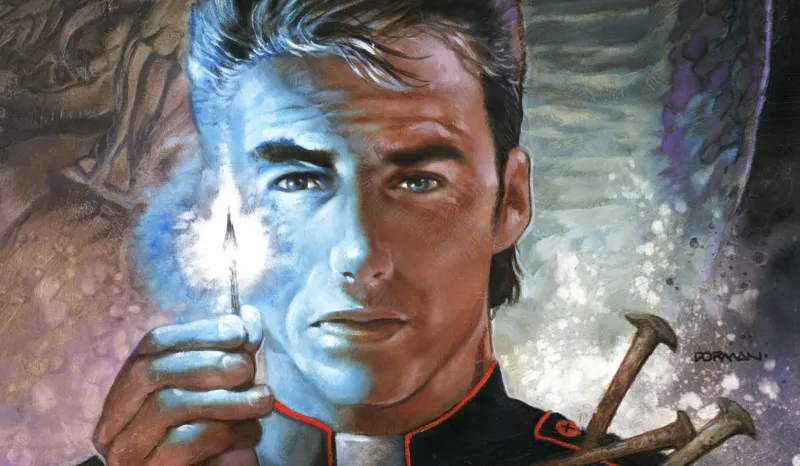
Together with a team of artists — Timothy Lim, Brett R. Smith, Matthew Weldon, and Dave Dorman, to name a few — Ernst brings to life characters who dedicate themselves to serving God after serving their country. They apply their experience of fighting in the physical world to, now, battling in the spiritual realm.
The series is already saving souls, both inside and outside of its pages.
“I love it when someone writes me and says that reading the books brought them back to the Catholic Church after they drifted away,” Ernst revealed. “Perhaps they haven’t gone to Mass in years, but something in the stories rekindled the flame of faith.”
Stories of selfless service
A Catholic veteran himself, Ernst shares something in common with his protagonists. He served as a mechanized infantryman in the ‘90s, leaving before the 9/11 terrorist attacks. He saw many of his friends go to war — and never return.
Ernst brings this background to his books, which follow the adventures of Retter (an Iraq/Afghanistan war veteran), Father Reginald Crane (a Vietnam veteran), and Detective Gregory Chua.
“My hope is that I’ve done right by the military community,” he said. “Selfless service and the willingness to lay down one’s life for another is a crucial component of the series.”
Ernst, who previously worked as a journalist in Washington, D.C., now splits his time between Reno, Nevada, and Missoula, Montana, while focusing on his graphic novels.
His first two — “Soulfinder: Demon’s Match” and “Soulfinder: Black Tide” — greet readers with vivid colors and rich Catholic symbolism. The second book, available in hardcover, shimmers with gilded pages — and even a glow-in-the-dark monster.
“Where are the Catholic creators who will attempt to pick up where G.K. Chesterton and J.R.R. Tolkien left off?” asks Douglas Ernst, the creator of the “Soulfinder” graphic novels. ICONIC Comics
There is a dramatic reality at the core of these works of fiction. The series illustrates Catholic priests not only as courageous heroes but also as imperfect human beings — men who may fall, but always pick themselves back up, driven by a desire to do the right thing. Along the way, their personality (and sense of humor) shines through the narrative.
Available through ICONIC Comics, the first two volumes also appear on AmazonKindle. In January, both made No. 1 on Amazon’s list of new releases in “Religious Graphic Novels.”
Inspired by Catholic writers
Ernst — who learned to read by devouring the adventures of Spider-Man, Iron Man, Daredevil, and Captain America as a boy — began his series after encountering mainstream comic books filled with moral relativism.
“Where are the Catholic creators who will attempt to pick up where G.K. Chesterton and J.R.R. Tolkien left off?” he asked. “That’s a tall task, but the culture will continue to drift into dangerous waters if Catholic writers and artists do not enter as many creative places as possible.”
Ernst shared what he did to prepare for the books, to ensure that they were theologically sound.
Being a “cradle Catholic” helped, he admitted, in addition to consulting with other Catholics, including a priest. His stories, he said, have been inspired by the works of St. Francis de Sales, Father Gabriele Amorth, St. Thomas Aquinas, St. Catherine of Siena, and others.
Ernst began the series after organizing a hugely successful crowdfunding campaign. He also credits his success to working with talented artists and to Word on Fire, Bishop Robert Barron’s media ministry, which has featured his work in blog and YouTube interviews.
A ‘PG-13’ advisory
Teenagers and adults seeking classic storytelling with “good vs. evil” seem to enjoy Soulfinder, Ernst said of his series, which he rates as “PG-13.” This is because, among other things, the series addresses a dark subject matter.
In his first book with artist Timothy Lim, also a practicing Catholic, a black mass scene involves a naked woman.
“She is nude, but there’s shadows where there needs to be shadows,” Ernst pointed out the strategic shading over her body. “It’s also shown as a bad thing.”
While the series is for more mature readers, it offers content for Catholics and non-Catholics alike.
“Most Catholic characters in modern comics and in Hollywood tend to be cartoonish version of the Faith,” he said.
His series, he emphasized, is different.
“It makes me incredibly happy when readers who are not Catholic say that these stories show a side of our faith that they have never encountered before.”
Third book on the way
Ernst told CNA the third installment of the series is in production.
“‘Soulfinder: Infinite Ascent’ takes our heroes to the other side of the world to apprehend a rogue member of the CIA who has evaded capture through supernatural means,” Ernst told CNA. “The U.S. government was so impressed with Father Retter and his friends regarding their success in ‘Soulfinder: Black Tide’ that it returns to them once again to clean up a global network of occultists.”
While there is no official release date yet, Ernst expects the book to be colored and lettered in March. From there, it will be sent to the printer.
“The story, at its core, focuses on the loss of loved ones, grief, and the need for forgiveness,” Ernst hinted. “The key to saving the day hinges on one character’s ability to forgive others for their trespasses against him.”
The volume will include a bonus story, “Soulfinder: War Cry,” which takes place at Arlington Cemetery.
In the end, Ernst hopes that these books will bring him, and his readers, closer to heaven.
“I know that one day I will stand before my Creator and I’ll have to give an account of what I’ve done with the talents I’ve been given,” he said. “I hope that my creative team has done its small part in saving souls while simultaneously entertaining readers.”
Statue of St. Peter in front of St. Peter’s Basilica. / Credit: Vatican Media
CNA Staff, Nov 17, 2023 / 15:06 pm (CNA).
The Vatican Dicastery for the Doctrine of the Faith (DDF) in response to a question from a Filipino bishop recently reaffirmed the long-standing position of the Catholic Church that being an active Freemason constitutes a grave sin.
“Active membership in Freemasonry by a member of the faithful is forbidden,” said the letter, signed by Pope Francis and DDF Prefect Cardinal Victor Fernández.
The dicastery sent the letter to Bishop Julito Cortes of the Diocese of Dumaguete, who asked the Vatican for guidance on how to approach the “very significant” number of Filipino Catholics enrolled in Freemasonry and “a large number of sympathizers and associates who are personally convinced that there is no opposition between membership in the Catholic Church and in Masonic lodges,” according to the dicastery document.
In addition to reaffirming the Church’s teaching on Freemasonry, the dicastery encouraged Filipino bishops to conduct catechesis explaining why Catholicism and Freemasonry are irreconcilable.
Why is the Church against Freemasonry?
The first papal condemnation of Freemasonry came from Pope Clement XII in 1738, but it has been reiterated by numerous popes over the past three centuries. The pronouncement was in Clement’s papal bull titled In Eminenti.
In this bull, Clement commented on the secrecy of Masonic lodges and the “host of grievous punishment” received when violating the oath of secrecy. The bull did not delve into many specific objections to Masonic practices but concluded, based on “certain knowledge and mature deliberations,” that “all prudent and upright men have passed the same judgment on them as being depraved and perverted.”
Pope Leo XIII greatly expanded on the Church’s teaching nearly 150 years later in his 1884 papal encyclical Humanum Genus. The encyclical detailed why Freemasonry is irreconcilable with Catholicism and accused the Freemasons of “planning the destruction of the holy Church publicly and openly” and holding to doctrines that contradict Church teaching.
According to Leo, Freemasonry adheres to naturalism, which he says is the idea that “human nature and human reason ought in all things to be mistress and guide.” He adds that “they deny that anything has been taught by God; they allow no dogma of religion or truth which cannot be understood by the human intelligence, nor any teacher who ought to be believed by reason of his authority.”
The encyclical expands on the naturalism of Freemasonry, noting that people of all religions can become freemasons and that religion is “held as an indifferent matter and that all religions are alike,” which ruins “all forms of religion, and especially of the Catholic religion, which, as it is the only one that is true, cannot, without great injustice, be regarded as merely equal to other religions.”
Leo says that Freemasons desire to secularize marriage as simply civil contracts, desire that children be left to choose their own religion when they come of age instead of receiving proper religious instruction, and desire that governments refuse to recognize God. He adds that this proposed secularization seeks to eliminate fundamental truths from society.
“If these be taken away, as the naturalists and Freemasons desire, there will immediately be no knowledge as to what constitutes justice and injustice, or upon what principle morality is founded,” Leo says. “And, in truth, the teaching of morality which alone finds favor with the sect of Freemasons, and in which they contend that youth should be instructed, is that which they call ‘civil,’ and ‘independent,’ and ‘free,’ namely, that which does not contain any religious belief.”
Which Freemason actions and practices promote naturalism and indifferentism?
Freemasons do not consider Freemasonry to be a religion; rather, they accept members from various religions, including Islam, Judaism, and Christianity. Yet, Freemasons do have altars at their lodges, they engage in secret rituals, and they say prayers to a generic conception of God, which they often call the “Great Architect of the Universe.”
This practice itself promotes religious indifferentism, but Freemasonry is very decentralized and does not adhere to a specific body of texts that declare all religions to be equal. Some prominent and influential Freemasons, however, have more clearly articulated support for indifferentism toward religion.
Albert Pike, who was the sovereign grand commander of the supreme council of the southern jurisdiction of the Scottish Rite of Freemasonry in the late 1800s, wrote a book called “Morals and Dogma,” which was given to 14th-degree Masons under that jurisdiction for about a century. His writings draw supposed connections between various religions and promote indifferentism.
“We do not undervalue the importance of any truth,” Pike says. “We utter no word that can be deemed irreverent by any one of any faith. We do not tell the [Muslim] that it is only important for him to believe that there is but one God, and wholly unessential whether [Muhammad] was his prophet. We do not tell the Hebrew that the Messiah whom he expects was born in Bethlehem nearly two thousand years ago; and that he is a heretic because he will not so believe. And as little do we tell the sincere Christian that Jesus of Nazareth was but a man like us, or his history but the unreal revival of an older legend.”
Freemasonry has also used political influence throughout Europe and the Americas over the centuries to push a secularization of society and to diminish the influence of the Catholic Church.
For example, in his 1873 encyclical Etsi Multa, Blessed Pope Pius IX detailed Masonic political attacks on the Church in Italy, Switzerland, and Germany. He referred to the Masonic “deceits and machinations” as forming “the synagogue of Satan” in reference to the second and third chapters of the Book of Revelation.
The encyclical touches on attacks against Catholic education, specifically the Gregorian University in Rome being “suppressed and abolished.” Regarding Switzerland, it discusses the passage of anti-Catholic laws, state intrusion into Church matters, and “the violent banishment of our venerable brother Gaspar, bishop of Hebron and vicar apostolic of Geneva.” It also details the “persecution set in motion” against Catholics and the suppression of religious freedom in the German Empire, particularly in Prussia.
“Apply all your effort to protect the faithful committed to your care against the snares and contagion of these sects,” Pius urges the clergy. “Bring back those who have unhappily joined these sects. Expose especially the error of those who have been deceived or those who assert now that only social utility, progress, and the exercise of mutual benefits are the intention of these dark associations.”
Pius adds that these decrees are “not only [in reference] to Masonic groups in Europe but also those in America and in other regions of the world.”
In Mexico as recently as 2007, the Masonic Grand Lodge of the Valley of Mexico fought efforts against the Church gaining authority over its own schools and communications. Prominent Freemasons played a major role in the Mexican revolution and other Latin American revolutions that diminished Church influence.
What does canon law say about Freemasonry?
Prior to 1983, the Code of Canon Law explicitly stated that if a Catholic joins the Freemasons, that person incurs an automatic excommunication that can only be lifted by the Holy See. This applied not just to the Freemasons but to any group that engages in plots against the Church.
“Those giving their name to Masonic sects or other associations of this sort that machinate against the Church or legitimate civil powers contract by that fact excommunication simply reserved to the Apostolic See,” canon 2335 of the 1917 Code of Canon Law reads.
The 1983 revision of the Code of Canon Law avoided a specific mention of Freemasonry and removed the penalty of automatic excommunication but maintained its ban on joining any groups that plot against the Church.
“A person who joins an association which plots against the Church is to be punished with a just penalty; one who promotes or takes office in such an association is to be punished with an interdict,” canon 1374 of the current Code of Canon Law reads.
Although the new canon did not explicitly reference the Freemasons, the Congregation for the Doctrine of the Faith issued a declaration on the Freemasons within the same year, clarifying that despite a change in the wording, there has been no change to the Church’s opposition to Freemasonry and that joining any Masonic association is still a grave sin that bars one from receiving communion.
“Therefore the Church’s negative judgment in regard to Masonic association remains unchanged since their principles have always been considered irreconcilable with the doctrine of the Church and therefore membership in them remains forbidden,” the document reads. “The faithful who enroll in Masonic associations are in a state of grave sin and may not receive holy Communion.”
CNA Staff, Mar 19, 2021 / 08:00 am (CNA).- Catholics in Poland launched a week of prayer for the protection of life on Friday, the feast of St. Joseph.
The week-long pro-life initiative, starting on March 19, is supported by Catholic bishops in dioces… […]





Leave a Reply