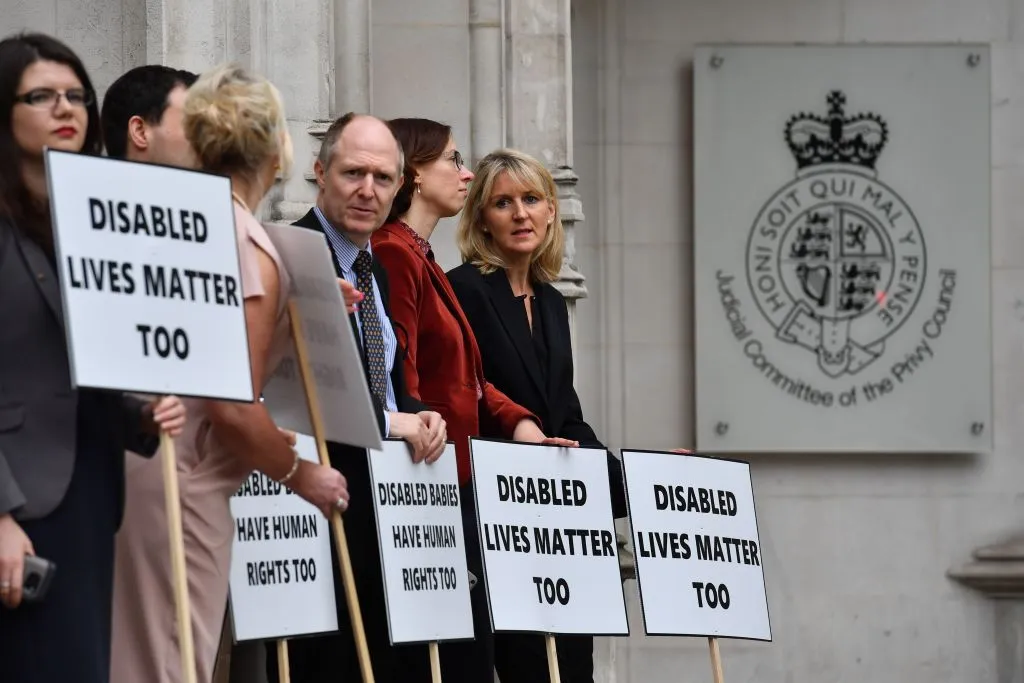
London, England, Jun 7, 2018 / 04:23 pm (CNA/EWTN News).- The UK Supreme Court threw out a case challenging Northern Ireland’s abortion law on Thursday, saying the commission which brought the case does not have standing to do so. However, the judges also said the current law violates the European Convention on Human Rights.
The challenge was brought by the Northern Ireland Human Rights Commission. Abortion is allowed in Northern Ireland only if the mother’s life is at risk, or if there is risk of permanent, serious damage to her mental or physical health.
Lord Mance, delivering the judgement June 7, said that had the commission the competence to bring the challenge, “I would have concluded, without real hesitation at the end of the day, that the current Northern Ireland law is incompatible with article 8 of the [European human rights] convention insofar as it prohibits abortion in cases of fatal foetal abnormality, rape and incest but not insofar as it prohibits abortion in cases of serious foetal abnormality.”
Four of the seven judges agreed that Northern Ireland abortion law is incompatible with the ECHR in cases of fatal fetal abnormality, rape, and incest. A fifth agreed it it incompatible only in casese of fatal fetal abnormality.
One of the justices, Lord Kerr, said that the court unanimously agreed that banning the abortion of unborn children with serious, but not fatal, abnormalities is compatible with the ECHR: “Many children born with disabilities, even grave disabilities, lead happy, fulfilled lives. In many instances they enrich and bring joy to their families and those who come into contact with them. Moreover the difficulty in devising a confident and reliable definition of serious malformation we regarded as a potent factor against a finding of incompatibility.”
Kerr also said that “to require in every instance” a woman to carry to term a child conceived in incest “could not … be considered as having struck the right balance between her rights and those of society.”
And with respect to children conceived in rape, Kerr stated: “A woman is potentially responsible for the child once born under a relationship which may continue for the rest of her life. For these reasons, we concluded that the blanket ban on abortion in cases of rape was plainly disproportionate.”
The court’s ruling signalled that while it could not strike down the law with the challenge from the human rights commission, it would were the case presented by a woman who was pregnant as a result of rape or incest, or who was carrying a child with a fatal abnormalities.
“The judges made absolutely clear that if a woman [who had suffered such a case] was brought forward they would find that our laws are incompatible with human rights,” said Les Allamby, the head of the NIHRC, the Guardian reported.
Legislators may also consider changing the law. Kerr noted that while the decision is not binding, “it must nevertheless be worthy of close consideration” by legislators.
The matter could be taken up by either the Northern Ireland Assembly or the Parliament of the United Kingdom.
The Northern Ireland Assembly is currently suspended. The Democratic Unionist Party, the largest party, is opposed to changing the law. Sinn Féin, another prominent party in Northern Ireland, backs a liberalization of the abortion law.
Bills to legalize abortion for fatal fetal abnormality or rape or incest failed in the assembly in 2016.
British prime minister Theresa May has said abortion should be a devolved issue for Northern Ireland. The Secretary of State for Northern Ireland, Karen Bradley, said the government is “carefully considering” the court’s decision and that it “will be clearly heard by this house and politicians in Northern Ireland.”
The NIHRC hopes the British Parliament will change Northern Irish law “without delay”. The Northern Ireland director of the Royal College of Midwives made a similar comment.
In June 2017, May’s government announced that Northern Irish women would be able to procure free National Health Service abortions in England.
Peter Lynas, spokesman for the pro-life group Both Lives Matter, commented that “The Northern Ireland Assembly had a full debate on this in 2016 and didn’t want to make any changes to the law. It shouldn’t be over-ridden by Westminster. We welcome this ruling. The NIHRC did not have standing in this case. Any wider move to decriminalisation is off the table now.”
The push for the legalization of abortion in Northern Ireland is not a new campaign, and has gained traction with the overturn of an abortion ban in the Republic of Ireland only weeks ago.
On May 28, abortion activists gathered at the main court buildings in Belfast to protest the country’s pro-life laws, and several women publicly took abortion pills.
However, many pro-life groups in the area have been fighting against the liberalization of abortion laws, emphasizing the importance of fighting for the right to life.
“It is so incredibly important to lobby for life at this present point in time because of the stark threat to unborn children here as Northern Ireland faces a great deal of political instability,” said Precious Life, a pro-life group in Northern Ireland, in August 2017.
“Unborn children cannot speak for themselves so they need us to be their voice.”
 […]
[…]



Leave a Reply