

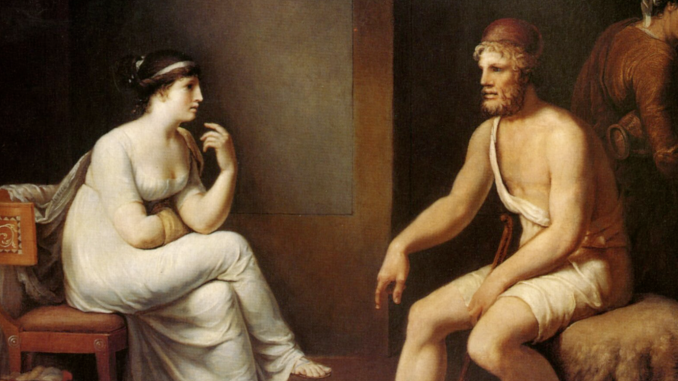
The Odyssey is one of the oldest and most lasting works in Western literature, so it’s no surprise that Christopher Nolan is the latest in a long line of people–authors, artists, and filmmakers–who seek to “adapt” it. Whether Nolan’s work is, indeed, a good adaptation of the original is both a separate question and one open to debate.
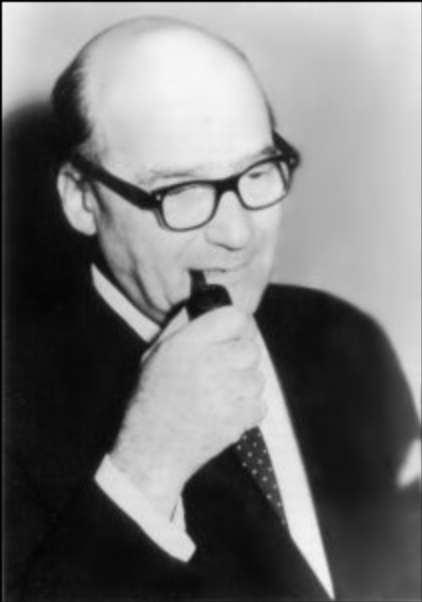
Let me, instead, focus on another adaptation. Polish author and dramatist Roman Brandstaetter (1906-1987) grew up in a solidly Jewish home, his grandfather a distinguished rabbi. Thoroughly immersed in Judaism, he quickly made a mark for himself in the 1930s as a Polish and Jewish thinker and writer. A process began during World War II in Jerusalem that resulted in Brandstaetter’s postwar baptism. He refused to call it a “conversion” because he insisted that his entry into Catholicism was not a turning from his Jewish roots but their fulfillment. His most notable work is a four-volume work, Jezus z Nazaretu [Jesus of Nazareth], whose life he retells in Christian terms but also wholly grounded in the thought, mentality, and culture of a first-century Jew.
Brandstaetter would be included among the major writers of the 20th-century Polish literary canon. But that does not mean he was readily accepted nor had an easy time of things. Any author in post-World War II Poland would have to contend with the dictates of socialist thinking: an observant Catholic was already suspect. A Jew might also rub various people the wrong way: Catholics who doubted the authenticity of his faith; Communists who played the antisemitism card; Jews who thought Brandstaetter’s Christianity was a betrayal.
And still he persisted … and succeeded.
His literary corpus includes 20 plays, including several adaptations of classical Greek stories: Antigone, Medea, Iphigenia, and, of course, Odysseus. “Odys płaczący” [Odysseus Weeping] is one of his shorter plays, one that reconsiders the whole Odysseus legend, especially the legend of the hero, the patience of his wife, Penelope, and the fate of their son, Telemachus.
In the Homeric tradition, Odysseus is King of Ithaca, who goes to Troy to fight in the famous Trojan War. Despite a decade-long siege, Troy remained impregnable. In response, Odysseus devised the scheme of building a giant wooden horse to leave behind as a “gift.” The Trojans would bring into their city, allowing the Greeks hiding inside it to emerge and sack the place. Odysseus and his men plunder the city, intending to return to Greece with their booty.
Boastfully planning to return home, his return is impeded by the gods who punish his hubris, his men who make bad decisions, and his own tarrying. By the time he returns to Ithaca, he has been gone twenty years, his wife and home beset by suitors convinced he is dead who want to marry his wife and divide his wealth. In Homer’s version, Odysseus, together with his son, Telemachus, slays the suitors, and the home is happy ever after.
Brandstaetter presents a somewhat different reality in a four-character play: Odysseus, Penelope, Telemachus, and a Greek chorus.
For most of the play, Odysseus is presented as a “drifter,” a man unrecognized by his wife, who is busy spinning. (In Homer’s original, Penelope weaves a shroud. She puts off her suitors by saying she would marry once she finishes it–only to unweave it at night.) The Drifter is impressed by what he has observed of Penelope and Telemachus and relays news about Odysseus in the third person, including assuring Penelope that Odysseus loves her. She wants to believe him, but she also doubts whether he is just another enterprising soul with a story who hopes somehow to profit by it.
The course of the discussion, however, turns on a deeper question. Thomas Wolfe broached it in his great 1940 novel, You Can’t Go Home Again, when he answered negatively whether one can ever really go home again.
Penelope awaits a man who left twenty years ago. Her memory and vision of that man are, in a sense, frozen in time. A warrior king sallied forth from Ithaca to do epic battle, gain great loot, and return with riches and honor.
Would one imagine this drifter—whose “feet and clothing are covered in dust”—was that man?
Even before revealing himself, the Drifter asks Penelope, “Of which Odysseus do you speak?” Yes, he remembers the brave and handsome Odysseus who went off to Troy, spilling blood as liberally as wine. But does she want to know “how the Odysseus who wanders the world looks? … He is old and grey. The sunset is in his gaze. He is as tired as a shadow.”
He tells her bluntly that “a man living beyond the reach of our sight and our touch is but a cruel illusion,” the fossil of our memories but not necessarily the living human being. Like a pond in the palace of Ithaca that used to be surrounded by now desiccated cypresses, “they died because their souls were their own reflections in water that is not there today.”
As their conversation progresses, Penelope seems unshakably attached to the past. It moves beyond Odysseus and Penelope to their child and Penelope’s concerns that, unlike his father (or at least her memory of him), Telemachus is perhaps too sensitive to be a king. When the Drifter presses to speak to the boy and tell him about his encounters with his father, Penelope refuses … and the Drifter reveals who he is.
“I am Odysseus! I am Odysseus!” He confesses he has been “born twice.”
The first time was in Ithaca, the boy who grew up to be the hero that lay siege to Troy. The second was born the day “when I came to know the world’s hells. I experienced suffering and saw suffering so great that even the wisest among us could not … understand its magnitude.” He disavows the man who “murdered people for three days and three nights without interruption … [who] killed girls who were like young olive trees, [who] smashed the heads of infants on marble steps and killed the incapacitated elderly with a sword thrust in the back.”
“Born twice” alludes to the Christian mystery of being “born again”—something not possible by human agency but divine grace.
Penelope dismisses that man: “Leave! You are lying, drifter!” And that Drifter withdraws with but two words: “Farewell, Penelope!”
The play concludes with the Chorus asking Penelope, “Are the ladies to sit down at the looms and weave a linen wedding dress?” She answers no. “What do you intend to do?” the Chorus asks. “Wait for Odysseus!” “But that was Odyseeus, after all, Penelope.” The curtain drops as “Penelope sits down motionlessly, like a stone, full of the weight of choked back weeping.”
Brandstaetter’s adaptation perhaps reflects aspects of his own life. The author who made a name for himself as a distinguished Jewish writer in Hebrew in interwar Poland never went back to those days or those writings. That chapter of his life was like a closed book.
But the play is not primarily an autobiography. Odysseus the Returnee, the Drifter, is in some sense … Everyman. Everyman for whom life continues, even when those who have surrounded or known or think they have known him discover that the person they think they knew is gone.
How do we treat a person whose life has been changed by the passage of time? Do we accept what they have become? Or do we insist on forcing them into the Procrustean bed of our own preconceptions, as if time froze when they stepped out of our daily lives? How often do we overlay our expectations on another, and then reject the other because they continued to live?
How often are marriages and families burdened by the weight of past expectations, of ideas and persons which time has passed by? And, instead of receiving the moment as it is, how often do we try to yoke what is to expectations of what has been? And how often do those expectations accompany a refusal to forgive and forget the past to live in the present, the now?
Conversion itself also involves putting on a new man, a new man who may not meet the expectations of others accustomed to the old man.
The lessons of Odysseus remain vital some 2,700 years after the Odyssey may have been written. They remain vital because they illumine constant challenges of human life, not because they might be just fodder for action heroes. In that task, Brandstaetter’s “Odysseus Weeping” gives us grist for Christian reflection on a great, if flawed, pagan hero.
(Note: Brandstaetter’s “Odysseus Weeping” is untranslated from Polish; translations here are by the author, all rights reserved.)
If you value the news and views Catholic World Report provides, please consider donating to support our efforts. Your contribution will help us continue to make CWR available to all readers worldwide for free, without a subscription. Thank you for your generosity!
Click here for more information on donating to CWR. Click here to sign up for our newsletter.

Homer is vastly superior to all his lamentable literary imitators. And to the most recent clown using the title of one of his great works for a ridiculous film. Read Homer.
Yes, reading books offer greater depth and nuance than watching films. This film title–Odysseus–is not the same as the book–The Odyssey. In the US, the book is in the public domain, so there is no copyright restriction on using the name or the title. Dp you really think Nolan is a clown? Why? I presume you’ve seen the film so that you can qualify it as ridiculous? What about it led you to conclude so?
Error in above. The book title is the same as the film title.
Thank you, Professor, for this write-up, most specially the play and its author. I was wondering how Nolan would approach the epic.
Nolan is one of those rare directors who sees deeply and depicts his insights well. He was baptized Catholic but reportedly does not now practice. His films (Dunkirk, Interstellar, Dark Knight) are worthy although Dark Knight is a bit too dark. I’m thankful that his movies typically differ from the junk Hollywood serves as ‘art’ or ‘entertainment.’ The last film I saw was probably Dunkirk, so I’m looking forward to Odysseus.
No. We cannot go home again. Didn’t the epic’s happy ending seem somewhat unbelievable? Perhaps I should re-read it. The warrior Odysseus, returning home after so many unbelievably precipitous calamities, as the cause of his delay. All along, the inkling that he couldn’t easily return home after the war that he’d seen kept nudging me. Fought because of an unfaithful woman,—why would Odysseus have any reason to think Penelope would be any different?
I’m happy, looking forward to what I hope will be a thoughtful, wholesome, realistic story well done, in an air-conditioned theatre since Seattle is forecast to have 85 degree days most days next week.
Thanks again.
Excellent piece & reflection Dr. G.
And, instead of receiving the moment as it is, how often do we try to yoke what is to expectations of what has been? And how often do those expectations accompany a refusal to forgive and forget the past to live in the present, the now? (Grondelski).
A dynamic many of us suffer. Seeking to relive the past rather than the realization, We cannot alter history. The Apostle Paul made the point that he left the past behind and looked toward what’s ahead.
What Francis of Paola had to say in A.D. 1486 about the past is that resentful memories of evil, at least, are unnecessary baggage:
“Memory of an injury is itself wrong. It adds to our anger, nurtures our sin and hates what is good. It is a rusty arrow and poison for the soul. It puts all virtue to flight. It is like a worm in the mind: it confuses our speech and tears to shreds our petitions to God. It is foreign to charity: it remains planted in the soul like a nail. It is indeed a daily death” (Letter by Saint Francis of Paolo, in “Liturgy of the Hours,” for April 2 in Vol. II).
Thank you for the reference. I will use it.
Far be it for me to disagree with a saint, but it’s not always that simple. A grave injustice should never be forgotten. Opportunity to redress a past evil may present in the future where a resolution is an ultimate good for all souls involved.
Yes, there are occasions when remembrance of a persecution, injury inflicted upon us can be spiritually utilized in imitation of Christ by offering ourselves as an oblation for their conversion and salvation.
As such we contribute to the sufferings lacking by Christ for the Mystical Body (Col. 1:24). By our willingness to offer our sufferings for sinners, in specific those who have harmed us, we carry on the work of Christ in the world.
I don’t think St. John of the Cross would disagree when memories cause us to do good. I think those type of memories is what you are addressing…memories where you have caused an injustice?
Memories carrying negative loads because of others’ injustices toward us are problematic. If painful, injurious memories arouse wrath, thought of revenge, or other evils because of injustices we’ve suffered, we do well to allow their ‘purification’ so we may grow in union with Christ.
If we have been the cause of injustice toward others, yes, our resolve and remembrance may help redress and atone.
In both cases, St. John points to HOPE for the present and for the future which basically grants to God our efforts to heal.
I don’t think St. John of the Cross would disagree when memories cause us to do good. I think those type of memories is what you are addressing…memories where you have caused an injustice?
Memories carrying negative loads because of others’ injustices toward us are problematic. If painful, injurious memories arouse wrath, thought of revenge, or other evils because of injustices we’ve suffered, we do well to allow their ‘purification’ so we may grow in union with Christ.
If we have been the cause of injustice toward others, yes, our resolve and remembrance may help redress and atone.
In both cases, St. John points to HOPE for the present and for the future which basically grants to God our efforts to heal.
I’m no Christopher Nolan fanboy. Some of his movies have been disappointing. “IntersteLLar,” for example, began promisingly only to become increasingly ridulous to the point that I thought my eyes were going to roll right out of my head. So I approached “The Odyssey” with a bit of trepidation. But I have to say, Nolan really knocked this one out of the park, and I’m not going to fault him for taking a three year hiatus from filmmaking, as he says he plans to do. Sure, he could have stuck very strictly to the source material, including a lot more gore not to mention Odysseus’ year-long sexual romp with Circe. But that would have made for a MUCH longer and unmarketable film. Like Peter Jackson and his “Lord of the Rings” movies, Nolan made some hard choices in order to craft a convincing epic tale. It’s already outgrossed “Disclosure Day.” Again, this is an R-rated movie based on a Greek epic and it’s close to three hours long. Only Nolan could have made this into a box office guarantee. I thought it was absolutely magnificent.