


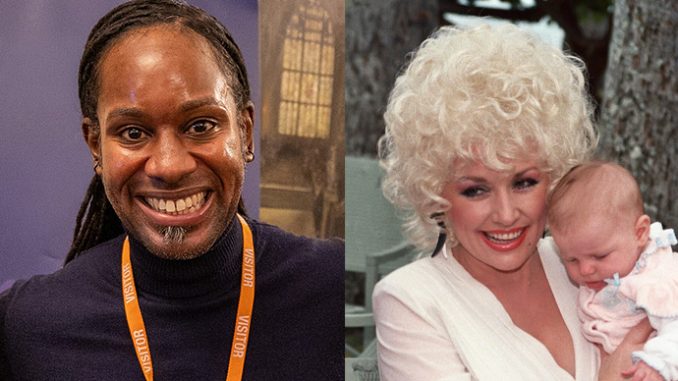
The August deaths of two very different people have dominated both traditional and social media.
On August 14, 41-year-old Cambridge University professor Jason Arday was found dead in his London home from apparent suicide. On August 25, 80-year-old American singer/songwriter Dolly Parton died after a short bout with cancer.
Both events precipitated a flurry of online commentary and mainstream analysis. Juxtaposed with one another, the respective deaths of these two public figures illustrate the difference between deception and transparency. The latter is liberating; the former is sometimes lethal. If the fabulist Arday was more like the fabulous Parton, the former would probably still be alive. He would not be famous, but neither would he be dead.
Jason Arday was appointed full professor in the Faculty of Education at Cambridge University at age 37, the youngest black professor in the history of this elite university. He was hailed as brave and triumphant, overcoming individual handicaps and social barriers, to ascend to the apex of the academic universe. He claimed to have been autistic, non-verbal until he was 11 years old, and unable to write anything other than his name at age 18. Despite these alleged impediments, by the age of 30, he was awarded a Ph.D. by little-known Liverpool John Moores University. This precipitated Arday’s rapid rise to celebrity in the UK, including numerous honorary degrees, appearances on popular UK television shows, and, eventually, his appointment at Cambridge.
As unlikely as this trajectory from illiteracy to academic superstar sounds, it was the more believable of the many fantasist stories that Arday told about himself. For example, he made all the following ludicrous claims, none of which withstand even the most cursory scrutiny: ran 30 marathons in 35 days, the last five on a broken leg (no documentation, no eye witness corroboration); ran 600 miles in 6 days (ditto); had brain surgery to remove a cancerous tumor a week before his dissertation defense, after which he forgot everything in his dissertation, but still passed his defense (no medical records can be found of any such surgery or cancer); visiting professorships at Ohio State, Coventry, Glasgow, and Nelson Mandela (South Africa) universities. All these institutions have denied his claim.
Despite the absurdity of all these claims and the paucity of any corroborating records, Hilary Cremin, Head of the Faculty of Education at Cambridge, celebrated Arday as “the best in the world, in terms of the research” he was doing. But it all began unravelling when Arday’s dissertation was proven to be largely plagiarized from an earlier thesis. This led to scrutiny of other academic papers, which also showed a pattern of wholesale plagiarism of the work of others.
Predictably, Arday and his supporters cried discrimination, complaining that he was a victim of a racist witch hunt. He sicced the police on journalists who merely asked him to clarify inconsistencies in his personal biography. He made false claims of being attacked by a knife-wielding intruder in his Cambridge office (there was no such attack) and of his family being sent a pig’s head at their home (again, it didn’t happen).
Initially, Cambridge doubled down in its defense of Arday, calling these inquiries into his fabulist claims “vile.” But as more and more stories were shown to be false, Cambridge was forced to open a formal investigation into his claims, prompting his sudden resignation on August 5. Nine days later, he was found dead in his South London home, from apparent suicide. Arday’s death is tragic. But it is not the fault of his critics. Rather, his blood is on the hands of his enablers, the racist faux academics who saw him not as a celebrated academic but as a totem of diversity, equity, and inclusion. In the hands of True Believers, DEI is a lethal weapon.
Don’t get me wrong. Arday was responsible for the lies he told, and, ultimately, death by his own hand. He is dead, in large part, because he was the apotheosis of narcissism. But if the racist university infrastructure at Cambridge and other U.K. institutions had not enabled Arday’s fantastically absurd claims, he would probably still be alive. It is more likely that he would be a primary school P.E. instructor (the field of his “Ph.D.”) than a world-famous “scholar.” But he would be alive.
The contrast of the fabulist Jason Arday to the fabulous Dolly Parton could hardly be starker. Born into poverty in East Tennessee, with little prospect of ever leaving her native Sevier County, Parton became perhaps the most important female country singer and musician in American history. Parton was beloved through virtually any lens of American public life through which one cares to view her life and career. Composer of perennial favorite songs, “Jolene,” “9 to 5,” and “I Will Always Love You” (among thousands of others), Parton forged a golden career from the raw ore of a self-described Appalachian hillbilly.
While many in the U.S. and around the world enjoy her music, it was Parton’s honesty and transparency that really won our hearts. Yes, she wore wigs, sported fake fingernails, and had numerous plastic surgeries. But in her case, these were not indicia of self-deception, but rather the careful cultivation of a transparent personality. She didn’t pretend about anything, including the various enhancements to her physical appearance. Rather, in a lifelong example of actual irony (an abused and misused term), Parton told us what role she was playing, without guile or deception.
She could be coy, of course. But even then, she told us so. She was the antithesis of narcissism.
But beneath the celebrity persona she created was the real life of an enormously talented singer/songwriter and perhaps the most generous philanthropist in American popular music. Using tens of millions of dollars of her own money, Parton leveraged her wealth and celebrity into an international reading and literacy program, known as Imagination Library. Over the 31 years of the program, the Imagination Library has distributed more than 300 million books to libraries and underprivileged households in the U.S., the U.K., Canada, the Republic of Ireland, and Australia.
Self-deception is among the most enervating practices in which we humans engage. Beginning with our primordial parents in the Garden of Eden, we can see that attempts to tell ourselves that we are something other than what we really are can be soul-destroying. And when we try to deceive others, soul-killing self-deception can lead to the premature death of the body, as well. Of course, as rational moral agents, we are responsible for the choices we make and the stories we tell. But when narcissistic impulses are aided and abetted by racist ideologues looking for trophies, self-deception is both encouraged and embellished. And, in the case of Jason Arday, it was lethal.
Fabulist Jason Arday achieved celebrity status through chronic self-deception, abetted by a racist ideological infrastructure, and died an untimely death. Fabulous Dolly Parton achieved celebrity through self-giving transparency and lived a full life. There’s a cautionary tale in both their stories.
If you value the news and views Catholic World Report provides, please consider donating to support our efforts. Your contribution will help us continue to make CWR available to all readers worldwide for free, without a subscription. Thank you for your generosity!
Click here for more information on donating to CWR. Click here to sign up for our newsletter.

Leave a Reply