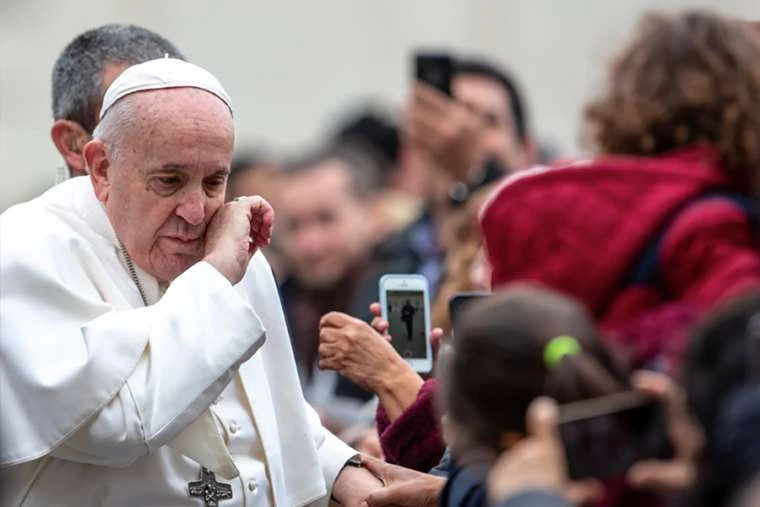
Pope Francis greets pilgrims before his general audience Feb. 26, 2020. / Daniel Ibanez/CNA.
Vatican City, Feb 23, 2023 / 02:45 am (CNA).
The Vatican said Thursday that Pope Francis is suffering from a heavy cold.
The Feb. 23 message said that due to a “strong cold,” the pope distributed copies of his speeches at two morning appointments, rather than read them aloud as usual.
Francis still took part in the two audiences: the first with young priests and monks from Eastern Orthodox Churches and the second with a delegation from the German NGO and non-profit Max Planck Society for the Advancement of Science.
The Vatican did not indicate whether there would be further changes to Pope Francis’ Feb. 23 schedule due to being under the weather.
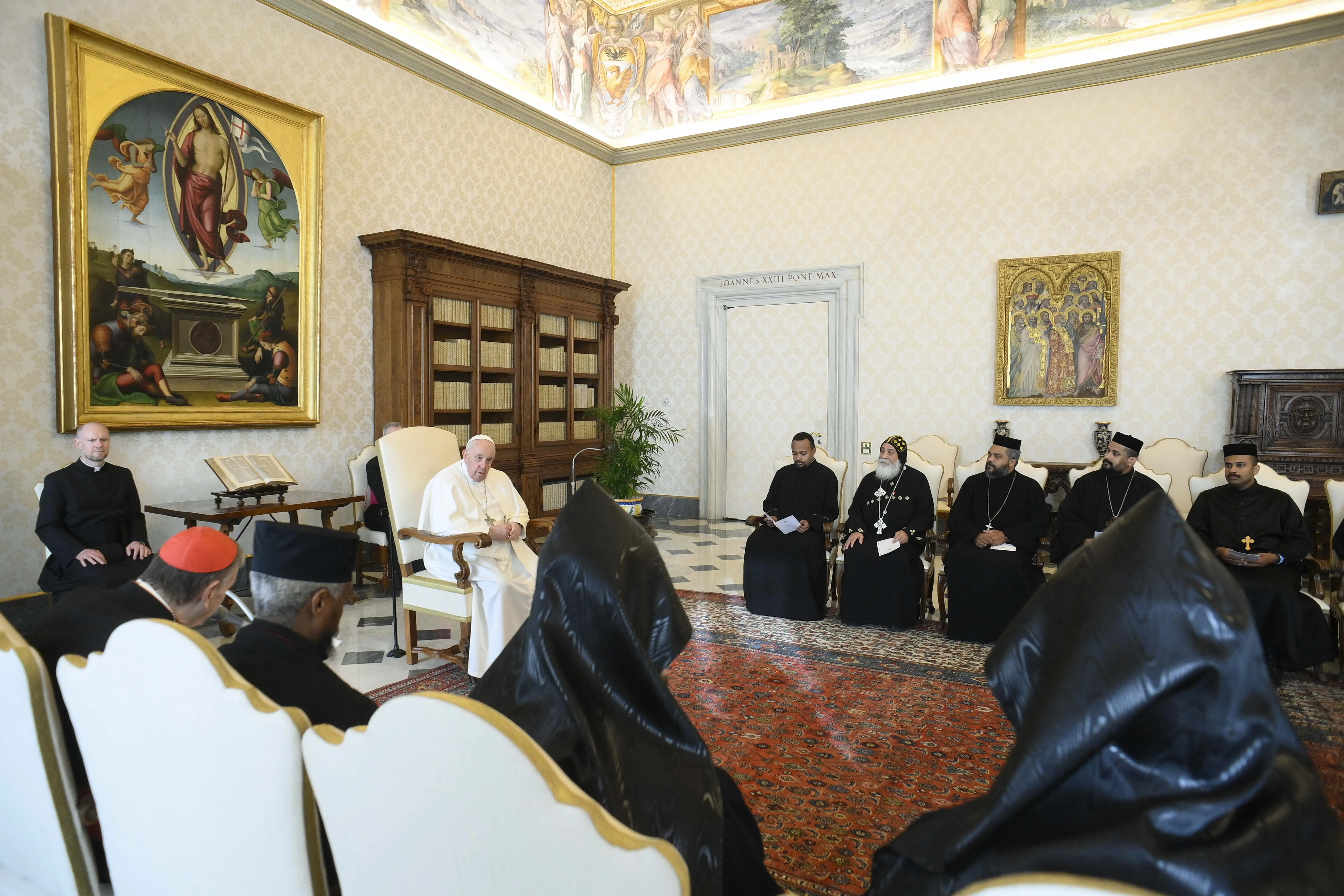
Pope Francis in an audience with young priests and monks of the Eastern Orthodox Churches on Feb. 23, 2023. Vatican Media.
On the afternoon of Feb. 22, the pope celebrated Ash Wednesday Mass at the 5th-century Basilica of Santa Sabina on Rome’s Aventine Hill.
It was his first time returning to the basilica since the start of Lent in February 2020.
Pope Francis’ schedule was also impacted by a cold in late February and early March 2020.
He was seen coughing and blowing his nose during his general audience and Ash Wednesday Mass Feb. 26, 2020.
Francis later canceled several appointments in favor of working from the Vatican’s Casa Santa Marta guesthouse, where he lives.
The Vatican said a few days later that the pope had tested negative for COVID-19 and was suffering from a “common cold.”
This story is developing.
If you value the news and views Catholic World Report provides, please consider donating to support our efforts. Your contribution will help us continue to make CWR available to all readers worldwide for free, without a subscription. Thank you for your generosity!
Click here for more information on donating to CWR. Click here to sign up for our newsletter.
Vatican City, Feb 10, 2020 / 11:34 am (CNA).- Pope Francis emphasized unity in a message sent Monday to bishops connected to the Focolare Movement, which is celebrating 100 years since the birth of its founder.
“The charism of unity is one of these graces for our time, which is experiencing a momentous change, and calls for a simple and radical spiritual and pastoral reform which brings the Church back to the ever new and current source of the Gospel of Jesus,” the pope said in the Feb. 10 message.
The pope referenced John 17:21, in which Christ prays, “so that they may all be one, as you, Father, are in me and I in you, that they also may be in us, that the world may believe that you sent me.”
“Through the charism of unity, fully attuned to the magisterium of the Second Vatican Ecumenical Council, the Holy Spirit concretely teaches how to live the grace of unity” according to Christ’s prayer, he said.
The message from Pope Francis was read aloud at the opening of a conference of seven cardinals and 137 Catholic bishops from 50 countries Feb. 10.
The bishops and cardinals are connected to the Focolare Movement and referred to as “friends” of the group. The meeting, titled “a charism at the service of the Church and humanity,” is taking place Feb. 10-12 in Loppiano, Italy.
The Focolare Movement is a Catholic organization focused on the principles of unity and fraternity; it began in northern Italy in 1943.
In 2020, the movement is celebrating the centenary of the birth of its founder, laywoman Chiara Lubich, whose cause for beatification was opened by the Vatican in 2015.
Lubich was born on Jan. 22, 1920 in Trento and died March 14, 2008 in Rocca di Papa, surrounded by members of the movement. In the days leading up to her death, she was visited by many people, including important political and religious leaders.
Her funeral was celebrated at St. Paul’s Outside the Walls in Rome and was attended by nearly 40,000 people.
In his message, the pope also spoke about the Holy Spirit’s invitation to choose Christ Crucified as the “compass of our ministry” and to become “one with everyone, starting from the least, from the excluded, from the discarded, to bring them light, joy, peace.”
“The Spirit opens the dialogue of charity and truth with every man and woman, of all cultures, religious traditions, ideal convictions, to build the new civilization of love in encounter,” he continued. “The Spirit puts us at the school of Mary, where we learn that what is worthy and remains is love.”
The president of the Focolare Movement, Maria Voce, sent a video message to the bishops’ meeting Feb. 10.
Voce said they want to promote “a lifestyle of fellowship and communion with Jesus among Catholic bishops from all over the world… Such a lifestyle contributes to making collegiality ever more effective and affective.”
More than 1,800 priests gathered with cardinals and bishops at St. Peter’s Basilica for the Holy Thursday Chrism Mass, April 17, 2025. / Credit: Daniel Ibáñez/CNA
Rome Newsroom, Apr 17, 2025 / 05:35 am (CNA).
On Holy Thursday, more than 1,880 priests, bishops and cardinals renewed the promises made at their ordinations during the Chrism Mass inside St. Peter’s Basilica.
Pope Francis delegated Cardinal Domenico Calcagno, a retired Vatican official who oversaw the Holy See’s management of real estate and investments until 2018, to preside over the Mass on April 17.
Calcagno read a homily written by Pope Francis, who did not attend the Mass due to his ongoing convalescence following a prior hospitalization for double pneumonia.
Cardinal Domenico Calcagno reads Pope Francis’ homily during the Chrism Mass at St. Peter’s Basilica, April 17, 2025. Credit: Daniel Ibáñez/CNA
“On Holy Thursday, when we renew the promises made at our ordination, we confess that we can read that history only in the light of Jesus of Nazareth,” Pope Francis wrote in the homily.
“Jesus, ‘who loves us and freed us from our sins by his blood’ (Rev 1:5) opens the scroll of our own lives and teaches us to find the passages that reveal its meaning and mission. If only we let him teach us, our ministry becomes one of hope, because in each of our stories God opens a jubilee: a time and an oasis of grace.”
Forty-two cardinals, 42 bishops and 1,800 priests living in Rome concelebrated the Mass. Holy Thursday marks the institution of the Eucharist and the sacrament of the priesthood at the Last Supper.
During the Vatican’s Chrism Mass, Calcagno blessed the oil of the sick, the oil of catechumens, and the chrism oil, which will be used in the diocese throughout the coming year.
The vessels of oil to be blessed during the Chrism Mass at St. Peter’s Basilica, April 17, 2025. Credit: Daniel Ibáñez/CNA
The oils were processed up the main altar of St. Peter’s in large silver urns as hymns from the Sistine Chapel Choir filled the basilica.
The cardinal prayed over the oil for the sick: “O God, Father of all consolation, who through your Son have willed to heal the infirmities of the sick, listen favorably to this prayer of faith: Send down from heaven, we pray, your Holy Spirit, the Paraclete, upon the rich substance of this oil, which you were pleased to bring forth from vigorous green trees to restore our bodies, so that by your holy blessing this oil may be for anyone who is anointed with it a safeguard for body, mind and spirit, to take away every pain, every infirmity and every sickness.”
The blessed oil will be used for the anointing of the sick in Rome throughout the year.
Chrism oil is used in the sacraments of confirmation, baptism and holy orders, as well as in the consecration of churches. Anointing with chrism signifies the full diffusion of grace.
“The sacred chrism that we consecrate today seals this mystery of transformation at work in the different stages of Christian life. Take care, then, never to grow discouraged, for it is all God’s work. So believe,” Pope Francis wrote.
“It is God’s work, not ours: to bring good news to the poor, freedom to prisoners, sight to the blind and freedom to the oppressed. If Jesus once found this passage in the scroll, today he continues to read it in the life story of each one of us,” he added.
Priests in white vestments renew their ordination promises during the Vatican’s Chrism Mass on Holy Thursday, April 17, 2025. Credit: Daniel Ibáñez/CNA
In his homily, Pope Francis also encouraged Catholics to pray especially for priests on Holy Thursday.
“Dear members of the faithful, people of hope, pray today for the joy of priests. May all of you experience the liberation promised by the Scriptures and nourished by the sacraments.
“Many fears can dwell within us and terrible injustices surround us, but a new world has already been born. God so loved the world that he gave us his Son, Jesus. He pours balm upon our wounds and wipes away our tears. ‘Look! He is coming with the clouds’ (Rev 1:7). His is the Kingdom and the glory forever and ever.”
The Vatican has announced that Pope Francis has personally delegated cardinals to preside over all of the Holy Week events.
Cardinal Giovanni Battista Re, dean of the College of Cardinals, will preside at the Easter Vigil in St. Peter’s Basilica. The Easter morning Mass in St. Peter’s Square will be presided over by Cardinal Angelo Comastri, vicar general emeritus of Vatican City.
On Good Friday, the celebration of the Passion will be led by Cardinal Claudio Gugerotti, prefect of the Dicastery for the Eastern Churches, and the Way of the Cross at the Colosseum will be led by Cardinal Baldassare Reina, vicar general of the Diocese of Rome.
The texts for the Stations of the Cross at the Colosseum on Good Friday were prepared personally by Pope Francis.
“The passion, death and resurrection of Jesus, which we are about to relive, are the soil that solidly sustains the Church and, within her, our priestly ministry,” Pope Francis wrote in his Holy Thursday homily.
One of 100 ancient churches identified for preservation by France’s Patrimony Foundation, this church is in Cachen, located within the Nouvelle-Aquitaine region of southwestern France. / Credit: Wikimedia Commons
CNA Staff, Jun 4, 2024 / 06:00 am (CNA).
The danger that has been threatening France’s religious heritage for decades is becoming a matter of concern to the authorities and the general public.
As experts estimate that the country loses a religious building every 15 days, the country’s leading historical preservation nonprofit “Fondation du Patrimoine” (“Patrimony Foundation”)has launched a campaign aimed at restoring a thousand buildings, the vast majority of which are Catholic, in rural areas of the country.
This is the first time that the nonprofit organization, founded in 1996 to promote French heritage, has launched such a major campaign to raise awareness and preserve religious monuments. As part of the campaign, the foundation released a list of the first 100 sites to benefit from renovation funding.
The grants are aimed primarily at religious buildings in municipalities with fewer than 10,000 inhabitants in mainland France and fewer than 20,000 inhabitants in the French overseas territories, which cannot be protected by the French state as historical monuments.
Since the French Revolution (1789), which nationalized clergy property, and the 1905 law separating church and state, most religious heritage has belonged to municipalities, which are often unable to meet the costs of maintaining the sites. The preservation of historic places of worship also tends to be at the bottom of their budget priorities.
Of the 45,000 Catholic sites in France, only 15,000 are classified as historical monuments, as the president of the French Religious Heritage Observatory pointed out in a 2021 interview with CNA. For its part, the Patrimony Foundation estimates that some 5,000 religious monuments are currently directly threatened with extinction.
This list of the 100 sites selected by the foundation — spread throughout the French territory and most of which required urgent work — represents just the first ambitious move in a vast project to rehabilitate some 1,000 religious buildings over the next four years. The aim is to raise a total of 200 million euros (about $218 million) through corporate and individual donations.
The first subscription, which runs until the end of 2025 and includes special tax deductions, currently stands at just over 2.6 million euros ($2.8 million), thanks to the participation of some 14,000 people.
While this sum is still a long way short of the 15 million expected for the first 100 monuments awaiting renovation, Patrimony Foundation officials are noticing a new awareness on the ground, which is tending to become more widespread as the need grows to enhance the value of rural life and all that can represent anchoring and rallying points for communities.
“Even if they no longer go to Mass, [the French] are attached to their monument, to the steeple that gives them their identity, that establishes a landmark in space. People don’t want us to do just anything with their church,” Guillaume Poitrinal, president of the Patrimony Foundation, told the weekly Le Point.
He also pointed to a “Notre-Dame effect” in this growing public awareness of the decay of France’s heritage, of which religious monuments form a substantial part. Following the fire at the famous Paris cathedral in 2019, the images of which stunned and moved the whole world, some 40 million euros ($44 million) had been donated via the same Patrimony Foundation by 236,000 different donors.
If the campaign achieves its objectives, it could pave the way for additional large-scale initiatives, marking a real turning point in mindsets and heritage preservation policies.
Wishing the Holy Father good health. God bless.
Prayers for a return to health.
