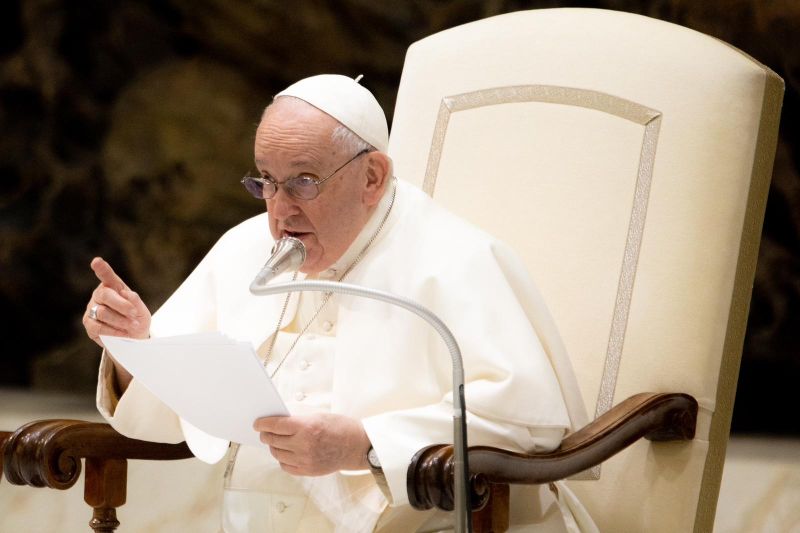
Pope Francis speaks during his weekly general audience on Ash Wednesday Feb. 22, 2023. / Daniel Ibanez/CNA. See CNA article for full slideshow.
Vatican City, Feb 22, 2023 / 03:00 am (CNA).
Pope Francis said Wednesday that the traditions of the Church should not be based on opinion or ideological leanings, but on whether they favor the proclamation of the Gospel.
“Everything in the Church must be conformed to the requirements of the proclamation of the Gospel; not to the opinions of the conservatives or the progressives, but to the fact that Jesus reaches people’s lives,” he said Feb. 22.
Francis asked: When there are ideological divisions in the Church, such as an identification as conservative or progressive, “where is the Holy Spirit?”
“Be careful,” he warned. “The Gospel is not an idea; the Gospel is not an ideology. The Gospel is a proclamation that touches the heart and makes the heart change. You are making the Gospel a political party, an ideology, a club…”
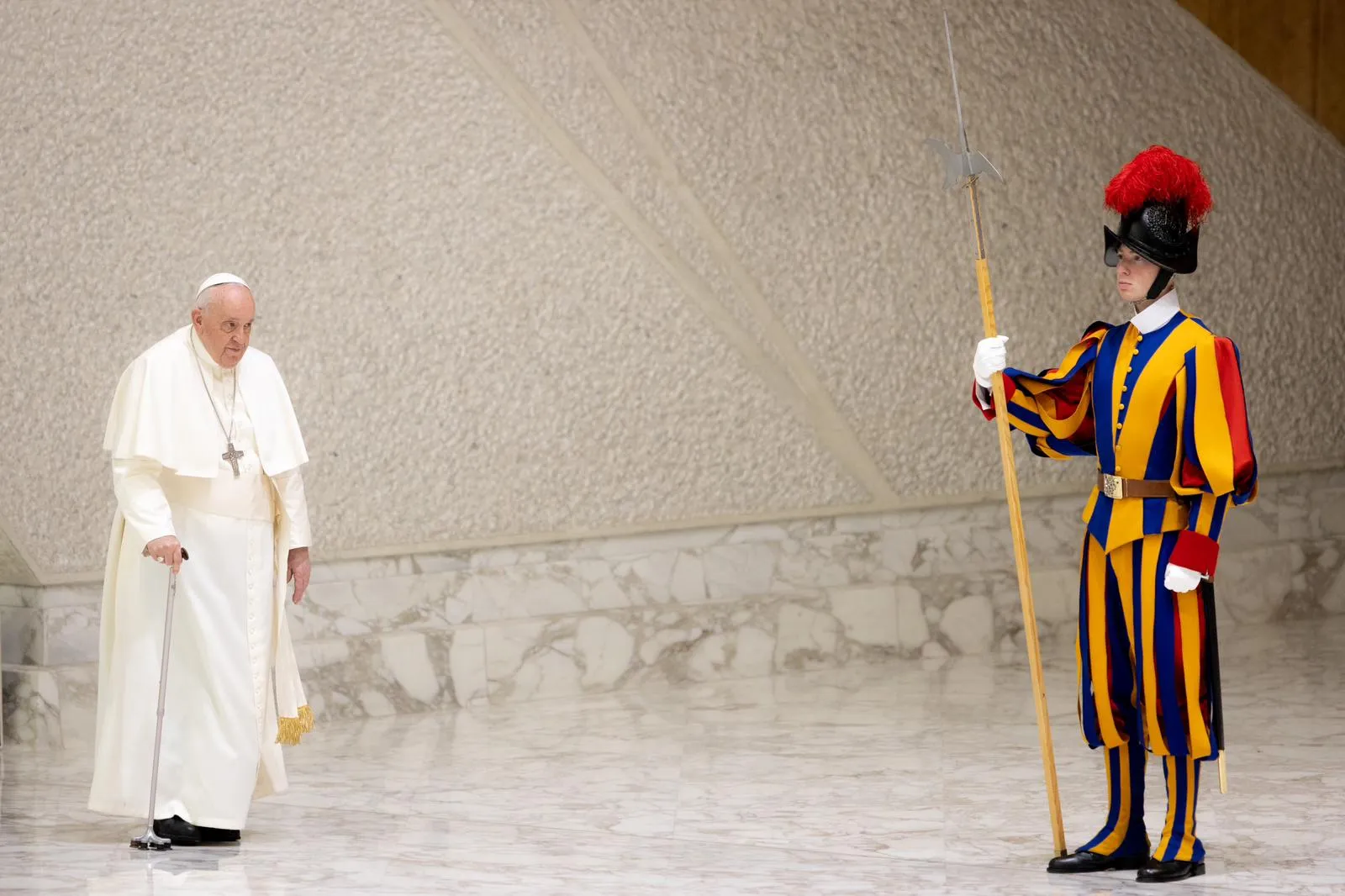
Pope Francis arrives at the Paul VI Hall for his weekly general audience on Ash Wednesday Feb. 22, 2023. Daniel Ibanez/CNA
The pope’s weekly general audience took place in a full Paul VI Hall on Ash Wednesday, the first day of the penitential Lenten season.
Speaking to pilgrims from around the world, he said, “Every choice, every use, every structure, and tradition [of the Church] is be evaluated on the basis of whether they favor the proclamation of Christ.”
“In this way the Spirit sheds light on the path of the Church, always. In fact, he is not only the light of hearts; he is the light that orients the Church: he brings clarity, helps to distinguish, helps to discern,” he said. “This is why it is necessary to invoke him often; let us also do so today, at the beginning of Lent.”
To illustrate his point, Pope Francis recalled “a pivotal moment” from the early Church, recounted in the Acts of the Apostles.
The apostles were worried about what to do with pagans who became Christian, but were not part of the Jewish people: “Were they or were they not bound to observe the prescriptions of the Mosaic Law?”
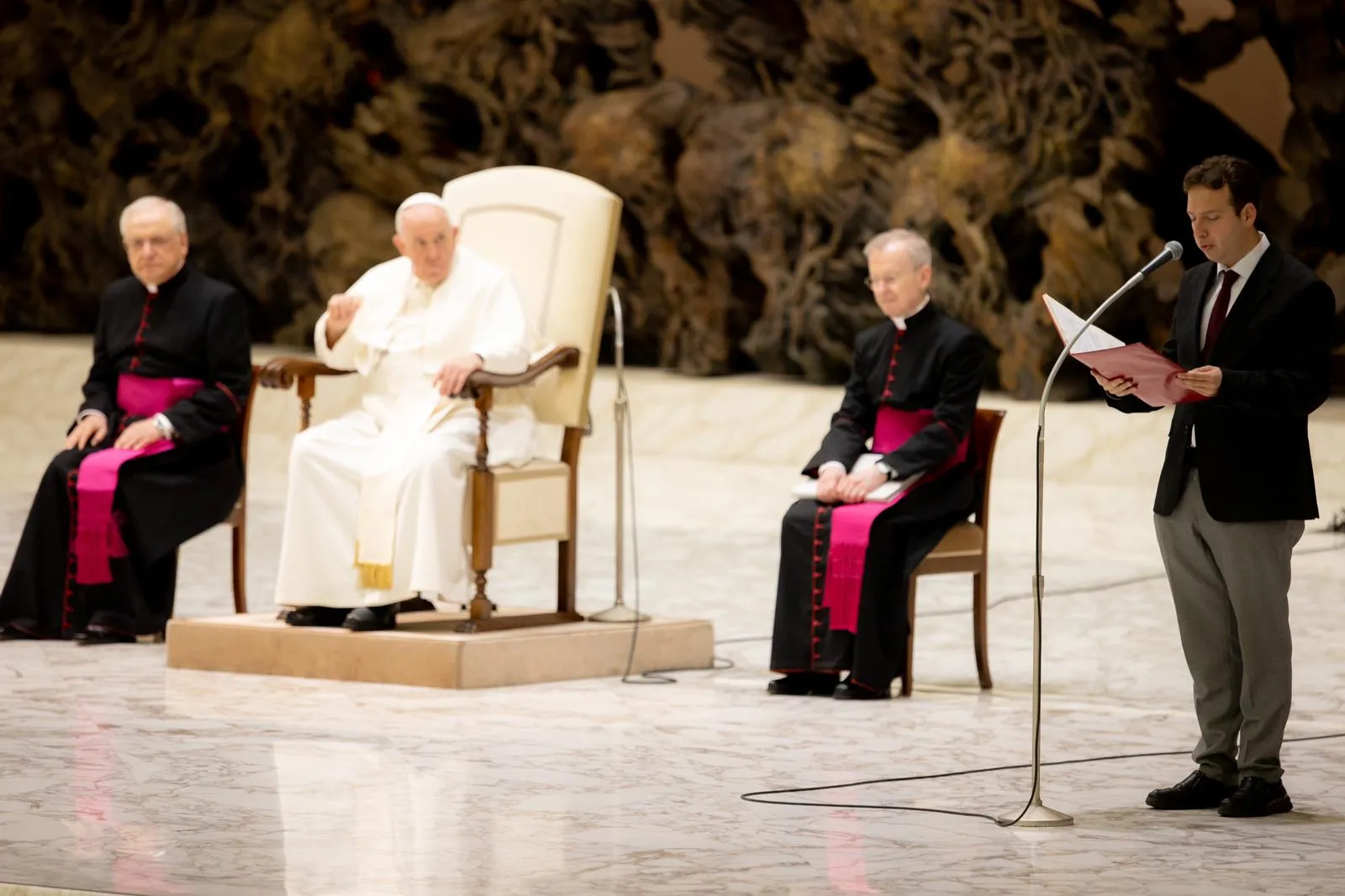
Pope Francis listens to a scripture reading during his weekly general audience on Ash Wednesday Feb. 22, 2023. Daniel Ibanez/CNA
To resolve this problem, the apostles gathered in what was called the Council of Jerusalem, the first Church council in history, he explained.
The apostles “might have sought a good compromise between tradition and innovation: some rules are observed, others are left out,” he said, but what they did instead was “adapt to the work of the Spirit.”
“And so,” he continued, “removing almost every obligation related to the Law, they communicate the final decisions, made — and they write this — by ‘the Holy Spirit and by us’ (cf. Acts 15:28).”
“This is how the apostles always act,” he underlined. “Together, without being divided, despite having different sensitivities and opinions, they listen to the Spirit.”
Pope Francis asked everyone to think about whether they pray often to the Holy Spirit, or if they only speak to Jesus and the Father, or invoke the Virgin Mary and the saints, in their prayers.
“Because, as Church, we can have well-defined times and spaces, well-organized communities, institutes and movements, but without the Spirit, everything remains soulless,” he said. “The organization … is not enough. It is the Spirit who gives life to the Church.”
“The Church, if it does not pray to him and invoke him, closes in on itself, in sterile and exhausting debates, in wearisome polarizations, while the flame of the mission is extinguished,” he added.
The pope called it sad to see the Church operate as if it is just a parliament, when it is really a community of men and women who believe in and proclaim Jesus Christ, guided by the Holy Spirit, not their own reason.
“The Spirit makes us go out, urges us to proclaim the faith in order to confirm ourselves in the faith, to go on mission to discover who we are,” he said. “That is why the Apostle Paul recommends: ‘Do not quench the Spirit’ (1 Thessalonians 5:19).”
“Let us pray to the Spirit often, let us invoke him, let us ask him every day to kindle his light in us,” he urged. “Let us do this before each encounter, to become apostles of Jesus with the people we find.”
If you value the news and views Catholic World Report provides, please consider donating to support our efforts. Your contribution will help us continue to make CWR available to all readers worldwide for free, without a subscription. Thank you for your generosity!
Click here for more information on donating to CWR. Click here to sign up for our newsletter.
Washington, D.C. Newsroom, Mar 7, 2022 / 15:07 pm (CNA).
The U.S. Court of Appeals for the 3rd Circuit recently ruled in favor of a Christian couple in New Jersey seeking legal protection to welcome foster children into t… […]
Attendees at a Mass for the feast of the Santo Niño de Cebú at the Cathedral of Our Lady of the Angels in Los Angeles, Calif., Jan. 16, 2022. / Victor Alemán/Angelus News
Los Angeles, Calif., Jan 17, 2022 / 17:42 pm (CNA).
Archbishop Gomez of L… […]
“What’s the Eucharist?” Kent Shi, a 25-year-old Harvard graduate student, asked that question when he attended eucharistic adoration for the first time. The answer put him on a path to conversion. / Julia Monaco | CNA
Cambridge, Massachusetts, Apr 16, 2022 / 09:03 am (CNA).
One convert’s journey to Catholicism began with an invitation to an ice-cream social.
Another says he instantly believed in the Real Presence the moment someone explained what the round object was that everyone was staring at during eucharistic adoration.
For a third, the poems of T.S. Eliot — and a seemingly random encounter with a priest on a public street — led to deeper questions about truth and faith.
Their paths differed but led them to the same destination: St. Paul’s Catholic Church in Cambridge, Massachusetts, where they are among 31 people set to be fully initiated into the Catholic Church during the Easter vigil Mass on Saturday, April 16.
That number of initiates is a record high for St. Paul’s, a nearly century-old Romanesque-style brick church whose bell tower looms over Harvard Square.
A scheduling backlog caused by the COVID-19 pandemic is partly responsible for the size of this year’s group of catechumens (non-baptized) and candidates (baptized non-Catholics.) But Father Patrick J. Fiorillo, the parochial vicar at St. Paul’s, believes there’s more to it than that.
“There’s definitely a significant segment of people who started thinking more deeply about their lives and faith during COVID-19,” Fiorillo said. “So, coming out of Covid has given them the occasion to take the next step and move forward.”
Fiorillo is the undergraduate chaplain for the Harvard Catholic Center, a chaplaincy based at St. Paul’s for undergraduate and graduate students at Harvard University and other academic institutions in the area. This year, 17 of the 31 initiates are Harvard students.
“Everybody assumes that, because this is the Harvard Catholic Center, that everybody here is very smart and therefore has a very highly intellectual orientation towards their faith,” Fiorillo told CNA.
“That is definitely true of some people. But I would say the majority are not here because of intellectually thinking their way into the faith. Some are. But the majority are just kind of ordinary life circumstances, just seeking, questioning the ways of the world, and just trying to get in touch with this desire on their heart for something more,” he said.
Fiorillo says welcoming converts into the Church at the Easter vigil is one of the highlights of his ministry.
“It’s an honor. It gives me hope just seeing all this new life and new faith here. So much in one place,” he said.
“When I tell other people about it, it gives them hope to hear that many young people are still converting to Catholicism, and they’re doing it in a place as secular as Cambridge.”
Prior to the Easter vigil, CNA spoke with five of St. Paul’s newest converts. Here are their stories:
‘This is what I’ve been looking for’
Katie Cabrera, a 19-year-old Harvard freshman, told CNA that she was excited to experience the “transformative power of Christ through his body and blood” at Mass for the first time at the Easter vigil.
A native of Dorchester, Massachusetts, she said she was baptized as a child and comes from a family of Dominican immigrants. Her father, who grew up in an extremely impoverished area, lacked a formal education, but always kept the traditions of the Catholic faith close to him in order to persevere in difficult times.
Her father’s love for her and his Catholic faith deeply inspired Cabrera, and served as an anchor for her faith throughout her life.
Growing up, however, Cabrera attended a non-denominational church with her mother. Because she felt the church’s teachings lacked an emphasis on God’s love and mercy, Cabrera eventually left.
“Even though I Ieft, I always knew that I believed in God,” Cabrera said. “So, I was at a place where I felt kind of lost, because I always had that faith, but I didn’t know what to do with it.”
“There was a void that existed in my heart,” says Katie Cabrera, a Harvard undergraduate student. She discovered what was missing when she started to get involved with the Harvard Catholic Center. Courtesy of Katie Cabrera
After she arrived at Harvard, she accepted a friend’s invitation to attend an ice-cream social at the Harvard Catholic Center — “and that was like, sort of, how it all started,” she told CNA.
Once she was added to the email list for the center’s events, she felt a “calling” that she “really wanted to officially become Catholic” after many difficult years without a faith community.
Catholic doctrine about the sacraments was no hurdle for Cabrera, as she credits Fiorillo with explaining the faith well.
“There was a void that existed in my heart,” she said. “As soon as Father Patrick started teaching about marriage and family, theology of the body, and the sacraments, I was like, ‘This is what I’ve been looking for my whole life.’”
‘What’s the Eucharist?’
“What is that thing on the thing?”
Kent Shi laughs when he recalls how perplexed he was the first time he attended eucharistic adoration at St. Mary’s of the Assumption in Cambridge.
Someone helpfully explained that what Shi was looking at was the Eucharist displayed inside a monstrance.
“What’s the Eucharist?” he wanted to know.
For many non-Catholics considering entering the Catholic Church, the Real Presence can be a major obstacle. But Kent Shi, a Harvard graduate student, says that once the Eucharist was explained to him, he instantly believed. Julia Monaco | CNA
For many non-Catholics considering entering the Catholic Church, the Real Presence can be a major obstacle.
Not Shi. He says that once the Eucharist was explained to him that day, he instantly believed.
Shi, 25, told CNA that he considered himself an agnostic for most of his life, meaning he neither believed nor disbelieved in God.
Between his first and second years as a graduate student in Harvard’s Kennedy School of Government, however, he accepted Christ and started attending services at a Presbyterian church.
One day in the summer of 2021, a crucifix outside St. Paul’s that Shi says he “must have passed multiple times a week for months and never noticed” caught his eye, and deeply moved him.
Shortly after, he accepted a friend’s invitation to attend eucharistic adoration at St. Mary’s even though he “didn’t know what adoration meant.” Unaware of what he was about to walk into, Shi asked a friend what the dress code was for adoration. His friend replied, “Respectful.”
And so, respectfully dressed in a button-down shirt and slacks, Shi sat in the front row with his friend, only a few feet from the monstrance. That’s when the questions began.
It wasn’t long after that encounter that Shi began attending Mass at St. Paul’s and the parish’s RCIA (Rite of Christian Initiation for Adults) program. Shi asked CNA readers to pray for him and his fellow RCIA classmates.
“There’s a lot of prodigal sons and daughters here, so we would very much appreciate that,” he said, “especially me.”
Poetry and art opened the door
For Loren Brown, choosing to attend a secular university like Harvard proved to be “providential.”
The 25-year-old junior from La Center, Washington, said he comes from a “lapsed” Catholic family and wasn’t baptized.
He didn’t think much about the faith until the spring semester of his freshman year, when, he says, Catholic friends of his “began to question my lack of commitment to faith.”
Later, when students were sent home to take classes virtually due to the pandemic, he had time to reflect and began to read some of the books they’d recommended to him. The poetry of T.S. Eliot (his favorite set of poems being “Four Quartets”) and the “Confessions” by St. Augustine, in particular, “pulled me towards the faith,” he said.
Brown describes his conversion as a “gradual process” which backed him into a “logical corner.” But a chance meeting with a priest also played a pivotal role.
One day in the summer of 2021 while walking back to his dormitory he encountered a man wearing a priestly collar outside St. Paul’s Church on busy Mount Auburn Street.
It was Father George Salzmann, O.S.F.S., graduate chaplain of the Harvard Catholic Center.
“He asked me how I was doing, what I was studying, and we immediately found a common interest in St. Augustine,” Brown told CNA.
“You know, there’s this great window of St. Augustine inside St. Paul’s and you should come see it,” Brown remembers the gregarious priest telling him. Salzmann wound up giving Brown a brief tour of the church, which was completed in 1923.
Harvard undergraduate student Loren Brown describes his conversion to Catholicism as a “gradual process” which backed him into a “logical corner.” But a chance meeting with a priest also played a pivotal role. Courtesy of Loren Brown
The next week, Brown found himself sitting in a pew for his first Sunday Mass at St. Paul’s. He hasn’t missed a Sunday since, a routine that ultimately led him to join the RCIA program that fall.
Brown says he now realizes that coming to Harvard was about more than majoring in education.
“What I wanted out of Harvard has completely changed,” he said. “Instead of an education that prepares me for a job or a career, I want one that forms me as a moral being and a human.”
‘I can’t do this alone. Please help me.’
Verena Kaynig-Fittkau, 42, is a German immigrant who came to the U.S. 10 years ago with her husband to do her post-doctoral research in biomedical image processing at Harvard’s engineering school.
The couple settled in Cambridge, where they had their first child. Two subsequent pregnancies ended in miscarriage, however. That second loss was overwhelming for Kaynig-Fittkau, who says she was raised as a “secular Lutheran” without any strong faith.
“It broke me and a lot of my pride and made me realize that I can’t do things by myself,” she told CNA.
She found herself on knees one Thanksgiving, pleading with God. “I can’t do this alone,” she said. “Please help me.”
She says God answered her prayer by introducing her to another mother, who she met at a playground. She was a Christian who later invited Kaynig-Fittkau to attend services at a Presbyterian church in Somerville, Massachusetts.
In that church, there was a lot of emphasis on “faith alone,” she said. But Kaynig-Fittkau, who now works for Adobe and is the mother of two girls, kept questioning if her faith was deep enough.
A YouTube video about the Eucharist by Father Mike Schmitz sent Verena Kaynig-Fittkau on a path toward converting to Catholicism. Courtesy of Verena Kaynig-Fittkau
Then one day she stumbled upon a YouTube video titled “The hour that will change your life,” in which Father Mike Schmitz, a Catholic priest from the Diocese of Duluth, Minnesota, known for his “Bible in a Year” podcast, speaks about the Eucharist.
Intrigued, she began watching similar videos by other Catholic speakers, including Father Casey Cole, O.F.M., Bishop Robert Barron, Matt Fradd, and Scott Hahn, each of whom drew her closer and closer to the Catholic faith.
Familiar with St. Paul’s from her days as a Harvard researcher and lecturer, she decided to attend Mass there one day, and made an appointment before she left to meet with Fiorillo.
When they met, Fiorillo answered all of her questions from what she calls “a list of Protestant problems with Catholicism.” She entered the RCIA program three weeks later.
Recalling her first experience attending eucharistic adoration, she said it felt “utterly weird” to be worshiping what she describes as “this golden sun.”
A conversation with a local Jesuit priest helped her better understand the Eucharist, however. Now she finds that spending time before the Blessed Sacrament is “amazing.”
“I am really, really, really excited for the Easter vigil,” Kaynig-Fittkau said. “I can’t wait, I have a big smile on my face just thinking about it.”
The rosary brought him peace
Another catechumen at St. Paul’s this year is Kyle Richard, 37, who lives in the Beacon Hill neighborhood of Boston and works in a technology startup company downtown.
Although he grew up in a culturally Catholic hub in Louisiana, his parents left the Catholic faith and joined a Full Gospel church. Richard said he found the church “intimidating,” which led him eventually to leave Christianity altogether.
When Richard was in his mid-twenties, his father battled pancreatic cancer. Before he died, he expressed a wish to rejoin the Catholic Church. He never did confess his sins to a priest or receive the Anointing of the Sick, Richard recalls sadly. But years later, his non-believing son would remember his father’s yearning to return to the Church.
“I kind of filed that away for a while, but I never really let it go,” he said.
While Kyle Richard’s father was dying from pancreatic cancer, he returned to the Catholic faith, which made a lasting impression on his non-believing son. Courtesy of Kyle Richard
Initially, Richard moved even farther away from the Church. He said he became an atheist who thought that Christianity was simply “something that people used to just soothe themselves.”
Years later, while going through a divorce, he had a change of heart.
Feeling he ought to give Christianity “a fair shot,” he began saying the rosary in hopes of settling his anxiety. The prayer brought him peace, and became a gateway to the Catholic faith.
Before long, he was reading the Bible on the Vatican’s website, downloading prayer apps, and meditating on scripture.
A Google search brought him to St. Paul’s. Joining the RCIA program, he feels, was a continuation of his father’s expressed desire on his deathbed more than a decade ago.
“I think he would be proud, especially because he was born on April 16th and that is the date of the Easter vigil,” he said.
To me this exaggerates the circumcision question. They were doing this in my former parish in the late 1990’s so it’s not new; what seems to be happening is there is a purpose to make it theologically definitive.
I raised objections back then and it is not as if I wasn’t heard.
An interesting detail is that today’s exaggeration now involves a Pope just as the original stumbling block – circumcision – held up Peter the first Pope.
The Council of Jerusalem laid out 4 prohibitions and from the account in Acts the matter of circumcision was ultimately sidelined as not bearing on forward with any continuing importance.
The 4 prohibitions apply to everyone not merely to the unconverted. Peter put the stress on grace and hence the Council was a witness to the integrity and efficacy of baptism. The sense is very much that the conclusions reached are permanently enduring and unchangeable.
By this time Peter would have felt the further edification in his own baptism of Cornelius; however, to get to it he had to endure the imposition from Paul and yield to Paul.
In the CNA account above, the idea is given that at the time of the first Apostles, some “tradition” extends from the past. Is that really so? Surely it is our faith that what they were initiating in the Council of Jerusalem is Tradition as it comes forth from the Redemption.
Another insight from my former parish is that there could be a lot of mentalist engagement on all sorts of headings but “going forth” kind of stayed the same, which was generally immobile and well positioned in the comfort zone. What the mentalism achieved was raising mental connectivity and helping the group always behave in concert, quite artificial.
Theory and practice …… diverge? – converge? – both?
“You are making the Gospel a political party, an ideology, a club…”
Francis gave an ambulance to Ukraine, but he continually gives no truck to faithful Catholics.
“And so,” he continued, “removing almost every obligation related to the Law, they communicate the final decisions, made — and they write this — by ‘the Holy Spirit and by us’ (cf. Acts 15:28).”
“This is how the apostles always act,” he underlined. “Together, without being divided, despite having different sensitivities and opinions, they listen to the Spirit.”
Listening to the Spirit of God leads one to follow His Law. His Law includes the Ten Commandments. Love of God is where the Spirit of God dwells. One does not love God if one does not follow all the words of command which God the Father, God the Son, and God the Holy Spirit speak.
Where the ‘spirit’ speaks differently from the eternal words of the Father and the Son, that ‘spirit’ is UNholy and is not from God. Logic and Reason vs. Francis.
Our God gave us Himself in the Incarnation and in His Spirit. Where the Spirit is, the Son is also. When the Son of God incarnates (appears in the flesh) to confirm Francis’ understanding of the ‘spirit,’ I’ll believe Francis.
Tongues, anyone? When the Holy Spirit anointed and empowered the Church at Pentecost, He proved His Presence with works and words and signs. Francis travels alone with none of the signs (fruits and gifts) of the Holy Spirit. Ergo.
“Everything in the Church must be conformed to the requirements of the proclamation of the Gospel; not to the opinions of the conservatives or the progressives, but to the fact that Jesus reaches people’s lives,” (Pope Francis Feb 22).
Yes. However, Jesus said to Peter and the other Apostles, ‘Teach them all that I have commanded you. Repentance for the forgiveness of sins’. Christ Our Lord never said, ‘Forgive whether or not they repent of their sins’, as you did to Spanish seminarians regarding confession of sins, the sacrament of penance. Christ Jesus never said adultery wasn’t adultery as you did because of mitigating circumstances in Amoris Laetitia. You omitted grace in that section! The whole purpose of the crucifixion and resurrection, of the descent of the Holy Spirit upon the faithful. Our Lord never said about homosexuality, ‘God made you as you are, he loves you.
Today is the feast day of the Chair of Peter, on which you sit, instituted by Christ to defend the truth in the Apostolic witness of the Church. All the Apostles condemned homosexual acts, although you appoint homosexual advocates to key positions in the governance of the Church, continue to promote men to high office who believe Church teaching on homosexual behavior, in effect the scriptures themselves need to be revised.
As such it is you who excludes us, those who cannot surrender and repudiate the faith handed down to us from the Apostles. You call us dangerous, ‘backwardists’, persons closed to compassion. You expect us to leave the Catholic Church and join the equivalent of an enlightened men’s social club. That we resist. We remain true to the Chair of Peter, its long history of loyalty to Christ evident in its ample formal doctrinal documentation, not to the opinions of its occupant.
To me this exaggerates the circumcision question. They were doing this in my former parish in the late 1990’s so it’s not new; what seems to be happening is there is a purpose to make it theologically definitive.
I raised objections back then and it is not as if I wasn’t heard.
An interesting detail is that today’s exaggeration now involves a Pope just as the original stumbling block – circumcision – held up Peter the first Pope.
The Council of Jerusalem laid out 4 prohibitions and from the account in Acts the matter of circumcision was ultimately sidelined as not bearing on forward with any continuing importance.
The 4 prohibitions apply to everyone not merely to the unconverted. Peter put the stress on grace and hence the Council was a witness to the integrity and efficacy of baptism. The sense is very much that the conclusions reached are permanently enduring and unchangeable.
By this time Peter would have felt the further edification in his own baptism of Cornelius; however, to get to it he had to endure the imposition from Paul and yield to Paul.
In the CNA account above, the idea is given that at the time of the first Apostles, some “tradition” extends from the past. Is that really so? Surely it is our faith that what they were initiating in the Council of Jerusalem is Tradition as it comes forth from the Redemption.
Another insight from my former parish is that there could be a lot of mentalist engagement on all sorts of headings but “going forth” kind of stayed the same, which was generally immobile and well positioned in the comfort zone. What the mentalism achieved was raising mental connectivity and helping the group always behave in concert, quite artificial.
Theory and practice …… diverge? – converge? – both?
“You are making the Gospel a political party, an ideology, a club…”
Francis gave an ambulance to Ukraine, but he continually gives no truck to faithful Catholics.
Where’s the Holy Spirit in that?
“The Spirit makes us go out,…. to go on mission to discover who we are,” Francis said.
No, the spirit makes us go INto God. We go on mission [out to the periphery] to share with others the God in whom we are and in whom others may be.
Will someone mail him a catechism?
“And so,” he continued, “removing almost every obligation related to the Law, they communicate the final decisions, made — and they write this — by ‘the Holy Spirit and by us’ (cf. Acts 15:28).”
“This is how the apostles always act,” he underlined. “Together, without being divided, despite having different sensitivities and opinions, they listen to the Spirit.”
Listening to the Spirit of God leads one to follow His Law. His Law includes the Ten Commandments. Love of God is where the Spirit of God dwells. One does not love God if one does not follow all the words of command which God the Father, God the Son, and God the Holy Spirit speak.
Where the ‘spirit’ speaks differently from the eternal words of the Father and the Son, that ‘spirit’ is UNholy and is not from God. Logic and Reason vs. Francis.
Our God gave us Himself in the Incarnation and in His Spirit. Where the Spirit is, the Son is also. When the Son of God incarnates (appears in the flesh) to confirm Francis’ understanding of the ‘spirit,’ I’ll believe Francis.
Tongues, anyone? When the Holy Spirit anointed and empowered the Church at Pentecost, He proved His Presence with works and words and signs. Francis travels alone with none of the signs (fruits and gifts) of the Holy Spirit. Ergo.
Could he be urged to step aside?
We read: “In fact, he [the Spirit] is not only the light of hearts; he is the light that orients the Church: he brings clarity…”
Clarity. Indeed.
“Everything in the Church must be conformed to the requirements of the proclamation of the Gospel; not to the opinions of the conservatives or the progressives, but to the fact that Jesus reaches people’s lives,” (Pope Francis Feb 22).
Yes. However, Jesus said to Peter and the other Apostles, ‘Teach them all that I have commanded you. Repentance for the forgiveness of sins’. Christ Our Lord never said, ‘Forgive whether or not they repent of their sins’, as you did to Spanish seminarians regarding confession of sins, the sacrament of penance. Christ Jesus never said adultery wasn’t adultery as you did because of mitigating circumstances in Amoris Laetitia. You omitted grace in that section! The whole purpose of the crucifixion and resurrection, of the descent of the Holy Spirit upon the faithful. Our Lord never said about homosexuality, ‘God made you as you are, he loves you.
Today is the feast day of the Chair of Peter, on which you sit, instituted by Christ to defend the truth in the Apostolic witness of the Church. All the Apostles condemned homosexual acts, although you appoint homosexual advocates to key positions in the governance of the Church, continue to promote men to high office who believe Church teaching on homosexual behavior, in effect the scriptures themselves need to be revised.
As such it is you who excludes us, those who cannot surrender and repudiate the faith handed down to us from the Apostles. You call us dangerous, ‘backwardists’, persons closed to compassion. You expect us to leave the Catholic Church and join the equivalent of an enlightened men’s social club. That we resist. We remain true to the Chair of Peter, its long history of loyalty to Christ evident in its ample formal doctrinal documentation, not to the opinions of its occupant.
Truth and courage to say and do what is right. We bless those who lead by godly example. Thanks be to God for Christ inspired leadership.
Gospel – Good News of healing and empowerment.
