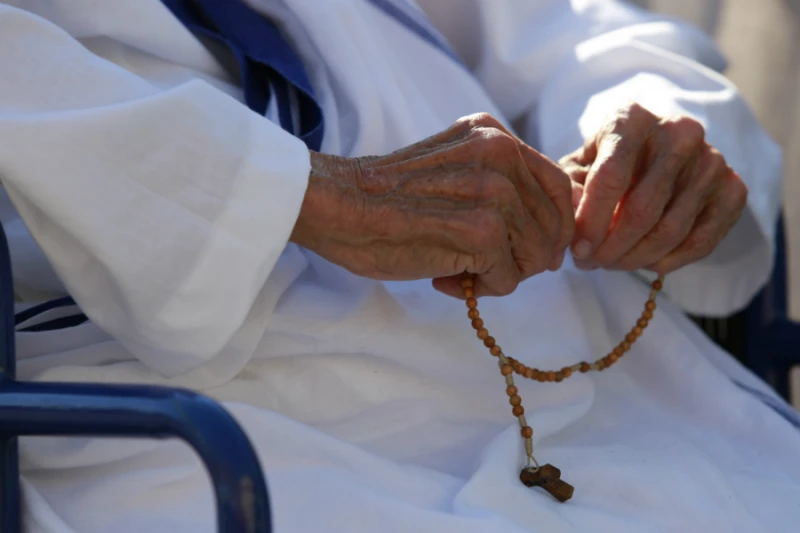
 Missionary of Charity sister prays the rosary. / Daniel Ibanez
Vatican City, Oct 10, 2021 / 09:04 am (CNA).
It is interesting that in her appearances at Lourdes, Fatima and other locations, the Mother of God repeatedly recommends praying the Rosary. She does not invite us to pray the Divine Office, or to do spiritual reading, or Eucharistic Adoration, or practice interior prayer or mental prayer. All the mentioned forms of prayer are good, recognized by the Church and practiced by many saints. Why does Mary “only” place the Rosary in our hearts?
We can find a possible answer by looking at the visionaries of Lourdes and Fatima. Mary revealed herself to children of little instruction, who could not even read or write correctly. The Rosary was for them the appropriate school to learn how to pray well, since bead after bead, it leads us from vocal prayer, to meditation, and eventually to contemplation. With the Rosary, everyone who allows himself to be led by Mary can arrive at interior prayer without any kind of special technique or complicated practices.
This does not mean – and I want to emphasize this point – that praying the Rosary is for “dummies” or for simple minded people. Even great intellectuals must come before God as children, who in their prayers are always simple and sincere, always full of confidence, praying from within.
All Christians are called to the kind of interior prayer that allows an experience of closeness with God and recognition of his action in our lives. We can compare the Rosary to playing the guitar. The vocal prayers – the Our Father, the Hail Mary and the Glory Be – are the central prayers of Christianity, rooted in Scripture. These are like the rhythm in a song.
But simply strumming a guitar is not a song. And mindless repetition of words is not interior prayer. In addition to rhythm, keys are needed. The Mysteries of the Rosary are like the chords on the guitar. The vocal prayers form the framework for meditation on the Mysteries.
There are always these five chords to the rhythm of the repetition of the prayers, which make the lives of Jesus and Mary pass before our eyes. With meditation, we go on reflecting on what happens in each Mystery and what it means for our lives: At Nazareth, the Son of God is incarnated in Mary. In Holy Communion, He also comes to me. In Gethsemane, Jesus sweats blood. He suffers, is in anguish, and yet his friends remain asleep. Can I keep vigil with Him or do my eyes close with tiredness? On Easter morning, Jesus rises and breaks forth from the tomb. The first day of creation brought light. The first day of the week conquered death and gave us life. Christ can change the darkness in my life into light.
And so, our prayer begins to change into music. That is to say, it is no longer monotonous and boring, but now it is full of images and thoughts. And when the grace of God permits, it is also filled with supernatural illuminations and inspirations.
There is one more thing needed to have really great music, or to have a prayer that is even more profound and intimate: the melody that the heart sings. When playing the guitar, a voice is needed to interpret the song. When praying the Rosary, it is the song of our heart, as we place our own life before God, to the tempo of the prayers and meditations.
It is this song of the heart that allows us to enter into the mysteries of the Rosary: For my sake you were scourged, and it was I who struck you. Forgive me! You have ascended into Heaven, Lord. I long for You, I long for your kingdom, my true homeland.
In contemplation, the person praying sees the mysteries pass before his eyes, and at the same time he abides in particular affections or movements of the heart before God. The one who prays sings the song of his own life, in which naturally there can arise specific desires: You wanted to be the son of a human Mother; help my sick mother! You were crowned with thorns; help me in this financial difficulty which I can’t get out of my head. You sent the Holy Spirit; without You I don’t have the courage or the strength to make a good decision.
With this understanding, the following tips can help those who pray the Rosary move from vocal prayer to meditation to inner contemplation:
1) Schedule the time
Our schedule is full of appointments. More or less consciously, we also plan out the time we’re going to need for each task or appointment. Sometimes it is good to set aside 20 or 30 minutes to pray the Rosary, and write it down in the schedule. This “appointment” with Jesus and Mary is then just as important as all the other ones planned. For all of us, it is possible to set aside a time to pray the Rosary, at first, once, twice or three times a week. Over time – and this is the goal – it will be easier to find a time to pray the Rosary daily.
2) Don’t rush
We can learn a lesson about prayer by observing people in love. During a romantic candlelit dinner, no one would be constantly looking at the clock, or choking down their food, or leaving the dessert to one side to finish as quickly as possible. Rather, a romantic meal is stretched out, maybe lingering for an hour to sip a cocktail, and enjoying every moment spent together. So it is with praying the Rosary. It shouldn’t be treated as sets of Hail Mary’s to be performed as if one were lifting weights. I can spend time lingering on a thought. I can also break away from it. I can, principally at the beginning, simply be peaceful. If I keep this peaceful attitude and an awareness of how important this 20-minute “appointment” is, then I will have prayed well. It will have been a good prayer, because my will is focused on pleasing the Beloved and not myself.
3) Savor the experience
Saint Ignatius recommends what’s called the “third form of prayer,” which consists in adjusting the words to the rhythm of one’s own breathing. Often it is sufficient in praying the Rosary to briefly pause between the mysteries, and to remember that Jesus and Mary are looking at me full of joy and love, recognizing with gratitude that I am like a little child babbling words every so often to in some way affirm that I love God. To do this, it can be useful to pause and take a few breaths before resuming vocal prayer.
4) A gaze of love
The vocal prayers of the Rosary only provide the rhythm of the prayer. With my thoughts, I can and should go out from the rhythm to encounter the Mystery which is being contemplated. This is more clear in German, where the mystery is announced not only at the beginning of each decade, but before each Hail Mary. It’s a time to look your Beloved in the eyes and let Him look back, with eyes full of love.
5) Allow yourself to be amazed
One of the first and most important steps for inner prayer is to go from thinking and speculation to looking upon and being amazed. Think of lovers who meet, not to plan out what they’re going to give each other or what they might do on the next vacation, but to enjoy the time together and to rejoice in each other. Looking at a family photo album is very different from looking at a history book. In the photo album, we see people who are important to us, whom we love – and even more – who love us! That’s how our gaze at Jesus and Mary ought to be in the Rosary.
6) Allow your “inner cameraman” to notice details
Some people close their eyes while praying in order to concentrate. Others find it useful to focus their eyes on a certain point (such as a crucifix). Either way, what is important is for the eyes of the heart to be open. Praying the Rosary is like going to the movies. It’s about seeing images. It’s useful to ask yourself: Who, What, Where am I looking at when I contemplate the birth of Jesus, or his crucifixion, or his ascension into Heaven? And on some occasions, like a good cameraman does, come in for a close-up image of some detail: contemplate the warm breath of the ox that’s warming the Child, the pierced hand of Jesus that spread so much love, the tears in John’s eyes as he gazes at Jesus rising up to Heaven.
7) Pray in words, mind, and heart
The words accompany, the mind opens, but it is the heart that has the leading role in prayer. All the great spiritual authors agree that inner prayer is about dwelling in the affections, that is, the inner sentiments and movements. Teresa of Avila says very simply: “Don’t think a lot, love a lot!” An elderly lady was ruefully complaining to me that she could not reflect while praying her daily Rosary, and that in that situation she could barely say “Jesus, Mary, I love you!” I congratulated the lady. That is exactly what praying the Rosary ought to lead us to.
This commentary was first published April 26, 2017.

[…]





Love and Justice: “The Holy Father’s homily concluded, ‘All of us are children of God . . . all of us making up the Church, all of us. We are his sheep, his flock, and we can only be so together and as one. Let us overcome all polarization and preserve our communion.’”
Also a reference to “synodality” with its diminished role for the shepherds (now “facilitators” among the sheep), so not much clarity on how to also preserve the “hierarchical communion” (now a polarization?) articulated in Lumen Gentium (Chapter 3, and the Explanatory Note).
@Incoherent Documents
Must be providential. Days before he left this world Card Pell wrote in the Spectator that the Synod on Synodality is a ‘Toxic Nightmare’, “Not only is it couched in neo-Marxist jargon, but it is hostile to the apostolic tradition”?
A point of interest central to Pope Francis’ rationale of moving the Church from a legalistic posture to become less doctrinal, more welcoming and pastoral is access to the Holy Eucharist.
Discussed recently was my response to Francis’ admonition that ‘The only requisite for receiving Our Lord in communion is the garment of faith’. A compelling addition in support was a past observation made by, I believe it was Fr Antonio Spadaro SJ editor of journal La Civiltà Cattolica and confidant of Pope Francis. What was said is, ‘They refuse them what they need the most’ [the Holy Eucharist]. Them, those living in irregular unions. As such relative to anyone not practicing the faith as required by Apostolic tradition.
This complaint has substance if there is intent, at least some desire to make reparation for acknowledged transgression, some anticipated effort to express thankful love to Christ for his passion and death – by reform. If this is absent, receiving the Eucharist is an act of self affirmation. On precisely this issue Card Pell admonishes those concerned in his refutation of Synod Relator Card Jean-Claude Hollerich SJ who publicly rejects the teachings of the Church on sexuality. ‘What they need the most’ in actual context means support of a chosen, illicit lifestyle, not a remedy for the repentant sinner.
Soft spoken Pell’s last testament to the Church he loves is one of unusual fury. Righteous fury, not physically violent but morally so as that of John the Baptist, the Apostle Paul, Jesus’ anger at the Pharisees in today’s Gospel for their obstinacy in refusal of the truth. A lesson to the Church, an admonition from a virtuous humble man for us to express moral outrage at this distortion of the truth of our faith, outrage at the multitude of souls led to the eternal precipice.
The article “Fading American Dream” is a classic and clear example of an illogical presentation. The writer takes his very narrow personal perspective about his perception of the decline of California as being the totality of the reality of the state as getting lost and as the “fading American dream.” This reflections which is just a grievance and hate therapy exemplifies the Fallacy of Misplaced Concreteness.
A Work of Art
It’s impossible to guess what Ribes meant by Caravaggio a Radical Approach to Truth when nothing is quoted, except a quote from Chesterton on mind to mind creativity. If that means what the painter wished to convey. Although, that’s the intent of all visual art.
Caravaggio’s innovative tenebrism, as this writer perceives and as some others also is the dramatic use of dark juxtaposed to stark light that draws the viewer into the reality of what’s seen. As to religious painting his scenes of the crucifixion place us in the moment, the sense of anguish, pain that the persons depicted must have experienced. Making his passion scenes the best that I have seen.
The interview with Archbishop Chaput somehow shows his grievance and resentment at Pope Francis because he was not made to extend more years in his office as Archbishop and not elevated a Cardinal. Careerist clericalism coupled with anti-Pope Francism on display here. By CWR’s inclusion of this article here despite its disclaimer as not an endorsement just shows its latent anti-Pope Francism.
“….because he was not made to extend more years in his office as Archbishop and not elevated a Cardinal. Careerist clericalism …”
Evidence for your assertion? Or are you merely making judgments without evidence, as do so many who attack anyone who dares raise questions or concerns about various actions and statements from Pope Francis?
“Are you disappointed that you’re not a cardinal?”
“No, and I sleep a lot better for it.”
I met the man once, and I would tend to take him at his word. I think Philadelphians and Archb Chaput’s fan club were more disappointed than anyone.
I was struck by this:
“No one in current Church leadership has the capacity to replace them. That will happen in time, but the talent bench at the moment seems pretty thin.”
Too many bishops later in this interview, and we have a few thousand bishops and we’re thin in talent? That’s about the only bitterness I see in this interview. If I were the interviewer I would’ve pounced on that and suggest he name the almost-talent among his brother bishops today.
What crap!
I will be following Cynthia Millen’s 12-part essay at CATHOLIC STAND, re Latin Mass “love letters”, see above last entry, Embedded.
Briefly, Traditionis Custodes is a wrong “directive”/direction, in that it does not set up and bless the impulse and idea of getting to know Tradition and growing in appreciation of it. The Latin Mass “issue” could have served -and should have served- as the first channel and “type of experience” for renewal of this area (Tradition) of the faith.
Asserting instead that “tradition must grow OR OTHERWISE it is dead and backwardist” is not the way that anyone deepens in his “heritage” or encounters it; nor is it a way of growing into the new; nor is it the way the heritage -Tradition- is sustained in what it always will be.
Allow me to share that as I write this I see words and sentences that I encountered in a dream 3 nights ago.