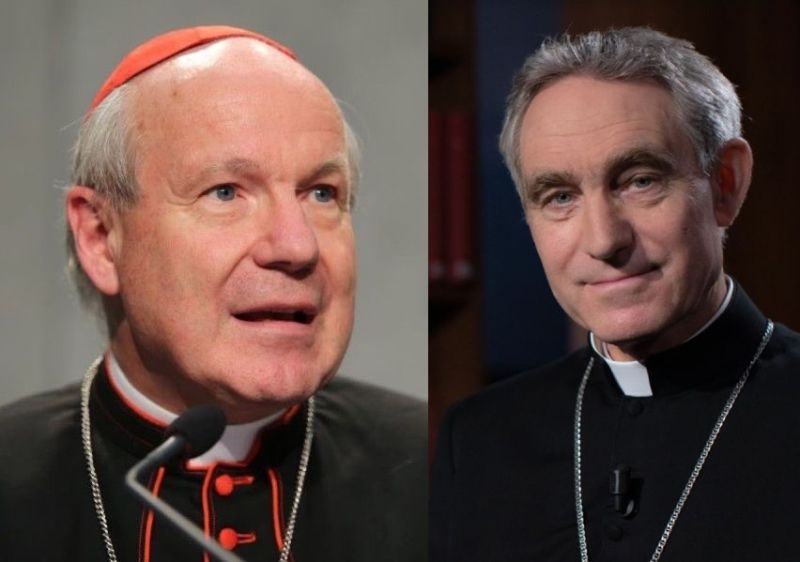
Austrian Cardinal Christoph Schönborn (left) and Archbishop Georg Gänswein, longtime personal secretary for Pope Benedict XVI. / Daniel Ibañez/CNA
CNA Newsroom, Jan 18, 2023 / 08:00 am (CNA).
Austrian Cardinal Christoph Schönborn on Wednesday confirmed he was the person who encouraged Joseph Ratzinger to accept the conclave’s decision — if elected — to become the successor to Pope John Paul II as supreme pontiff of the Catholic Church.
Benedict’s longtime secretary, Archbishop Georg Gänswein, revealed Schönborn’s identity in his book titled “Nothing but the Truth” (“Nient’altro che la verita”), which was published in Italy last week.
CNA Deutsch, CNA’s German-language news partner, reported that Schönborn on Jan. 18 confirmed Gänswein’s assertion that Schönborn had written Cardinal Ratzinger “a little letter just in case.”
At the same time, the archbishop of Vienna accused Gänswein of committing an act of “unseemly indiscretion” with his book by publishing “confidential things,” according to the Archdiocese of Vienna’s website.
Schönborn said he had “so far deliberately kept silent” about his note to Benedict, noting “it happened within the context of the meeting of the cardinals, and not at the conclave itself.”
Benedict’s ‘guillotine speech’
Pope Benedict XVI spoke about the letter on April 25, 2005, during an audience with pilgrims from Germany.
The address is famous among German Catholics as the “guillotine speech” — in German Fallbeilrede.
In it, Benedict compared the experience of his election to that of having the axe of a guillotine dropping down on him. The guillotine blade in German is called a fallbeil.
Speaking just as openly about what swayed him to accept his election, the then newly elected pope revealed he had been “very touched by a brief note written to me by a brother cardinal.”
Benedict said: “He reminded me that on the occasion of the Mass for John Paul II, I had based my homily, starting from the Gospel, on the Lord’s words to Peter by the Lake of Gennesaret: ‘Follow me!’ I spoke of how again and again, Karol Wojtyła received this call from the Lord, and how each time he had to renounce much and to simply say: ‘Yes, I will follow you, even if you lead me where I never wanted to go.’”
“This brother cardinal wrote to me: Were the Lord to say to you now, ‘Follow me’, then remember what you preached. Do not refuse! Be obedient in the same way that you described the great pope, who has returned to the house of the Father. This deeply moved me. The ways of the Lord are not easy, but we were not created for an easy life, but for great things, for goodness.”
Benedict added: “Thus, in the end I had to say ‘yes.’”
In his book, Gänswein also addressed the fact that Schönborn and Ratzinger were on a first-name basis.
Apart from Benedict’s childhood friends, Cardinal Schönborn, a member of Ratzinger’s circle of students, was one of the few who addressed his former teacher as “Du” (the informal “You”), Gänswein wrote.
Another episode covered in Gänswein’s book — a brief but very personal conversation between the newly elected Pope Benedict XVI and Schönborn — also took place as described by Gänswein, the Viennese archbishop confirmed on Jan. 18.
Schönborn, a Dominican friar descended from the Austrian nobility, tendered his resignation as archbishop of Vienna before his 75th birthday on Jan. 22, 2020.
Around the same time, the archdiocese said Pope Francis had declined the resignation, asking Schönborn to stay on for “an indefinite period.”
If you value the news and views Catholic World Report provides, please consider donating to support our efforts. Your contribution will help us continue to make CWR available to all readers worldwide for free, without a subscription. Thank you for your generosity!
Click here for more information on donating to CWR. Click here to sign up for our newsletter.
Pope Francis interacted with an energetic crowd of 65,000 young adults and catechists at Martyrs’ Stadium in Kinshasa, Democratic Republic of Congo, on Feb. 2, 2023. / Vatican Media
Rome Newsroom, Feb 2, 2023 / 05:45 am (CNA).
To bring about peace, “prayer is the most powerful weapon there is,” Pope Francis told thousands of young adults and catechism teachers in the Democratic Republic of Congo on Thursday.
The meeting in Martyrs’ Stadium in Kinshasa, the capital city of the DRC, took place on Feb. 2, the third day of the pope’s visit to the central African country. On Feb. 3, Francis will fly to Juba, South Sudan, for the second leg of his peace pilgrimage.
Pope Francis on Thursday interacted with an enthusiastic crowd of about 65,000 young people and adults, some of whom traveled days to be present for the papal visit.
Pope Francis interacted with an energetic crowd of 65,000 young adults and catechists at Martyrs’ Stadium in Kinshasa, Democratic Republic of Congo, on Feb. 2, 2023. Vatican Media
“Yes, prayer conquers fear and enables us to take our future into our hands. Do you believe this?” the pope said. “Do you want to make prayer your secret, as refreshing water for the soul, as the one weapon you carry, as a traveling companion on each day’s journey?”
During the second half of his speech, the pope was repeatedly drowned out by the energetic audience, which broke out in cheering, singing, and dancing despite the hot weather.
Pope Francis interacted with an energetic crowd of 65,000 young adults and catechists at Martyrs’ Stadium in Kinshasa, Democratic Republic of Congo, on Feb. 2, 2023. Vatican Media
In his talk, Francis used the imagery of the hand to speak about the future of the DRC.
“God has placed the gift of life, the future of society and the future of this great country in those hands of yours,” he said.
“Dear brother, dear sister, do your hands not seem small and frail, empty and unsuited to so great a task? It’s true,” he said. “Let me tell you something: your hands all look alike, they all look alike, but none of them is exactly the same. No one has hands just like yours, and that is a sign that you are a unique treasure, an unrepeatable and incomparable treasure.”
He invited those present in the stadium to open and close their hands while meditating on whether they wanted to choose peace or violence.
Pope Francis interacted with an energetic crowd of 65,000 young adults and catechists at Martyrs’ Stadium in Kinshasa, Democratic Republic of Congo, on Feb. 2, 2023. Vatican Media
“Notice how you can squeeze your hand, closing it to make a fist. Or you can open it, to offer it to God and to others,” he said.
“You who dream of a different future: from your hands, tomorrow can be born, tomorrow can be born from your hands, from your hands peace so lacking in this country can at last come about.”
Bishop Donatien Bafuidinsoni Maloko-Mana from the Diocese of Inongo, in western DRC, was at the meeting.
He told EWTN News that people from his diocese traveled in boats on the Congo River for two to four days to arrive in Kinshasa.
Bafuidinsoni said the Congolese people were disappointed last year when the pope’s visit was canceled, but “now that the pope is here it’s a big joy for us all.”
Even those who are following the trip from home “are really happy,” he added. “It’s a message of joy, of peace, and of hope for all.”
Sister Asterie Neema, 29, is from Rutshuru in eastern DRC, where her brother was brutally killed last year. Elias Turk/CNA
Sister Asterie Neema, 29, is from Rutshuru in eastern Congo, where, she told EWTN News, they are under the control of an armed group called M23.
Neema said her older brother was killed in 2022 by unidentified rebels in front of his 12- and 7-year-old children.
In her 29 years of life, she said, her region of the DRC has never seen peace. Neema added that she has forgiven her brother’s killers, but she hopes for peace in her country.
Not everyone in the audience was Catholic. Two young Muslim men also attended the youth gathering with Pope Francis.
Yassine Mumbere, from Butembo in eastern DRC, told EWTN News that he came to the event because all young people were invited. He also studied at a Catholic school.
Muslim Yassine Mumbere, 35, from Butembo in eastern Congo, (R) with his friend (L) at the youth gathering with Pope Francis in Kinshasa, DRC on Feb. 2, 2023. Elias Turk/CNA
The 35-year-old Muslim Scout leader said he hopes the pope’s trip will help bring peace to the DRC’s eastern region.
In his speech, Pope Francis encouraged those present to be careful of the temptation to point fingers at people, or to exclude others because of “regionalism, tribalism, or anything that makes you feel secure in your own group, but at the same time is unconcerned with the life of the community.”
“You know what happens: first, you believe in prejudices about others, then you justify hatred, then violence, and in the end, you find yourself in the middle of a war,” he said.
To create a concrete sign of community, Francis invited the crowd to hold hands with those beside them and to sing a song together: “Imagine yourselves as one Church, a single people, holding hands.”
Pope Francis interacted with an energetic crowd of 65,000 young adults and catechists at Martyrs’ Stadium in Kinshasa, Democratic Republic of Congo, on Feb. 2, 2023. Vatican Media
“Yes, brother and sister, you are indispensable and you are responsible for your Church and for your country,” he said after the song. “You are part of a greater history, one that calls you to take an active role as a builder of communion, a champion of fraternity, an indomitable dreamer of a more united world.”
After Pope Francis spoke against corruption — inviting everyone to shout together, “Go away, corruption!” — the stadium broke out in loud singing and cheering.
The event’s emcee had to invite the crowd to quiet down before the pope could continue speaking.
Francis also drew attention to two Congolese martyrs and their examples of faith: Blessed Isidore Bakanja and Blessed Marie-Clémentine Anuarite.
Statues of Blessed Isidore Bakanja and Blessed Marie-Clémentine Anuarite, young Congolese martyrs beatified by Pope John Paul II, in Martyrs’ Stadium in Kinshasa, DRC, on Feb. 2, 2023. Elias Turk/CNA
Blessed Marie-Clémentine Anuarite, a member of the Sisters of the Holy Family, was killed during the civil war in 1964 at the age of 24. Anuarite was beatified by Pope John Paul II during his visit to the DRC, then known as the Republic of Zaire, in 1985.
Blessed Isidore Bakanja was a Catholic convert at the age of 18. He became a catechist and was devoted to Our Lady of Mount Carmel. He died in 1909, around the age of 21 or 22, after succumbing to an infection caused by a beating and other torture he received at the hands of a European manager for refusing to remove his brown scapular at work. Bakanja was beatified in 1994 by Pope John Paul II.
Statues of the two blesseds were present at the youth meeting, where people in the crowd shouted and held signs asking the pope to make them “santi subito!”
The pope pointed to another example of virtue from the DRC, Floribert Bwana Chui, who was killed in 2007 in Goma.
The 26-year-old man, who worked as a customs manager, was killed for refusing to cooperate with corruption; specifically, he did not allow the passage of expired food products.
A spectator at Martyrs’ Stadium in Kinshasa, DRC, on Feb. 2, 2023, holds a sign with the phrase “santi subito” in reference to two Congolese blesseds. Elias Turk/CNA
“He could easily have turned a blind eye; nobody would have found out, and he might even have gotten ahead as a result,” Francis said. “But, since he was a Christian, he prayed. He thought of others and he chose to be honest, saying no to the filth of corruption.”
“Now I want to tell you something important,” he added. “Listen closely: If someone offers you a bribe, or promises you favors and lots of money, do not fall into the trap. Do not be deceived; do not be sucked into the swamp of evil. Do not be overcome by evil!”
Fra’ John T. Dunlap, was sworn in as grand master of the Order of Malta on May 3, 2023. / Twitter @orderofmalta.
Rome Newsroom, May 4, 2023 / 10:00 am (CNA).
The Order of Malta this week elected Fra’ John Dunlap as prince and 81st grand master … […]
3 Comments
Ganswein’s book (yes, with “unseemly indiscretion”) also reminds yours truly of another fly on the wall, or more than one, who thought to take notes and convey something valuable in a hostile environment…These would be the writers of the New Testament.
And, maybe too, others later, following the Extraordinary Synod of Bishops 1985, who collaborated to write the new Catechism. A group of 44 consultors was organized, with their draft texts then circulated worldwide, resulting in over 930 replies and some 24,000 suggestions. The 12 cardinals commissioned by St. John Paul II to oversee the entire work were chaired by Cardinal Ratzinger—and the senior editor was Cardinal Schonborn.
Noticing, here, the staged procedural parallels with today’s more communal exercise…But, also the devolution of “synodality” into a block-party plebiscite, corrupting even the overlap into the Deposit of Faith as entrusted by the incarnate Christ to the ordained successors of the Apostles.
Well, surely, the 12 or more non-ordained “experts” delegated to set thing straight, so to speak, will figure things out. Especially under the incomparable Cardinal Hollerich who, instead, signals his hell-bent intention to overturn human sexual morality and, therefore, the Catechism itself….Displacement of the Catechism by, whatever.
So, let us not be distracted. Yes, with Cardinal (and editor) Schonborn we might pause at “unseemly indiscretions,” but what about the elephant in the synodal living room who has lost both his famous memory and his identity–what about “unseemly apostasy”?
If reportage of innocuous conversation leads the cardinal to indignantly charge unseemliness and indiscretion, imagine his apoplexy at learning of all the scandalous words and acts emanating under the current papal roof.
Ganswein’s book (yes, with “unseemly indiscretion”) also reminds yours truly of another fly on the wall, or more than one, who thought to take notes and convey something valuable in a hostile environment…These would be the writers of the New Testament.
And, maybe too, others later, following the Extraordinary Synod of Bishops 1985, who collaborated to write the new Catechism. A group of 44 consultors was organized, with their draft texts then circulated worldwide, resulting in over 930 replies and some 24,000 suggestions. The 12 cardinals commissioned by St. John Paul II to oversee the entire work were chaired by Cardinal Ratzinger—and the senior editor was Cardinal Schonborn.
Noticing, here, the staged procedural parallels with today’s more communal exercise…But, also the devolution of “synodality” into a block-party plebiscite, corrupting even the overlap into the Deposit of Faith as entrusted by the incarnate Christ to the ordained successors of the Apostles.
Well, surely, the 12 or more non-ordained “experts” delegated to set thing straight, so to speak, will figure things out. Especially under the incomparable Cardinal Hollerich who, instead, signals his hell-bent intention to overturn human sexual morality and, therefore, the Catechism itself….Displacement of the Catechism by, whatever.
So, let us not be distracted. Yes, with Cardinal (and editor) Schonborn we might pause at “unseemly indiscretions,” but what about the elephant in the synodal living room who has lost both his famous memory and his identity–what about “unseemly apostasy”?
Are we talking about this cardinal Schönborn?
https://www.traditioninaction.org/RevolutionPhotos/A811-Wien.htm
If reportage of innocuous conversation leads the cardinal to indignantly charge unseemliness and indiscretion, imagine his apoplexy at learning of all the scandalous words and acts emanating under the current papal roof.
