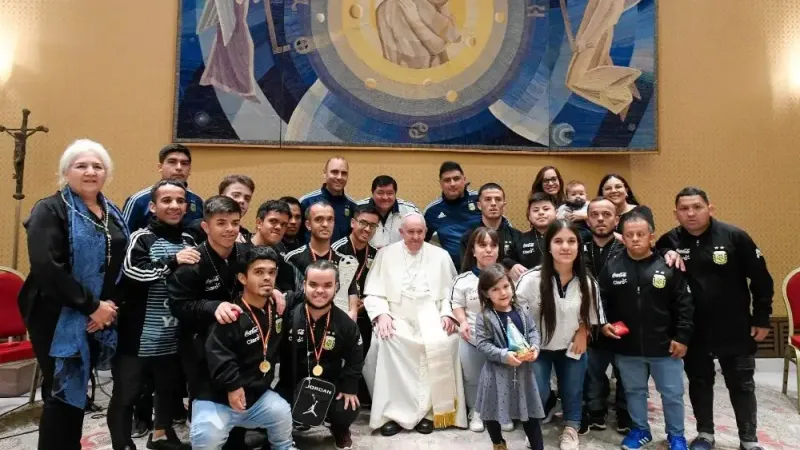
Pope Francis meets with the Argentine dwarf soccer team at an audience on Wednesday, Oct. 26, 2022, at the Vatican. / Photo credit: Vatican Media
Denver Newsroom, Oct 28, 2022 / 07:05 am (CNA).
On Wednesday morning Pope Francis received the dwarf Argentine soccer team in an audience, encouraging them to continue with courage and to be themselves.
Pope Francis highlighted the “courage” of those present gathered in the Vatican during the time of “opening new paths.”
“You are brave, cultivate this courage, never, never throw it away: the courage to go forward in life the way you are. With your intellectual, affective, physical values, everything.”
Then Pope Francis explained that “in life one can look at things with two measures: the upside or the downside. That is to say: there are the usual pessimists and whatever happens to them they look on the downside: ‘Too bad’ … And they get depressed. And those people, the only thing they do is build bitter horizons.”
“And there are the optimists, like you, who look at any difficulty from the upside: go on ahead, make progress” to keep on going “as we are now with what I have. I mean, capitalize on everything, even capitalize on what seems to be negative,” he said.
The Holy Father explained that this is “human maturity” and expressed his joy at seeing that these dwarf players have chosen this path.
The soccer players explained to the Holy Father all the efforts made for the inclusion of dwarves in society through sports.
In addition, the players of this National All Star Team that won the America’s Cup and the European Cup championships gave Pope Francis a jersey signed by everyone, a team schedule with the image of the Virgin of Itatí and an image of the Virgin of the Valley of Catamarca on it.
This story was first published by ACI Prensa, CNA’s Spanish-language news partner. It has been translated and adapted by CNA.
If you value the news and views Catholic World Report provides, please consider donating to support our efforts. Your contribution will help us continue to make CWR available to all readers worldwide for free, without a subscription. Thank you for your generosity!
Click here for more information on donating to CWR. Click here to sign up for our newsletter.
Cardinal Fernando Filoni. Photo credits: Daniel Ibáñez/CNA. / null
Vatican City, Jan 28, 2022 / 14:00 pm (CNA).
Who is Benedict XVI? This is the question that has emerged in the minds of many in recent days; days of great suffering for him and … […]
Washington, D.C. Newsroom, Jun 28, 2023 / 16:17 pm (CNA).
In the latest development in the ongoing dispute between a Texas Carmelite monastery and the Diocese of Fort Worth, Texas, former prioress Theresa Gerlach ad… […]
Pope Leo XIV greets the faithful in St. Peter’s Basilica, May 31, 2025 / Credit: Daniel Ibáñez/CNA
CNA Newsroom, May 31, 2025 / 17:58 pm (CNA).
Pope Leo XIV has praised an international bioethics summit in Rome for advancing an “authentically human” approach to science, urging researchers to pursue truth grounded in the dignity of the human person.
In a message delivered by Vatican Secretary of State Cardinal Pietro Parolin, the pope expressed his “vivid appreciation” for the 3rd International Bioethics Conference, held May 30–31 at the Patristicum.
The event was organized under the theme “The Splendor of Truth in Science and Bioethics.”
The pope described the initiative as “a valuable opportunity to reflect on the ethical implications of scientific progress” and encouraged “interdisciplinary dialogue grounded in the dignity of the human person,” according to the Vatican message. He expressed his hope that such efforts would “foster approaches to science that are increasingly authentically human and respectful of the integrity of the person.”
Held under the patronage of the Pontifical Academy for Life and the Dicastery for Culture and Education, the conference brought together nearly 400 participants — including researchers, physicians, philosophers, and legal scholars — from universities across Latin America, Europe, and Africa.
‘Science must serve the truth,’ cardinal says
Cardinal Willem Jacobus Eijk of the Netherlands opened the conference with a keynote address outlining three foundational principles for bioethics and scientific research in service of truth.
The archbishop of Utrecht, who is also a medical doctor, on Friday said the Pontifical Academy for Life should give more attention to the bioethical issues linked to “transgender” treatments and the push for “gender theory” .
Eijk emphasized that human reason must recognize its ability to know metaphysical truth, that human beings possess only relative autonomy, and that human life is an intrinsic value.
The cardinal warned: “Without metaphysics and a proper anthropology, science becomes dangerous because it loses its moral compass.”
Participants gather for a group photo at the 3rd International Bioethics Conference at the Pontificio Istituto Augustinianum in Rome on May 31, 2025. Credit: Jérôme Lejeune Foundation
Scholars highlight the role of philosophy in science
Spanish philosopher Juan Arana, a member of the Royal Academy of Moral and Political Sciences, argued that modern science too often neglects the pursuit of deeper philosophical truths. While acknowledging the empirical advances of science, he emphasized that “great truths of philosophy and the small truths of science” are still connected “by threads that, though subtle, are effective.”
Bernard Schumacher of the University of Fribourg criticized the modern scientific method for reducing reality to the mathematical and quantifiable, while French philosopher Thibaud Collin challenged assumptions within natural law theory.
Two roundtables tackled practical bioethical challenges in genetics and conscience rights. Geneticist Teresa Perucho, surgeon Emmanuel Sapin, and neonatologist Robin Pierucci discussed the moral foundations of genetic counseling and the need to support parents with compassion and clarity when faced with difficult prenatal diagnoses.
Upholding a Catholic vision of science
The conference was organized by the International Chair of Bioethics Jérôme Lejeune and supported by more than 40 academic institutions worldwide. Since its founding in 2023, the event has become a leading forum for Catholic engagement with contemporary bioethical issues.
Jean-Marie Le Méné, president of the Jérôme Lejeune Foundation, closed the gathering by recalling the late French geneticist’s legacy: “The scientist is one who admits without shame that what he knows is microscopic compared to all that he does not know — and is fascinated by the adventure of intelligence on the path toward the intelligible.”
Jérôme Lejeune, a devout Catholic and pioneer in genetics, discovered the chromosomal cause of Down syndrome and became a passionate defender of the unborn, laying the foundation for much of the Church’s engagement in bioethics today.
Pope Leo XIV concluded his message with a call for scientists to “contribute to the search for truth, so that science may remain at the service of humanity, never becoming its master.”







Life is precious in the physically short or tall person. Zacchaeus may have been short, but he was called by name by none other than Jesus.