Left: Bishop Georg Bätzing, president of the German bishops' conference, in a Sept. 29, 2022 photo. (CNS photo/Harald Oppitz, KNA); right: Cardinal Kurt Koch, president of the Pontifical Council for Promoting Christian Unity, in an April 25, 2021 photo. (CNS photo/Paolo Galosi, KNA)
CNA Newsroom, Oct 5, 2022 / 06:46 am (CNA).
Following demands for an apology and a threat he might “file an official complaint with the Holy Father,” the German Bishops’ Conference president met with a Vatican cardinal in Rome this week.
Bishop Georg Bätzing sat down with Cardinal Kurt Koch on Oct. 4 to apparently clear the air over what the German Bätzing had called a “totally unacceptable gaffe” by the Vatican cardinal, who is a native of Switzerland and president of the Vatican’s Pontifical Council for Promoting Christian Unity.
The exchange was the result of a disagreement over remarks involving “German Christians,” Nazi ideology, and theological claims of a key document of the German Synodal Way.
“For Cardinal Koch and Bishop Bätzing, it is clear after the conversation that the theological debate, to which the cardinal wanted to contribute in the interview, must continue,” spokesman Matthias Kopp said Wednesday, according to a report by CNA Deutsch, CNA’s German-language partner agency.
According to the bishops’ conference statement, the cardinal had “assured the bishop that he in no way meant the Synodal Way of the Church in Germany or the Synodal Assembly by the comparison he drew between theological debates on the Synodal Way and the events surrounding the so-called ‘German Christians’ during the Nazi era.”
“Expressly Cardinal Koch emphasizes that it is completely far from him to want to impute the terrible ideology of the 1930s to the Synodal Way,” the spokesman continued.
“Cardinal Koch asks for forgiveness from all those who feel hurt by the comparison he made.”
However, this assertion is not new, nor is the apology that Bätzing said he found not to be to his satisfaction.
CNA contacted Koch about his perspective on the encounter but had not received a response at the time of publication.
On Sept. 29, Koch had apologized for any hurt but at the same time defended himself against Bätzing’s claims of an “unacceptable gaffe,” saying, “I cannot retract my essential point, simply because I have in no way compared the Synodal Way to a Nazi ideology, nor will I ever do so.”
At that time, this clarification did not sit well with the German Bishops’ Conference president.
One day after Koch’s rejoinder, on Sept. 30, Bätzing replied he would not accept this apology as “satisfactory,” reported CNA Deutsch.
So what did the Swiss prelate say that enraged the German bishop and now led to a meeting in Rome?
In an interview with a German newspaper, Koch — an internationally respected theologian — had said he was shocked that, of all places, the German Synodal Way was talking about new sources of revelation.
“This phenomenon already existed during the National Socialist dictatorship, when the so-called ‘German Christians’ saw God’s new revelation in blood and soil and in the rise of Hitler,” Koch told the weekly Catholic newspaper Die Tagespost.
The “German Christians” (Deutsche Christen) were a Nazi-era pressure group that wanted to align Protestantism with racist Nazi Ideology.
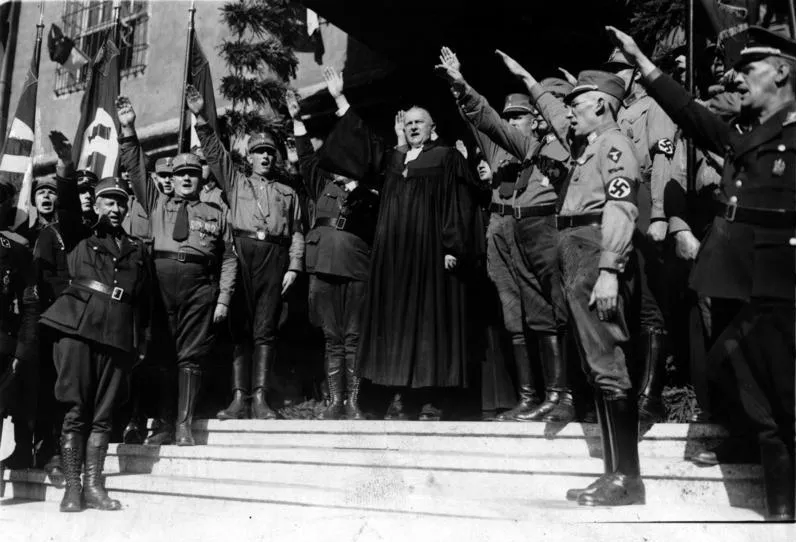
The National Synod of “German Christians” in Wittenberg, September 1933. Bundesarchiv, Bild 183-H25547 / CC-BY-SA 3.0
In contrast, the opposing Confessing Church’s Barmen Theological Declaration spoke against such distortions of Christian teaching.
The 1934 statement said, in its first article: “We reject the false doctrine, as though the church could and would have to acknowledge as a source of its proclamation, apart from and besides this one Word of God, still other events and powers, figures and truths, as God’s revelation.’”
Following demands by Bishop Bätzing for an apology, Koch said in a response, written Thursday last week: “It was a matter of concern to me to recall the Barmen Theological Declaration in this context, because I still consider it important today, also for ecumenical reasons. In order to make the content understandable to those who read it, I had to briefly note what this declaration responded to.”
“In saying this, I was in no way comparing the Synodal Way with the mentality of the ‘German Christians,’ nor did I want to do so,” the Swiss prelate added.
Koch pointed out he was far from “alone in my criticism of the orientation text of the Synodal Way,” adding: “My critical comment, then, cannot simply be an expression of a completely mistaken theology.”
“Just as the so-called ‘German Christians’ — thank God — did not comprise all German Christians, I also, in no way, had all [Synodal Way] participants in mind with my statement, but only those Christians who represent the assertion formulated in the question. And I hope to continue to assume that this assertion is not the opinion of the Synodal Way.”
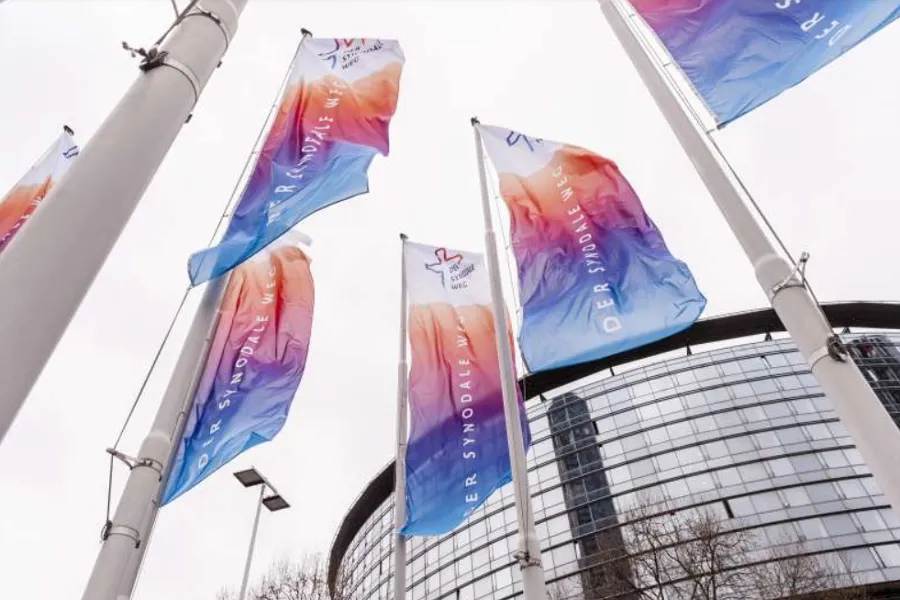
‘Synodal Way’ flags fly in front of the Congress Center Messe Frankfurt in Germany. Max von Lachner/Synodal Way.
The Synodal Way — Synodaler Weg in German, sometimes translated as “Synodal Path” — is a controversial process that has come under sustained criticism from cardinals, bishops, and theologians both internationally and in Germany.
The Vatican intervened in July, warning of a threat of new schism from Germany arising from the process.
Writing about the Synodal Way, Pope Francis warned of disunity in his letter to German Catholics in 2019.
Cardinal Walter Kasper, a German theologian considered close to Pope Francis, in June 2022 warned that the German process is at risk of “breaking its own neck” if it does not heed the objections raised by a growing number of bishops around the world.
In April, more than 100 cardinals and bishops from around the world released a “fraternal open letter” to Germany’s bishops, warning that sweeping changes to Church teaching advocated by the process may lead to schism.
In March, an open letter from the Nordic bishops expressed alarm at the German process, and in February, a strongly-worded letter from the president of Poland’s Catholic bishops’ conference raised serious concerns.
Bishop Bätzing has repeatedly rejected any and all concerns, instead expressing disappointment in Pope Francis in May. In his first reaction to the criticism by Cardinal Koch, the German prelate said Koch’s words betrayed a fear that “something will change.”
“But I promise you: Something will change and even Cardinal Koch will not be able to stop that — certainly not with such statements,” Bätzing added.
If you value the news and views Catholic World Report provides, please consider donating to support our efforts. Your contribution will help us continue to make CWR available to all readers worldwide for free, without a subscription. Thank you for your generosity!
Click here for more information on donating to CWR. Click here to sign up for our newsletter.
U.S. Senate candidate J.D. Vance speaks at the Dayton International Airport on Nov. 7, 2022 in Vandalia, Ohio. News outlets projected Vance the winner in his tight race against Democratic candidate for U.S. Senate Rep. Tim Ryan (D-Ohio) in the N… […]
Washington, D.C. Newsroom, Dec 12, 2023 / 14:30 pm (CNA).
Illinois has agreed to halt its enforcement of a law that restricts the speech and advertising of pro-life crisis pregnancy centers following a lawsuit … […]
Pope Francis at the general audience in St. Peter’s Square, Oct. 5, 2016. / Credit: Daniel Ibanez/CNA
CNA Staff, Mar 13, 2024 / 12:00 pm (CNA).
March 13 marks the anniversary of the election of Pope Francis as the 266th successor of St. Peter. Here is a timeline of key events during his papacy:
2013
March 13 — About two weeks after Pope Benedict XVI steps down from the papacy, Cardinal Jorge Bergoglio is elected pope. He takes the papal name Francis in honor of St. Francis of Assisi and proclaims from the central balcony of St. Peter’s Basilica: “Let us begin this journey, the bishop and people, this journey of the Church of Rome, which presides in charity over all the Churches, a journey of brotherhood in love, of mutual trust. Let us always pray for one another.”
March 14 — The day after he begins his pontificate, Pope Francis returns to his hotel to personally pay his hotel bill and collect his luggage.
July 8 — Pope Francis visits Italy’s island of Lampedusa and meets with a group of 50 migrants, most of whom are young men from Somalia and Eritrea. The island, which is about 200 miles off the coast of Tunisia, is a common entry point for migrants who flee parts of Africa and the Middle East to enter Europe. This is the pope’s first pastoral visit outside of Rome and sets the stage for making reaching out to the peripheries a significant focus.
Pope Francis gives the Wednesday general audience in St. Peter’s Square on Oct. 2, 2013. Elise Harris/CNA.
July 23-28 — Pope Francis visits Rio de Janeiro, Brazil, to participate in World Youth Day 2013. More than 3 million people from around the world attend the event.
July 29 — On the return flight from Brazil, Pope Francis gives his first papal news conference and sparks controversy by saying “if a person is gay and seeks God and has goodwill, who am I to judge?” The phrase is prompted by a reporter asking the pope a question about priests who have homosexual attraction.
Nov. 24 — Pope Francis publishes his first apostolic exhortation Evangelii Gaudium (The Joy of the Gospel). The document illustrates the pope’s vision for how to approach evangelization in the modern world.
2014
Feb. 22 — Pope Francis holds his first papal consistory to appoint 19 new cardinals, including ones from countries in the developing world that have never previously been represented in the College of Cardinals, such as Haiti.
March 22 — Pope Francis creates the Pontifical Commission for the Protection of Minors. The commission works to protect the dignity of minors and vulnerable adults, such as the victims of sexual abuse.
Pope Francis greets pilgrims during his general audience on Nov. 29, 2014. Bohumil Petrik/CNA.
Oct. 5 — The Synod on the Family begins. The bishops discuss a variety of concerns, including single-parent homes, cohabitation, homosexual adoption of children, and interreligious marriages.
Dec. 6 — After facing some pushback for his efforts to reform the Roman Curia, Pope Francis discusses his opinion in an interview with La Nacion, an Argentine news outlet: “Resistance is now evident. And that is a good sign for me, getting the resistance out into the open, no stealthy mumbling when there is disagreement. It’s healthy to get things out into the open, it’s very healthy.”
2015
Jan. 18 — To conclude a trip to Asia, Pope Francis celebrates Mass in Manila, Philippines. Approximately 6 million to 7 million people attend the record-setting Mass, despite heavy rain.
March 23 — Pope Francis visits Naples, Italy, to show the Church’s commitment to helping the fight against corruption and organized crime in the city.
May 24 — To emphasize the Church’s mission to combat global warming and care for the environment, Pope Francis publishes the encyclical Laudato Si’, which urges people to take care of the environment and encourages political action to address climate problems.
Pope Francis at a Wednesday general audience in St. Peter’s Square on June 17, 2015. Bohumil Petrik.
Sept. 19-22 — Pope Francis visits Cuba and meets with Fidel Castro in the first papal visit to the country since Pope John Paul II in 1998. During his homily, Francis discusses the dignity of the human person: “Being a Christian entails promoting the dignity of our brothers and sisters, fighting for it, living for it.”
Sept. 22-27 — After departing from Cuba, Pope Francis makes his first papal visit to the United States. In Washington, D.C., he speaks to a joint session of Congress, in which he urges lawmakers to work toward promoting the common good, and canonizes the Franciscan missionary St. Junípero Serra. He also attends the World Meeting of Families in Philadelphia, which focuses on celebrating the gift of the family.
Pope Francis speaks to the U.S. Congress in Washington, D.C. on Sept. 24, 2015. . L’Osservatore Romano.
Oct. 4 — Pope Francis begins the second Synod on the Family to address issues within the modern family, such as single-parent homes, cohabitation, poverty, and abuse.
Oct. 18 — The pope canonizes St. Louis Martin and St. Marie-Azélie “Zelie” Guérin. The married couple were parents to five nuns, including St. Therese of Lisieux. They are the first married couple to be canonized together.
Dec. 8 — Pope Francis’ Jubilee Year of Mercy begins. The year focuses on God’s mercy and forgiveness and people’s redemption from sin. The pope delegates certain priests in each diocese to be Missionaries of Mercy who have the authority to forgive sins that are usually reserved for the Holy See.
2016
March 19 — Pope Francis publishes the apostolic exhortation Amoris Laetitia, which discusses a wide variety of issues facing the modern family based on discussions from the two synods on the family. The pope garners significant controversy from within the Church for comments he makes in Chapter 8 about Communion for the divorced and remarried.
April 16 — After visiting refugees on the Greek island of Lesbos, Pope Francis allows three Muslim refugee families to join him on his flight back to Rome. He says the move was not a political statement.
Pope Francis at the General Audience in St. Peter’s Square, Feb. 24, 2016. Daniel Ibanez/CNA.
July 26-31 — Pope Francis visits Krakow, Poland, as part of the World Youth Day festivities. About 3 million young Catholic pilgrims from around the world attend.
Sept. 4 — The pope canonizes St. Teresa of Calcutta, who is also known as Mother Teresa. The saint, a nun from Albania, dedicated her life to missionary and charity work, primarily in India.
Sept. 30-Oct. 2 — Pope Francis visits Georgia and Azerbaijan on his 16th trip outside of Rome since the start of his papacy. His trip focuses on Catholic relations with Orthodox Christians and Muslims.
Oct. 4 — Pope Francis makes a surprise visit to Amatrice, Italy, to pray for the victims of an earthquake in central Italy that killed nearly 300 people.
2017
May 12-13 — In another papal trip, Francis travels to Fatima, Portugal, to visit the Shrine of Our Lady of Fatima. May 13 marks the 100th anniversary of the first Marian apparition to three children in the city.
July 11 — Pope Francis adds another category of Christian life suitable for the consideration of sainthood: “offering of life.” The category is distinct from martyrdom, which only applies to someone who is killed for his or her faith. The new category applies to those who died prematurely through an offering of their life to God and neighbor.
Pope Francis greets a participant in the World Day of the Poor in Rome, Nov. 16, 2017. L’Osservatore Romano.
Nov. 19 — On the first-ever World Day of the Poor, Pope Francis eats lunch with 4,000 poor and people in need in Rome.
Nov. 27-Dec. 2 — In another trip to Asia, Pope Francis travels to Myanmar and Bangladesh. He visits landmarks and meets with government officials, Catholic clergy, and Buddhist monks. He also preaches the Gospel and promotes peace in the region.
2018
Jan. 15-21 — The pope takes another trip to Latin America, this time visiting Chile and Peru. The pontiff meets with government officials and members of the clergy while urging the faithful to remain close to the clergy and reject secularism. The Chilean visit leads to controversy over Chilean clergy sex abuse scandals.
Aug. 2 — The Vatican formally revises No. 2267 of the Catechism of the Catholic Church, which concerns the death penalty. The previous text suggested the death penalty could be permissible in certain circumstances, but the revision states that the death penalty is “inadmissible.”
Aug. 25 — Archbishop Carlo Viganò, former papal nuncio to the United States, publishes an 11-page letter calling for the resignation of Pope Francis and accusing him and other Vatican officials of covering up sexual abuse including allegations against former Cardinal Theodore McCarrick. The pope initially does not directly respond to the letter, but nine months after its publication he denies having prior knowledge about McCarrick’s conduct.
Aug. 25-26 — Pope Francis visits Dublin, Ireland, to attend the World Meeting of Families. The theme is “the Gospel of family, joy for the world.”
Pope Francis at the 2018 World Meeting of Families in Ireland. Daniel Ibanez/CNA.
Oct. 3-28 — The Synod on Young People, the Faith, and Vocational Discernment takes place. The synod focuses on best practices to teach the faith to young people and to help them discern God’s will.
2019
Jan. 22-27 — The third World Youth Day during Pope Francis’ pontificate takes place during these six days in Panama City, Panama. Young Catholics from around the world gather for the event, with approximately 3 million people in attendance.
Feb. 4 — Pope Francis signs a joint document in with Sheikh Ahmed el-Tayeb, the grand imam of Al-Azhar, in Abu Dhabi, United Arab Emirates, titled the “Document on Human Fraternity for World Peace and Living Together.” The document focuses on people of different faiths uniting together to live peacefully and advance a culture of mutual respect.
Pope Francis and Ahmed el-Tayeb, grand imam of al-Azhar, signed a joint declaration on human fraternity during an interreligious meeting in Abu Dhabi, UAE, Feb. 4, 2019. Vatican Media.
Feb. 21-24 — The Meeting on the Protection of Minors in the Church, which is labeled the Vatican Sexual Abuse Summit, takes place. The meeting focuses on sexual abuse scandals in the Church and emphasizes responsibility, accountability, and transparency.
Oct. 6-27 — The Church holds the Synod of Bishops for the Pan-Amazon region, which is also known as the Amazon Synod. The synod is meant to present ways in which the Church can better evangelize the Amazon region but leads to controversy when carved images of a pregnant Amazonian woman, referred to by the pope as Pachamama, are used in several events and displayed in a basilica near the Vatican.
Oct. 13 — St. John Henry Newman, an Anglican convert to Catholicism and a cardinal, is canonized by Pope Francis. Newman’s writings inspired Catholic student associations at nonreligious colleges and universities in the United States and other countries.
2020
March 15 — Pope Francis takes a walking pilgrimage in Rome to the chapel of the crucifix and prays for an end to the COVID-19 pandemic. The crucifix was carried through Rome during the plague of 1522.
March 27 — Pope Francis gives an extraordinary “urbi et orbi” blessing in an empty and rain-covered St. Peter’s Square, praying for the world during the coronavirus pandemic.
Pope Francis venerates the miraculous crucifix of San Marcello al Corso in St. Peter’s Square during his Urbi et Orbi blessing, March 27, 2020. Vatican Media.
2021
March 5-8 — In his first papal trip since the start of the COVID-19 pandemic, Pope Francis becomes the first pope to visit Iraq. On his trip, he signs a joint statement with Grand Ayatollah Ali al-Sistani condemning extremism and promoting peace.
July 3 — Cardinal Giovanni Angelo Becciu, who was elevated to the College of Cardinals by Pope Francis, is indicted in a Vatican court for embezzlement, money laundering, and other crimes. The pope gives approval for the indictment.
July 4 — Pope Francis undergoes colon surgery for diverticulitis, a common condition in older people. The Vatican releases a statement that assures the pope “reacted well” to the surgery. Francis is released from the hospital after 10 days.
July 16 — Pope Francis issues a motu proprio titled Traditionis Custodes. The document imposes heavy restrictions on the celebration of the Traditional Latin Mass.
Dec. 2-6 — The pope travels to Cyprus and Greece. The trip includes another visit to the Greek island of Lesbos to meet with migrants.
Pope Francis greets His Beatitude Ieronymos II in Athens, Greece on Dec. 5, 2021. Vatican Media
2022
Jan. 11 — Pope Francis makes a surprise visit to a record store in Rome called StereoSound. The pope, who has an affinity for classical music, blesses the newly renovated store.
March 19 — The pope promulgates Praedicate Evangelium, which reforms the Roman Curia. The reforms emphasize evangelization and establish more opportunities for the laity to be in leadership positions.
May 5 — Pope Francis is seen in a wheelchair for the first time in public and begins to use one more frequently. The pope has been suffering from knee problems for months.
Pope Francis greeted the crowd in a wheelchair at the end of his general audience on Aug. 3, 2022. Daniel Ibanez/CNA
July 24-30 — In his first papal visit to Canada, Pope Francis apologizes for the harsh treatment of the indigenous Canadians, saying many Christians and members of the Catholic Church were complicit.
2023
Jan. 31-Feb. 5 — Pope Francis travels to the Democratic Republic of Congo and South Sudan. During his visit, the pope condemns political violence in the countries and promotes peace. He also participates in an ecumenical prayer service with Anglican Archbishop of Canterbury Justin Welby and Moderator of the Church of Scotland Iain Greenshields.
Pope Francis greets a young boy a Mass in Juba, South Sudan on Feb. 5, 2023. Vatican Media
March 29-April 1 — Pope Francis is hospitalized for a respiratory infection. During his stay at Rome’s Gemelli Hospital, he visits the pediatric cancer ward and baptizes a newborn baby.
April 5 — The pope appears in the Disney documentary “The Pope: Answers,” which is in Spanish, answering six “hot-button” issues from members of Gen Z from various backgrounds. The group discusses immigration, depression, abortion, clergy sexual and psychological abuse, transgenderism, pornography, and loss of faith.
April 28-30 — Pope Francis visits Hungary to meet with government officials, civil society members, bishops, priests, seminarians, Jesuits, consecrated men and women, and pastoral workers. He celebrates Mass on the final day of the trip in Kossuth Lajos Square.
Pope Francis stands on an altar erected outside the Parliament Building in Budapest’s Kossuth Lajos’ Square during a public outdoor Mass on April 30, 2023. Vatican Media
June 7 — The Vatican announces that Pope Francis will undergo abdominal surgery that afternoon under general anesthesia due to a hernia that is causing painful, recurring, and worsening symptoms. In his general audience that morning before the surgery, Francis says he intends to publish an apostolic letter on St. Thérèse of Lisieux, “patroness of the missions,” to mark the 150th anniversary of her birth.
June 15 — After successful surgery and a week of recovery, Pope Francis is released from Gemelli Hospital.
Aug. 2-6 — Pope Francis travels to Lisbon, Portugal, for World Youth Day 2023, taking place from Aug. 1-6. He meets with Church and civil leaders ahead of presiding at the welcoming Mass and Stations of the Cross. He also hears the confessions of several pilgrims. On Aug. 5, he visits the Shrine of Our Lady of Fátima, where he prays the rosary with young people with disabilities. That evening he presides over the vigil and on Sunday, Aug. 6, he celebrates the closing Mass, where he urges the 1.5 million young people present to “be not afraid,” echoing the words of the founder of World Youth Days, St. John Paul II.
Pope Francis waves at the crowd of 1.5 million people who attended the closing Mass of World Youth Day 2023 in Lisbon, Portugal on Aug. 6, 2023. Vatican Media.
Aug. 31-Sept. 4 — Pope Francis travels to Mongolia, the world’s most sparsely populated sovereign country. The trip makes Francis the first pope to visit the Asian country that shares a 2,880-mile border with China, its most significant economic partner. Mongolia has a population of about 1,300 Catholics in a country of more than 3 million people.
Pope Francis meets with local priests and religious of Mongolia, which includes only 25 priests (19 religious and six diocesan), 33 women religious, and one bishop — Cardinal Giorgio Marengo — in Ulaanbaatar’s Cathedral of Sts. Peter and Paul on Sept. 2, 2023. Credit: Vatican Media
Sept. 22-23 — On a two-day trip to Marseille, France, Pope Francis meets with local civil and religious leaders and participates in the Mediterranean Encounter, a gathering of some 120 young people of various creeds with bishops from 30 countries.
Pope Francis asks for a moment of silence at a memorial dedicated to sailors and migrants lost at sea on the first of a two-day visit to Marseille, France, Sept. 22, 2023. A Camargue cross, which comes from the Camargue area of France, represents the three theological virtues of faith, hope, and charity. The three tridents represent faith, the anchor represents hope, and the heart represents charity. Credit: Daniel Ibañez/CNA
Oct. 4-29 — The Vatican hosts the first of two monthlong global assemblies of the Synod on Synodality, initiated by Pope Francis in 2021 to enhance the communion, participation, and mission of the Church. Pope Francis celebrates the closing Mass of the synod at St. Peter’s Basilica on Oct. 29. The second and final global assembly will take place at the Vatican in October 2024.
Pope Francis at the Synod on Synodality’s closing Mass in St. Peter’s Basilica on Oct. 29, 2023. Vatican Media
Nov. 25 — Pope Francis visits the hospital briefly for precautionary testing after coming down with the flu earlier in the day. Although he still participates in scheduled activities, other officials read his prepared remarks. The Vatican on Nov. 28 cancels the pope’s planned Dec. 1–3 trip to Dubai for the COP28 climate conference, where he was scheduled to deliver a speech, due to his illness.
Dec. 18 — The Dicastery for the Doctrine of the Faith issues the declaration Fiducia Supplicans, which authorizes nonliturgical blessings for same-sex couples and couples in “irregular situations.” Various bishops from around the world voice both support for and criticism of the document.
2024
Jan. 4 — Amid widespread backlash to Fiducia Supplicans, Cardinal Victor Manuel Fernández, prefect of the Dicastery for the Doctrine of the Faith, publishes a five-page press release that refers to Fiducia Supplicans as “perennial doctrine” and underlines that pastoral blessings of couples in irregular situations should not be “an endorsement of the life led by those who request them.”
Jan. 14 — Pope Francis for the first time responds publicly to questions about Fiducia Supplicans in an interview on an Italian television show. The pope underlines that “the Lord blesses everyone” and that a blessing is an invitation to enter into a conversation “to see what the road is that the Lord proposes to them.”
Feb. 11 — In a ceremony attended by Argentine president Javier Milei, Pope Francis canonizes María Antonia of St. Joseph — known affectionately in the pope’s home country as “Mama Antula” — in a Mass at St. Peter’s Basilica. The president and the former archbishop of Buenos Aires embrace after the ceremony. Pope Francis, who has not returned to his homeland since becoming pope in 2013, has said he wants to visit Argentina in the second half of this year.
Pope Francis meets with Argentina President Javier Milei in a private audience on Feb. 12, 2024, at the Vatican. Credit: Vatican Media
Feb. 28 — After canceling audiences the previous Saturday and having an aide read his prepared remarks at his Wednesday audience due to a “mild flu,” Pope Francis visits the hospital for diagnostic tests but returns to the Vatican afterward.
March 2 — Despite having an aide read his speech “because of bronchitis,” the pope presides over the inauguration of the 95th Judicial Year of the Vatican City State and maintains a full schedule.
March 13 — Pope Francis celebrates 11 years as Supreme Pontiff of the Roman Catholic Church.
Can’t help but notice the parallel between Koch today and Benedict a few years back…
Speaking to an academic audience in his Regensburg Address (2006), Pope Benedict quoted views not his own but those of the 14th-century Byzantine Emperor Manuel II Paleologus: “Show me just what Muhammad brought that was new, and there you will find things only evil and inhuman.” The pope’s later “apology” was not that of a chameleon. Rather than retracting a truth spoken, Benedict (like Koch) apologized only for unnecessary misunderstandings in the illiterati.
As later published, Benedict’s lecture includes a footnote:
“I hope that the reader of my text can see immediately that this sentence does not express my personal view of the Qur’an, for which I have the respect due to the holy book of a great religion. In quoting the text of the Emperor Manuel II, I intended solely to draw out the essential relationship between faith and reason. On this point I am in agreement with Manuel II, but without endorsing his polemic.”
Does the emperor Batzing truly believe that in sodomizing the binary sexual relationship into something else upside-down, that such posturing then will be validated by a synodalized and upside-down Church? Batzing is beyond his depth, and would do well to shut up while he’s behind.
You remind us of the Koran’s inadequacy and how too often it tries to change the word of God into something self serving. Though I mean no disrespect to the one who adheres to the Koran, it is not the Word of the God of Jacob.
Never the less, should a follower of Islam wish to pursue this thought, it would be a pleasure to have a courteous discussion on the relative merits of Christianity compared with Islam.
Though this is your theme Peter, hope you don’t mind me taking this liberty, At the same, we both proclaim Christ crucified to the benefit of mankind!
With respect and appreciation,
Brian
Zechariah 8:16 These are the things that you shall do: Speak the truth to one another; render in your gates judgments that are true and make for peace;
Psalm 119:160 The sum of your word is truth, and every one of your righteous rules endures forever.
Psalm 86:11 Teach me your way, O Lord, that I may walk in your truth; unite my heart to fear your name.
John 8:32 And you will know the truth, and the truth will set you free.”
An emphatic yet, brash statement by Bätzing. Should he choose to listen to our Lord and saviour, Jesus Christ, what a different message he would hear. Men like this are no benefit to the church, much less the flock or to themselves.
His place, along with likeminded individuals, is outside of the church. Rebellion and unrepentant behaviour is never a qualification for membership in God’s house.
Those in the church recognize their need for a saviour and we hold the word of our Lord in high esteem. Yes, we sin and we readily confess it. We don’t try to promote it or say it is not a sin.
Papa appears reluctant to uphold the dignity of our Lord in this matter. No action suggests weakness or tacit agreement with the aforementioned.
Romans 1:26 For this reason God gave them up to dishonourable passions. For their women exchanged natural relations for those that are contrary to nature;
1 John 2:1 My little children, I am writing these things to you so that you may not sin. But if anyone does sin, we have an advocate with the Father, Jesus Christ the righteous.
Acts 2:38 And Peter said to them, “Repent and be baptized every one of you in the name of Jesus Christ for the forgiveness of your sins, and you will receive the gift of the Holy Spirit.
Titus 1:12 One of the Cretans, a prophet of their own, said, “Cretans are always liars, evil beasts, lazy gluttons.”
2 Corinthians 4:16-18 So we do not lose heart. Though our outer self is wasting away, our inner self is being renewed day by day. For this light momentary affliction is preparing for us an eternal weight of glory beyond all comparison, as we look not to the things that are seen but to the things that are unseen. For the things that are seen are transient, but the things that are unseen are eternal.
Let us honour the Lord in word and deed, for we were bought at a great price.
As the German bishops capitulate to the cultural zeitgeist today, how does that differ from the capitulation of Catholics to the political zeitgeist 80 years ago? As a German American, I hate to say it, but what is it about Germans being so easily swayed by prevailing and tyrannical cultural fads? Then cry “Victim!” I know it is a stereotype of my own people but it seems to apply all too easily.
The German bishops are seeking to legitimize the mass slaughter of innocent unborn lives and regard it as progress for humanity. No reason at all to apologize for drawing parallels to Nazism.
And the German church is growing, flourishing, evangelizing, attracting young people? The German model is irrelevant to all except those who want to subordinate the Church to the spirit of the age.
Batzing should be censured by the Vatican and removed from office if he continues down this path. Schism is the likely outcome if the Vatican lacks the nerve to enforce church discipline. We have been down this road before with Martin Luther, have we not??The time to stop it is NOW, before the process goes any further and cannot be recalled.
Marin Luther, one may posit! Though i don’t know a great deal about him, my understanding is that he didn’t want to leave the Church of Rome, rather he wanted to take matters back to what was established at the Council of Trent.
We had pure religion that honoured the Lord at that time. Anything superfluous or the product of mans imagination followed over the centuries. Going beyond has not aided the believer. He probably didn’t break any new ground, however he searched the scriptures diligently to rediscover Gods pathway for His creation!
There is bound to be some controversy here, which would be welcome and informative.
Rather than “controversy,” how about some information?
Luther found the stage lights in 1517; the Council of Trent was in 1545-1563 and was both an affirmation of Catholic Tradition and a specific response to Luther’s deconstruction of this Church (e.g., elimination of Holy Orders and the sacrament of Marriage, redefinition of the Eucharist, etc.). Many abuses to be corrected, but too many added!
As you suppose, it might not have been “new ground” that he broke, but it was nearly everything else. Even the human expectation that a near-infinite splattering of mutually contradictory interpretations of Scripture might be averted, instead, by the gifted indwelling of the Holy Spirit in the institution of the Catholic Church—an institution founded by and in Jesus Christ, not by Luther, nor Calvin, nor Zwingli nor Knox nor anyone else in the neighborhood with a building permit and a diploma, and probably married to a wife (rather than exclusively to the Church).
Thank you for correcting me regarding the Council of Trent. When a person takes time to rectify an error of mine it is appreciated! 🙂
You know Catholic Church Tradition and the precepts, which you hold dear. This I resect, yet your broad based denunciation of Luther calls out for a fuller examination. Where or if Luther is mistaken, Holy Writ will rebuke him, for scripture Is God breathed and always the correct path for the follower of Christ.
Why not choose one one of the points that you find especially egregious and make your case via Holy Scripture? This will be an aid to those who share your views. As in all matters, the final word always belongs to God.
It is with pleasure that I look forward to your response.
Mine was not a “broad based denunciation of Luther.” A complex man and a complex situation…
My Lutheran minister grandfather (dearly loved) was perplexed by where the Catholics found all those seven extra books (etc.) not found in the Lutheran bible. Inverted history, this, since the canon was written by the Church (not the other way round), and compiled in the 4th and 5th centuries, about one thousand years before Luther deleted the disputed texts. Luther also hesitated to include James (who speaks of works! as well as faith), but then included James while still editing the troubling verse.
Scripture is about the alarming and historical event of the Incarnation. A subtle misdirection, in my opinion, is to preach scriptural or “Gospel values” possibly in place of the actual Christ who is witnessed in the Gospels. In the Catechism, the gifted and sacramental Real Presence (n. 1374) is clearly proclaimed, in italics even, but still is too much overwhelmed in all else that must also be said, in my opinion. Sacramentally, we are actually incorporated into Jesus Christ.
You are correct that Luther never really intended to rupture the Church, or at least not until the end when he replaced ordained bishops with high-placed layman from the fledgling government. This action broke the apostolic succession (Tradition!) and renders invalid the Lutheran sacrament. Similarly, Anglicanism.
The Church Tradition includes, and is not apart from, the written and later compiled Scripture, to which you appeal. But, the “final word” (your term) IS the eternal “Word made flesh(!)” and now sacramentally present—not only scriptural words about the Word.
But also, in a nod toward the Church’s Scripture, since Vatican II, much more is made about the readings and the homilies (a three-year cycle on Sundays, and two-year cycle on weekdays, covering about 70 percent of the entire Bible, I hear). Perhaps a welcome Lutheran influence…
Does your most recent response of “OCTOBER 8, 2022 AT 11:32 AM”, not deserve a reply? It did not include the customary RSVP! However, I appreciate you taking the time to offer a rejoinder.
Allow me, if you will, to touch on a point or two in your answer!
If your initial comments regarding ML was not a “broad based denunciation of Luther.” one wonders what the full extent of your criticism might be then? 🙂
Your “(dearly loved)” grandfather wondered about those extra books found in the Vulgate! He was not alone for upon careful examination they were dropped from the Revised Vulgate, if recent memory serves me!
You write “Luther also hesitated to include James (who speaks of works! as well as faith), but then included James while still editing the troubling verse.”
Luther did not understand what James was saying (a common error). However if he took the passage out of Scripture, his error was a flagrant blunder indeed.
Ephesians 2:8-9 For by grace you have been saved through faith. And this is not your own doing; it is the gift of God, not a result of works, so that no one may boast.
James 2:26 For as the body apart from the spirit is dead, so also faith apart from works is dead.
This may appear to be a contradiction, all the same, scripture interprets so we need to go a little deeper.
Philippians 2:13 for it is God who works in you, both to will and to work for his good pleasure. For we are his workmanship, created in Christ Jesus for good works, which God prepared beforehand, that we should walk in them.
Philippians 2:13 for it is God who works in you, both to will and to work for his good pleasure.
Thank you once again. God bless you as you serve Him in spirit and truth.
“[Luther] was not alone for upon careful examination they were dropped from the Revised Vulgate, if recent memory serves me!”
A big “if”. It seems probable that what you are actually referring to is not the recent deletion of the Catholic “deuteronomical” books from the Bible, but rather the re-admission (!) of the same “apocryphal” books at the end of the Protestant Bible.
The subject books were originally found in the Septuagint compilation, which was written in Greek rather than Hebrew (Luther translated directly from the more exclusive Hebrew). The meaning is that revelation to the Chosen People was not entirely tribal…that revelation was still being received by Jews of the early diaspora, those who came later than the Palestine era and lived outside of Palestine, and who spoke Greek rather than Hebrew.
Just a bit of the Catholic “memory”–part of the faith as it then opened up to the Gentiles, that is, the Bible as rooted in Tradition.
Once again, you omit the opportunity of replying (as the crow flies) to your latest dispatch, “OCTOBER 9, 2022 AT 7:26 AM”! Controversy is one matter, however, do polemics honour God and serve our fellow man all that well? God has given you intelligence to bring understanding to us.
It goes without saying that CWR is an exceptional forum for celebrating God and building harmony through sharing His word. I have asked you to frame your arguments by means of scripture. Ambiguous motions are sometimes interesting, yet in these difficult days of attacks on the church, we need God’s wisdom.
Ecclesiastes 7:12 For the protection of wisdom is like the protection of money, and the advantage of knowledge is that wisdom preserves the life of him who has it.
James 3:17 But the wisdom from above is first pure, then peaceable, gentle, open to reason, full of mercy and good fruits, impartial and sincere.
Proverbs 2:6 For the Lord gives wisdom; from his mouth come knowledge and understanding;
“Therefore, brethren, stand fast, and hold the traditions [!] which ye have been taught, whether by word, or our epistle” (2 Thessalonians 2:15). “Polemics”?
Written scripture, itself, nowhere claims to be the exclusive touchstone (sola Scriptura, as some on these pages of CWR would seem to insist). Quite the opposite. “Traditions?” It’s almost as if the Church existed before Gutenberg invented the printing press, and before monks produced illuminated manuscripts (Catholics allergic to Scripture!), and even before the earliest witnessing and proclamation was reduced to written epistles now part of Scripture–as St. Paul indicates.
Of course, history (“as the crow flies”) could be mistaken about this track record of “harmony.”
But, yes, accessible history also does show us a world religion that does revert back, exclusively and even mechanically, to only a written imprint. A circular argument, this, in the Qur’an (not gracefully inspired, but literally “dictated”) and by the name of Islam: “the word made book,” in place of “the Word made flesh” (John 1:14).
On this point of Islam (as part of a generic mindset?), and at the risk, again, of not artificially confining my comments to possible bibliolatry in place of, rather than as part of a living and sacramental Tradition, readers of CWR (an “exceptional forum”) might be intrigued by this only partly outdated perspective:
“There is something decidedly Islamic in original Protestantism, with its idea of an all-controlling hidden God and His infallible Prophet [and sola Scriptura?], its secularization of marriage, its Puritanism and messianism. Even today some of the survivals of original (i.e., pre-liberal) Protestantism in remote parts of Scandinavia, Holland, Scotland and the United States have, at least culturally, more affinity with the Wahhabis than with Catholics from which they stem. It must be borne in mind that not so much the authoritarian organization but the liberal theology [prior to the modernist sense] of Catholicism was the target of the reformers” (Eric von Kuehnelt-Leddihn, “Liberty or Equality,” 1952, p. 221).
Dear Peter:
Thank you for your response. You offer a considerable amount to reflect on. One again, a circuitous route is necessary in responding to you! 🙂 Perhaps you would prefer no reply and you might not be alone.
To open up and share your mindset on a variety of topics is an aid in understanding your position in relation to the Catholic Church. Though we have differing views, allow me to say, we have the best interest of one another at heart.
The Apostolic “Tradition” I have complete confidence in. We will find a reliable guide for it is God breathed. There are some strong statements in the Catechism which point to the supremacy of scripture. We ask ourselves, is God’s word cardinal in our lives?
If scripture is not the “exclusive touchstone” what is comparable? Generalities are subservient to facts and specifics. Where are they then? You have cast aspersions without true supporting knowledge. If you had brought individual examples of church tradition or scripture that supports your contentions, we could address them point by point and bring enlightenment to one another.
Put your finger on a precise target and expand on it, if you will. You offered much to think about, so lets puts our minds to work and honour God.
To justify the German Synodal Path’s stance on homosexuality, Holerich said:
[Quote] “What was condemned in the past was sodomy. At that time, it was thought that the whole child was contained in the sperm of the man,[**huh???**] and that was simply transferred to homosexual men. But there is no homosexuality in the New Testament.[**huh??? again**] There is only the mention of homosexual acts, which were partly pagan ritual acts. That was, of course, forbidden. I think it is time for a fundamental revision of the doctrine.”[End Quote] Does Holerich’s agenda-led-exegesis hold up? Here is what God said to St. Catherine of Siena (a Saint and Doctor of the Church) about Sodom. She quotes thus:
[Quote]“[The sins of Sodom were] not simply [committed] with the sort of impurity and weakness to which you are all naturally inclined because of your weak nature … No, these wretches not only do not restrain their weakness; they make it worse by committing that cursed unnatural sin [of homosexuality and other types of same-sex-relations]. … they do not recognize what miserable filth they are wallowing in. The stench reaches even up to me, Supreme Purity, and is so hateful to me that for this sin **alone** [emphasis SML] five cities were struck down by my divine judgment. For my divine justice could no longer tolerate it, so despicable to me is this abominable sin” [End Quote: Catherine of Siena, The Dialogue, trans. Suzanne Noffke (New York: Paulist Press, 1980), 237].
Why is it abominable? God told Moses his name was I AM That I AM. If one examines the Hebrew, the fact that the conjunctive relates to a primitive relative pronoun, the name can be understood as: I AM (the Father) so that I AM (the Son) in the one I of the Holy Spirit. Part of God’s Essence is Fruitfulness. Sex resulting from Same-Sex-Attraction is inherently and irrevocably sterile. Thus, such acts render the sinner still in the Image of God (though fallen), but NOT in His likeness.
I wrote a twenty-seven-thousand word article titled “Open Letter to Members of the German Synodal Way.” I respond at length to the errors I find in their documents. I not only point out the errors they promulgate, but also show why they are wrong. I back up my ascertions with plenty of data. I destroy virtually every argument thay make to justify leading their flock over a theological and cultural cliff. Frankly, the German Episcopate is sounding less and less like shephards and more and more like Pharisees and Sadducees.
Jesus said, “But woe to you, scribes and Pharisees, hypocrites! because you shut the kingdom of heaven against men; for you neither enter yourselves, nor allow those who would enter to go in. Woe to you, scribes and Pharisees, hypocrites! for you traverse sea and land to make a single proselyte, and when he becomes a proselyte, you make him twice as much a child of hell as yourselves” (Mt 23:13-15).
Good work from your chair. We have a duty to speak God’s truth to one another in hopes a person will repent and look to God for the pathway forward! Your words may change the heart of someone.
Last night Cardinal Muller appeared on Ramond Arroyo’s show “The World Over.” He made the point that the goal of the Synod, as viewed by the German hierarchy, is to destroy the Catholic Church.
I do not understand the frustration of the German Church. What they desire already exists. It is called the “Old Catholic Church of Germany”, priestesses, married priests, gay marriage, Open Communion, etc. Why try to reinvent the wheel?
As I passed over the photo, The National Synod of “German Christians” in Wittenberg 1933 a flash [yes bizarre] thought of a choral presentation of Hail Holy Queen Enthroned Above. Would Nazi German Christians sing the Salve Regina as they escorted the unworthy of life to the gas chambers? What of the Synodaler Weg? Would they sing a Marian hymn in celebration of their hard fought right for Catholic constituents to abort their infants? Was Cardinal Kurt Koch off the mark or to the point?
Terrific Socratic questions to pose, not only to these Germans but numerous other radical progressives in the Church. I’ve always managed to undermine liberal assumptions with questions perhaps less charitable like asking why 98+ percent of gays are pro-abortion if their condition is so natural. I’ll learn to apply your questions Father.
Edward, as you’re likely aware of the dynamics, it’s worth stating here that the 98+ percent apparently seek to assuage their self evident guilt by dismissal of rules in general.
Can’t help but notice the parallel between Koch today and Benedict a few years back…
Speaking to an academic audience in his Regensburg Address (2006), Pope Benedict quoted views not his own but those of the 14th-century Byzantine Emperor Manuel II Paleologus: “Show me just what Muhammad brought that was new, and there you will find things only evil and inhuman.” The pope’s later “apology” was not that of a chameleon. Rather than retracting a truth spoken, Benedict (like Koch) apologized only for unnecessary misunderstandings in the illiterati.
As later published, Benedict’s lecture includes a footnote:
“I hope that the reader of my text can see immediately that this sentence does not express my personal view of the Qur’an, for which I have the respect due to the holy book of a great religion. In quoting the text of the Emperor Manuel II, I intended solely to draw out the essential relationship between faith and reason. On this point I am in agreement with Manuel II, but without endorsing his polemic.”
Does the emperor Batzing truly believe that in sodomizing the binary sexual relationship into something else upside-down, that such posturing then will be validated by a synodalized and upside-down Church? Batzing is beyond his depth, and would do well to shut up while he’s behind.
Dear Peter:
You remind us of the Koran’s inadequacy and how too often it tries to change the word of God into something self serving. Though I mean no disrespect to the one who adheres to the Koran, it is not the Word of the God of Jacob.
Never the less, should a follower of Islam wish to pursue this thought, it would be a pleasure to have a courteous discussion on the relative merits of Christianity compared with Islam.
Though this is your theme Peter, hope you don’t mind me taking this liberty, At the same, we both proclaim Christ crucified to the benefit of mankind!
With respect and appreciation,
Brian
Zechariah 8:16 These are the things that you shall do: Speak the truth to one another; render in your gates judgments that are true and make for peace;
Psalm 119:160 The sum of your word is truth, and every one of your righteous rules endures forever.
Psalm 86:11 Teach me your way, O Lord, that I may walk in your truth; unite my heart to fear your name.
John 8:32 And you will know the truth, and the truth will set you free.”
An emphatic yet, brash statement by Bätzing. Should he choose to listen to our Lord and saviour, Jesus Christ, what a different message he would hear. Men like this are no benefit to the church, much less the flock or to themselves.
His place, along with likeminded individuals, is outside of the church. Rebellion and unrepentant behaviour is never a qualification for membership in God’s house.
Those in the church recognize their need for a saviour and we hold the word of our Lord in high esteem. Yes, we sin and we readily confess it. We don’t try to promote it or say it is not a sin.
Papa appears reluctant to uphold the dignity of our Lord in this matter. No action suggests weakness or tacit agreement with the aforementioned.
Romans 1:26 For this reason God gave them up to dishonourable passions. For their women exchanged natural relations for those that are contrary to nature;
1 John 2:1 My little children, I am writing these things to you so that you may not sin. But if anyone does sin, we have an advocate with the Father, Jesus Christ the righteous.
Acts 2:38 And Peter said to them, “Repent and be baptized every one of you in the name of Jesus Christ for the forgiveness of your sins, and you will receive the gift of the Holy Spirit.
Titus 1:12 One of the Cretans, a prophet of their own, said, “Cretans are always liars, evil beasts, lazy gluttons.”
2 Corinthians 4:16-18 So we do not lose heart. Though our outer self is wasting away, our inner self is being renewed day by day. For this light momentary affliction is preparing for us an eternal weight of glory beyond all comparison, as we look not to the things that are seen but to the things that are unseen. For the things that are seen are transient, but the things that are unseen are eternal.
Let us honour the Lord in word and deed, for we were bought at a great price.
Well witnessed….blessings
satan bellows and cowards show yellow…Lord grant us to be courageous lovers of the Salvation of each of Your Little Ones….
As the German bishops capitulate to the cultural zeitgeist today, how does that differ from the capitulation of Catholics to the political zeitgeist 80 years ago? As a German American, I hate to say it, but what is it about Germans being so easily swayed by prevailing and tyrannical cultural fads? Then cry “Victim!” I know it is a stereotype of my own people but it seems to apply all too easily.
Unbridled PRIDE
The German bishops are seeking to legitimize the mass slaughter of innocent unborn lives and regard it as progress for humanity. No reason at all to apologize for drawing parallels to Nazism.
And the German church is growing, flourishing, evangelizing, attracting young people? The German model is irrelevant to all except those who want to subordinate the Church to the spirit of the age.
Yes, exactly. Chesterton was onto it a century ago: “A dead thing can go with the stream, but only a living thing can go against it.”
“Synods bring to light… stupid, subjective ideas as private revelation from God…”, Cardinal Mueller.
Batzing should be censured by the Vatican and removed from office if he continues down this path. Schism is the likely outcome if the Vatican lacks the nerve to enforce church discipline. We have been down this road before with Martin Luther, have we not??The time to stop it is NOW, before the process goes any further and cannot be recalled.
Marin Luther, one may posit! Though i don’t know a great deal about him, my understanding is that he didn’t want to leave the Church of Rome, rather he wanted to take matters back to what was established at the Council of Trent.
We had pure religion that honoured the Lord at that time. Anything superfluous or the product of mans imagination followed over the centuries. Going beyond has not aided the believer. He probably didn’t break any new ground, however he searched the scriptures diligently to rediscover Gods pathway for His creation!
There is bound to be some controversy here, which would be welcome and informative.
God bless you.
Rather than “controversy,” how about some information?
Luther found the stage lights in 1517; the Council of Trent was in 1545-1563 and was both an affirmation of Catholic Tradition and a specific response to Luther’s deconstruction of this Church (e.g., elimination of Holy Orders and the sacrament of Marriage, redefinition of the Eucharist, etc.). Many abuses to be corrected, but too many added!
As you suppose, it might not have been “new ground” that he broke, but it was nearly everything else. Even the human expectation that a near-infinite splattering of mutually contradictory interpretations of Scripture might be averted, instead, by the gifted indwelling of the Holy Spirit in the institution of the Catholic Church—an institution founded by and in Jesus Christ, not by Luther, nor Calvin, nor Zwingli nor Knox nor anyone else in the neighborhood with a building permit and a diploma, and probably married to a wife (rather than exclusively to the Church).
Thank you for correcting me regarding the Council of Trent. When a person takes time to rectify an error of mine it is appreciated! 🙂
You know Catholic Church Tradition and the precepts, which you hold dear. This I resect, yet your broad based denunciation of Luther calls out for a fuller examination. Where or if Luther is mistaken, Holy Writ will rebuke him, for scripture Is God breathed and always the correct path for the follower of Christ.
Why not choose one one of the points that you find especially egregious and make your case via Holy Scripture? This will be an aid to those who share your views. As in all matters, the final word always belongs to God.
It is with pleasure that I look forward to your response.
Mine was not a “broad based denunciation of Luther.” A complex man and a complex situation…
My Lutheran minister grandfather (dearly loved) was perplexed by where the Catholics found all those seven extra books (etc.) not found in the Lutheran bible. Inverted history, this, since the canon was written by the Church (not the other way round), and compiled in the 4th and 5th centuries, about one thousand years before Luther deleted the disputed texts. Luther also hesitated to include James (who speaks of works! as well as faith), but then included James while still editing the troubling verse.
Scripture is about the alarming and historical event of the Incarnation. A subtle misdirection, in my opinion, is to preach scriptural or “Gospel values” possibly in place of the actual Christ who is witnessed in the Gospels. In the Catechism, the gifted and sacramental Real Presence (n. 1374) is clearly proclaimed, in italics even, but still is too much overwhelmed in all else that must also be said, in my opinion. Sacramentally, we are actually incorporated into Jesus Christ.
You are correct that Luther never really intended to rupture the Church, or at least not until the end when he replaced ordained bishops with high-placed layman from the fledgling government. This action broke the apostolic succession (Tradition!) and renders invalid the Lutheran sacrament. Similarly, Anglicanism.
The Church Tradition includes, and is not apart from, the written and later compiled Scripture, to which you appeal. But, the “final word” (your term) IS the eternal “Word made flesh(!)” and now sacramentally present—not only scriptural words about the Word.
But also, in a nod toward the Church’s Scripture, since Vatican II, much more is made about the readings and the homilies (a three-year cycle on Sundays, and two-year cycle on weekdays, covering about 70 percent of the entire Bible, I hear). Perhaps a welcome Lutheran influence…
Does your most recent response of “OCTOBER 8, 2022 AT 11:32 AM”, not deserve a reply? It did not include the customary RSVP! However, I appreciate you taking the time to offer a rejoinder.
Allow me, if you will, to touch on a point or two in your answer!
If your initial comments regarding ML was not a “broad based denunciation of Luther.” one wonders what the full extent of your criticism might be then? 🙂
Your “(dearly loved)” grandfather wondered about those extra books found in the Vulgate! He was not alone for upon careful examination they were dropped from the Revised Vulgate, if recent memory serves me!
You write “Luther also hesitated to include James (who speaks of works! as well as faith), but then included James while still editing the troubling verse.”
Luther did not understand what James was saying (a common error). However if he took the passage out of Scripture, his error was a flagrant blunder indeed.
Ephesians 2:8-9 For by grace you have been saved through faith. And this is not your own doing; it is the gift of God, not a result of works, so that no one may boast.
James 2:26 For as the body apart from the spirit is dead, so also faith apart from works is dead.
This may appear to be a contradiction, all the same, scripture interprets so we need to go a little deeper.
Philippians 2:13 for it is God who works in you, both to will and to work for his good pleasure. For we are his workmanship, created in Christ Jesus for good works, which God prepared beforehand, that we should walk in them.
Philippians 2:13 for it is God who works in you, both to will and to work for his good pleasure.
Thank you once again. God bless you as you serve Him in spirit and truth.
“[Luther] was not alone for upon careful examination they were dropped from the Revised Vulgate, if recent memory serves me!”
A big “if”. It seems probable that what you are actually referring to is not the recent deletion of the Catholic “deuteronomical” books from the Bible, but rather the re-admission (!) of the same “apocryphal” books at the end of the Protestant Bible.
The subject books were originally found in the Septuagint compilation, which was written in Greek rather than Hebrew (Luther translated directly from the more exclusive Hebrew). The meaning is that revelation to the Chosen People was not entirely tribal…that revelation was still being received by Jews of the early diaspora, those who came later than the Palestine era and lived outside of Palestine, and who spoke Greek rather than Hebrew.
Just a bit of the Catholic “memory”–part of the faith as it then opened up to the Gentiles, that is, the Bible as rooted in Tradition.
Once again, you omit the opportunity of replying (as the crow flies) to your latest dispatch, “OCTOBER 9, 2022 AT 7:26 AM”! Controversy is one matter, however, do polemics honour God and serve our fellow man all that well? God has given you intelligence to bring understanding to us.
It goes without saying that CWR is an exceptional forum for celebrating God and building harmony through sharing His word. I have asked you to frame your arguments by means of scripture. Ambiguous motions are sometimes interesting, yet in these difficult days of attacks on the church, we need God’s wisdom.
Ecclesiastes 7:12 For the protection of wisdom is like the protection of money, and the advantage of knowledge is that wisdom preserves the life of him who has it.
James 3:17 But the wisdom from above is first pure, then peaceable, gentle, open to reason, full of mercy and good fruits, impartial and sincere.
Proverbs 2:6 For the Lord gives wisdom; from his mouth come knowledge and understanding;
God bless you and cause you to be a blessing.
“Therefore, brethren, stand fast, and hold the traditions [!] which ye have been taught, whether by word, or our epistle” (2 Thessalonians 2:15). “Polemics”?
Written scripture, itself, nowhere claims to be the exclusive touchstone (sola Scriptura, as some on these pages of CWR would seem to insist). Quite the opposite. “Traditions?” It’s almost as if the Church existed before Gutenberg invented the printing press, and before monks produced illuminated manuscripts (Catholics allergic to Scripture!), and even before the earliest witnessing and proclamation was reduced to written epistles now part of Scripture–as St. Paul indicates.
Of course, history (“as the crow flies”) could be mistaken about this track record of “harmony.”
But, yes, accessible history also does show us a world religion that does revert back, exclusively and even mechanically, to only a written imprint. A circular argument, this, in the Qur’an (not gracefully inspired, but literally “dictated”) and by the name of Islam: “the word made book,” in place of “the Word made flesh” (John 1:14).
On this point of Islam (as part of a generic mindset?), and at the risk, again, of not artificially confining my comments to possible bibliolatry in place of, rather than as part of a living and sacramental Tradition, readers of CWR (an “exceptional forum”) might be intrigued by this only partly outdated perspective:
“There is something decidedly Islamic in original Protestantism, with its idea of an all-controlling hidden God and His infallible Prophet [and sola Scriptura?], its secularization of marriage, its Puritanism and messianism. Even today some of the survivals of original (i.e., pre-liberal) Protestantism in remote parts of Scandinavia, Holland, Scotland and the United States have, at least culturally, more affinity with the Wahhabis than with Catholics from which they stem. It must be borne in mind that not so much the authoritarian organization but the liberal theology [prior to the modernist sense] of Catholicism was the target of the reformers” (Eric von Kuehnelt-Leddihn, “Liberty or Equality,” 1952, p. 221).
Dear Peter:
Thank you for your response. You offer a considerable amount to reflect on. One again, a circuitous route is necessary in responding to you! 🙂 Perhaps you would prefer no reply and you might not be alone.
To open up and share your mindset on a variety of topics is an aid in understanding your position in relation to the Catholic Church. Though we have differing views, allow me to say, we have the best interest of one another at heart.
The Apostolic “Tradition” I have complete confidence in. We will find a reliable guide for it is God breathed. There are some strong statements in the Catechism which point to the supremacy of scripture. We ask ourselves, is God’s word cardinal in our lives?
If scripture is not the “exclusive touchstone” what is comparable? Generalities are subservient to facts and specifics. Where are they then? You have cast aspersions without true supporting knowledge. If you had brought individual examples of church tradition or scripture that supports your contentions, we could address them point by point and bring enlightenment to one another.
Put your finger on a precise target and expand on it, if you will. You offered much to think about, so lets puts our minds to work and honour God.
Yours in Christ.
Brian
To justify the German Synodal Path’s stance on homosexuality, Holerich said:
[Quote] “What was condemned in the past was sodomy. At that time, it was thought that the whole child was contained in the sperm of the man,[**huh???**] and that was simply transferred to homosexual men. But there is no homosexuality in the New Testament.[**huh??? again**] There is only the mention of homosexual acts, which were partly pagan ritual acts. That was, of course, forbidden. I think it is time for a fundamental revision of the doctrine.”[End Quote] Does Holerich’s agenda-led-exegesis hold up? Here is what God said to St. Catherine of Siena (a Saint and Doctor of the Church) about Sodom. She quotes thus:
[Quote]“[The sins of Sodom were] not simply [committed] with the sort of impurity and weakness to which you are all naturally inclined because of your weak nature … No, these wretches not only do not restrain their weakness; they make it worse by committing that cursed unnatural sin [of homosexuality and other types of same-sex-relations]. … they do not recognize what miserable filth they are wallowing in. The stench reaches even up to me, Supreme Purity, and is so hateful to me that for this sin **alone** [emphasis SML] five cities were struck down by my divine judgment. For my divine justice could no longer tolerate it, so despicable to me is this abominable sin” [End Quote: Catherine of Siena, The Dialogue, trans. Suzanne Noffke (New York: Paulist Press, 1980), 237].
Why is it abominable? God told Moses his name was I AM That I AM. If one examines the Hebrew, the fact that the conjunctive relates to a primitive relative pronoun, the name can be understood as: I AM (the Father) so that I AM (the Son) in the one I of the Holy Spirit. Part of God’s Essence is Fruitfulness. Sex resulting from Same-Sex-Attraction is inherently and irrevocably sterile. Thus, such acts render the sinner still in the Image of God (though fallen), but NOT in His likeness.
I wrote a twenty-seven-thousand word article titled “Open Letter to Members of the German Synodal Way.” I respond at length to the errors I find in their documents. I not only point out the errors they promulgate, but also show why they are wrong. I back up my ascertions with plenty of data. I destroy virtually every argument thay make to justify leading their flock over a theological and cultural cliff. Frankly, the German Episcopate is sounding less and less like shephards and more and more like Pharisees and Sadducees.
Jesus said, “But woe to you, scribes and Pharisees, hypocrites! because you shut the kingdom of heaven against men; for you neither enter yourselves, nor allow those who would enter to go in. Woe to you, scribes and Pharisees, hypocrites! for you traverse sea and land to make a single proselyte, and when he becomes a proselyte, you make him twice as much a child of hell as yourselves” (Mt 23:13-15).
Good work from your chair. We have a duty to speak God’s truth to one another in hopes a person will repent and look to God for the pathway forward! Your words may change the heart of someone.
God bless you.
Last night Cardinal Muller appeared on Ramond Arroyo’s show “The World Over.” He made the point that the goal of the Synod, as viewed by the German hierarchy, is to destroy the Catholic Church.
I do not understand the frustration of the German Church. What they desire already exists. It is called the “Old Catholic Church of Germany”, priestesses, married priests, gay marriage, Open Communion, etc. Why try to reinvent the wheel?
As I passed over the photo, The National Synod of “German Christians” in Wittenberg 1933 a flash [yes bizarre] thought of a choral presentation of Hail Holy Queen Enthroned Above. Would Nazi German Christians sing the Salve Regina as they escorted the unworthy of life to the gas chambers? What of the Synodaler Weg? Would they sing a Marian hymn in celebration of their hard fought right for Catholic constituents to abort their infants? Was Cardinal Kurt Koch off the mark or to the point?
Terrific Socratic questions to pose, not only to these Germans but numerous other radical progressives in the Church. I’ve always managed to undermine liberal assumptions with questions perhaps less charitable like asking why 98+ percent of gays are pro-abortion if their condition is so natural. I’ll learn to apply your questions Father.
Edward, as you’re likely aware of the dynamics, it’s worth stating here that the 98+ percent apparently seek to assuage their self evident guilt by dismissal of rules in general.
Fr Peter,
Informative, yet saddening. May your words bring some to the light, may our prayers stir the conscious of many.
God bless you in your service,
Brian
Thanks Brian.