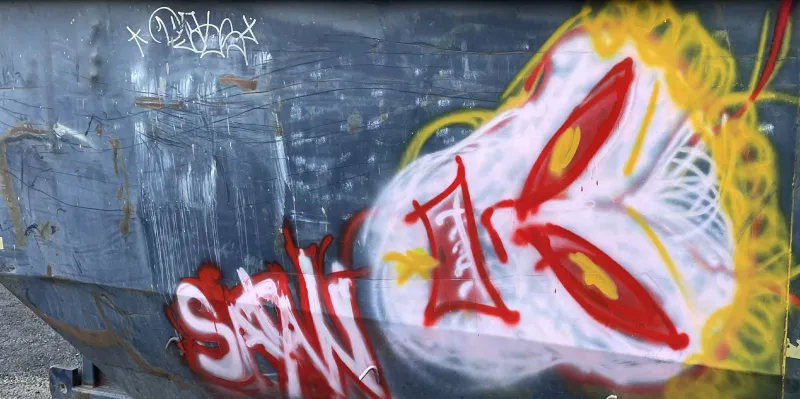
Graffiti on the exterior of Bella Health + Wellness in Englewood, Colorado, on Sept. 25, 2022. / Courtesy of Bella Health + Wellness
Denver, Colo., Sep 25, 2022 / 22:50 pm (CNA).
A suspect was quickly arrested in the vandalism of a Denver-area Catholic pro-life medical clinic. It is not clear whether the clinic was targeted for its pro-life Catholic mission, though the various graffiti included a reference to Satan and a stylized depiction of a devilish character.
“We are sad to have to share that our clinic was just vandalized,” Bella Health + Wellness medical group said Sept. 25 in a 3 p.m. Facebook post including some photos of the vandalism. “If you could take a moment today to pray for our mission, our team and their families, and our patients, we would be grateful!”
The medical group sought help to repair the building before patients arrived Monday morning.
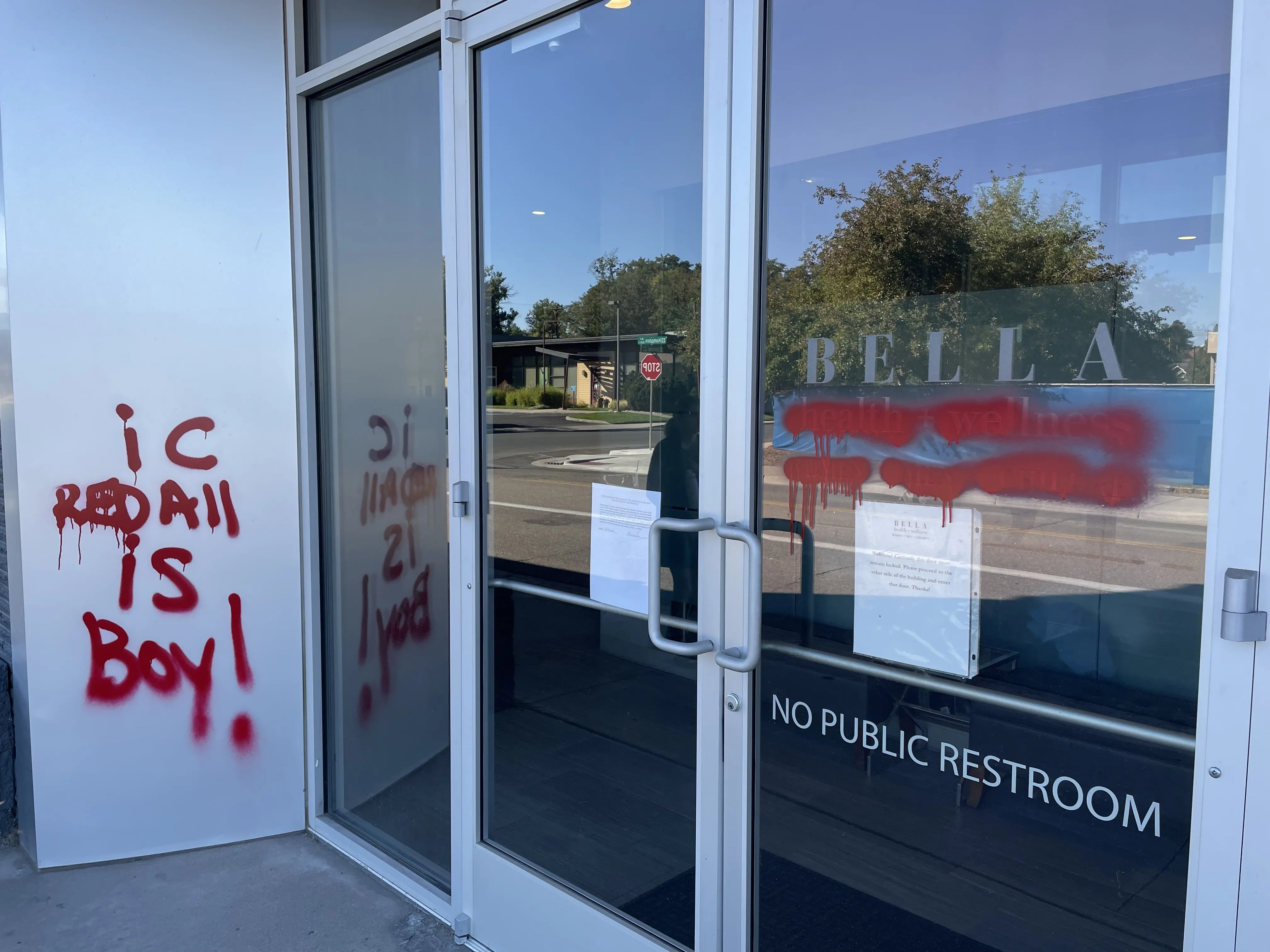
Graffiti on the exterior of Bella Health + Wellness in Englewood, Colorado, on Sept. 25, 2022. Courtesy of Bella Health + Wellness
The Englewood clinic’s front double glass doors normally show the words “Bella Health + Wellness,” among other words. Spray-painted red lines obscured most of the words.
Near the doors, the building was spray painted in red with phrases of what appeared to be graffiti slang including the phrase “IC Redall is boy.”
A large dumpster alongside the building was tagged with large graffiti and the word “Satan” next to a multi-colored, devilish-looking spray-painted face.
After 7 p.m. on Sunday, Bella’s social media reported that the Englewood Police Department had made an arrest. Its Facebook post said “huge thanks to the Englewood Police Department.”
Bella is a non-profit medical practice that operates in alignment with Catholic teaching. Archbishop Samuel Aquila of Denver praised the practice at its December 2014 launch. It offers full OB-GYN care with a specialization in NAPRO technologies as well as family primary care, including pediatrics.
According to its website, Bella served over 1,700 patients in 2021 and provided almost $250,000 in free care. It says 382 babies were born with Bella’s assistance, 981 Medicaid patients were served, and another 622 patients were served in partnership with Marisol Health, the pro-life medical centers of Catholic Charities of the Archdiocese of Denver.
“Bella has a mission to protect life-affirming, dignified health care,” the clinic says on the front page of its website. “We believe providers and patients deserve to act according to their own medical consciences.”
If you value the news and views Catholic World Report provides, please consider donating to support our efforts. Your contribution will help us continue to make CWR available to all readers worldwide for free, without a subscription. Thank you for your generosity!
Click here for more information on donating to CWR. Click here to sign up for our newsletter.
U.S. Vice President JD Vance. | Credit: Gage Skidmore, CC BY-SA 4.0, via Wikimedia Commons
Jan 16, 2026 / 16:40 pm (CNA).
Vice President JD Vance is scheduled to speak at the 2026 March for Life Rally in Washington, D.C., on Jan. 23.Vance, who … […]
Pope Francis addresses international diplomats to the Holy See on Jan. 9, 2023, in the Vatican’s Blessing Hall. / Vatican Media
Rome Newsroom, Jan 9, 2023 / 06:28 am (CNA).
The global community is engaged in a “third world war” marked by heightened fear, conflict, and risk of nuclear violence, but a recommitment to “truth, justice, solidarity and freedom” can provide a pathway to peace, Pope Francis told international diplomats Monday.
Citing the ongoing war in Ukraine, but also drawing on conflicts in places such as Syria, West Africa, Ethiopia, Israel, Myanmar, and the Korean Peninsula, the Holy Father said this global struggle is being “fought piecemeal,” but is nonetheless interconnected.
“Today the third world war is taking place in a globalized world where conflicts involve only certain areas of the planet direct, but in fact involve them all,” said Pope Francis, speaking in the Vatican’s apostolic palace.
The pope made these remarks as part of his annual address to the diplomatic corps accredited to the Holy See. Pope Francis characterized this speech as “a call for peace in a world that is witnessing heightened divisions and war.”
Pope Francis addresses diplomats to the Holy See in the Blessing Hall at the Vatican on Jan. 9, 2023. Vatican Media
As part of this heightening of tensions, the Pope warned about the increased threat of nuclear warfare, drawing particular concern to the stall in negotiations for the Iran nuclear deal. He told the gathered diplomats that the possession of nuclear weapons is “immoral” and called for an end to a mentality that pursues conflict deterrence through the development of ever-more lethal means of warfare.
“There is a need to change this way of thinking and move toward an integral disarmament, since no peace is possible when instruments of death are proliferating,” the pope said.
In proposing a path towards global peace, the Holy Father drew heavily from Pacem in Terris (“Peace on Earth”), the papal encyclical promulgated by St. John XXIII in 1962. Pope Francis said the conditions which prompted the “good Pope” to issue Pacem in Terris 60 years ago bear a striking similarity to the state of the world today.
In particular, the Holy Father drew from what John XXIII described as the “four fundamental goods” necessary for peace: truth, justice, solidarity, and freedom, values that “serve as the pillars that regulate relationships between individuals and political communities alike.”
Regarding “peace in truth,” the Holy Father underscored the “primary duty” of governments to protect the right to life at every stage of human life.
“Peace requires before all else the defense of life, a good that today is jeopardized not only by conflicts, hunger, and diseases, but all too often in the mother’s womb, through promotion of an alleged ‘right to abortion,’” said Pope Francis, also calling for an end to the death penalty and violence against women.
Speaking of the necessity of religious freedom for peace, the Holy Father noted widespread religious persecution against Christian minorities, but also discrimination in countries where Christianity is a majority religion.
“Religious freedom is also endangered wherever believers see their ability to express their convictions in the life of society restricted in the name of a misguided understanding of inclusiveness,” he said.
Regarding justice, the Holy Father called for a “profound rethinking” of multilateral systems such as the United Nations to make them more effective at responding to conflicts like the war in Ukraine. But he also criticized international bodies for “imposing forms of ideological colonization, especially on poorer countries” and warned of the growing risk of “ideological totalitarianism” that promotes intolerance towards those who dissent from certain positions claimed to represent ‘progress.’”
Pope Francis visits with international diplomats accredited to the Holy See on Jan. 9, 2023, at the Vatican. Vatican Media
The Holy Father also spoke of the need to deepen a sense of global solidarity, citing four areas of interconnectedness: immigration, the economy and work, and care for creation,
“The paths of peace are paths of solidarity, for no one can be saved alone. We live in a world interconnected that, in the end, the actions of each have consequences for all.”
Finally, regarding “peace in freedom,” Pope Francis warned of the “weakening of democracy” in many parts of the world, and an increase in political polarization. He said peace is only possible if “in every single community, there does not prevail that culture of oppression and aggression in which our neighbor is regarded as an enemy to attack, rather than a brother or sister to welcome and embrace.”
The Holy Father’s address to the diplomatic corps, which includes representatives of the 91 countries and entities with an embassy chancellery accredited to the Holy See, also served as an opportunity to review diplomatic highlights of the past year and expectations for the year to come.
Milestones included the signing of new bilateral accords with both the Democratic Republic of São Tomé and Príncipe and with the Republic of Kazakhstan. The Holy Father also briefly mentioned the provisional agreement between the Holy See and the People’s Republic of China, first agreed to in 2018 and renewed in 2022 for an additional two years.
“It is my hope that this collaborative relationship can increase, for the benefit of the life of the Catholic Church and that of the Chinese people.”
The next significant marker on the pope’s diplomatic docket: His trip to the Democratic Republic of Congo at the end of the month as a “pilgrim of peace,” followed by a joint visit to South Sudan with the Archbishop of Canterbury and the head of the Presbyterian Church of Scotland.
Leave a Reply
