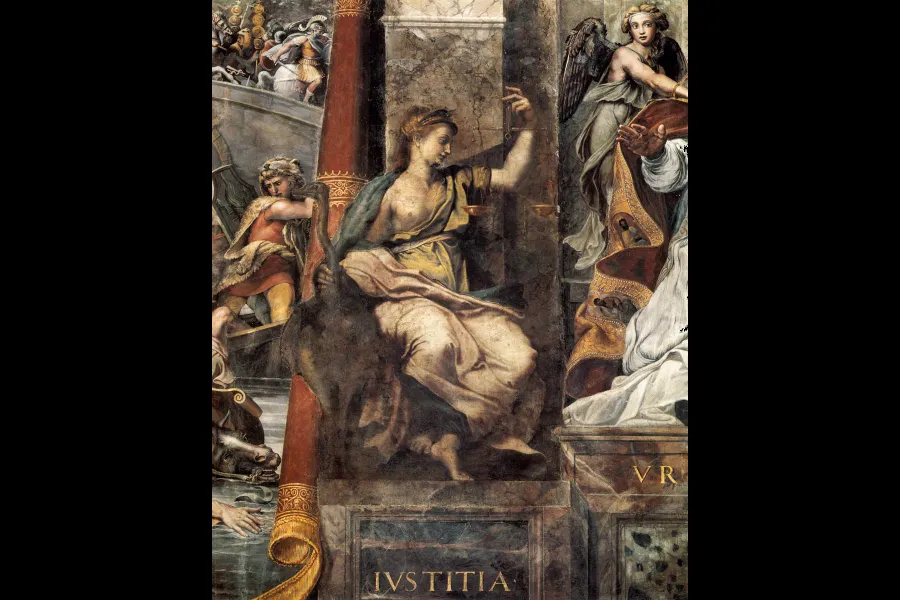
Vatican City, Jul 12, 2017 / 04:58 pm (CNA/EWTN News).- Two works painted by Renaissance master Raphael have been newly identified after art experts restored famous frescoes in the Apostolic Palace of Vatican City.
Arnold Nesselrath, an art historian who heads technical and scientific research at the Vatican Museums, told the Italian newspaper La Stampa that 16th century sources had offered clues. These sources said that Raphael had indeed painted two figures in the Apostolic Palace’s Hall of Constantine as tests of his oil technique.
In Nesselrath’s words, these figures were described as being “of a much higher quality than the ones around them.”
The exact identity of these figures was forgotten until the 21st century.
In an art restoration process that began in 2015, experts cleaned the works and removed the effects of centuries of previous restoration work.
They discovered that Raphael himself had painted two figures of women who serve as allegories for the virtues of Friendship and Justice. Only the art restoration made apparent Raphael’s oil technique.
The Hall of Constantine was intended to serve as a reception room in the Apostolic Palace of Vatican City. It depicts the life of the Constantine the Great, the first Roman emperor to seek baptism. The four frescoes depict The Vision of the Cross, the Battle of the Milvian Bridge, the Baptism of Constantine, and the Donation of Constantine.
The Vision of the Cross fresco depicts a key event said to have been a step towards Constantine’s conversion to Christianity during his battles to become emperor. The fresco depicts the emperor in a military camp looking towards giant cross in the sky that is surrounded by Greek words saying, “In this sign, conquer.”
At one side of this fresco, a woman labeled as Friendship wears a blue gown. She is seated to the left of St. Clement I, a first century Pope, the art blog Hyperallergic reports.
Another figure believed to be painted by Raphael is on the far right side of the fresco depicting Constantine’s battle at the Milvian bridge with his brother-in-law Maxentius, a rival imperial claimant. This woman’s image is labeled as Justice and bears a set of scales, at which she is staring.
Raphael, working under a commission from Julius II, had sketched plans for the Hall of Constantine before his death in 1520. The frescos’ completion was left to his students.
“They continued in the traditional method and have left only these two figures, autographs of the master,” Nesselrath told La Stampa.
Three other rooms in the Apostolic Palace feature Raphael’s work, including his famous depiction of the Greek philosophers Plato and Aristotle in his work “School of Athens.” Known as the “Raphael Rooms,” the frescoes can be seen by visitors to the Vatican Museums.
 […]
[…]






“Reportedly”? If true, then we might be reminded of the communal kiss of Judas and, then later on the road to Calvary, the smiley folks at the periphery who refrained from calling for blood, but who also discretely remained silent. The lukewarm and useless.
One possibly rational explanation for the reported event might be what has traditionally been understood as “invincible ignorance.” Is Pelosi a cretin and totally beyond reach in dealing with elementary moral contradictions, and so defective as to be possibly not morally responsible?
Or, perhaps this reported event is a synodally inclusive symbol to the effect that the Eucharist is so fluidly universal that it even includes unrepentant Aztec practitioners (in addition to Pachamama).
But, then, there’s the scandal thing and the warning from Christ (!) about the millstone…
In a more complete report, we find that Communion was distributed by priests who likely would not even recognize Pelosi.
https://mail.google.com/mail/u/0/#inbox/FMfcgzGpGdnzggzkHwVhNcJfsnLZCDWS
As to that particular explanation, prudence might counsel that it strains credulity.
Sorry, there is only one way to interpret these (repeated) gestures, but the usual spinmeisters will quickly show up to explain it all away for us. Thank goodness we have Catholic (or at least papal) apologists to prevent us from sinning by drawing some obvious conclusions! When Francis compares abortion to hiring a hitman to solve a problem, it is not at all apparent to me that he means to condemn the practice.
As to general attempts to explain away this new stunt by Pontiff Francis, I offer the suggestion that while Jesus called his followers his sheep, he didn’t call us to act like cattle.
St. Paul explains in 1 Corinthians that “whoever…eats the bread or drinks the cup of the Lord in an unworthy manner will be guilty of profaning the body and blood of the Lord. Let a man examine himself, and so eat of the bread and drink of the cup. For any one who eats and drinks without discerning the body eats and drinks judgment upon himself.”
‘ Dickson recalled to LifeSiteNews how at one point during the Amarillo hearings, interestingly, the Lilith Fund attorney clarified to the judge that their lawsuit did not take issue with a reference by Dickson to Lilith, the mythological figure for which the group is named, as “a demon that preys on women and children.”
“I thought that was kind of funny because Lilith is a demon that preys on women and children,” Dickson told LifeSiteNews, adding that he sees the fund as just that. He pointed to his 2019 comment, “Perhaps they have a desire to live up to their name.”
‘
https://www.lifesitenews.com/news/pro-life-activist-sued-for-calling-abortion-murder-takes-case-to-texas-supreme-court/