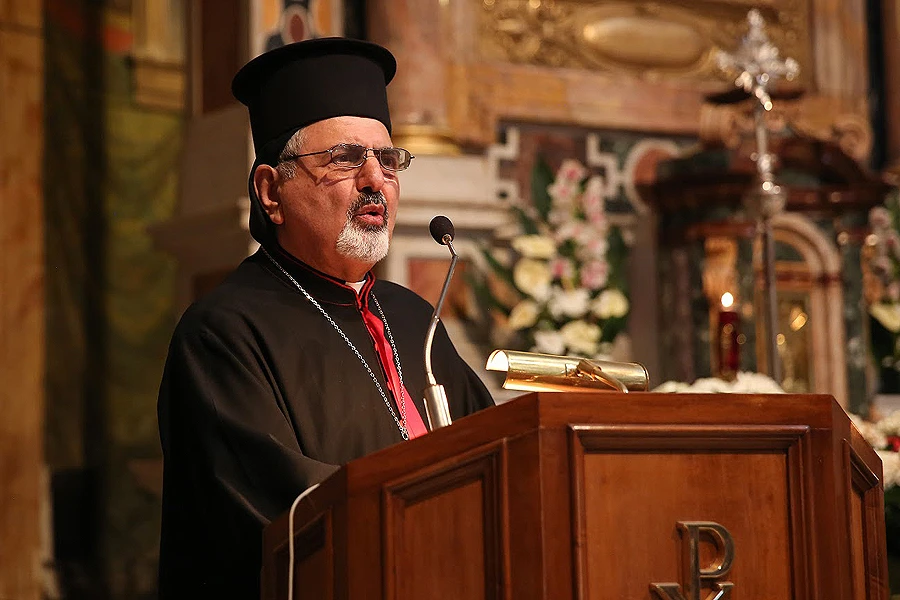
Rome, Italy, Oct 12, 2017 / 10:20 am (CNA/EWTN News).- As interreligious tensions and a migration crisis continue in the Middle East, key Church leaders in the region have said Christians largely feel abandoned by the international community, which has done little to help resolve the situation.
According to Syriac Catholic Patriarch of Antioch Ignatius Joseph III Younan, Christians in the Middle East “feel that we have been abandoned, even betrayed, because we were hoping that the international community would defend our rights and provide us with the equal chance to live in our homeland, but that wasn’t the case.”
“It’s not easy to endure that violent upheaval in those two countries, in Iraq and Syria,” he said, explaining that both faithful and Church leaders in the region share this sense of abandonment and betrayal by Western countries in particular, which he said are more “opportunistic” than helpful.
“We, the heads of Churches, along with some other prominent lay people who have been caring for their communities, we try to send our voice, our rights, like St. John the Baptist, but it seems that we are shouting in the desert,” he said.
Younan cited “opportunistic geopolitics” as one of the main reasons Christians have either been left homeless with no funding to rebuild their cities, or left lingering in refugee camps for years due to a backlog in visa requests while being denied official refugee status.
“We don’t have the interest regarding our faith among the politicians that govern the Western countries. We don’t have the numbers, we don’t have the oil, we don’t pose any terrorist threat to the civilized world, and therefore we have been put aside and neglected,” he said.
The patriarch is in Rome for the Oct. 9-12 plenary assembly marking the centenary of the Congregation for the Oriental Churches and the Pontifical Oriental Institute, founded by Benedict XV.
Christians from Iraq and Syria who have fled to neighboring countries such as Lebanon, Turkey, and Jordan are still living “in a kind of limbo. They don’t know what to do for their children,” he said.
In terms of numbers, Younan said that so far more than 50 percent of Christians in Iraq have already left the country, while a third of the remaining Christian population is internally displaced.
As far as the Christian presence in Syria, “we can easily talk about a third” of the Christian population having left, with many still waiting to be admitted to new countries.
The main needs of refugees and displaced persons is first of all humanitarian assistance, Younan said, explaining that the Church tries to provide for their basic needs, “but surely its not enough,” since most have already been displaced for several years.
“We still suffer with them in our souls because we don’t know what to do for them. We can’t seek refugee visas for them, because otherwise the Christian community would be empty in their homelands and for us this is a great loss,” he said. “But we try to respond to their basic needs.”
In terms of dialogue between Christianity and Islam, the patriarch said at times it’s difficult to speak of such a dialogue in the current cultural context, but it must happen at the level of “the believers of each religion.”
At the present moment, dialogue is focused on how the two can mutually and peacefully coexist, he said, with an emphasis on the fact that “we live in the 21 st century, that we have to respect each other, to accept each other and not discriminate because of religion.”
“This is also the mission, the task of the countries who have a word to say on the international scene,” he said. “We sit together at the United Nations…and we talk about human rights and therefore we have to uphold those rights for all, not only for the ones who believe in our religion, but for all people.”
While the Holy See, and Pope Francis in particular, understand and are doing their best to help in the plight of Christians in the Middle East, Younan said that in the broader community “the geopolitical strategy of the mighty countries is still in, let’s say, the ‘winning’ part in the world.”
“To follow the ethics of the Gospel, the real defense of human rights is for those who are the weakest and for the forgotten ones among the minorities in the Middle East,” he said, but “that’s not the case, we are not the point of their interest.”
The first right that needs to be promoted for Christians in the Middle East is to be able “to live in freedom as equal citizens,” rather than second-class citizens who face harsh discrimination which frequently goes unpunished by the law, the patriarch said.
Another key right is the ability “to choose our creed, our religion, and the right also to announce our creed, our religion to others,” he said.
However, currently “it’s forbidden” to evangelize in Muslim countries apart from Lebanon. Because of this, “we’ve been always, along the centuries, reduced to minorities because we’ve been forbidden to be missionaries in our own country.”
Issuing an appeal to the international community, Younan asked that Western nations not look at Christian and other minorities in the Middle East “as numbers, but as people, as persons, being persecuted along the centuries.”
“We’ve been reduced to minorities not because we had to leave our countries, but because we are not considered equal citizens with the Muslim majority,” he said, and called on “this so-called civilized world not just to look for their own political, economic interest,” but to protect “the rights of those who are persecuted because of their religion and their creed.”
“This is the way to deal with our problems, our very critical situation,” he said. And if the world fails to do defend the “human and religious” rights of everyone, “the Middle East will be emptied of their Christian communities and it would be a very great loss.”
Material from EWTN News Nightly was used in this report.
 […]
[…]




Birds of a feather…
Only to the heterodox…
A prophet, indeed — a false prophet.
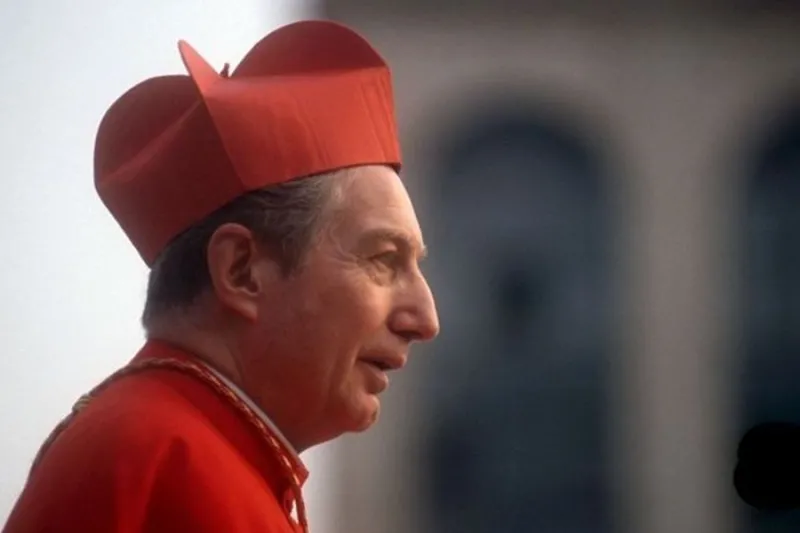
“The Martini Curve should indeed make us think. I thought about it at the time and ended up with questions rather than answers. What, precisely, was the Church two hundred years behind? A western culture come unglued from the deep truths of the human condition? A culture that celebrates the imperial autonomous Self? A culture that detaches sex from love and responsibility? A culture that breeds a politics of immediate gratification and inter-generational irresponsibility? Why on earth would the Church want to catch up with that? Call me a dullard, but try as I might to adjust my thinking, I’m afraid that’s what I still think about the allegation that Catholicism’s contemporary failures result from our being stuck in a rut behind the curve of history” (George Weigel Denver Catholic 1.8. 2020).
Weigel’s instincts were correct. Cardinal Carlo Martini SJ was ahead of his time [and space] envisioning a Church unlike anything that preceded. Archbishop Bergoglio considered Martini his mentor. What Martini envisioned for a Church 200 years behind Francis is achieving in hypersonic transit.
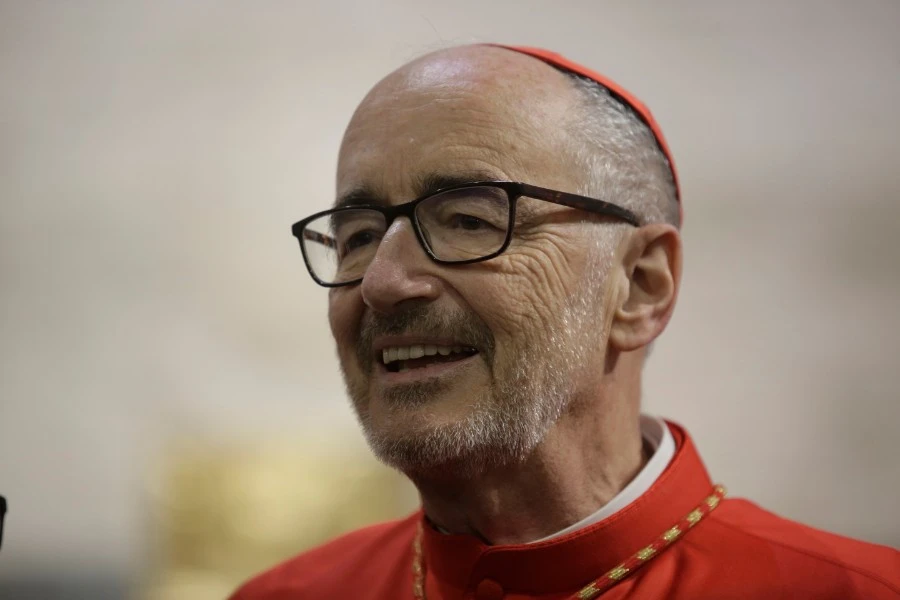
When previously held eternal truth [tightly held by the unfavorably impressed], revealed once and forever by the Son of God suddenly becomes as relevant as a moth eaten rug we’re reminded of the words of the Apostle, Whoever preaches a Gospel other than what you have received, be he an angel of light’ let him be anathema. Cardinal Czerny SJ doesn’t seem to see the difference.
Some time ago I read Martini’s booklet meditations /retreat based on themes and reflections from David (OT King). I would use Pope Francis’ phrase incurvatus to describe the experience. My impression was, he was leading – teaching – a “turned in” spirit. I think there’s a way of dwelling too much on one’s own being and that it can happen that it ends up being guided; and Martini was one such guide.
I am not an expert nor have I any training. Maybe it is suited to the feminine psyche but not the masculine. I suspect however that my proposed distinction would not salvage the thing for authentic spiritual direction that made one so absorbed.
Mind you, if I had a vision or something like that I would accept that it would command my attention. But just transposing David’s religious encounters into shared “spiritual” feelings is not going to transfix me. Jolly sorry.
My other impression of the ideas from his retreat, is, his presentation of David outside the Incarnational reality; and/or, the presentation of David as archetype of Incarnational reality. With my question why I should I have to solve that, nagging me all the way through the reading!
Besides that Martini had strange ideas about conception and about homosexuality; which went un-redressed until he died.
https://www.goodreads.com/book/show/15056623-david
https://web.archive.org/web/20061207144612/http://www.chiesa.espressonline.it/dettaglio.jsp?id=53021&eng=y
https://www.catholicworldreport.com/2014/02/24/cardinal-burke-francis-asks-people-to-put-aside-obstacles-and-to-welcome-christ-without-any-excuse-into-their-lives/
A Martini is two drinks away from a Montini. Both are ____________ fill-in-the-blank with the correct multiplechoice answer. The cocktail bar beckons.
A couple of years ago the English and Italian and I think Spanish parts of ZENIT stopped publishing but the French and Arabic continued. ZENIT is publishing in English and Spanish once more but the Italian is still at a stall. Another problem with ZENIT is that -at least for my location,- the Google search does not return the main links; instead giving links to fb, dud lead-pages, past pages and so forth. Also going between pages, ads jump in and freeze the screen, it’s very trying. Someone should look into it and make things work well. ZENIT news is often unique plus the articles reveal the atmosphere surrounding the Curia, it is an important resource.
I would note that there used to be SOME REALLY GOOD JOURNALISTS with ZENIT. Where have they gone?
Today in the Arabic section there is a report of the spontaneous interview the Holy Father gave to Spotify, apparently the first week of this month. This led me to the original ZENIT report of it in the English section, July 7, that I had missed. The English page says there is a link to the audio but I can’t find it anywhere.
‘ In regard to the myth that the Pope escapes and goes around the streets, the Holy Father said: “It’s not true,” adding that “the one who did so was Saint John Paul II; he found a way. He liked to ski and 100 kilometers from here it’s possible to ski, and he used to do so. He went with his ski cap and covered his face and no one recognized him; he skied a while and then came back. And in the summer there is nothing here.”
Pope Francis explained again why he changed to his present residence in Santa Marta, and added that on Sundays he eats with the Vatican’s employees. He also said that he is reading a book-interview with the late Jesuit and former Archbishop of Milan, Cardinal Carlo Maria Martini.
The full interview can be heard at this link. ‘
https://zenit.org/2022/07/07/pope-francis-on-spotify-first-interview-on-a-podcast-the-one-who-escaped-from-the-vatican-was-saint-john-paul-ii/
https://ar.zenit.org/2022/07/21/%d8%a7%d9%84%d8%a8%d8%a7%d8%a8%d8%a7-%d8%a3%d9%88%d9%91%d9%84-%d9%85%d9%8e%d9%86-%d9%87%d8%b1%d8%a8-%d9%85%d9%86-%d8%a7%d9%84%d9%81%d8%a7%d8%aa%d9%8a%d9%83%d8%a7%d9%86-%d9%83%d8%a7%d9%86-%d8%a7%d9%84/
2012, Robert McClory of NCR was agreeing that Martini was a prophet. He makes a parallel with the context of story of Nicholas Copernicus and Galileo Galilei.
McClory does not resolve issues I identified above; and moreover I wouldn’t place the story of the sciences working through evidences, with the story of Martini.
‘ Was he reaching out to some like-minded colleagues from within the institution, even in the upper reaches of the Vatican, who, like him, have grown weary of the endless retrenchment, the reform of the reform and the insistent papal drumbeat of gloom and negativity? Was Martini hoping for a fearless Galileo, or maybe several, for this age and in this dire situation? God knows, at some point and at some time, there has to be a breakthrough and a sharp turn in the direction of the institutional Catholic church.
May Carlo Maria Martini live on as a prophet of the coming new age. ‘
https://www.ncronline.org/blogs/ncr-today/what-was-cardinal-martini-thinking