


Vatican City, May 7, 2022 / 08:10 am (CNA).
Pope Francis said Saturday that the liturgy should not be “a battleground” for “outdated issues.”
“I emphasize again that the liturgical life, and the study of it, should lead to greater Church unity, not division. When the liturgical life is a bit like a banner of division, there is the stench of the devil in there, the deceiver,” Pope Francis said at the Vatican on May 7.
“It’s not possible to worship God while making the liturgy a battleground for issues that are not essential, indeed, outdated issues, and to take sides starting with the liturgy, with ideologies that divide the Church.”
Speaking at an audience with the Pontifical Liturgical Institute in the apostolic palace, the pope said that he believes that “every reform creates resistance.”
Pope Francis recalled reforms made when he was a child by Pope Pius XII, particularly when Pius XII reduced the fasting requirement before receiving holy Communion and reintroduced the Easter Vigil.
“All of these things scandalized closed-minded people. It happens also today,” he said.
“Indeed, such closed-minded people use liturgical frameworks to defend their views. Using the liturgy: this is the drama we are experiencing in ecclesial groups that are distancing themselves from the Church, questioning the Council, the authority of the bishops … in order to preserve tradition. And the liturgy is used for that.”
Pope Francis spoke to the Pontifical Liturgical Institute, an institute in Rome whose school of liturgy has had increasing influence in liturgical norms coming from the Vatican.
The secretary and undersecretary of the Vatican’s Congregation for Divine Worship were both formed by the institute, which was established in 1961 by Pope John XXIII as part of the Pontificio Ateneo Sant’Anselmo.
Andrea Grillo, one of the most prominent theology professors at the Sant’Anselmo, has been a vigorous defender of Traditionis custodes, the motu proprio issued by Pope Francis in 2021 which restricted Masses celebrated in the extraordinary form of the Roman Rite.
In the pope’s remarks, Francis further warned of “the temptation of liturgical formalism,” which he said can be seen today “in those movements that try to go back a little and deny the Second Vatican Council itself.”
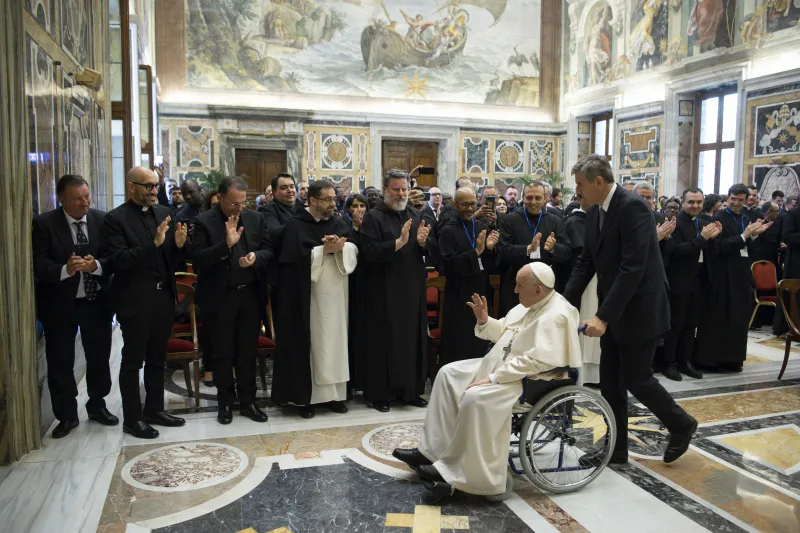
Pope Francis delivered his speech from a wheelchair. The 85-year-old pope has been making his public appearances in a wheelchair since May 5 due to a torn ligament in his right knee.
If you value the news and views Catholic World Report provides, please consider donating to support our efforts. Your contribution will help us continue to make CWR available to all readers worldwide for free, without a subscription. Thank you for your generosity!
Click here for more information on donating to CWR. Click here to sign up for our newsletter.



Hey, Holy Father, it’s not possible to worship God while making the liturgy devoid of all its symbolism and beauty either. Where are these council deniers, anyhow? Probably hanging out with all the other straw men you’ve created.
The Pontiff is simply an arsonist who likes to stick around and watch what he’s firebombed burn to the ground.
He’s gonna’ have to live a long time if he hopes to see the TLM gone. Just like the papal oath against modernism; practitioners simply took it underground.
Well Gary, if that is what the fire in him (the Holy Spirit) does, then why should we grumble.
This reader doesn’t have a dog in this fight, and I don’t reject Traditionis custodes, but how are we to interpret this dismissal of “those movements that try to go back a little and deny the Second Vatican Council itself.”
In the interests of dialogue, reconciliation, factual accuracy and Church unity, what is really called for is not monologue but a coming together of today’s liturgy with what the Council actually adopted in Sacrosanctum Concilium–as a unified development of Tradition with what was explicitly intended for the Novus Ordo. Not either/or. Not setting the clock “back a little,” but setting in right.
Now that at least 70 percent of Catholics no longer believe in the Real Presence, or even attend Mass, what is to be done, really? Invest in doughnuts rather than candles?
Righteous, Jeff T. As for smelling Satan?, I’ve not got the nose for that. I have heard it said that Satan hates Latin, so he and Francis may have that in common.
I pray that Almighty God soon take this poor, confused soul into that big synodally synodal synod in the sky, and grant him the fullness of peace, mercy and salvation, regardless of his many human mistakes.
“When the liturgical life is a bit like a banner of division, there is the stench of the devil in there, the deceiver,”
It does seem that way. For the first three decades of worship in the old form, the change introduced by Vatican 2 came like a breath of fresh air. The liturgy of the Word was richer and more meaningful since it was done in a language I understood. I accepted the change because I went along with the decision of the Church. After all, I belonged to the Church having been baptized into it. I believe this the way our Lord wants it to be.
Malware Alert!
Regarding the liturgy, you refer to the “decision of the Church.” Notwithstanding that much cleaning-up has been done in recent decades, the earlier experimental masses (in both senses of the term) still linger as a bad taste associated with the Novus Ordo.
You, who in a recent post proudly imply that others fall short of your lofty personal standard of actually reading the works of Pope Francis, are invited to take a another or new look at what Vatican II actually decided and authorized in the Constitution on the Sacred Liturgy:https://www.vatican.va/archive/hist_councils/ii_vatican_council/documents/vat-ii_const_19631204_sacrosanctum-concilium_en.html
And as for your reported “millions”—certainly true–who admire the subtleties of Pope Francis’ writings (and his contrary signaling?), what are these compared to the 1,300 millions of Catholics in the world today and all those who have come before, the real Tradition-—what G.K. Chesterton calls the more inclusive (!) “democracy of the dead”?
Make no self-referential mistake, Pope Francis is the pope of all of us, but we also agree with him that his actions are far from perfect. These would be tough times for any pope, but unfortunately his successes include progress on his goal of “making a mess of things.”
Your own headcount of sympathetic followers on these pages could improve if you refrained from branding others—surely less pristine than yourself—as “trads and protestants.” Show some self respect.
I say “trads and Protestants” because they form the bulk of the people that oppose Pope Francis. Of course, there are others who think like them but who do not associate with them. I suppose I could add “and a few others”. But I will not change my ways because those groups are harming the Church and, sadly, quite a few souls.
“…others who think like them [only]? “I will not change my ways.” How “bigoted” and how very “rigid” can one be? How very “traditional”!
Brother Mal,
My less sarcastic remark is to recommend the 19th century St. John Henry Cardinal Newman (regarded as the “grandfather of the Second Vatican Council”) who, in his “Development of Christian Doctrine,” explains that in moving “forward” it is necessary to NOT burn our bridges (the real Tradition). The “others” whom you now recognize simply notice some fires and that’s where the one-sided (!) dialogue is focused.
Newman offers seven criteria:
(1) One and the same TYPE [doctrine/ natural law v. a disconnected degree of pastoral “accompaniment”?],
(2) The same PRINCIPLES [sound philosophy v. neo-Hegelianism?],
(3) The same ORGANIZATION [the Barque of Peter v. Fratellli tuti’s all religions equivalently (?) “the will of God”?];
(4) If its beginnings ANTICIPATE its subsequent phases [Catechism/Veritatis Splendor v. signaling the normalization of homosexual activity, etc.?], and
(5) Its later phenomena PROTECT and subserve its earlier [VS/Familiarus Consortio v. the fanciful social-science of Marx, and Batzing and Hollerich?];
(6) If it has a power of assimilation and REVIVAL [Evangelization v. Amazonia/Germania?], and
(7) A vigorous ACTION from first to last…” [energized witnessing while/because also fully and steadfastly engaging new challenges v. double-speak?].
That’s great, as long as you never travel and have to listen to Mass in another language. Then it is no different than the Latin Mass. I have traveled to several countries, and any Mass in other than English or French is just as “non-understandable” as Latin. At least in my youth, most people had a missal with English translations so one could follow along, even without understanding the priest.
This is too much even from this Pope.
What do they call those who attribute actions to others that they themselves are doing???
The word you are looking for is projection
Pot and kettle maybe?
“Indeed, such closed-minded people use liturgical frameworks to defend their views.”
Were more true words ever spoken by the man?
Problems with worship go all the way back to the Church at Corinth. St. Paul had to give them correction to keep the faith pure in the face of pagan idol worship. St. Paul’s comments about women covering their heads and the eating of meat offered to idols was in response to the pagan worship practices of the time. The general sequence for pagan worship was for there to be a sacrifice to a pagan god. The meat from the pagan sacrifice was served in attached dining halls or sold in meat markets. The people in the dining halls got drunk and engaged in sexual orgies. In the pagan temples women who wore their hair down meant that they were sexually available. Proper women wore their hair up.
*
St. Paul wrote:
*
Now concerning food offered to idols: we know that “all of us possess knowledge.” “Knowledge” puffs up, but love builds up. 2 If any one imagines that he knows something, he does not yet know as he ought to know. 3 But if one loves God, one is known by him.
4 Hence, as to the eating of food offered to idols, we know that “an idol has no real existence,” and that “there is no God but one.” 5 For although there may be so-called gods in heaven or on earth—as indeed there are many “gods” and many “lords”— 6 yet for us there is one God, the Father, from whom are all things and for whom we exist, and one Lord, Jesus Christ, through whom are all things and through whom we exist.
7 However, not all possess this knowledge. But some, through being hitherto accustomed to idols, eat food as really offered to an idol; and their conscience, being weak, is defiled. 8 Food will not commend us to God. We are no worse off if we do not eat, and no better off if we do. 9 Only take care lest this liberty of yours somehow become a stumbling block to the weak. 10 For if any one sees you, a man of knowledge, at table in an idol’s temple, might he not be encouraged, if his conscience is weak, to eat food offered to idols? 11 And so by your knowledge this weak man is destroyed, the brother for whom Christ died. 12 Thus, sinning against your brethren and wounding their conscience when it is weak, you sin against Christ. 13 Therefore, if food is a cause of my brother’s falling, I will never eat meat, lest I cause my brother to fall.
(1 Corinthians 8:1-13 RSVCE)
*
CWR has had articles about open, uncorrected liturgical abuses. Many modernist Catholics are all too puffed up with worldly knowledge, very much like the Church at Corinth.
Pope Francis neglected to add that he is the one who made the liturgy a battleground, not those who love the Mass of Ages. Popes John Paul and Benedict pursued a policy of peaceful coexistence and mutual enrichment, which he disregarded out of irrational hatred and a will to flex his power.
I agree completely. His Holiness absolutely should stop gratuitously making the Liturgy a battleground and deliberately being divisive. It is tragic.
For Mahatma Gandhi, following Christ was much more than liturgy. He would often say, “Oh, I don’t reject your Christ. I love your Christ. It is just that so many of you Christians are so unlike your Christ”