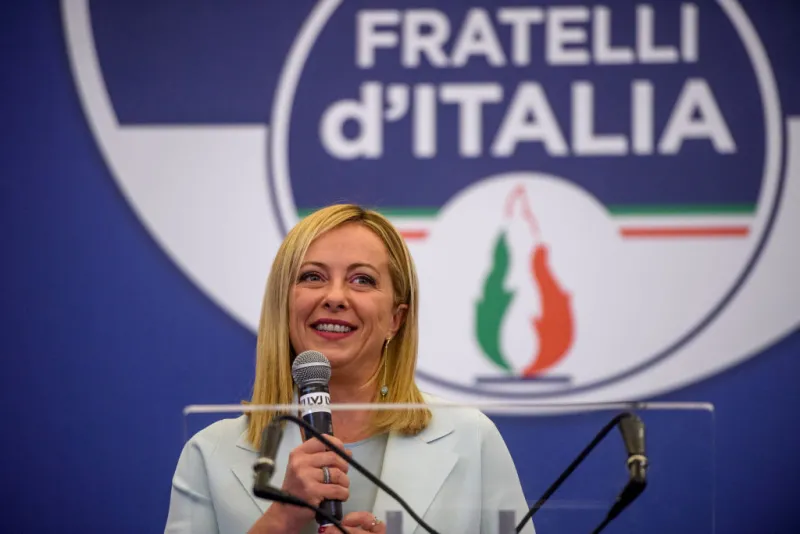
 Giorgia Meloni, leader of the Fratelli d’Italia (Brothers of Italy), speaks at a press conference at the party electoral headquarters overnight on Sept. 26, 2022. in Rome. Italy’s national elections on Sept. 25 saw voters poised to elect Meloni, a Catholic mother, as the country’s first female prime minister. / Photo by Antonio Masiello/Getty Images
Washington D.C., Sep 26, 2022 / 18:00 pm (CNA).
Italy’s national elections on Sept. 25 ended with Giorgia Meloni, a Catholic mother, poised to become the country’s first female prime minister.
In the snap elections — called after former prime minister Mario Draghi’s unity government collapsed due to economic and military tensions — Meloni’s Brothers of Italy party captured the most votes at around 26%, skyrocketing from a roughly 4% share four years ago.
Before and amid her party’s electoral victory, Meloni’s views have been described in the media as “far-right” and even as “fascist.” Here’s what you need to know about her:
She’s not the prime minister yet
It’s worth noting that although Meloni’s party garnered the most votes in the recent election, it’s not yet certain that she will be Italy’s prime minister.
It is up to Italian President Sergio Mattarella to nominate someone from the winning coalition as prime minister, a process that could take several weeks. The nominee is likely to be Meloni, who will then be tasked with assembling a majority in Parliament. Brothers of Italy was the leading party in a center-right coalition that now must form an alliance to govern.
Meloni comes from a working-class Roman background. She worked various jobs, including as a waitress and as a nanny, before becoming a full-time politician. In 2008, Prime Minister Silvio Berlusconi appointed her the country’s minister for youth, the youngest person to be appointed to that position.
She made her faith a major part of her campaign
Meloni has described herself in speeches as a Christian and has publicly expressed her admiration for Pope St. John Paul II. She keeps a photo of John Paul II and St. Teresa of Calcutta on her desk and has expressed a desire to meet Pope Francis in person — a virtual certainty when and if she becomes prime minister.
“I am a woman, I am a mother, I am Italian, I am a Christian, and you can’t take that away from me,” Meloni said in a speech in 2019.
Meloni — who was raised by a single mother in Rome — now has a daughter with her partner Andrea Giambruno, though the two have never married.
She supports several pro-life and pro-family policies
In a speech to the Vox party in Spain earlier this year, Meloni summarized her pro-life and pro-family platform: “Yes to natural families, no to the LGBT lobby, yes to sexual identity, no to gender ideology, yes to the culture of life, no to the abyss of death.”
In Italy, abortion is legal through the first 90 days of pregnancy, with exceptions after that point for fetal anomalies and risks to the mother’s life. Access to legal abortions is limited, however, due to widespread opposition from Italian doctors — 68.4% as of 2017, according to the Italian Ministry of Health — who oppose performing abortions due to conscience objections.
Meloni has not said she will attempt to change Italy’s abortion laws. She has, however, proposed pro-life and family policies to encourage motherhood, including free child-care services. She has cited Italy’s extremely low birth rate as a problem.
“I want our families to have children,” she said in a speech to supporters in Milan earlier this month.
She has committed to opposing LGBTQ policies and gender ideology
Meloni has made her views against same-sex unions widely known, referring to LGBTQ content as “woke ideology” and promising to continue opposing policies allowing homosexual couples to adopt or have children through surrogacy.
Italy has legalized same-sex civil unions but it does not afford them the same legal protections as it does marriages. Surrogacy and in vitro fertilization (IVF) are banned for same-sex couples, for example, who must travel outside the country for such procedures. Meloni proposed an amendment in 2018 to extend the surrogacy ban to same-sex couples who seek it abroad, which was not approved.
The amendment called surrogacy an “example of the commercialization of the female body and of the very children who are born through such practices, who are treated like commodities.”
Meloni said earlier this year that her opposition to such policies is not because she is “homophobic” but that she believes every child has the right to have a mother and a father for “stability.”
She cited her personal experience growing up in a single-parent home, saying, “I lived [in] a family condition that [made] me see this.”
Meloni is strongly against illegal immigration
Meloni has made it clear that she opposes the practice of migrants sailing from places such as North Africa to the Italian shore. In August, Meloni posted a video on social media saying she would introduce a naval blockade to patrol the Mediterranean and return migrants to their countries of origin, NPR reported.
Meloni’s anti-immigration stance puts her somewhat at odds with Pope Francis, who has frequently spoken about the need to welcome migrants and refugees.
Meloni is a Eurosceptic, and supports Ukraine in its war with Russia
Meloni has been critical of the European Union (EU), saying her first priority is to defend Italy’s national interests.
“We want a different Italian attitude on the international stage, for example in dealing with the European Commission,” Meloni said in an interview with Reuters this month on her party’s Eurosceptic views.
Still, Meloni has taken pains to assure world leaders that Italy would not leave the EU.
“This does not mean that we want to destroy Europe, that we want to leave Europe, that we want to do crazy things,” she said. “It simply means explaining that the defense of the national interest is important to us as it is for the French and for the Germans.”
Since Russia’s invasion in February, Meloni has come out as a strong defender of Ukraine, promising to continue supplying arms to the country.
Meloni has also taken a hardline stance against China and called on Italian athletes to boycott Beijing in the 2008 Olympics.
She has rejected the “fascist” and “far-right” labels often attributed to her
Meloni has been branded as “far-right” and “fascist” by media outlets, pro-abortion and LGBTQ activists, and world leaders — a label she has rejected.
“Everything that defines us is now an enemy for those who would no longer like us to have an identity,” Meloni said in a widely shared speech on Sept. 26. “Like it or not … we will defend God, country, and family.”
In an interview with Reuters last month, she dismissed any suggestion that her party was nostalgic for the fascist era and distanced herself from comments she made in 1996, as a teenager, which some critics took as a praising Benito Mussolini.
Meloni has received a warm welcome from other conservative European leaders, including Hungarian Prime Minister Viktor Orbán, who shares her traditional family views and immigration policy.
[…]


.jpg)


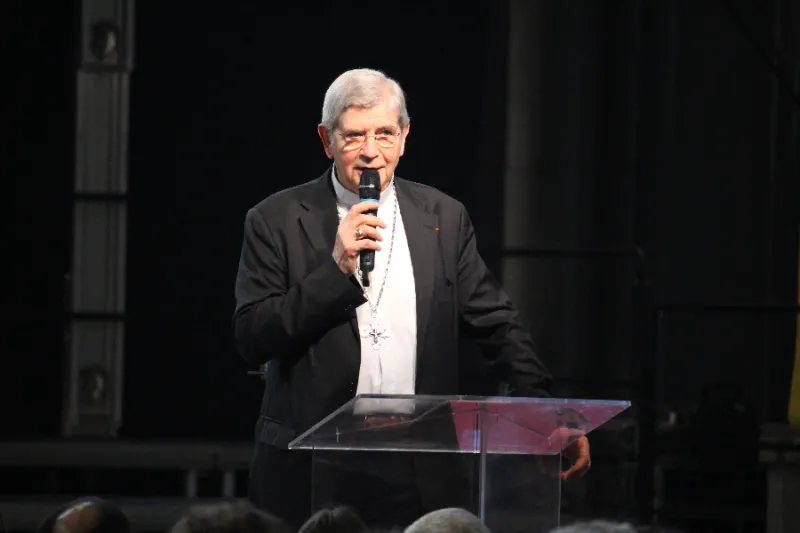
Archbishop Aupetit was effectively removed by His Holiness on the pontiff’s alleged “Altar Of Hypocrisy” following submission of resignation [recall the difference with Cardinal Reinhard Marx who was instead retained on similar grounds]. “The problem with the altar of hypocrisy is that the weight of public opinion becomes unbearable. And this also influences the criteria for the selection of new bishops, because their positions must be those that public opinion can understand so that the Church is not under attack. It is an original sin that has been with us since the election of Pope Francis” (Andrea Gagliarducci MondayVatican 4.25.22).
Gagliarducci waxing objectively perceives Francis’ Altar of Hypocrisy rationale for dismissing/accepting removal as a seeming benevolent bow to public opinion, although he does name it a sin. Or is it more pretext to reconstitute [Archbishop Aupetit practiced medicine from 1979 to 1990 and taught bioethics until 2006. His book, L’Embryon, Quells Enjeux? The Embryo: What Are the Stakes? Paris: Éditions Salvator, 2008 is a vigorous defense of the unborn child in NCReg]. Perhaps too rigorous a defender of the unborn to meet Dicastery science?
“Pope Francis, over the years, has become the protagonist of what has been defined by many as “a pastoral turning point.” The profile of some new bishops immediately made cardinals testifies to this: in the United States, Blase Cupich, transferred to Chicago; Wilton Gregory, moved to Washington; and Joseph Tobin, transferred to Newark. In Latin America, the creation of the archbishop of Huancayo Pedro Carlo Barreto as cardinal” (Ibid).
Archbishop Laurent Ulrich, Aupetit’s replacement, reveals little of the moral character and expertise of the latter. Despite allegation that Aupetit had an unacceptable shoulder rubbing relationship with his secretary warranting Aztec sacrifice on the Altar of Hypocrisy when His Holiness upgrades those who are far more engaged.
But wait, Fr. Morello, we find biblical reference to the likes of the rainbow-bannered Marx, Bats-sing and Hollerich who, now with complicit media accompaniment (!), would hijack the synodal process to sabotage inborn human morality and settled Catholic teaching on faith and morals…
BIBLICAL! Without commenting on either Archbishop Ulrich or the former Archbishop Apetit, we find the relevant scriptural passage right here in the Liturgy of the Hours for today (the second Tuesday after Easter):
“…I know you cannot tolerate wicked men; you have tested those self-styled apostles [!] who are nothing of the sort, and discovered that they are imposters [!]” (Rev 2:2). Sinodize that!
Pope Francis who, in 2017, appointed Bishop Aupetit as Archbishop to Paris, accepted the latter’s resignation because there was much media backlash.
However, a few months later the Archbishop said: “He also wanted to show his confidence by asking me to remain in the Roman Congregation for Bishops.” This is the “department of the Roman Curia responsible for identifying and selecting candidates for bishop, before presenting them to the pope for a final decision.”
https://www.catholicworldreport.com/2022/02/05/archbishop-aupetit-pope-francis-asked-me-to-stay-in-congregation-of-bishops-after-paris-resignation/