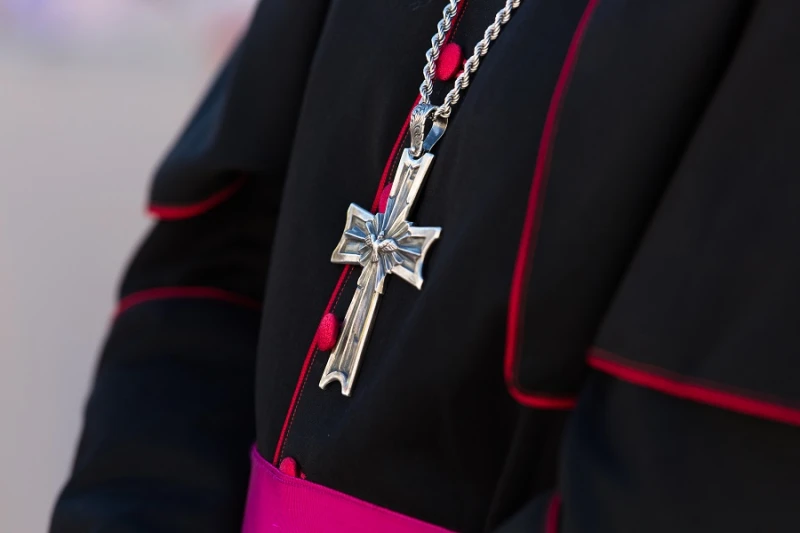
Pope Francis has named a priest of Helena, Mont., Father Jeffrey Fleming, coadjutor bishop of the state’s other diocese, Great Falls-Billings.
Fleming, 56, has been Chancellor and moderator of the Curia of western Montana’s Diocese of Helena since 2020. He has been a priest of the diocese for almost 30 years.
As coadjutor bishop, Fleming will serve alongside the current bishop of Great Falls-Billings, Michael Warfel, and will automatically succeed him upon his resignation.
Warfel, 73, has led the eastern Montana diocese since January 2008.
The Diocese of Great Falls-Billings covers over 93,000 square miles, the eastern two-thirds of Montana. It has 50 parishes and serves 31,813 Catholics. The total population of the diocese is 427,358.
Coadjutor bishop-elect Fleming was born in Billings, Mont. in 1966. He studied religious education and theology at Carroll College in Helena and completed his priestly studies at Mount Angel Seminary in Oregon, where he also received a master’s degree in theology.
He holds a license in canon law from the Catholic University of America in Washington, D.C.
In his nearly 30 years as a priest, Fleming has been parochial vicar and pastor at various parishes in the Diocese of Helena. He was also director of campus ministry at Carroll College.
In addition to his duties as chancellor of the diocese, since March, Fleming also serves as pastor of St. Mary Catholic Community in Helena.
If you value the news and views Catholic World Report provides, please consider donating to support our efforts. Your contribution will help us continue to make CWR available to all readers worldwide for free, without a subscription. Thank you for your generosity!
Click here for more information on donating to CWR. Click here to sign up for our newsletter.
CNA Staff, Feb 23, 2021 / 04:35 pm (CNA).- The nomination of California Attorney General Xavier Becerra for Health and Human Services (HHS) Secretary has been opposed by Democrats For Life of America, which has called for his nomination to be withdrawn… […]
CNA Staff, May 19, 2024 / 05:00 am (CNA).
As assisted suicide and euthanasia continue to grow more common throughout much of the developed world, services like palliative and hospice care serve as a v… […]
Pope Francis reflected on the dangers of coveting wealth and possessions during his Angelus reflection in St. Peter’s Square in Rome on July 31, 2022. / Vatican Media
Washington, D.C. Newsroom, Jul 31, 2022 / 06:32 am (CNA).
A day after returning to Rome from his weeklong trip to Canada, Pope Francis on Sunday reflected on the dangers of coveting wealth and possessions.
In Sunday’s Gospel, Jesus responds to a man who wants his brother to share his inheritance with him. “Take care to guard against all greed,” Jesus tells the crowd, “for though one may be rich, one’s life does not consist of possessions” (Lk. 12:15).
The Holy Father noted that rather than entering into the details of the man’s situation, he “goes to the root of the divisions caused by the possession of things”: covetousness.
“What is covetousness? It is the unbridled greed for possessions, always desiring to be rich,” the pope said, speaking to pilgrims in St. Peter’s Square before the weekly recitation of the Angelus.
“This is an illness that destroys people, because the hunger for possessions creates an addiction. Above all, those who have a lot are never content, they always want more, and only for themselves. But this way, the person is no longer free: he or she is attached to, a slave, of what paradoxically was meant to serve them so as to live freely and serenely,” Pope Francis warned.
“Rather than being served by money, the person becomes a servant of money.”
The pope identified covetousness as a “dangerous illness for society as well,” pointing to the greed that fuels wars and in particular the “scandal” of the arms trade.
“And so, let us try to ask ourselves: Where am I at with my detachment from possessions, from wealth?” the pope asked. “Do I complain about what I lack, or do I know how to be content with what I have? In the name of money or opportunity, am I tempted to sacrifice relationships and sacrifice time with others? And yet again, does it happen that I sacrifice legality and honesty on the altar of covetousness?”
Pope Francis reflected on the dangers of coveting wealth and possessions during his Angelus reflection in St. Peter’s Square in Rome on July 31, 2022. Vatican Media
The pope next shifted to focus on the “richness” of God.
“And so, we might think, so, no one should desire to get rich? Certainly, you can; rather, it is right to want it. It is beautiful to become rich, but rich according to God! God is the richest of anyone,” he said.
“He is rich in compassion, in mercy. His riches do not impoverish anyone, do not create quarrels and divisions. It is a richness that knows how to give, to distribute, to share. Brothers and sisters, accumulating material goods is not enough to live well, for Jesus says also that life does not consist in what one possesses (see Lk 12:15). It depends, instead, on good relationships – with God, with others, and even with those who have less.”
The pope continued: “So, let us ask ourselves: For myself, how do I want to get rich? Do I want to get rich according to God or according to my covetousness? And, returning to the topic of inheritance, what legacy do I want to leave? Money in the bank, material things, or happy people around me, good works that are not forgotten, people that I have helped to grow and mature?”
Pope Francis concluded by asking Our Lady, who shared in God’s riches, to “help us understand what the true goods of life are, the ones that last forever.”
Following his reflection, the pope thanked all those who assisted him on his trip to Canada, while assuring those suffering from the war in Ukraine that they remain in his prayers.
“Also, during this journey, I did not cease praying for the suffering and battered Ukrainian people, asking God to free them from the scourge of war,” Pope Francis said.
“If one looked at what is happening objectively, considering the harm that war brings every day to those people, and even to the entire world, the only reasonable thing to do would be to stop and negotiate,” he added. “May wisdom inspire concrete steps toward peace.”
Leave a Reply
