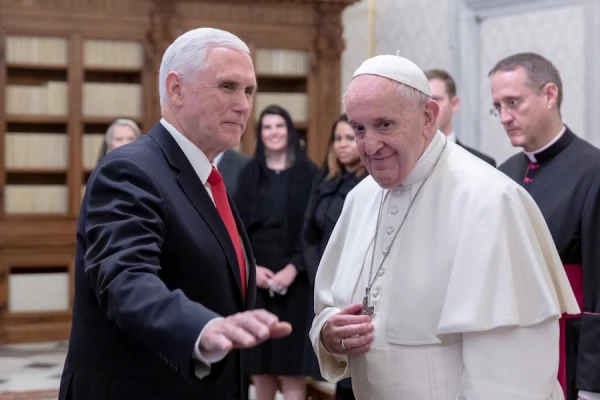
Vatican City, Jan 24, 2020 / 09:40 am (CNA).- After an hour long meeting with Pope Francis Jan. 24, Vice President Mike Pence sat down with EWTN News to discuss their conversation. Here is CNA’s transcript of that interview:
EWTN News: Mr. Vice President, you spent about an hour with the Holy Father, Pope Francis, today and what did you discuss?
Pence: Well, it was a great privilege for me to spend time with Pope Francis and to be able to do so on a day that literally hundreds of thousands of Americans, including many Catholic Americans, are gathered on our National Mall in Washington D.C. standing up for the right to life, was a particular joy for me. And to hear his passion for the sanctity of life, and to hear the American Bishops were coming to him this month and speaking about their determination to see the Church in the United States continue as it has always done to stand without apology for the sanctity of human life. It was a great privilege.
EWTN News: How can the U.S. government work together with the Holy See in the entire world to promote the sanctity of life and work against abortion and also euthanasia?
Pence: Well, I believe that the Church in the U.S. has been a bulwark in the right to life movement since Roe v Wade was first adopted by our Supreme Court in 1973. In fact, on the National Mall today, among those hundreds of thousands of young people, will be an enormous number of Catholic youth.
They will be waving their banners of their parishes, they’ll be waving the banners of their Catholic schools, and I think continuing to educate young people about the unalienable right to life, and the fact that every child is a gift from God has been the contribution that the Church has made to this cause, and the truth is in the U.S. we see more young people everyday embracing the right to life. The numbers are growing.
I know the Church is playing a critical role in that and I know will continue to until we reach that day that we restore the sanctity of life to the center of American law and will carry that message throughout the world.
EWTN News: You’ve personally been involved with many Marches for Life now, Mr. Vice President. Why have you taken this on as your sort of personal campaign as well?
Pence: Well, for my wife and me to stand for life in the public square is a calling. It’s a calling of our convictions, it’s a calling of our faith. We think it is the most pressing moral issue of our time.
And throughout our years in congress, and as Governor, and now as Vice President, I’ve sought to stand for the right to life and to stand with all of those who cherish the unborn.
But I have to tell you, I couldn’t be more proud to be Vice President to the most Pro-Life president in American history. As we gather here in Rome today, President Trump will go to the National Mall and be the first American president to ever address the March for Life in person. And that’s no real surprise when you see President Trump’s record for life, whether it be ending the Mexico City Policy, ending the providing funding for organizations that promote or support abortion around the world, defunding the largest abortion provider in America, or appointing principled conservatives to our courts.
One step after another, President Donald Trump has stood consistently for the right to life, and I expect the warm reception that he’ll get today from those hundreds of thousands of people gathered on our National Mall will reflect the fact that people all across America know in President Donald Trump they have a champion for life.
EWTN News: Going back to your meeting with Pope Francis today, did you speak about the tensions between the United States and Iran? He has spoken about this and has invited both parties to dialogue.
Pence: Today in my discussions with Pope Francis, we spoke about a number of issues, including the Pope’s great concern for Christian and religious minorities in Iraq and across the Nineveh Plain. I told the Pope that we are very proud to work with many Catholic charities as we work to rebuild Christian communities that were so set upon through ISIS and terrorist action in the region in recent years.
We’ve really partnered with the Knights of Columbus and other organizations across the region to make it possible for those Christian communities to come back and to have vibrant communities, not only Christian, but Yazidi communities, and the Pope shared with me his great passion for [the issue of] religious persecution and for religious minorities across the Middle East. We also then talked about Venezuela.
Pope Francis is a son of South America, and I wanted to better understand his insight about how we can together work as a global community to help restore democracy for the people of Venezuela. As I stand here today, the dictatorship of Nicolás Maduro has impoverished their country, nearly 5 million people have fled Venezuela to neighboring countries, the poverty and deprivation there in what was once one of the wealthiest countries in our hemisphere is tragedy.
I sought Pope Francis’ counsel about how we can work more closely with him and with the Church in Venezuela and across South and Central America to really continue to bring the kind of pressure to bear from the ground up that will make it possible for the people of Venezuela to have a new birth of freedom. The reality is that the National Assembly has named Juan Guaidó now more than a year ago as the interim president, and democracy is waiting in the wings in Venezuela, but it will take all of us and I trust the consistent and courageous voice of the Church in Venezuela to see liberty restored.
EWTN News: You said yesterday in Israel that you invited states to stand together against this rise of anti-Semitism worldwide. Pope Francis has often spoken out against anti-Semitism…
Pence: He has.
EWTN News:… as well. How do you see that the US and Europe and the world can take concrete steps forward against anti-Semitism?
Pence: Well, first it’s so important that we remember the past, so as not to relive it in the future. And yesterday in Jerusalem, it was my great privilege to be there as we mark the 75th anniversary of the liberation of Auschwitz, and to see nearly 60 world leaders come together to mark what was not only the darkest chapter in human history but to really…to mark a triumph of freedom 75 years ago was deeply moving. But what was equally impressive was the universal call by all those present to condemn anti-Semitism in all of its forms.
And the truth is that we are seeing vile anti-Semitism rear its head in both rhetoric and violence across the world.
We’ve seen synagogues attacked in the United States of America, Jewish communities attacked around the world, and we believe as we said yesterday that it’s imperative that leaders around the world and in the faith community and in the public sphere condemn anti-Semitism without reservation every time it emerges. And also in the midst of that that we stand together against the leading state purveyor of anti-Semitism on the planet: the Islamic Republic of Iran.
Iran actually today, as a state position denies the Holocaust ever happened or routinely says that its aim is to wipe Israel off the map. It’s important, particularly in the light of our action against Iran and a military leader just a month ago that the world continue to isolate Iran economically and diplomatically, and President Trump is going to continue to lead that charge.
We cannot allow the leading state sponsor of terrorism with so much enmity toward Israel to ever have a nuclear weapon, and we will continue to stand strong, and we will continue to work to bring the world community together, but stopping anti-Semitism wherever it emerges must be a priority of every nation in the world, and we need only to look to that dark chapter 75 years ago to know how dangerous anti-Semitism is and how it is a moral imperative in this century to see to it that it is condemned and rejected wherever it’s expressed.
EWTN News: Thank you so much, Mr. Vice President.
Pence: Thank you.
This interview will air on EWTN News Nightly, Jan. 24, 2020.
 […]
[…]


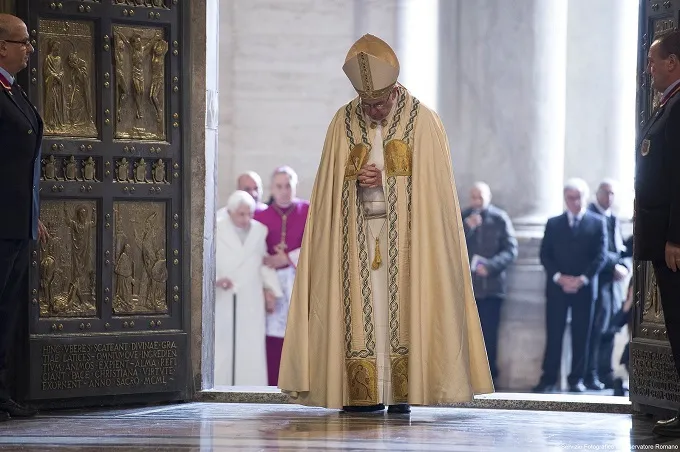
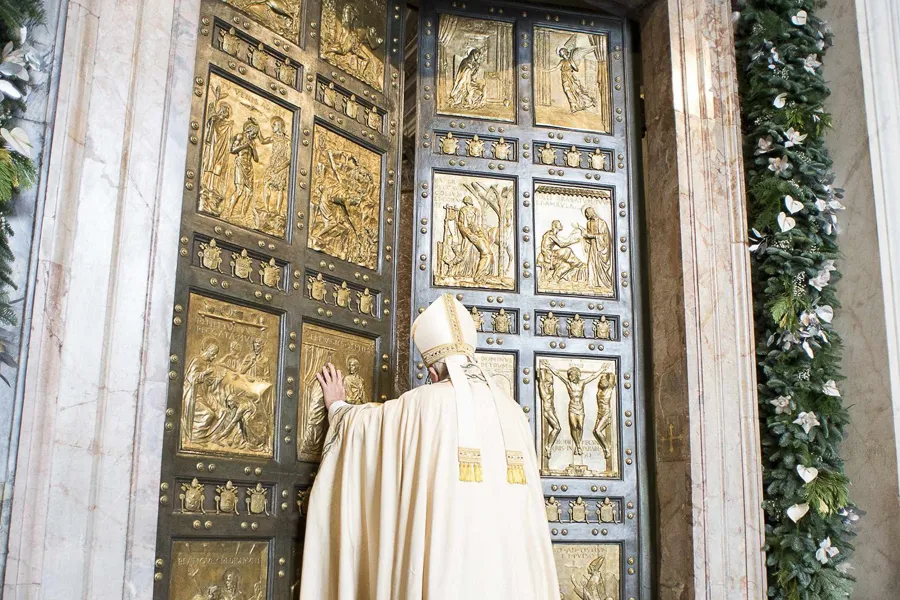



Wondering prayerfully how well, in 2025, the “symphony” of prayer will harmonize with the more orchestrated Synod on Synodality (viz the grand finale “synthesis” of additively “compiled, and aggregated” concerns/agendas, together with “minority reports”), and especially the dull notes of the German “synodal way” (on a piano, the very broken “keys to the kingdom!”)
Both paths now curiously projected to continue in an “endless journey” of parallel and supposedly/glibly harmonized contradictions, beyond 2023 into 2025 and beyond.
Wondering, too, about the crying need, urgently noted by Pope Francis, for “universal fraternity.” But, also as clearly purified and even transformed by gifted, shared and sacramental incorporation into the mysterious divine life of the Triune One. This reality, as beckoning each of us weekly for centuries in our communal recitation of the Nicene Creed at each Eucharistic sacrifice/ celebration.
And as for the wording of the Creed, it reflects St. Athanasius’ “Incarnation of the Word” actually written probably in A.D. 318, seven years prior to the Council of Nicaea. Athanasius was still a non-voting deacon even at the Council, but his written reflections—not original to himself, but based on what he and all others had been taught from the beginning in/by the Church—were the Council’s ready response to reductionist Arianism when it first appeared. (The 2500th anniversary of the book, then, would have been A.D. 2018.)
Dissonance can add depth to harmony, or it can remain dissonant and disordered. What we pray for is what may produce harmony. Harmony in our modern age has tended toward an incorporation of world values, whereas the great Fathers of the Church perceived harmony as a revitalization of the natural law within the world. This brought about by prayer, example, and reason.
Prayer for the intentions of the Roman pontiff is regularly offered as formatted within the Eucharistic liturgy after the consecration. Often raising the question [for this writer] whether those intentions are for the betterment of the Church, or for an agenda alien to it. As one might have conscientious reservations on the Synod on synodality format. That judgment cannot be honestly made, whereas what may seem a quandary is resolved by my intention, on behalf of his intentions, is for the good of the Church.
A priest can be honest in disagreement with a Roman Pontiff where reasonable, and retain respect for the Chair of Peter, and even when behavior is disagreeable for the person. Faith and good will added to prayer can work miracles of grace, and in that vein we are indebted to heartily endorse Francis’ call to prayer.
Concurring, might we note the difference between Subtractive Compromise and Additive Compromise?
Take, for example, St. John’s Gospel where he found the term LOGOS to be a valuable container for evangelizing the Greek Gentiles. To the Christians of Jewish heritage Logos meant the self-disclosing Divine Revelation in Christ; to the Gentiles logos meant the reasoned coherence of existence, or Reason. Logos: The Incarnation in the person of Christ, as also the embodied coherence between Faith and Reason…
Likewise, today? With the Church and Pope Francis in our post-Christian, totally fractured and uncomprehending world? The term “FRATERNITY”? Instead of dissolving into generic Christianity, likely to be absorbed into the new-world-order “reset,” how might this single word instead contain the working of the Holy Spirit?
ST. THOMAS MORE, who gave us the coherent “Development of Christian Doctrine,” also gave us this counsel for navigating in the world:
“…Suppose wrong opinions cannot be plucked up by the root, and you cannot cure, as you would wish, vices of long standing, yet you must not on that account abandon ship of state and desert it in a storm, because you cannot control the winds. But neither must you impress upon them new and strange language, which you know will carry to weight with those of opposite conviction, but by indirect approach and covert suggestion you must endeavor and strive to the best of your power to handle all things well, and what you cannot turn to good, you must make as little bad as you can. For it is impossible that all should be well, unless all men are good, which I do not expect for a great many years to come” (Utopia).
The PROBLEM is that “Utopia” (like the Logos or Fraternity) also has a double meaning! Ambiguity!
“Sir Thomas More (1477 – 1535) was the first person to write of a ‘utopia’, a word used to describe a perfect imaginary world…He coined the word ‘utopia’ from the Greek ou-topos meaning ‘no place’ or ‘nowhere’. It was a pun – the almost identical Greek word eu-topos means ‘a good place.’” In many ways More’s ‘Utopia’ was a human anthill…
But, yes, let us both practice and pray for Pope Francis’ “Fraternity.” This, without abandoning the Barque of Peter to the winds that blow, or to the lavender stowaways, or to the German synodal (psycho)path. That is, WITHOUT detaching the “bigoted” compass, or the “rigid” rudder. That is, without enabling/detaching actual praxis from (reaffirmed, of course!) dogma. That is, without mutilating the coherence of Faith and Reason, e.g., Veritatis Splendor.
Yes, to Fraternity as Additive Compromise(!): but in our “walking together” in synodality, how to both walk AND steadfastly chew gum at the same time?
I pray that the Pope’s call for special prayers, including the Lord’s Prayer, will be heeded by Catholics all over the world. I have no doubt that our Pope will lead us in this wonderful spiritual exercise. It is obvious that Pope Francis spends a lot of time praying.
One condition for many Indulgences is prayer for the pope’s intentions. In days of yore, The Vatican’s Congregation of Indulgences and Sacred Rites (no longer extant, its functions are now performed by the Apostolic Penitentiary) published in its “Roccolta” four specific intentions of the pope:
1) The progress of the faith and triumph of the Church.
2) Peace and union among Christian princes and rulers.
3) The conversion of sinners.
4) The uprooting of heresy.
The ‘Magisterium of Francis’ holds large soft spots for many of the above. Does it still agree with the list or does it direct yet another traditional teaching to the dustbin?
An author at onepeterfive: “The Church cannot enjoin us to do evil. Yet for centuries, she has enjoined us in many magisterial teachings to make a blanket prayer for the intentions of the Holy Father in order to obtain a plenary indulgence. It follows that making such a blanket prayer cannot be a material contribution to evil on our part.”
To tell the truth, I have no doubts that this “great symphony of prayer” ahead of the Jubilee Year in 2025 has a huge importance both for people and for church because it is truly a great event which will help us to get closer to God and grow richer spiritually. I think that it is really important not to neglect such events because, from my point of view, they have a Immense value, remembering people about really significant things. I totally share the position of Pope Francis because I think that primarily we need to create cohesion with each other and feel this support from each other because only these things will help us to change this deplorable state of affairs. I really hope that the 2025 Jubilee would truly help to restore “a climate of hope and trust” in such a current difficult situation because we all want to keep these wonderful feelings in our souls which can heal us and help us cope with all difficulties.