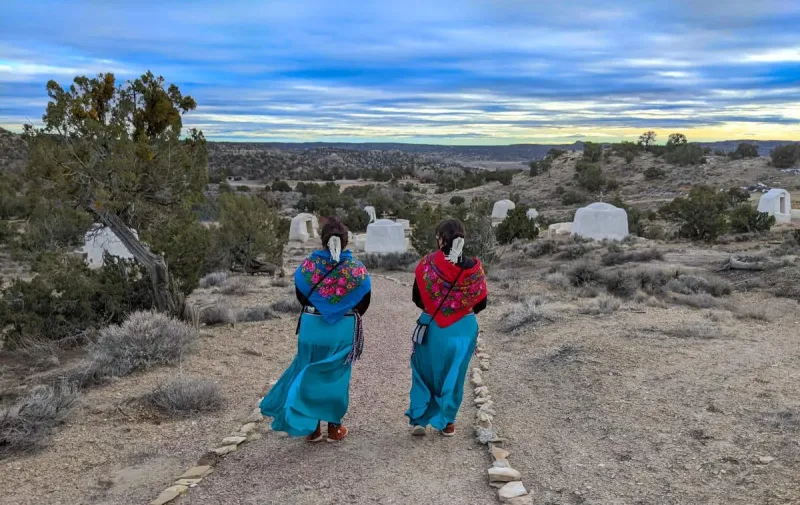
Two women enjoy the Saint Kateri Rosary Walk, still under construction in Gallup, N.M. / Saint Kateri Rosary Walk via Facebook.
Gallup, N.M., Feb 6, 2022 / 15:00 pm (CNA).
A summer internship program in the Diocese of Gallup aims to provide college-aged Catholic men spiritual formation and hands-on experience in traditional southwestern building techniques.
“We are inviting young men to prayerfully consider applying to become missionaries to the Diocese of Gallup for the third year of this program,” Bishop James Wall told CNA. “It’s not just a job with a paycheck, but an opportunity to witness to the Gospel and prayerfully serve the Native American Catholic community.”
Men will live and work at the Sacred Heart Retreat Center and help with the ongoing construction of a rosary walk on the grounds dedicated to Saint Kateri Tekakwitha, the first Native American to be canonized a saint.
The program also includes spiritual and academic formation, as well as travel and enrichment opportunities related to the life and history of the Catholic Southwest.
“This totally unique program provides intense leadership training that fosters steeled Catholic Manliness for a lifetime…At the same time, building something beautiful for Our Lady and St. Kateri that will last for generations,” said William McCarthy, CEO of the Southwest Indian Foundation, which is co-hosting the internship program.
The Saint Kateri Rosary Walk will include four trails representing the sets of mysteries of the rosary, including the luminous mysteries. Each trail will include five nichos constructed using traditional southwestern building techniques and depicting the mysteries of the rosary.
The project was inspired by the prayer life of the saint herself. Kateri was known to pray while walking through nature and she would use stones and wooden crosses to indicate the decades of the rosary.
“I think when you look at saints like St. Kateri, she is an incredible example that we try to emulate, and we are trying to reflect who she is in this project,” said Deacon Ed Schaub, executive director of the Saint Kateri Rosary Walk. “The whole effort of this project is to bring everyone and anyone to God.”
The Saint Kateri Rosary Walk is the first installment of an ongoing project to build a shrine dedicated to the Native American saint and to Our Lady of Guadalupe. The Diocese of Gallup, with the Knights of Columbus and Southwest Indian Foundation, broke ground on the Rosary Walk and shrine in August 2019.
“It is our hope that in the years to come, this St. Kateri shrine will become a national, spiritual home for Native Americans and, equally importantly, for all Catholics in North America,” then-Supreme Knight Carl Anderson said in his 2019 announcement of the project, which is part of a larger Knights of Columbus initiative to support Native American communities.
Plans for the current phase of the shrine include the rosary walk with a plaza dedicated to Our Lady of Guadalupe, and a large outdoor chapel.
If you value the news and views Catholic World Report provides, please consider donating to support our efforts. Your contribution will help us continue to make CWR available to all readers worldwide for free, without a subscription. Thank you for your generosity!
Click here for more information on donating to CWR. Click here to sign up for our newsletter.
CNA Staff, Aug 21, 2020 / 01:00 pm (CNA).- The chair of the US bishops’ international justice and peace committee on Thursday called gratifying Israel’s decision to suspend the annexation of parts of the West Bank, part of its normalization of relations with the United Arab Emirates, but reiterated the need for Israel to negotiate directly with Palestine.
Bishop David Malloy of Rockford said Aug. 20 that “it was gratifying to note that as part of this agreement, the State of Israel announced that it would suspend its efforts for annexation of disputed territory, a proposal not resulting from dialogue and agreement with the Palestinian authorities. The Catholic bishops of the United States have long held that both morally and as a basis for lasting peace, the two parties must negotiate directly and arrive at a fair compromise that respects the aspirations and needs of both peoples.”
“As Catholic bishops, we join in this aspiration and know much work remains in the pursuit of peace in this region,” he added.
The agreement, announced Aug. 13, makes the UAE the first Persian Gulf state, and after Egypt and Jordan, the third Arab nation, to have open diplomatic relations with Israel. Egypt, Oman, and Bahrain have all signed a letter of support for the agreement.
Iran’s state news agency IRNA quoted the country’s foreign ministry calling the agreement a “strategic act of idiocy” and “dangerous”, and it has been denounced by Turkey.
In Defense of Christians, an advocacy group for Christians and other religious minorities in the Middle East, called the agreement a “historic step in the peace process.” It added: “We are pleased that Israel is suspending plans to annex new areas of the West Bank, as the historic Christian communities of the Holy Land have voiced their concern about this,” but added that there is “much more work to be done” and that “we encourage all parties to Middle East Peace Talks to continue to consult with the historic Christian communities of the Holy Land in these negotiations.”
A spokesperson for Palestinian president Mahmoud Abbas said the Palestinian government “rejects and denounces” the agreement.
“The Palestinian leadership rejects the actions of the Emirati government, considering it to be a betrayal of the Palestinian people and Jerusalem and al-Aqsa,” said Nabil Abu Rudeineh.
After urging direct talks between Isral and Palestine, Bishop Malloy noted that during his 2019 visit to the UAE, Pope Francis stated that “Dialogue, understanding and the widespread promotion of a culture of tolerance, acceptance of others and of living together peacefully would contribute significantly to reducing many economic, social, political and environmental problems that weigh so heavily on a large part of humanity.”
The Rockford bishop stated that “it is our hope that this agreement will contribute to that peace.”
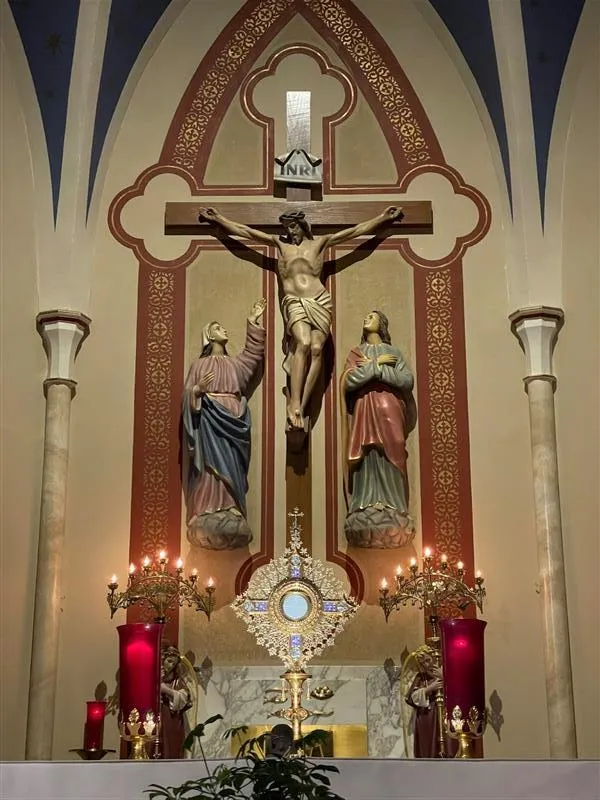
The Adoration Chapel at St. Peter’s Catholic Church in Beaufort, South Carolina. / Photo Credit: Aaron Miller, Miller Design & Marketing
Washington, D.C. Newsroom, Aug 20, 2023 / 05:00 am (CNA).
“Awesome. Awesome.”
That’s how Anna Sudomerski, the communications coordinator at St. Peter’s Catholic Church in Beaufort, South Carolina, describes the parish’s eucharistic adoration program.
St. Peter’s is among the parishes in the United States that are hosting perpetual eucharistic adoration with the Blessed Sacrament exposed 24 hours a day.
Since Church law dictates that exposition of the Blessed Sacrament requires at least one adorer present at all times, this means the parishes that opt for this extraordinary form of worship must coordinate a major year-round effort to ensure at least one volunteer is present before the Eucharist every hour of the day.
Eucharistic adoration, whether exposed or reserved in the tabernacle, is an ancient custom of the Church dating back to its earliest centuries. Yet its practice today occurs among flagging faith in the real presence of Christ in the Eucharist, with U.S. Catholics signaling a growing reluctance to believe that Jesus is truly present in the Blessed Sacrament.
Yet multiple parishes around the country in recent years have maintained vibrant adoration initiatives, including St. Peter’s, which began its perpetual adoration in the early 1990s.
Sudomerski said the St. Peter’s adoration program started at the parish’s original historic church in downtown Beaufort. With the construction of a new church building in 2006, adoration moved to a purpose-built chapel there.
For years, Sudomerski said, the adoration program was run by team captains who each supervised a specific stretch of hours within a given 24-hour period.
“They were in charge of certain times, like from midnight to 6 a.m., in case the adorer could not make it, so the captain would have to find a substitute or cover the hour themselves,” she told CNA. “We had four team captains covering midnight to 6, 6 to noon, noon to 6, and 6 to midnight.”
She said the church’s adoption of the sign-up software Adoration Pro “made it a lot easier for people to sign up.”
“From there, ever since, we’ve done several campaigns,” she said. “One to pass out interest forms to see who would be interested in what hour. We just finished another campaign because Father thought the Eucharist is the most important thing that we have. We’ve done callouts, mailings.”
Light of the World Catholic Church in Littleton, Colorado
Kathryn Nygaard, the communications director at Light of the World Catholic Church in Littleton, Colorado, outside of Denver, said the parish has maintained an adoration program since 2007.
“There are two parishioners who are the main adoration chapel coordinators and they do an incredible job,” she said. “In addition, there are 24 ‘hourly coordinators’ to assist with making sure substitutes fill in during open hours and communicating with the adorers in their specific hour.”
“There are approximately 270 people involved in adoration, as either regularly scheduled adorers or as substitutes,” she said. The church hosts two “renewal weekends” in February for adorers to re-up for the coming year; regular announcements are also made at weekend Masses to attract more interest.
Adorers at Light of the World use the church software Flocknote to communicate with one another, Nygaard said. “Most requests for substitutes are filled within 1-2 days,” she noted.
Bishops aim to ‘start a fire’ of eucharistic renewal
The U.S. bishops last year launched the National Eucharistic Revival, meant to “start a fire” of eucharistic devotion among Catholics in the United States. The initiative was first conceived following the 2019 Pew poll showing low numbers of Catholics with a belief in the Real Presence.
As part of the three-year program, parishes around the country have been encouraged to launch Eucharist-focused programs and events to draw parishioners into a deeper relationship with Jesus through the Blessed Sacrament.
Next year, the bishops will host a National Eucharistic Congress featuring multiple high-profile Catholic speakers along with what is expected to be a crowd of about 80,000 Catholics. Pope Francis in June called next year’s national congress “a significant moment in the life of the Church in the United States.”
St. Bonaventure Catholic Church in Columbus, Nebraska
At St. Bonaventure Catholic Church in Columbus, Nebraska, worshippers have been keeping perpetual adoration there for more than 62 years — since Feb. 14, 1961, according to a live clock on the parish’s website.
The exposed Blessed Sacrament at St. Bonaventure Catholic Church in Columbus, Nebraska. Credit: Tim Cumberland
The parish on its website says the roots of its adoration program go back to 1949 and expanded thereafter. The program now includes worshippers from other nearby parishes who come to participate in adoration.
Parishioner Tim Cumberland told CNA the church is “blessed to have about 550 people in the program.”
“A few years ago, we went to an automated process of managing our perpetual adoration program, using the Adoration Pro software,” Cumberland said. “This has greatly improved our ability for our adorers to find subs online when necessary. A request for a substitute is usually filled within minutes.”
Kim Waller said the 25-year-old adoration program at Holy Infant Catholic Church in Ballwin, Missouri, still uses a coordinator-led sign-up program instead of an online sign-up. Like many programs, Holy Infant breaks down management of the adoration schedule into hourly segments.
“The 24 hourly coordinators form the backbone of perpetual adoration,” she said. “They ensure that there is at least one adorer present in the chapel at all times. The hourly coordinator reviews the sign-up list weekly to ensure that their committed hourly adorer fulfills his/her commitment and contacts the adorer if she/he has not been to adoration as committed for two consecutive weeks.”
A new team of coordinators just took over in January, Waller said. “The last several years, the ministry was administered by a couple who since have passed within six months of each other,” she said.
St. Mary Help of Christians in Aiken, South Carolina
Donna Pierce told CNA she helped launch the 24/7 adoration program at St. Mary Help of Christians in Aiken, South Carolina, roughly 30 years ago.
“I think we have about 10-15 people who have maintained their Holy Hour since it began, and currently we have 318 weekly adorers and about 60 substitutes, not counting the many people that pop in the chapel when they can,” she said.
Pierce said a priest from a perpetual adoration apostolate helped the parish launch the program. “He told us that having perpetual adoration is actually much easier to run than a 40-hours or other time frame,” she said. “Adorers incorporate their hour into their schedule, so you don’t have to keep signing up from scratch.”
The exposed Blessed Sacrament in the St. Claire Chapel at St. Mary Help of Christians in Aiken, South Carolina. Credit: Lori Rainchuso
She said the parish maintains participation in the program by way of biannual talks at Masses (which Pierce described as “our fall and Lent blitzes”). These efforts usually result in upwards of a few dozen sign-ups.
On the website for the National Eucharistic Revival, the bishops say that the current year of the program is focused on “fostering eucharistic devotion at the parish level, strengthening our liturgical life through the faithful celebration of the Mass, eucharistic adoration, missions, resources, preaching, and organic movements of the Holy Spirit.”
Catholic evangelist Tim Glemkowski in a video for the revival urged parish leaders to “prioritize personal encounters with Jesus in the Eucharist” over the course of the year.
“The heart of this invitation … is to create space in our parish calendar this year for people to come and encounter Jesus in the Eucharist personally,” he said. “This could mean parishes that don’t have perpetual adoration start that opportunity, or opportunities for eucharistic processions, or different devotional experiences.”
Pierce said that starting the St. Mary program decades ago was a daunting prospect, but she went ahead with it by putting her trust in God.
“It was terrifying when Msgr. [Thomas] Evatt asked me to be head coordinator to start it so long ago — I was 30 years old with a toddler and working part time,” Pierce said. “So I made a deal with God. He would have to be responsible for sustaining it, and we would just be his instruments.”
“How many, many times he made it obvious he was running it!” she said.
Graces for eternity
St. Bonaventure’s website, meanwhile, predicts that the graces of perpetual adoration will redound not just in the present but for eternity.
“Someday far, far from now, there will be a magnificent heavenly banquet where all of the adorers in the St. Bonaventure adoration program will be reunited,” the parish’s website says.
“Won’t it be wonderful,” the website continues, “for all of us who have been in the program to share stories of how many of our lives, and the lives of those we touched as a result, were radically changed by this personal and enduring encounter with Our Lord!”







Leave a Reply