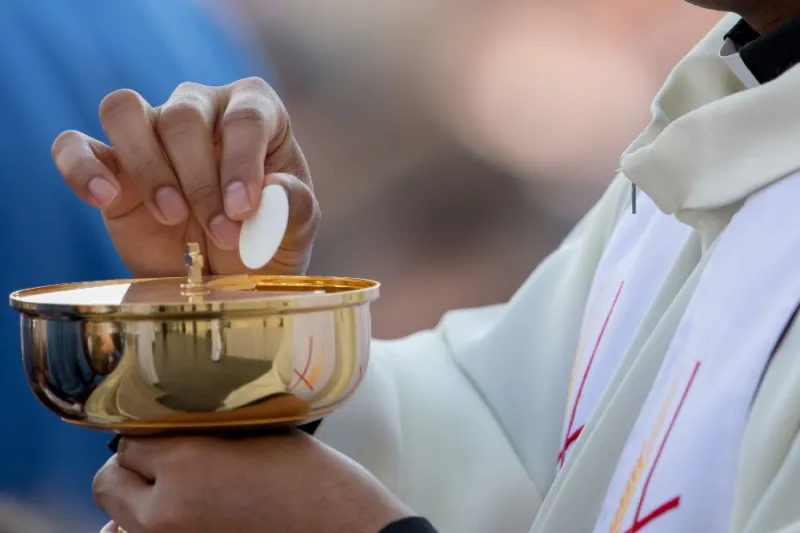
An Italian bishop has prohibited unvaccinated priests and lay people from distributing Communion as Italy tightens its COVID-19 restrictions.
Bishop Giacomo Cirulli of the southern Italian diocese of Teano-Calvi and Alife-Caiazzo issued a letter on Jan. 8 with new rules to stem the spread of the coronavirus.
“I prohibit the distribution of the Eucharist by priests, deacons, religious and lay people who are not vaccinated,” the bishop wrote.
“With regard to vaccines, let me recall what Pope Francis said: ‘Getting vaccinated … is an act of love. And helping to ensure that the majority of people get vaccinated is an act of love. Love for yourself, love for family and friends, love for all peoples,’” he said.
In the letter, Cirulli also issued the suspension of all in-person pastoral, catechetical and formative activities in his diocese.
Cirulli graduated from medical school in Naples before becoming a priest. The 69-year-old bishop was hospitalized with COVID-19 in November 2020 and recovered.
He asked Catholics in his diocese to abide by the COVID-19 restrictions issued by the Italian government.
New Italian government restrictions came into force this week banning unvaccinated citizens from entering restaurants, public transportation, gyms, theaters, and sports events.
“Most of the problems we are facing today are due to the fact that there are unvaccinated people,” Prime Minister Mario Draghi said at an evening press conference on Jan. 10.
Draghi’s government made it mandatory last October for all employees in Italy to show either proof of vaccination or a negative test before entering the workplace each week.
The Italian government also announced last week that it will impose mandatory vaccination for every person over the age of 50, regardless of employment, starting Feb. 15.
More than 86% of people over the age of 12 in Italy are fully vaccinated, according to health authorities.
Amid the spread of the COVID-19 Omicron variant, there were more than 100,000 new cases of COVID-19 recorded in Italy each day for the past five days.
If you value the news and views Catholic World Report provides, please consider donating to support our efforts. Your contribution will help us continue to make CWR available to all readers worldwide for free, without a subscription. Thank you for your generosity!
Click here for more information on donating to CWR. Click here to sign up for our newsletter.
The Holy Tunic of Christ on display in Argenteuil, France, in 2016. / Credit: Simon de l’Ouest, CC BY-SA 4.0, via Wikimedia Commons
Paris, France, Apr 24, 2025 / 11:00 am (CNA).
A rare exhibit of the Holy Tunic of Christ — believed to be the garment worn by Jesus during his passion — is drawing unprecedented crowds to the Basilica of Saint-Denis in Argenteuil, a suburb of Paris.
Open to the public from April 18 to May 11, the exhibit is galvanizing Catholic faithful across Europe. More than 400,000 pilgrims are expected during the 23-day event — more than double the attendance of the previous exhibit in 2016.
Argenteuil, a city that has seen significant Muslim immigration in recent decades, now finds itself at the heart of a surprising spiritual resurgence.
To accommodate the historic influx of visitors, the Diocese of Pontoise — which oversees the basilica — has launched a large-scale logistical effort. The monument will remain open daily from 9 a.m. to 10 p.m., with overnight access on the three Saturdays following Easter.
An educational and spiritual path accompanies pilgrims as they venerate the Holy Tunic, with several hundred trained volunteers assisting to guide the faithful and maintain a smooth flow of visitors.
The exhibit of the Holy Tunic opened on Good Friday, April 18, with a solemn Mass celebrated by Bishop Benoît Bertrand of Pontoise, followed by a public Stations of the Cross procession through the streets of Argenteuil. Secretary of State Cardinal Pietro Parolin was originally scheduled to preside over the closing Mass on May 11, but the recent death of Pope Francis on April 21 and the upcoming conclave may alter the Vatican delegation’s presence.
The Holy Tunic has only been publicly displayed twice in the 20th century — in 1934 and 1984 — drawing approximately 80,000 visitors each time.
In a statement, the Diocese of Pontoise emphasized that the purpose of the exhibit is to offer believers “an opportunity to meditate on the passion of Christ and the profound meaning of his sacrifice.”
Speaking to the Catholic weekly Famille Chrétienne, Father Guy-Emmanuel Cariot, rector of the basilica, underlined the spiritual dimension of the event. “Our task is to organize the encounter between people and the Holy Tunic — then the Lord does what he has to do,” he said.
For Cariot, the relic is “an open book of the Passion,” capable of moving modern hearts. “More than the relic itself, it is Jesus who draws people in,” he added, inviting every pilgrim to contemplate the mystery of redemption.
The Holy Tunic of Argenteuil is considered one of the most precious relics in Christendom. According to tradition, it was discovered in Jaffa in the fourth century by St. Helena, mother of Emperor Constantine, and later gifted by Empress Irene of Constantinople to Charlemagne in the year 800. It was then entrusted to the Benedictine nuns of the Argenteuil abbey. After disappearing during the French Revolution, it was rediscovered in the 19th century and has since undergone several restorations.
The Saint-Denis Basilica in Argenteuil, France. Credit: BastienM, CC BY-SA 3.0, via Wikimedia Commons
While scholars continue to debate its authenticity, the air of mystery surrounding the tunic has only deepened its veneration. For the faithful, it represents far more than a historical artifact: It is a tangible link to Christ’s passion — a sacred object that connects believers today with the redemptive suffering of Jesus.
Historian Jean-Christian Petitfils, author of “La sainte tunique d’Argenteuil: Authentique relique de la Passion du Christ”(“The Holy Tunic of Argenteuil: An Authentic Relic of Christ’s Passion”), argues that both scientific testing and historical indicators support the relic’s authenticity. Nonetheless, he acknowledges that gaps in documentation — and periods when the tunic vanished from the historical record — leave parts of its story shrouded in uncertainty.
This year’s exhibit takes place in a city that has experienced profound socio-religious shifts in recent decades. Argenteuil, home to nearly 110,000 residents — around a third of whom have at least one parent of immigrant origin — has witnessed a sharp and steady decline in Catholic practice, even as Islam has become more visibly present in the public sphere.
Against this backdrop, the display of the Holy Tunic carries significant symbolic weight. It represents a revival of Christian memory and a reaffirmation of the Church’s enduring presence in a society undergoing deep cultural and spiritual transformation. For many, it is a moment of awakening — a testament that the Catholic faith continues to resonate, even in a secularized and religiously diverse environment.
The pastoral programming reflects this ambition. Daily solemn Masses are celebrated by different Church leaders, including Cardinal Louis Raphaël Sako, patriarch of the Chaldeans in Iraq, and Cardinal Juan José Omella, archbishop of Barcelona. Special days are devoted to children, along with scouting vigils and catechesis sessions for families, youth, and spiritual seekers.
In the lead-up to the exhibit, the Holy Tunic toured several French cathedrals between 2024 and March 2025, preparing the public and cultivating a spirit of curiosity and reverence.
This display also coincides with the broader revitalization of the Basilica of Saint-Denis — a spiritual and historical landmark of the Île-de-France region and traditional burial place of French royalty. A major restoration project is underway to reconstruct its north tower and spire, dismantled in the 19th century after a storm.
Since 2022, archaeological excavations have unearthed Merovingian tombs and rare Romanesque elements, paving the way for a full restoration of the west façade, launched in 2023 and scheduled for completion in 2029. The initiative is not only architectural but also educational, featuring a craft village and immersive displays.
Like the exhibit in Argenteuil, it bears witness to a shared drive to revive France’s Christian roots through the transmission and enhancement of its sacred heritage.
Young Catholics take part in the Lednica 2000 meeting in Poland on June 4, 2022. / Courtesy of the Lednica2000 Facebook page.
Warsaw, Poland, Jun 6, 2022 / 11:05 am (CNA).
Twenty-two thousand young people from Poland and Ukraine attended the 26… […]
1 Comment
Wall Street Journal Tuesday,January 11,2022
Mexican Leader Gets Covid a Second Time
Mexico’s President Andes Manuel Lopez Obrador has contacted Covid-19 a second time, making him one of the first major world leaders to contract the virus twice.
The president, who has three doses of the AstraZeneca vaccine, said on Twitter late Monday that he tested positive, had only minor symptoms and would Isolate and continue his work remotely. He said Adin Augusta Lopez Hernandez, Mexico’s Interior minister, would represent him in the news conference and other official acts in his absence.
Earlier in the day, he held a two-hour news conference without a mask and despite saying he had coldlike symptoms and a cough. “Yes, I woke up hoarse, I’ll take a [Covid-19] test later, but I think it’s just a cold,” he said when asked by a journalist why he sounded sick.
During the press conference, he talked about the importance of people assuming they were sick with Covid-19 if they had coldlike symptoms. “If you’re vaccinated, and you get sick with something that seems like Covid, assume it is Covid”, he said.
The 68-year old president who initially played down Covid-19 as no worse than flu and encouraged Mexicans to keep socializing, got Covid-19 last January and was out for nearly two weeks
Wall Street Journal Tuesday,January 11,2022
Mexican Leader Gets Covid a Second Time
Mexico’s President Andes Manuel Lopez Obrador has contacted Covid-19 a second time, making him one of the first major world leaders to contract the virus twice.
The president, who has three doses of the AstraZeneca vaccine, said on Twitter late Monday that he tested positive, had only minor symptoms and would Isolate and continue his work remotely. He said Adin Augusta Lopez Hernandez, Mexico’s Interior minister, would represent him in the news conference and other official acts in his absence.
Earlier in the day, he held a two-hour news conference without a mask and despite saying he had coldlike symptoms and a cough. “Yes, I woke up hoarse, I’ll take a [Covid-19] test later, but I think it’s just a cold,” he said when asked by a journalist why he sounded sick.
During the press conference, he talked about the importance of people assuming they were sick with Covid-19 if they had coldlike symptoms. “If you’re vaccinated, and you get sick with something that seems like Covid, assume it is Covid”, he said.
The 68-year old president who initially played down Covid-19 as no worse than flu and encouraged Mexicans to keep socializing, got Covid-19 last January and was out for nearly two weeks
