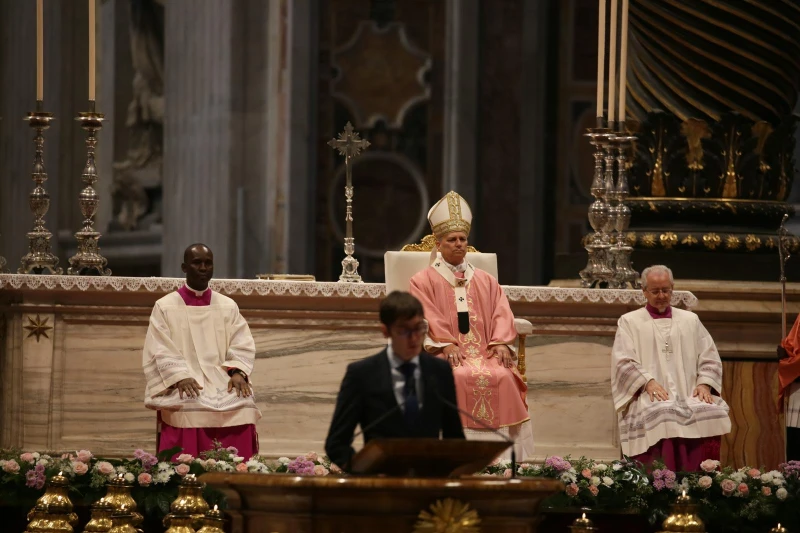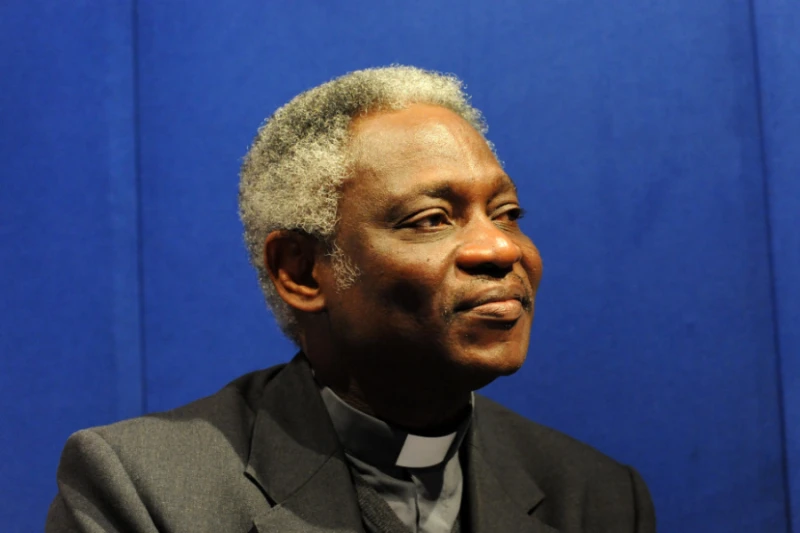
Cardinal Peter Turkson, prefect of the Dicastery for Promoting Integral Human Development, in London, England, on March 14, 2011. Credit: Mazur/catholicchurch.org.uk. / null
Vatican City, Dec 23, 2021 / 04:25 am (CNA).
Pope Francis on Thursday accepted the resignation of Cardinal Peter Turkson as prefect of the Vatican Dicastery for Promoting Integral Human Development.
He named the 75-year-old Canadian Jesuit Cardinal Michael Czerny as the interim head of the dicastery pending the appointment of “new leadership.”
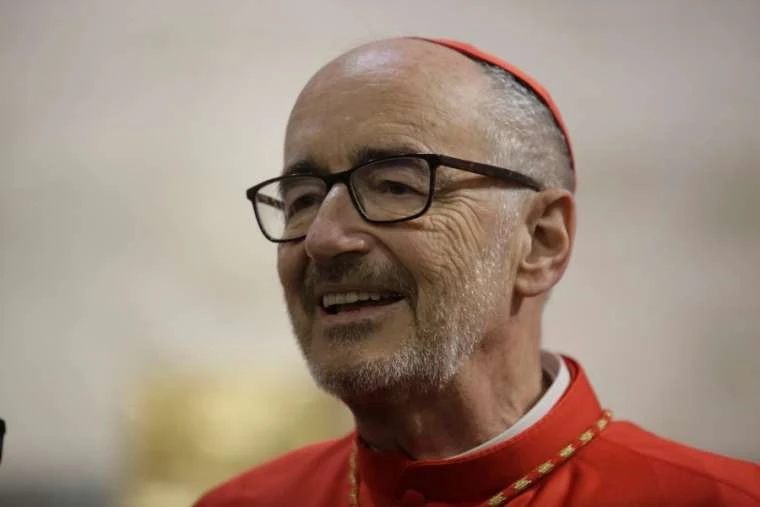
Cardinal Michael Czerny, undersecretary of the migrants and refugees section of the Dicastery for Promoting Integral Human Development. . Pablo Esparza/CNA.
The Holy See press office said on Dec. 23 that the dicastery’s leaders had left their mandates in the pope’s hands following the end of their five-year terms, which began when the dicastery was created in 2016.
“While sincerely thanking Card. Peter K. Appiah Turkson and his collaborators for their service and while awaiting the appointment of the new leadership, the Holy Father has entrusted ad interim the ordinary management of the same dicastery as of Jan. 1, 2022, to Card. Michael Czerny, S.J., as prefect and to Sister Alessandra Smerilli, F.M.A., as secretary,” it said.
Turkson served as the archbishop of Cape Coast, Ghana, before he was called to Rome in 2009 to be president of the Pontifical Council for Justice and Peace.
The rumors of his resignation appeared a few months after Pope Francis ordered an inspection of the dicastery, led by Cardinal Blase Cupich of Chicago, that was followed by personnel changes.
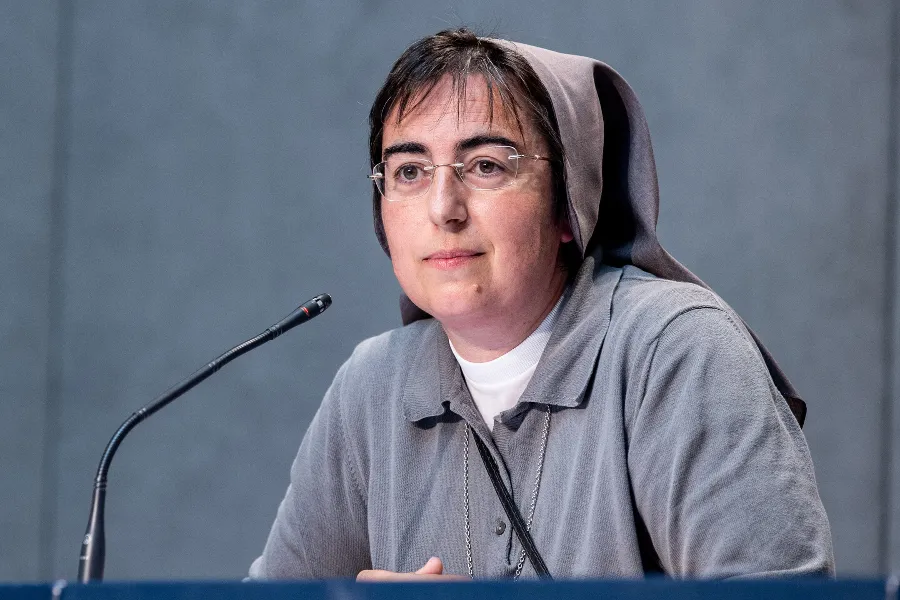
Sr. Alessandra Smerilli speaks at a press conference at the Vatican on July 7, 2020. Daniel Ibáñez/CNA.
Turkson told journalists on Tuesday that the pope would decide his future following the end of his five-year term.
“If the Holy Father decides to have me continue, that’s what it is. If he decides to reassign me, that’s what it is,” he said.
“All of us come here to serve and support the Holy Father in his ministry, and that’s what it is … We just wait for the Holy Father to see what he wants us to do.”
Czerny, who was born in Brno, Czechoslovakia, in 1946, has served as Under-secretary of the Migrants and Refugees Section of the dicastery since 2017. He received the cardinal’s red hat in October 2019.
Pope Francis named Smerilli, an Italian economist and member of the Salesian Sisters of Don Bosco, as the dicastery’s interim secretary in August.
Following the resignation of Guinean Cardinal Robert Sarah as prefect of the Congregation for Divine Worship in February, Turkson was the only African leading a Vatican department.
It is believed to be the first time since 1977 that the Vatican has had no African leaders among the heads of its dicasteries.
If you value the news and views Catholic World Report provides, please consider donating to support our efforts. Your contribution will help us continue to make CWR available to all readers worldwide for free, without a subscription. Thank you for your generosity!
Click here for more information on donating to CWR. Click here to sign up for our newsletter.
Baltimore, Md., Nov 11, 2019 / 03:41 pm (CNA).- The results of the Vatican’s investigation of Theodore McCarrick should be published by early 2020, Cardinal Sean O’Malley of Boston told U.S. bishops on Monday.
Vatican City, Feb 17, 2021 / 02:00 am (CNA).- Mario Draghi, an economist and retired banker, was sworn in as prime minister of Italy on Saturday, after the previous government coalition collapsed when a party pulled its support for then prime minister Giuseppe Conte.
As President Sergio Mattarella’s pick to form a new government, Draghi was an unexpected choice. But he was able to win enough support to form a new coalition, appointing a mix of technocrats and politicians to his cabinet.
Many in Italy hope that the 73-year-old Draghi, president of the European Central Bank from 2011 to 2019, can save the country’s faltering economy. He is credited with saving the failing euro during the eurozone crisis, earning him the nickname “Super Mario.”
Pope Francis signaled his approval for the economist in July 2020, when he named him as one of 26 ordinary academicians of the Pontifical Academy of Social Sciences, which promotes the study of economic and political sciences to aid the development of the Church’s social doctrine.
But Draghi, who has had private audiences and phone calls with Pope Francis, has been seen with favor from inside the Vatican for much longer.
The former banker, who described himself in 2015 as a “liberal socialist,” was featured in a November 2019 article in the Jesuit periodical La Civiltà Cattolica, which is approved by the Secretariat of State and the Holy See before publication.
The article had high praise for Draghi, saying that he “emerges as a policymaker of the highest stature: to gratitude is added the hope that his way of proceeding without rhetoric, with in-depth analysis and vision, will be adopted in broader areas of both European and Italian politics.”
Fr. Antonio Spadaro, S.J., La Civiltà Cattolica’s editor-in-chief, told the Italian news agency AdnKronos in early February, before Draghi was confirmed as prime minister, that “the figure of Draghi was the protagonist of one of the most complex phases in the recent history of Europe.”
Spadaro, seen to be close to Pope Francis, said that while a technocratic government was not ideal for Italy, it “could be a parenthesis intended as a moment of reflection” for the country before it returns to a political government.
Draghi’s connections to the Jesuits begin from childhood. He attended a Jesuit-run school in Rome, the Massimiliano Massimo Institute, from fourth grade through the third year of high school, an experience for which he has expressed “profound gratitude.”
In a 2010 interview with Vatican Radio, he recalled “the dedication of the Jesuit fathers” and the moral standards that the school imparted.
“A message that expressed that things had to be done to the best of one’s ability, that honesty was important, but above all that we were all special in some way. Not so much because we went to Massimo but because [we were] special as human persons,” he said.
While serving as president of the Bank of Italy in 2009, Draghi wrote an op-ed for the Vatican newspaper L’Osservatore Romano, in which he commented on Pope Benedict XVI’s social encyclical “Caritas in Veritate.”
The economic crisis “confirms the need for a relationship between ethics and economics,” Draghi noted in the more than 1,000-word article. “Every economic decision has moral consequences. This is even more true in the era of globalization…”
“According to the Church’s social doctrine, if the autonomy of economic discipline implies indifference to ethics, man is pushed to abuse the economic instrument,” he said. “If it is no longer a means for achieving the ultimate goal — the common good — profit risks generating poverty.”
The economist was also a featured speaker at the August 2020 Rimini Meeting, an annual gathering in Italy organized by the Catholic movement Communion and Liberation.
In 2019, he was given an honorary degree from the Catholic University of the Sacred Heart in Milan.
At the awarding ceremony, university rector Franco Anelli called Draghi “the protagonist of an economy ‘in action,’ not just ‘in the books.’”
And in his own speech, Draghi told students of the university that he hoped they would “put their skills to public service.”
“There will be mistakes and retreats because the world is complex,” he said. “However, I hope that you will be comforted by the fact that in history, decisions based on knowledge, courage, and humility have always shown their quality.”
Pope Francis prayed before a relic of St. Therese of Lisieux at the beginning of his general audience in St. Peter’s Square, and shortly before going to the hospital for an abdominal surgery, on June 7, 2023. / Daniel Ibanez/CNA
Vatican City, Jun 7, 2023 / 04:37 am (CNA).
One of Pope Francis’ last gestures before undergoing abdominal surgery on Wednesday was to pray before a relic of St. Therese of Lisieux.
A relic of the French Carmelite nun, also known as St. Therese of the Child Jesus, was present on the platform in front of St. Peter’s Basilica during the pope’s weekly general audience June 7.
Before beginning the audience, Francis venerated the relics of St. Therese in a moment of silent prayer. He also placed a single, white rose on the table in front of the reliquary.
Pope Francis was taken to Rome’s Gemelli Hospital for abdominal surgery under general anesthesia at the end of the morning audience, shortly after 11:00 a.m. Rome time, the Vatican said.
Relics of St. Therese’s parents, Sts. Louis and Zélie Guérin Martin, were also present at the meeting with the public June 7. The relics of all three saints will visit different churches in Rome through June 16.
Relics of St. Therese of Lisieux and her parents, Sts. Louis and Zelie Guerin Martin, were on the platform in front of St. Peter’s Basilica during Pope Francis’ general audience June 7, 2023. The relics made a pilgrimage to Rome June 6-16, 2023. Daniel Ibanez/CNA
Pope Francis said Wednesday he intends to publish an apostolic letter on St. Therese of Lisieux, “patroness of the missions,” to mark the 150th anniversary of her birth.
“She was a Carmelite nun who lived her life according to the way of littleness and weakness: she defined herself as ‘a small grain of sand,’” he said in St. Peter’s Square.
“Having poor health, she died at the age of only 24,” he added. “But though her body was sickly, her heart was vibrant, missionary.”
“Here before us are the relics of St. Therese of the Child Jesus, universal patroness of missions,” he said. “It is good that this happens while we are reflecting on the passion for evangelization, on apostolic zeal. Today, then, let us allow the witness of St. Therese to help us. She was born 150 years ago, and I plan to dedicate an apostolic letter to her on this anniversary.”
🎥HIGHLIGHTS | Before commencing the General Audience in St. Peter’s Square, Pope Francis shared a beautiful moment of prayer before the sacred relics of St. Therese of Lisieux, Doctor of the Church and Patroness of the Missions. As a symbol of his devotion, the Holy Father… pic.twitter.com/lRJeWuSx8n
St. Therese of Lisieux was born on Jan. 2, 1873, in Alençon, France. Her mother died when she was four, leaving her father and older sisters to raise her. She received papal permission to enter the Carmelite Monastery at the young age of 15, where she lived until her death from Tuberculosis at the age of 24.
She was proclaimed a Doctor of the Church by St. Pope John Paul II in 1997 and is the patron saint of missions.
Pope Francis reflected on the saint’s life as part of a series of lessons on evangelical zeal.
“She is patroness of the missions, but she was never sent on mission,” Francis explained in his catechesis. “She recounts in her ‘diary’ that her desire was that of being a missionary, and that she wanted to be one not just for a few years, but for the rest of her life, even until the end of the world.”
St. Therese did this, he said, by becoming a spiritual sister to several missionaries, whom she accompanied through her prayers, letters, and sacrifices from within the monastery walls.
“Without being visible, she interceded for the missions, like an engine that, although hidden, gives a vehicle the power to move forward,” the pope said.
“Missionaries, in fact — of whom Therese is patroness — are not only those who travel long distances, learn new languages, do good works, and are good at proclamation,” he added. “No, a missionary is anyone who lives as an instrument of God’s love where they are.”
Pope Francis spoke about St. Therese of Lisieux, the patroness of missions, during his general audience June 7, 2023. Relics of St. Therese and her parents, Sts. Louis and Zelie Guerin Martin, were present on the platform beside the pope for the audience. Daniel Ibanez/CNA
Pope Francis recounted two episodes from St. Therese’s life that help to explain the source of her zeal and missionary strength.
The first happened during Christmas 1886, when Therese was almost 14 years old.
St. Therese was pampered as the youngest child of the family, he explained. But her father was tired after midnight Mass for Christmas and did not feel like being present when his daughter opened her gifts, so he said he was glad it was the last year she would receive gifts.
“Therese, who was very sensitive and easily moved to tears, was hurt, and went up to her room and cried,” the pope said.
“But she quickly suppressed her tears, went downstairs and, full of joy, she was the one who cheered her father,” he said. “What had happened? On that night, when Jesus had made himself weak out of love, her soul became strong: in just a few moments, she had come out of the prison of her selfishness and self-pity; she began to feel that ‘charity entered her heart’ — so she said — ‘with the need to forget herself’ (cf. Manuscript A, 133-134).”
“From then on, she directed her zeal toward others, that they might find God…”
The second event happened after St. Therese became a Carmelite. Pope Francis said the nun became aware of a hardened criminal, Enrico Pranzini, who was sentenced to death by guillotine for having murdered three people.
Therese had a special zeal for saving sinners, and so “she took him into her heart and did all she could: she prayed in every way for his conversion, so that he, whom, with brotherly compassion she called ‘poor wretched Pranzini,’ might demonstrate a small sign of repentance and make room for God’s mercy,” Francis said.
The day after his execution, she read in the newspaper that before laying his head on the chopping block, Pranzini had, “‘all of a sudden, seized by a sudden inspiration, turned around, grabbed a Crucifix that the priest handed to him and kissed three times the sacred wounds’ of Jesus,” he continued.
“Then his soul,” St. Therese wrote, “went to receive the merciful sentence of the One who declared that in Heaven there will be more joy for a single sinner who repents than for the ninety-nine righteous who have no need of repentance!”
Pope Francis said: “With so many means, methods, and structures available, which sometimes distract from what is essential, the Church needs hearts like Therese’s, hearts that draw people to love and bring people closer to God.”
“Let us today ask this saint, whose relics we have here,” he added, “let us ask this saint for the grace to overcome our selfishness and for the passion to intercede that Jesus might be known and loved.”
Leave a Reply