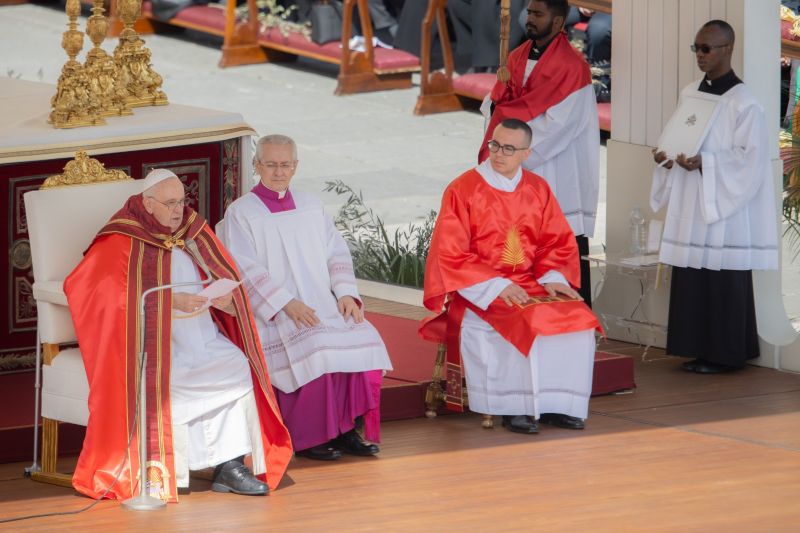
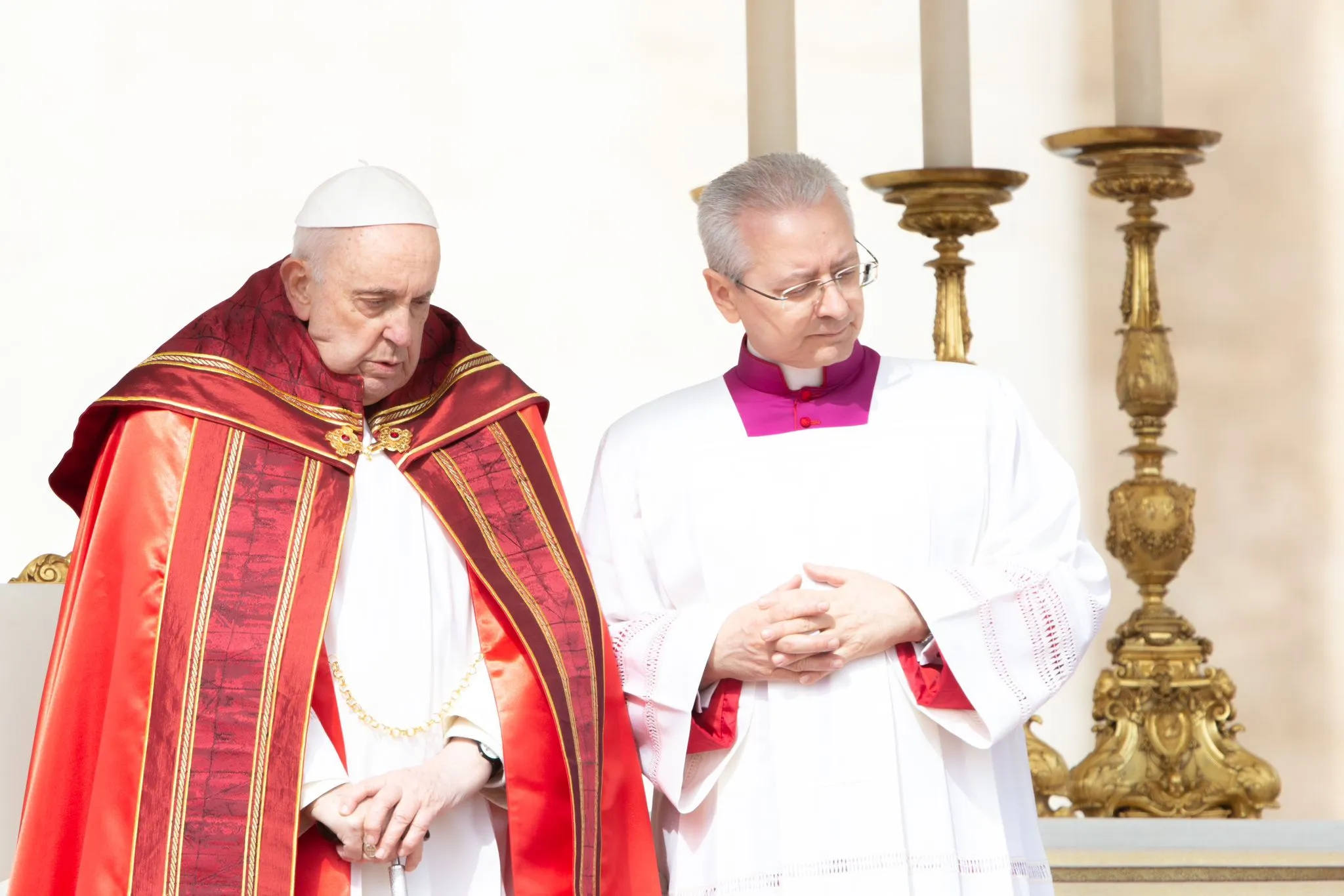
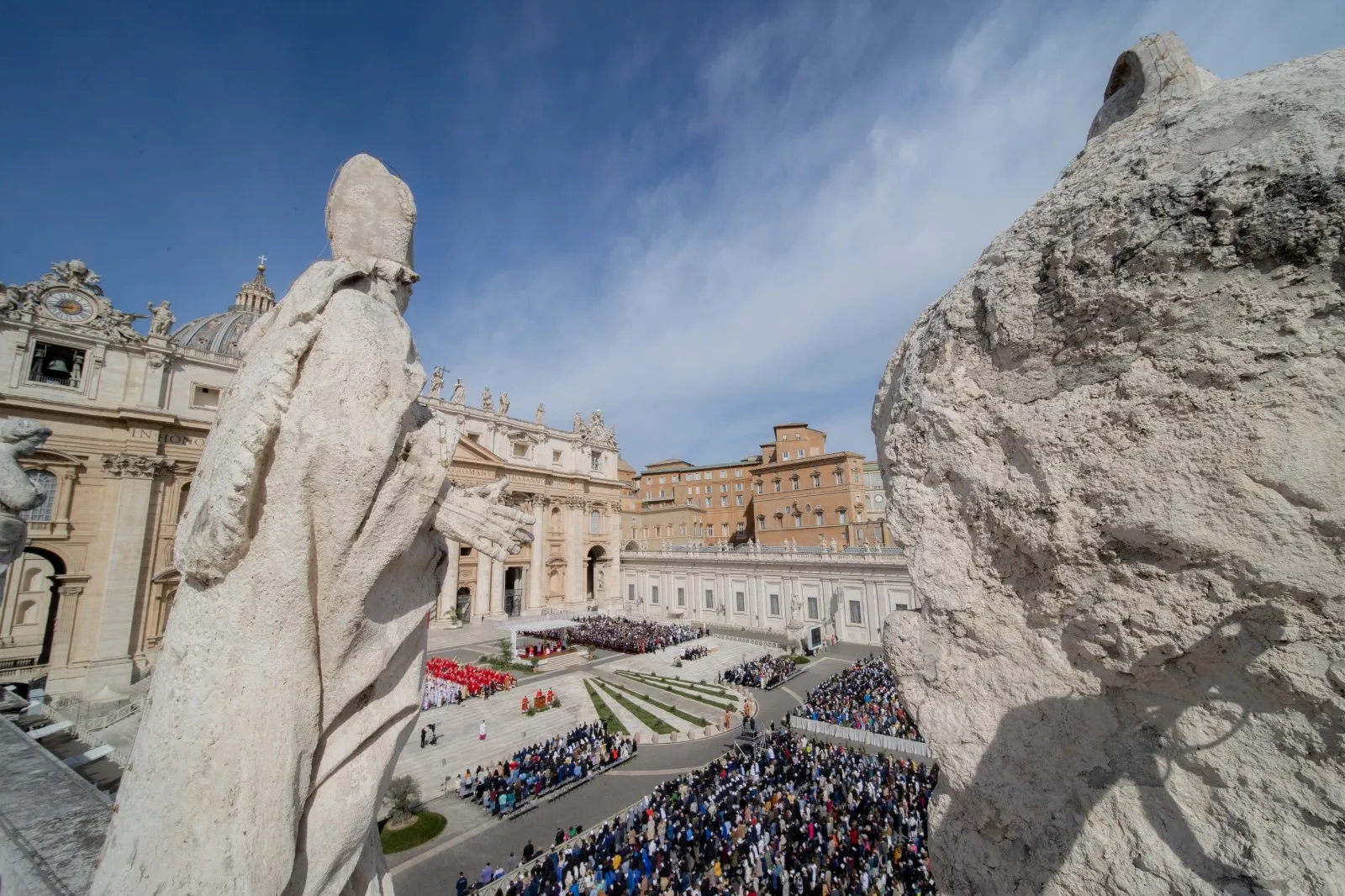
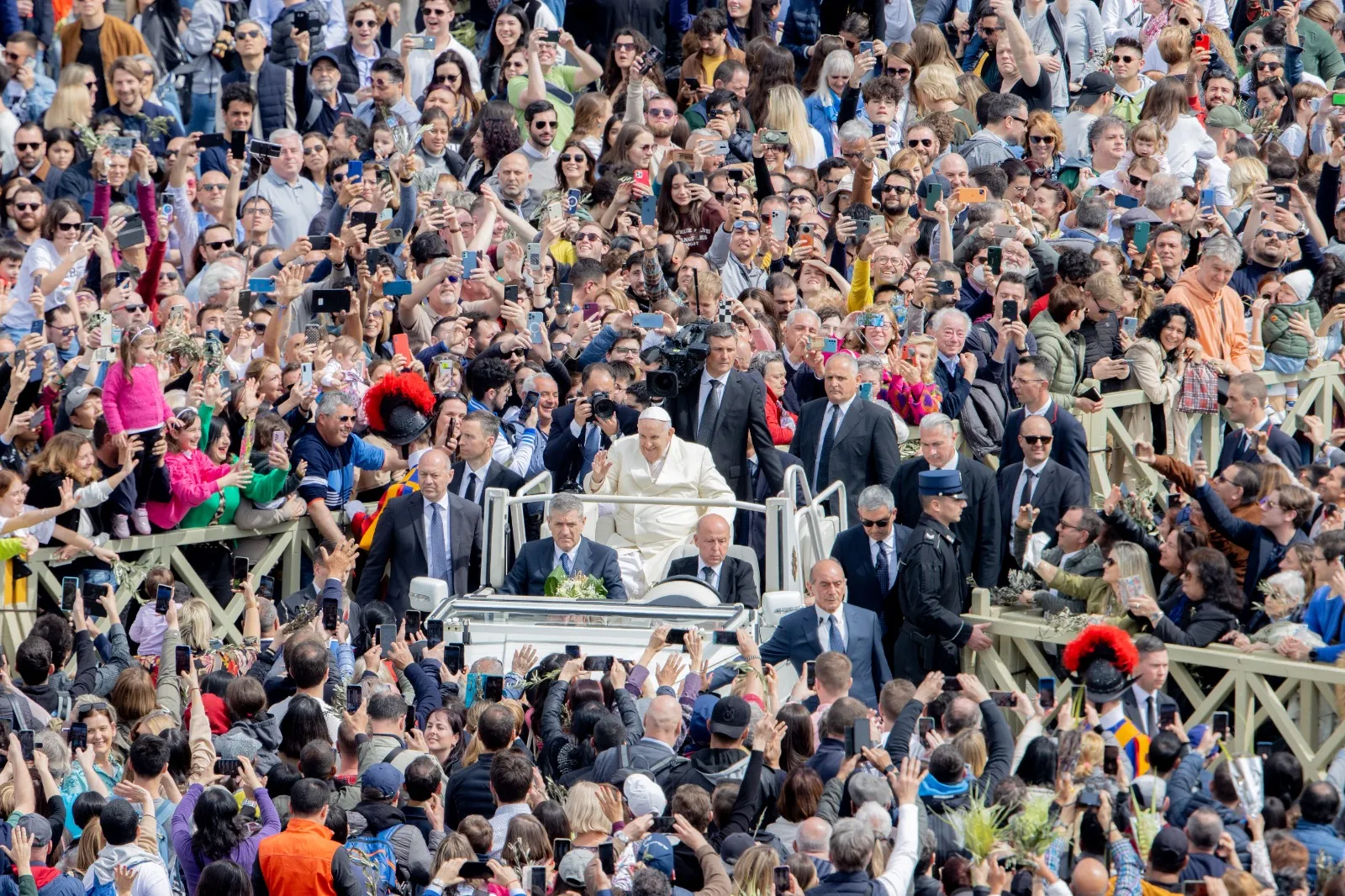
Mass during the 10th annual Populus Summorum Pontificum pilgrimage to Rome, Oct. 29-31, 2021. / Edward Pentin.
Rome, Italy, Nov 10, 2021 / 04:20 am (CNA).
The vicar general for the Diocese of Rome has banned the celebration of the Traditional Latin Mass during the Easter Triduum in his implementation of Pope Francis’ motu proprio Traditionis custodes.
In a letter dated Oct. 7, but made public on several blogs Nov. 9, Cardinal Angelo De Donatis said that Mass could continue to be celebrated according to the 1962 Roman Missal at five churches in Rome on all days except from the evening of Holy Thursday to the evening of Easter Sunday, the period known as the Triduum.
De Donatis also stated that no other sacraments or sacramentals may be celebrated according to the pre-Vatican II missal except the Mass.
The diocesan press office confirmed on Nov. 10 that the letter, addressed to the priests and faithful of the Diocese of Rome, was authentic.
As pope, Francis is also the bishop of Rome, but because the pope has many other responsibilities, the day-to-day care of the Diocese of Rome is entrusted to the vicar general, whose full title is Vicar General of His Holiness.
A vicar general is given, by canon law, executive power over the diocese in all administrative acts except those reserved to the bishop. In the Diocese of Rome, the cardinal vicar functions like a de facto diocesan bishop.
Rome diocese’s guidelines were issued in response to Pope Francis’ motu proprioTraditionis custodes, published in July, which placed tight restrictions on Mass using the 1962 Roman Missal, known variously as the extraordinary form of the Roman Rite, the Tridentine Mass, and the Traditional Latin Mass.
In a letter to the world’s bishops explaining his decision, the pope said he felt compelled to act because the use of the 1962 Missal was “often characterized by a rejection not only of the liturgical reform, but of the Vatican Council II itself, claiming, with unfounded and unsustainable assertions, that it betrayed the Tradition and the ‘true Church.’”
Responding to the pope’s motu proprio, the cardinal vicar of Rome said “it seemed fitting to continue to exercise a lively pastoral charity towards the faithful” who wish to participate in the Traditional Latin Mass.
He said that all priests in the diocese who sought to celebrate Mass according to the 1962 Missal must be authorized in writing by the diocesan bishop, as stipulated in Traditionis custodes.
The cardinal designated the pastor of Santissima Trinità dei Pellegrini, a church run by the Priestly Fraternity of St. Peter (FSSP), as responsible “pro tempore” (for the time being) for the “dignified celebration of the Eucharistic liturgy, as well as the ordinary pastoral and spiritual care of the faithful.”
The readings during Traditional Latin Masses must be proclaimed in Italian according to the 2008 translation by the Italian bishops’ conference, De Donatis’ letter said.
He added that with Pope Francis’ motu proprio, “it is no longer possible to use the Roman Ritual and the other liturgical books of the ‘ancient rite’ for the celebration of sacraments and sacramentals (e.g., not even the Ritual for the Reconciliation of Penitents according to the ancient form).”
Issued with immediate effect on July 16, Traditionis custodes (“Guardians of the tradition”) made changes to Benedict XVI’s 2007 apostolic letterSummorum Pontificum, which acknowledged the right of all priests to say Mass using the Roman Missal of 1962.
With Traditionis custodes, Pope Francis said that it is now each bishop’s “exclusive competence” to authorize the use of the Traditional Latin Mass in his diocese.
Since the motu proprio’s promulgation, some bishops have said that priests may continue to offer the Traditional Latin Mass in their dioceses, while others have banned it.
If you value the news and views Catholic World Report provides, please consider donating to support our efforts. Your contribution will help us continue to make CWR available to all readers worldwide for free, without a subscription. Thank you for your generosity!
Click here for more information on donating to CWR. Click here to sign up for our newsletter.
Washington D.C., Mar 22, 2021 / 04:49 pm (CNA).- Several Catholic dioceses are hosting a webinar Monday night to better inform people about the consequences of the Equality Act, which they say would seriously hinder religious freedom. Titled “The … […]
Bishop Steven Raica of Birmingham, Alabama, presented EWTN’s vice president of theology, Colin Donovan, with the Pontifical International Marian Academy’s Letter of Appointment and Diploma during a Mass on Aug, 9. / EWTN
Washington, D.C. Newsroom, Aug 10, 2023 / 20:11 pm (CNA).
Pope Francis appointed Colin Donovan, vice president of theology at EWTN Global Catholic Network, to the Pontifical International Marian Academy, which is tasked with promoting theological understanding and devotion to the Mother of God, the network announced Wednesday.
Donovan was presented with the Marian Academy’s Letter of Appointment and Diploma by Birmingham Bishop Steven J. Raica during an Aug. 9 televised Mass.
The appointment honors Donovan for his contributions to the field of Mariology and his commitment to spreading devotion to Mary.
In an interview with CNA on Thursday, Donovan called his appointment “a great privilege,” adding that it wasn’t something he was expecting, but a task that he is excited to take on.
EWTN is the parent company of Catholic News Agency.
Donovan said that the academy promotes “Mariological science,” the division of theology that studies Mary. The academy, founded in 1946, organizes International Marian Congresses and publishes a journal of their work called Marianum.
“The academy is there at the service of the Church and specifically at the service of the Roman Pontiff so that he can throw questions to them if he wants,” Donovan said.
Donovan is approaching his 27th year working at EWTN, where he serves as a theologian and on-air commentator, often answering questions about Mariology.
Part of Donovan’s role at EWTN requires him to review materials for broadcast or print, as well as answer questions on the radio during the show Open Live, which he has hosted for almost 20 years.
Donovan said that his appointment is an opportunity for him to continue his research and study of Mariology, which makes it “quite exciting,” apart from “the great honor that is represented simply by being appointed to it.”
Donovan told CNA he has always had a devotion to Mary, a relationship that began when he was a child with the recitation of the Rosary and Marian formation in Canada from his school teachers, the Sisters of Our Lady of Sion.
His first encounter with in-depth theological study began his freshman year of college while studying biology at Northwestern University in Evanston, Illinois, when someone asked him his thoughts on Humane Vitae, Pope Paul VI’s encyclical letter on birth control.
He went to read the encyclical to form an opinion and said that “the clarity of what the pope wrote about in the natural order of marriage and family just struck me immediately.”
Donovan, a Navy veteran, went on to study theology and philosophy at the Seminary of Christ the King in Mission, British Columbia, Canada. He then earned a licentiate in sacred theology from the Pontifical University of Saint Thomas Aquinas in Rome.
In the early 1990s, before joining EWTN, he was a professor at Aquinas College in Nashville, Tennessee.
In 2017, Donovan was invited to speak at the Pontifical Marian Academy’s conference in Ireland, which commemorated the 100th anniversary of the Fatima apparitions. He also participated in the academy’s 2021 conference which was held on Zoom because of the COVID-19 pandemic.
A close-up of the copy of Michelangelo’s Vatican Pietà, usually kept at the Vatican Museums. / Ela Bialkowska/OKNO studio.
Rome Newsroom, Mar 7, 2022 / 04:00 am (CNA).
As war rages in Ukraine and the pandemic lingers, Michelangelo’s celebrated Vatican Pietà — and two lesser-known figures he also sculpted — can be deeply meaningful to a pain-wracked world, says a priest and art historian.
Michelangelo Buonarotti’s Pietà depicts a larger-than-life Virgin Mary as she mourns her crucified Son, Jesus, lying limp in her lap. The masterpiece, carved out of Carrara marble, was finished before the Italian artist’s 25th birthday.
Over the course of more than 60 years, Michelangelo created two more sculptures on the same theme — and a new exhibit in the Italian city of Florence brings the three works together for the first time.
The Three Pietà of Michelangelo exhibit at Museo dell’Opera del Duomo in Florence, Italy. Museo dell’Opera del Duomo
The exhibit opened at the Museo dell’Opera del Duomo on Feb. 24, and includes the Florentine Pietà, also called the Deposition, which Michelangelo worked on from 1547 to 1555, and exact casts, or copies, of the Vatican Pietà and Milan Pietà — which could not be moved from their locations.
Msgr. Timothy Verdon, the director of the Museo dell’Opera del Duomo, told CNA by phone that the gallery wanted to do something to show its solidarity with a Feb. 23-27 meeting of mayors and Catholic bishops.
“The images of suffering that the Pietà always implies I think will deeply touch people. I think that visitors will be moved to see these works,” he said. The image of the Pietà evokes “the personal suffering of mothers who hold their children not knowing if their children will survive.”
A close-up of the copy of Michelangelo’s Vatican Pietà, usually kept at the Vatican Museums. Ela Bialkowska/OKNO studio.
The 75-year-old Verdon is an expert in art history and sacred art. He was born in Hoboken, New Jersey, but has lived in Italy for more than 50 years.
“So many of the issues that face the Mediterranean world today are forms of suffering,” he said, “and so this ideal series of images of the God who becomes man [and] accepts suffering, and whose Mother receives his tortured body into her arms, these are deeply meaningful.”
“All human situations of suffering and exclusion invite a comparison with the suffering of Christ, the death of Christ. And [the Pietà] condenses and concentrates a devout reflection on that,” the priest said.
The lesser-known Pietàs
Many years after Michelangelo completed the Pietà displayed in St. Peter’s Basilica, he began his Florentine Pietà, which depicts Nicodemus, Mary Magdalene, and the Virgin Mary receiving the body of Christ as it is removed from the Cross.
The 72-year-old Michelangelo worked on the sculpture for eight years before eventually abandoning it in 1555.
Michelangelo’s Florentine Pietà, part of the permanent collection at the Museo dell’Opera del Duomo in Florence, Italy. Museo dell’Opera del Duomo in Florence, Italy.
He probably began the Rondanini Pietà, which is in Milan, in 1553. Michelangelo continued to work on the piece until just days before his death in 1564.
According to a press release from the city of Florence, “near his own death, Michelangelo meditated deeply on the Passion of Christ.”
One way this is known is because shortly before his death, Michelangelo gave a drawing of the Pietà to Vittoria Colonna, the Marquess of Pescara, on which he wrote: “They think not there how much of blood it costs.”
The line, from Canto 29 of Paradiso, one of the books of Dante’s “Divine Comedy”, is also the subtitle of the Florence exhibition.
A perfect cast of Michelangelo’s unfinished Rondanini Pietà, on display at the Museo dell’Opera del Duomo in Florence, Italy. Museo dell’Opera del Duomo
Bringing the three Pietàs together into one exhibit gives the viewer the chance to see “the full range of Michelangelo’s reflection on this subject across 60-some years,” Verdon explained.
Not only is the Renaissance artist’s stylistic evolution on display, but also his spiritual development.
“We know that [Michelangelo] was a religious man,” Verdon said. “His interpretation of religious subjects, even in his youth, is particularly sensitive and well informed.”
According to the priest, Michelangelo seems to have had a range of theological influences.
“His older brother was a Dominican friar and in Michelangelo’s old age we’re told that he could still remember the preaching of Savonarola,” Verdon said.
Girolamo Savonarola was a popular Dominican friar, preacher, and reformer active in Renaissance Florence. He spoke against the ruling Medici family and the excesses of the time, and in 1498 he was hanged and his body burned after a trial by Church and civil authorities.
According to the Catholic Encyclopedia, “In the beginning Savonarola was filled with zeal, piety, and self-sacrifice for the regeneration of religious life. He was led to offend against these virtues by his fanaticism, obstinacy, and disobedience. He was not a heretic in matters of faith.”
“That’s an interesting page in cultural history,” Verdon said, “because the early Pietà is done in effect shortly after the Savonarola period, or in the Savonarola period.”
“So we’re talking about an artist to whom this subject means a great deal, and which he is also equipped to treat.”
The Three Pietà of Michelangelo exhibit at Museo dell’Opera del Duomo in Florence, Italy. Museo dell’Opera del Duomo
The artist’s last Pietàs were created, instead, in the context of the Counter-Reformation.
The council, he explained, “had to rebut the heretical ideas of Protestant reformers, and so it insists, in a decree on the Eucharist published in 1551, that indeed in the bread and wine, Christ’s Body and Blood are truly present.”
“So Michelangelo, who was personally religious, and who, especially in his later period, worked exclusively for the Vatican, was therefore very close to the changes occurring in Catholic thought, Catholic theology, Catholic devotion,” Verdon said.
The exhibit “really gives us the opportunity to gauge the evolution of a theme from one time to a very different one, from the end of the 15th, to the mid- 16th century.”
The St. Peter’s Basilica Pietà
Verdon said that the Vatican Pietà is the only one of the three to remain in the place it was intended for — above an altar in St. Peter’s Basilica.
The sculpture was originally created for the 4th-century Constantinian basilica, the “Old St. Peter’s Basilica,” which was replaced by the Renaissance basilica standing today.
In Michelangelo’s Pietà, the Virgin Mary holds her Son as she did at his birth. . Paweesit via Flickr.
Viewing art in a church is not the same as viewing it in a museum, the art historian noted.
“Obviously it is different, especially for the fact that the Vatican Pietà has remained on an altar, above an altar, and so the body of Christ depicted by Michelangelo would have been seen in relation to the sacramental body of Christ in the Eucharist.”
“This was true of the first situation in the Old St. Peter’s, the work was on an altar, and it’s true of the present collocazione [position],” he said.
“And actually,” the priest continued, “the same thing was true of both of the other Pietàs. They were intended by Michelangelo to go on an altar in a chapel in a Roman church where he expected to be buried. We think the church was Santa Maria Maggiore.”
“So the relationship of the image of Christ’s body with the Eucharistic Corpus Christi is very important,” he said.
The Three Pietà of Michelangelo exhibit at Museo dell’Opera del Duomo in Florence, Italy. Museo dell’Opera del Duomo
The copies of the Vatican and Milan Pietàs are on loan from the Vatican Museums, and will be in Florence for the Three Pietàs exhibit through Aug. 1.
“And in our museum, in the Florence Opera del Duomo Museum, we have put the Pietà, our Pietà, on a base that evokes an altar, as the very specific Church meaning [of an altar] has to do with the Sacrament,” Verdon said.
Well, in the day, the TLM Easter Vigil Mass was my favorite Mass of the year and the most sublime spiritual experience I have encountered in the Liturgy. I want to be charitable but it certainly seems possible that this pope and this vicar (and the bishop in my Diocese) are deliberately making evil choices.
About 6,550,000 results (0.48 seconds)
Search Results
Featured snippet from the web
The absence of good (Latin: privatio boni), also known as the privation theory of evil, is a theological and philosophical doctrine that evil, unlike good, is insubstantial, so that thinking of it as an entity is misleading. Instead, evil is rather the absence, or lack (“privation”), of good.
Absence of good – Wikipedia
******
There appears to be a lot of “lack” in some parts of Rome these days.
Parishioners who didn’t defenestrated their bishops are not worthy of that spiritual experience. It is that simple, since they can have Francis & De Donatis or the liturgy, but not both.
Don’t forget dialog and transparency that are supposed to characterize the authentic spirit of Vatican II. But, then again, when Modernists speak of the Spirit of Vatican II they actually mean animation by the Spirit of the Age rather than the Holy Spirit. This pope has apparently decided to be more inclusive by adding hypocrites to the inner circle of heretics and homosexuals giving him counsel.
Rome’s censure of the traditional rite for the Easter Vigil Mass renders an air of suppression not specifically of ancient rites and practices, rather of a way of life. Charity if it were evident would be less aggressive, more empathetic. The impression is that a new vision of the Church is being put in place whether we like it or not.
Formerly such suppression affected errors, activities that weren’t reconcilable with Christianity. In this instance what has for millennia been considered holy and faithful to Christ is the target. As if faith requires uniformity in every dimension of practice, to an extent requiring acculturation to a new order of lifestyle and mentality. It’s a dangerous strategy to implement change, because it speaks to enforced regimentation, control of life and with that violation of conscience.
Certainly the faithful to Christ will be strengthened by the Holy Spirit even flourish during adversity. What will mark our sincere faith is forgiveness and prayers for these misguided perpetrators.
Here is an article by Father John Hunwicke of the English Ordinariate, making a concise statement about the Pontiff Francis and his recent attempt by fiat to outlaw the prayers of the traditional Roman Rite of the Mass:
Pontiff Francis is the perfect totalitarian hypocrite. He has contempt for all laws he disagrees with (such as the 1st and 6th Commandments), and contempt for anyone who disagrees with his laws.
This pontificate is the counterfeit-katholik cult of the zombies McCarrick and Danneels, the abusers and coverup Cardinals of the St. Gallen fraud.
“Time is running out; this occasion must not be wasted, lest we have to face God’s judgment for our failure to be faithful stewards of the world he has entrusted to our care,” the pope wrote in a letter to Catholics in Scotland signed Nov. 9. -posted today at CWR, from CNA.
The pope reveals his heart: God will judge how we treat the world! Does the Pope give two diddlies for the Mass? Does Francis worry how God may judge his suppression of the reverent representation, the commemorative sacrifice of His Only Begotten Son? ‘Enough!’ Springboarding off Fr. Morello’s words below: Take heart, faithful Catholics. We flourish under the manure Rome continually shovels.
Well, in the day, the TLM Easter Vigil Mass was my favorite Mass of the year and the most sublime spiritual experience I have encountered in the Liturgy. I want to be charitable but it certainly seems possible that this pope and this vicar (and the bishop in my Diocese) are deliberately making evil choices.
Searching for:
evil is a privation, not a thing
we see:
About 6,550,000 results (0.48 seconds)
Search Results
Featured snippet from the web
The absence of good (Latin: privatio boni), also known as the privation theory of evil, is a theological and philosophical doctrine that evil, unlike good, is insubstantial, so that thinking of it as an entity is misleading. Instead, evil is rather the absence, or lack (“privation”), of good.
Absence of good – Wikipedia
******
There appears to be a lot of “lack” in some parts of Rome these days.
Parishioners who didn’t defenestrated their bishops are not worthy of that spiritual experience. It is that simple, since they can have Francis & De Donatis or the liturgy, but not both.
Cardinal Angelo De Donatis and Pope Francis,
“…go ahead and do what you have come for.”
“So pastoral and accompanying.”
But what if those who want to attend the Traditional Latin Mass on Easter Sunday are gay divorcées?
More petty spite from the Bergoglian regime. So much for mercy and accompaniment.
Don’t forget dialog and transparency that are supposed to characterize the authentic spirit of Vatican II. But, then again, when Modernists speak of the Spirit of Vatican II they actually mean animation by the Spirit of the Age rather than the Holy Spirit. This pope has apparently decided to be more inclusive by adding hypocrites to the inner circle of heretics and homosexuals giving him counsel.
Rome’s censure of the traditional rite for the Easter Vigil Mass renders an air of suppression not specifically of ancient rites and practices, rather of a way of life. Charity if it were evident would be less aggressive, more empathetic. The impression is that a new vision of the Church is being put in place whether we like it or not.
Formerly such suppression affected errors, activities that weren’t reconcilable with Christianity. In this instance what has for millennia been considered holy and faithful to Christ is the target. As if faith requires uniformity in every dimension of practice, to an extent requiring acculturation to a new order of lifestyle and mentality. It’s a dangerous strategy to implement change, because it speaks to enforced regimentation, control of life and with that violation of conscience.
Certainly the faithful to Christ will be strengthened by the Holy Spirit even flourish during adversity. What will mark our sincere faith is forgiveness and prayers for these misguided perpetrators.
Here is an article by Father John Hunwicke of the English Ordinariate, making a concise statement about the Pontiff Francis and his recent attempt by fiat to outlaw the prayers of the traditional Roman Rite of the Mass:
https://liturgicalnotes.blogspot.com/2021/11/which-is-real-bergoglio.html
Pontiff Francis is the perfect totalitarian hypocrite. He has contempt for all laws he disagrees with (such as the 1st and 6th Commandments), and contempt for anyone who disagrees with his laws.
This pontificate is the counterfeit-katholik cult of the zombies McCarrick and Danneels, the abusers and coverup Cardinals of the St. Gallen fraud.
Try as I may, I can find nothing appealing about this Pope.
Thanks for the link.
The comment about “when in March 2020 the Church of Accompaniment became the Church of Abandonment” is devastatingly accurate.
“Time is running out; this occasion must not be wasted, lest we have to face God’s judgment for our failure to be faithful stewards of the world he has entrusted to our care,” the pope wrote in a letter to Catholics in Scotland signed Nov. 9. -posted today at CWR, from CNA.
The pope reveals his heart: God will judge how we treat the world! Does the Pope give two diddlies for the Mass? Does Francis worry how God may judge his suppression of the reverent representation, the commemorative sacrifice of His Only Begotten Son? ‘Enough!’ Springboarding off Fr. Morello’s words below: Take heart, faithful Catholics. We flourish under the manure Rome continually shovels.
in the Vatican cellars an ex pope receives a further turn on the rack from the apostles of apostasy.