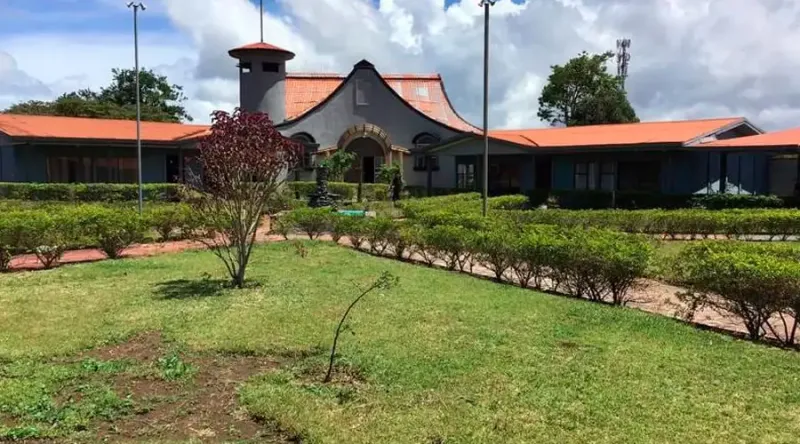
The Benedictine Monastery of San Jose in Costa Rica’s Diocese of Cartago, which was canonically closed Nov. 7, 2021. / Diocese of Cartago.
Cartago, Costa Rica, Nov 10, 2021 / 10:24 am (CNA).
The Diocese of Cartago has ordered the canonical closure of the San José Benedictine Monastery, a diocesan foundation that had functioned ad experimentum for some years.
“This decision of ecclesiastical closure is carried out as a result of an internal administrative process of the Church, which originated in a pastoral visit to the Monastery; this being done in accordance with the powers conferred by the Code of Canon Law, whose result and conclusions were endorsed by the Congregation for the Institutes of Religious Life and Societies of Apostolic Life in Rome,” the diocese stated Nov. 7.
Father Jorge David Arley Campos, press officer for the Diocese of Cartago, told ACI Prensa, CNA’s Spanish language sister news agency Nov. 9. that “as the assessment and investigation of the fruits of the experience is an internal process, the specific reasons” for the closure are not published, since “it was the decision of the commission in charge and the judicial vicar of the diocese.”
“The final decision was made known but not the reasons, since there are elements of secrecy in the matter and they cannot be exposed to public opinion due to the nature of the entrusted secret, in order not to damage the conscience of the faithful and to avoid incorrect interpretations by the faithful,” the priest said.
On its Facebook page, the monastery calls itself a “monastic community governed by the Rule of Saint Benedict, cloistered under our constitutions, and our main work is: prayer and manual labor.”
“We are a cloistered community, we do not do pastoral work outside the monastery. We do not belong to the Diocese of Cartago,” the Facebook page states.
The Nov. 7 diocesan communiqué says that “the members of this diocesan experience have been allowed and offered all our collaboration in their transfer to other experiences of community, if they see fit, awaiting word from them.”
The diocese said that while it has closed the monastery and thus ended its ecclesial mission, it is aware that the monastery was also established as a civil association enrolled in the Civil Registry and so “it belongs to them to determine its future as a civil association.”
From Nov. 7 “the Diocesan Experience of the San José Benedictine Monastery will not be part of the Diocese of Cartago, likewise there will be no authorization for the celebration of the sacraments and sacramentals in the place of that experience.”
Fr. Arley Campos explained to ACI Prensa that as a civil association the monastery is “a legal entity under which they were legally protected as a group.”
“As an association it’s up to them to determine their future, but they are no longer canonically a movement of the Catholic Church,” the priest said.
An article published Nov.1 La Nación, a San José daily, says that “the Benedictine monks of the San José Monastery, in Paraíso de Cartago, charged that the current bishop of Cartago, Mario Enrique Quirós Quirós, has persecuted them for years to ‘eliminate’ their ‘presence ‘in the diocese and take from them their monastery grounds.”
The monastery was founded about eight years ago under Bishop José Francisco Ulloa Rojas. Bishop Quirós succeeded him in 2017.
In its Nov. 7 statement, the Diocese of Cartago doesn’t mention the article in La Nación, but noted that “the land and facilities where the campus of said experience have been located is the property of the indicated Association and has never been the subject of discussion.”
A response sent by the Diocese of Cartago to La Nación says that “the members of the San José Monastery, which was founded by the diocese, were informed of the conclusion of said experience, as a result of not obtaining the expected fruits during this time.”
The diocese further noted that members of the monastery “have been given the opportunity to exercise, pursuant to CIC c. 50, their right of reply.”
Canon 50 of the Code of Canon Law establishes that “before issuing a singular decree, an authority is to seek out the necessary information and proofs and, insofar as possible, to hear those whose rights can be injured.”
The press officer of the Diocese of Cartago explained to ACI Prensa that what happened in this case was the “closure of a diocesan foundation that was subject to evaluation and that could have become an autonomous monastery,” as they exist in other parts of the world.
Fr. Arley Campos said that the members of the group can stay on their property, “since the material goods they enjoy are theirs and their internal regulations, like those of any civil group, are those that govern their action.”
However, the priest clarified, “its mode of operation and what that entails is no longer covered by the Diocesan Church of Cartago.”
If you value the news and views Catholic World Report provides, please consider donating to support our efforts. Your contribution will help us continue to make CWR available to all readers worldwide for free, without a subscription. Thank you for your generosity!
Click here for more information on donating to CWR. Click here to sign up for our newsletter.
Pope Francis greets a young girl at a conference on Friday, May 10, 2024, on the state of birth rates in Italy and the wider West at the Auditorium della Conciliazione in Rome. / Credit: Vatican Media
CNA Staff, Oct 25, 2023 / 17:50 pm (CNA).
Concerned students at the University of Notre Dame have objected to an upcoming drag show set to be held on campus as part of a one-credit course, which the … […]
Seminarians at Good Shepherd Major Seminary in Nigeria’s Kaduna state where four students were kidnapped and one, Michael Nnadi, was killed in 2020. / Credit: Good Shepherd Major Seminary Kaduna/ Facebook
ACI Africa, Jan 26, 2024 / 11:40 am (CNA).
Last year, 2023, was a difficult year for Brother Peter Olarewaju, a postulant at the Benedictine monastery in Nigeria’s Ilorin Diocese who was kidnapped alongside two others at the monastery. Olarewaju underwent different kinds of torture and witnessed the murder of his companion, Brother Godwin Eze.
After his release, Olarewaju said his kidnapping was a blessing, as it had strengthened his faith. He even said that he is now prepared to die for his faith.
“I am prepared to die a martyr in this dangerous country. I am ready any moment to die for Jesus. I feel this very strongly,” Olarewaju said in an interview with ACI Africa, CNA’s news partner in Africa, on Nov. 26, 2023, days after he was set free by suspected Fulani kidnappers.
The late Brother Godwin Eze who was kidnapped from the Benedictine monastery in Nigeria’s Ilorin Diocese and murdered by his kidnappers in October 2023. Credit: Benedictine monastery, Eruku
The monk’s testimony is not an isolated case in Nigeria, where kidnapping from seminaries, monasteries, and other places of religious formation has been on the rise. While some victims of the kidnappings have been killed, those who survived the ordeal have shared that they have come back stronger — and ready to die for their faith.
Seminarian Melchior Maharini, a Tanzanian who was kidnapped alongside a priest from the Missionaries of Africa community in the Diocese of Minna in August 2023, said the suffering he endured during the three weeks he was held captive strengthened his faith. “I felt my faith grow stronger. I accepted my situation and surrendered everything to God,” he told ACI Africa on Sept. 1, 2023.
Father Paul Sanogo (left) and Seminarian Melchior Maharini (right) were kidnapped from their community of Missionaries of Africa in Nigeria’s Diocese of Minna. Credit: Vatican Media
Many other seminarians in Nigeria have been kidnapped by Boko Haram militants, Fulani herdsmen, and other bandit groups operating in Africa’s most populous nation.
In August 2023, seminarian David Igba told ACI Africa that he stared death in the face when a car in which he was traveling on his way to the market in Makurdi was sprayed with bullets by Fulani herdsmen.
Seminarian Na’aman Danlami died when the Fulanis attacked St. Raphael Fadan Kamantan Parish on the night of Sept. 7, 2023. Credit: Photo courtesy of Aid to the Church in Need
In September 2023, seminarian Na’aman Danlami was burned alive in a botched kidnapping incident in the Diocese of Kafanchan. A few days earlier, another seminarian, Ezekiel Nuhu, from the Archdiocese of Abuja, who had gone to spend his holidays in Southern Kaduna, was kidnapped.
Two years prior, in October 2021, Christ the King Major Seminary of Kafanchan Diocese was attacked and three seminarians were kidnapped.
Seminarian David Igba during a pastoral visit at Scared Heart Udei of the Catholic Diocese of Makurdi. Credit: David Igba
In one attack that attracted global condemnation in 2020, seminarian Michael Nnadi was brutally murdered after he was kidnapped alongside three others from Good Shepherd Major Seminary in the Diocese of Kaduna. Those behind the kidnapping confessed that they killed Nnadi because he would not stop preaching to them, fearlessly calling them to conversion.
After Nnadi’s murder, his companions who survived the kidnapping proceeded to St. Augustine Major Seminary in Jos in Nigeria’s Plateau state, where they courageously continued with their formation.
The tomb of seminarian Michael Nnadi, who was brutally murdered after he was kidnapped alongside three others from the Good Shepherd Major Seminary in the Catholic Diocese of Kaduna in 2020. Credit: Father Samuel Kanta Sakaba, rector of a Good Shepherd Major Seminary in Kaduna
As Christian persecution rages in Nigeria, seminary instructors in the country have shared with ACI Africa that there is an emerging spirituality in Nigerian seminaries that many may find difficult to grasp: the spirituality of martyrdom.
They say that in Nigeria, those who embark on priestly formation are continuously being made to understand that their calling now entails being ready to defend the faith to the point of death. More than ever before, the seminarians are being reminded that they should be ready to face persecution, including the possibility of being kidnapped and even killed.
Father Peter Hassan, rector of St. Augustine Major Seminary in the Archdiocese of Jos, Plateau state, said that seminaries, just like the wider Nigerian society, have come to terms with “the imminence of death” for being Christian.
Father Peter Hassan, rector of St. Augustine Major Seminary in Jos, Nigeria, walks with an unnamed companion. Credit: Father Peter Hassan
“Nigerian Christians have been victims of violence of apocalyptic proportions for nearly half a century. I can say that we have learned to accept the reality of imminent death,” Hassan said in a Jan. 12 interview with ACI Africa.
He added: “Nevertheless, it is quite inspiring and comforting to see the many young men who are still ready to embrace a life that will certainly turn them into critically endangered species. Yet these same young men are willing to preach the gospel of peace and embrace the culture of dialogue for peaceful coexistence.”
Shortly after Nnadi’s kidnapping and killing, St. Augustine Major Seminary opened its doors to the three seminarians who survived the kidnapping.
Hassan told ACI Africa that the presence of the three former students of Good Shepherd Major Seminary was “a blessing” to the community of St. Augustine Major Seminary.
“Their presence in our seminary was a blessing to our seminarians, a wake-up call to the grim reality that not even the very young are spared by those mindless murderers,” Hassan said.
Back at Good Shepherd, seminarians have remained resilient, enrolling in large numbers even after the 2020 kidnapping and Nnadi’s murder.
Good Shepherd Major Seminary in Kaduna, Nigeria. Credit: Father Samuel Kanta Sakaba, rector of a Good Shepherd Major Seminary in Kaduna
In an interview with ACI Africa, Father Samuel Kanta Sakaba, the rector of Good Shepherd Major Seminary, said that instructors at the Catholic institution, which has a current enrollment of 265 seminarians, make it clear that being a priest in Nigeria presents the seminarians with the danger of being kidnapped or killed.
ACI Africa asked Sakaba whether or not the instructors discuss with the seminarians the risks they face, including that of being kidnapped, or even killed, to which the priest responded: “Yes, as formators, we have the duty to take our seminarians through practical experiences — both academic, spiritual, and physical experiences. We share this reality of persecution with them, but for them to understand, we connect the reality of Christian persecution in Nigeria to the experiences of Jesus. This way, we feel that it would be easier for them to not only have the strength to face what they are facing but to also see meaning in their suffering.”
“Suffering is only meaningful if it is linked with the pain of Jesus,” the priest said. “The prophet Isaiah reminds us that ‘by his wounds, we are healed.’ Jesus also teaches us that unless the grain of wheat falls on the ground and dies, it will remain a single grain, but that it is only when it falls and dies that it yields a rich harvest. Teachings such as these are the ones that deepen our resilience in the face of persecution.”
Seminarians and their instructors at St. Augustine Major Seminary in Jos, Nigeria. Credit: Father Peter Hassan
Sakaba spoke of the joy of those who look forward to “going back to God in a holy way.”
“Whatever happens, we will all go back to God. How joyful it is to go back to God in a holy way, in a way of sacrifice.” he said. “This holiness is accepting this cross, this pain. Jesus accepted the pain of Calvary, and that led him to his resurrection. Persecution purifies the individual for them to become the finished product for God. I believe that these attacks are God’s project, and no human being can stop God’s work.”
However, the rector clarified that those who enroll at the seminary do not go out seeking danger.
“People here don’t go out putting themselves in situations of risk,” he said. “But when situations such as these happen, the teachings of Jesus and his persecution give us courage to face whatever may come our way.”
Sakaba said that although priestly formation in Nigeria is embracing the “spirituality of martyrdom,” persecution in the West African country presents “a difficult reality.”
“It is difficult to get used to pain. It is difficult to get used to the issues of death … to get familiar with death,” he said. “No one chooses to go into danger just because other people are suffering; it is not part of our nature. But in a situation where you seem not to have an alternative, the grace of God kicks in to strengthen you to face the particular situation.”
Sakaba said that since the 2020 attack at Good Shepherd Major Seminary, the institution has had an air of uncertainty. He said that some of the kidnappers who were arrested in the incident have been released, a situation he said has plunged the major seminary into “fear of the unknown.”
“It hasn’t been easy for us since the release,” Sabaka told ACI Africa. “The community was thrown into confusion because of the unknown. We don’t know what will happen next. We don’t know when they will come next or what they will do to us. We don’t know who will be taken next.”
Seminarians at St. Augustine Major Seminary in Jos, Plateau state, Nigeria, during a Marian procession. Credit: Father Peter Hassan
In the face of that, however, Sabaka said the resilience of the seminary community has been admirable. “God has been supporting, encouraging, and leading us. His grace assisted us to continue to practice our faith,” he said.
The jihadist attacks, which continue unabated in communities surrounding the seminary, do not make the situation easier.
Church at the Good Shepherd Major Seminary in Kaduna, Nigeria. Credit: Father Samuel Kanta Sakaba, rector of Good Shepherd Major Seminary in Kaduna
“Every attack that happens outside our community reminds us of our own 2020 experience. We are shocked, and although we remain deeply wounded, we believe that God has been leading us,” he said.
This story was first published by ACI Africa, CNA’s news partner in Africa, and has been adapted by CNA.
We don’t know the reason why the Benedictine Monastery was suppressed, perhaps quite legitimate. Although there were recent closures of contemplative, more active monastic communities in Italy [prior to Custodes Traditionis] for multiple reasons some questionable including forced reforms to integrate within the community. This coincides with Rome’s censure of the traditional rite for the Easter Vigil Mass rendering an air of suppression not specifically of ancient rites and practices rather of a way of life, the contemplative.
Charity would if it were evident be less aggressive, more empathetic. The impression is that a new vision of the Church is being put in place whether the tradition affiliated like it or not.
Formerly such suppression affected errors, activities that weren’t reconcilable with Christianity. In this instance what has for millennia been considered holy and faithful to Christ is the target. As if faith requires uniformity in every dimension of practice, to an extent requiring acculturation to a new order of lifestyle and mentality. It’s a dangerous strategy to implement change, because it speaks to enforced regimentation, control of life and with that an assault on conscience.
What is increasingly apparent to this writer, is a perception that I hope will find good reason to decrease rather than increase.
We don’t know the reason why the Benedictine Monastery was suppressed, perhaps quite legitimate. Although there were recent closures of contemplative, more active monastic communities in Italy [prior to Custodes Traditionis] for multiple reasons some questionable including forced reforms to integrate within the community. This coincides with Rome’s censure of the traditional rite for the Easter Vigil Mass rendering an air of suppression not specifically of ancient rites and practices rather of a way of life, the contemplative.
Charity would if it were evident be less aggressive, more empathetic. The impression is that a new vision of the Church is being put in place whether the tradition affiliated like it or not.
Formerly such suppression affected errors, activities that weren’t reconcilable with Christianity. In this instance what has for millennia been considered holy and faithful to Christ is the target. As if faith requires uniformity in every dimension of practice, to an extent requiring acculturation to a new order of lifestyle and mentality. It’s a dangerous strategy to implement change, because it speaks to enforced regimentation, control of life and with that an assault on conscience.
What is increasingly apparent to this writer, is a perception that I hope will find good reason to decrease rather than increase.
What is it with Costa Rico?
