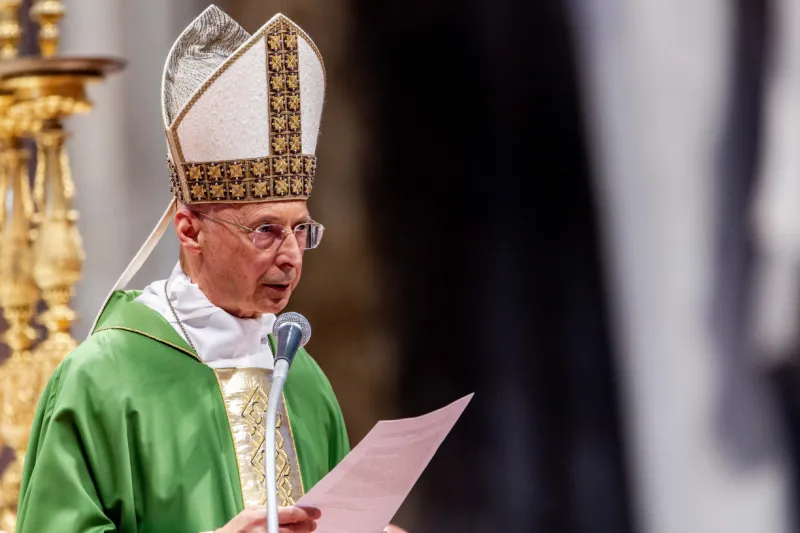
Cardinal Angelo Bagnasco has been hospitalized with COVID-19 after traveling to the International Eucharistic Congress in Budapest.
The cardinal, 78, had been fully vaccinated with an mRNA vaccine last May. He tested positive for COVID-19 upon his return to Italy from Hungary and was hospitalized on Sept. 28.
Bagnasco is currently being treated in the infectious diseases ward of the Galliera Hospital in Genoa, the northern Italian city where he served as archbishop from 2006 until his retirement last year.
The hospital released a note on Sept. 30 that said that the cardinal’s “general condition is more than good and the clinical progress is positive” that included a photo of Bagnasco waving from the hospital window.
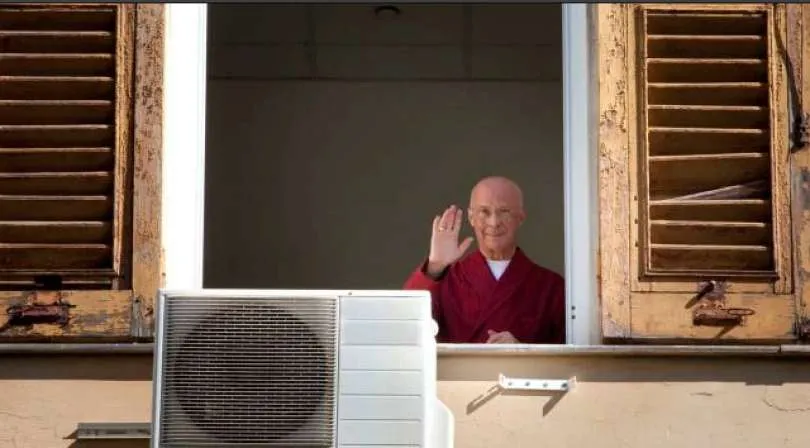
Cardinal Bagnasco waves from the hospital window. Galliera Hospital
Before he was hospitalized, Bagnasco told Vatican Radio in September that he had “an extremely light” form of COVID-19.
“I think this mildness is certainly due to the fact that I have already completed the vaccinations last May. So it is known that even with vaccination one can be infected and you can also be infected, but with an extremely light form. This is my experience,” the cardinal said.
Bagnasco is the president of the Council of the Bishops’ Conferences of Europe (CCEE) and formerly served as the president of the Italian bishops’ conference from 2007 to 2017.
He is one of many Catholic cardinals to have contracted COVID-19 since the pandemic began.
Cardinal Philippe Ouedraogo of Burkina Faso and Cardinal Angelo De Donatis, vicar general of the Diocese of Rome, both tested positive and recovered from COVID-19 in March 2020.
Cardinal Gualtiero Bassetti, president of the Italian bishops’ conference, was hospitalized with the virus in November 2020. Cardinal Jean-Claude Hollerich of Luxembourg tested positive in January, as did Honduran Cardinal Óscar Rodríguez Maradiaga in February.
Cardinal Raymond Burke was placed on a ventilator in August after testing positive for the coronavirus. He was discharged from the hospital on Sept. 3 and wrote Sept. 26 that it will be “several more weeks” until he will be ready to return to his normal activities.
Bagnasco offered the opening Mass of the International Eucharistic Congress on Sept. 5. The outdoor Mass took place in Heroes’ Square in Budapest and featured a 1,000-strong choir.
If you value the news and views Catholic World Report provides, please consider donating to support our efforts. Your contribution will help us continue to make CWR available to all readers worldwide for free, without a subscription. Thank you for your generosity!
Click here for more information on donating to CWR. Click here to sign up for our newsletter.
Pope Francis meets with priests of Rome’s 17th prefecture in the Parish of Santa Maria Madre dell’Ospitalità in Villa Verde in Rome on Nov. 16, 2023. / Credit: Vatican Media
Rome Newsroom, Nov 17, 2023 / 11:24 am (CNA).
Pope Francis met with priests of Rome’s 17th prefecture — which sits on the eastern edge of the metropolitan area — in the Parish of Santa Maria Madre dell’Ospitalità in Villa Verde on Thursday evening to discuss pressing pastoral needs and material challenges.
The pope’s visit reflects his call to reach out to the “peripheries” of society, a theme that has been central to his pontificate. The 17th prefecture includes the neighborhoods of Rome’s fifth municipal district such as Tor Bella Monaca, Torre Angela, and Torre Gaia; it is one of the poorest areas of the city.
During the one-and-a-half-hour conversation, the pope took time to meet the 40 priests gathered there and to discuss the main pastoral needs of the parish and the prefecture, including “work, the sacraments, poverty, hospitality, assistance to socially weaker groups, [and] evangelization,” Vatican News reported.
Bishop Riccardo Lamba, auxiliary bishop of Rome’s eastern sector, said the meeting was characterized by “a very open, cordial, and familiar dialogue” and that the pope “encouraged everyone to continue with the good work they already do, to continue being among people, to continually propose the Gospel even if there are difficulties,” RomaSette reported.
Pope Francis meets with priests of Rome’s 17th prefecture in the parish of Santa Maria Madre dell’Ospitalità in Villa Verde in Rome on Nov. 16, 2023. Credit: Vatican Media
“He said to continue to have this synodal style in the parishes, which implies continuous collaboration between laypeople and priests,” the bishop said.
At the end of his meeting the pope visited the Villaggio dell’ospitalità (Hospitality Village), a complex adjacent to the parish that consists of 12 apartments and provides emergency housing for both Italian and foreign families.
At that complex he met with several families, including a Ukrainian family that had fled from the ongoing war in the country a month ago.
“At the moment, seven families live in the village and then people waiting to reunite with their husbands, wives, or children, for a total of 12 apartments, which were built when the parish complex was built,” said Father Rocco Massimiliano Caliandro, pastor of Santa Maria Madre dell’Ospitalità, according to RomaSette.
Pope Francis meets with residents of apartments adjacent to the Parish of Santa Maria Madre dell’Ospitalità in Villa Verde in Rome on Nov. 16, 2023. Credit: Vatican Media
“With the help of a group of volunteers and with the support of the whole community, we try to stay close to these families both humanly and materially, offering them not only accommodation but also the possibility of taking food from a warehouse we have here in the parish,” he continued.
Caliandro said the visit reflected the pope’s pastoral priorities centered on the care of the most vulnerable.
“[The pope] made one word resonate in reference to all the themes touched upon in the meeting with us priests and it is ‘taking risks,’ compromising with people, always making sure that people prevail,” he said.
This was not the pope’s first visit to impoverished Roman neighborhoods. On Sep. 29 the Holy Father visited the Parish of Santa Maria della Salute in Rome in the Primavalle neighborhood in Rome’s fifth municipality. Like others on the “periphery,” the neighborhood deals with a high rate of poverty, crime, and homicide.
Cardinal Michael Czerny, prefect of the Dicastery for Promoting Integral Human Development, takes possession of his titular church of San Michele Arcangelo in Rome, Jan. 19, 2020. / Pablo Esparza/CNA
Rodrigo Iván Cortés, president of the National Front for the Family, described Claudia Sheinbaum’s victory as “very bad news for life, family, and freedoms.” / Credit: EWTN Noticias/Screenshot
ACI Prensa Staff, Jun 5, 2024 / 18:50 pm (CNA).
Various pro-life, pro-family, and lay leaders of the Catholic Church in Mexico have reacted with concern to the election of Claudia Sheinbaum as president of the country.
Rodrigo Iván Cortés, president of the National Front for the Family, described Sheinbaum’s victory as “very bad news for life, family, and freedoms.”
For the pro-family leader, Sheinbaum represents continuity with the same progressive agenda of the outgoing administration of President Andrés Manuel López Obrador. Citing the growing legalization of abortion and use of gender ideology throughout the country, Cortés explained that “the López Obrador regime culminated in a culture of death, of ideology, not only of gender confusion but also of socialist populist indoctrination.”
However, in an interview with “EWTN Noticias,” EWTN’s Spanish-language news program, Cortés emphasized that just as people didn’t vote for López Obrador because of his position on abortion, gender ideology, or for freedoms to be canceled, people didn’t vote for Sheinbaum for those same reasons. What happens, he indicated, is that “when they come to power, they implement [that agenda].”
For Juan Dabdoub, president of the Mexican Family Council (ConFamilia), there are “two important factors” that would explain Sheinbaum’s victory in the presidential elections.
The first, he told ACI Prensa, CNA’s Spanish-language news partner, is that in Mexico there is “a poor political culture, which makes a large majority of the people manipulable.”
A second factor, Dabdoub noted, is that “Mexican Catholicism has failed in something extremely important that Pope St. John Paul II already pointed out: ‘A faith that does not create culture is a useless faith.’”
In a Jan. 16, 1982, speech, John Paul II said: “A faith that does not become culture is a faith that is not fully accepted, not entirely thought out, not faithfully lived.”
For the president of ConFamilia, “Mexico has stopped being a country of practicing Catholics and has become one of simply baptized people; and when a Catholic doesn’t live his faith in the outside world, that is, outside his home and his parish, those who dominate the world take control.”
Dabdoub considered Sheinbaum’s victory to be “a brutal threat” to the defense of life, family, and freedoms, since she has “a radical progressive agenda.”
‘Formation and serious work are needed’
For Father Hugo Valdemar, who for 15 years headed the communications office of the Primatial Archdiocese of Mexico when Cardinal Norberto Rivera led the archdiocese, “Catholics must learn that social media are not enough to really influence; serious formation and work are needed, otherwise everything remains up in the air.”
“The big problem is that we haven’t been seriously forming the laity, and nothing is being done to do so,” he told ACI Prensa. However, he noted that with a Sheinbaum administration, “the Church is not in danger. I don’t see an adverse climate, much less persecutory, and Christian values have been violated for a long time.”
What’s next in the battle for life and family?
Pilar Rebollo, director of the Steps for Life platform, pointed out that Sheinbaum’s election “means much more work” for pro-lifers: “It requires us to be united, it requires us to be coordinated,” anticipating possible “frontal attacks on what we know as our values that are foundational.”
Rebollo also emphasized the importance of serving underserved and vulnerable populations, which, she considered, were key to Sheinbaum’s victory. This, she said, must be done “not out of a desire for numbers but zeal for souls, a desire to [heal] wounds, zeal for humanity, to see Christ in others.”
It should be noted that all three candidates for president — Sheinbaum, Xóchitl Gálvez, and Jorge Álvarez Máynez — backed the legalization of abortion and the LGBTQ policy agenda, so Mexican voters had no real alternative to vote for a pro-life and pro-family candidate.
Sheinbaum is the first person of Jewish ancestry to be elected to Mexico’s presidency. In February of this year, she visited Pope Francis at the Vatican, where she asked him to bless a rose wrought in silver by a Mexican artisan. She later presented it to the rector of the Basilica Shrine of Our Lady of Guadalupe in Mexico City.
Jason Poblete of the Global Liberty Alliance anticipates that Claudia Sheinbaum will govern under the shadow of the current president and his leftist party. Credit: EWTN News Nightly/Screenshot
During her campaign, Sheinbaum was seen wearing a skirt bearing the image of the revered Virgin of Guadalupe. According to Jason Poblete of the Global Liberty Alliance, Sheinbaum also wore a rosary around her neck at a public event. He and others suggested that this was an act of demagoguery intended to appeal to Catholics, who comprise approximately 78% of the country’s population.
Sheinbaum, 61, holds a doctorate in physics specializing in energy and taught at Mexico’s National Autonomous University. Her political militancy began during her student years, joining a group that became the founding youth movement of the socialist Party of Democratic Revolution. She later joined the ruling Morena party. She has been described as a climate activist, having been part of a Nobel Prize-winning commission advising the United Nations on climate change.
Sheinbaum’s tenure as Mexico City mayor was marked by progressive initiatives. For example, the World Economic Forum, led by Klaus Schwab, noted that as mayor she ended public school policy requiring gender-appropriate uniforms for children. Sheinbaum said: “The era when girls had to wear a skirt and boys had to wear trousers has been left behind; I think that’s passed into history,” and added: “Boys can wear skirts if they want and girls can wear pants if they want.”
While she did not raise the issue during her campaign, Sheinbaum’s Morena party is a firm supporter of abortion. The newly-elected congress will be seated in September, one month before Sheinbaum’s inauguration, thus allowing incumbent president López Obrador an opportunity to push through his legislative initiatives.
Poblete told “EWTN News Nightly” that the 2024 election may have led to a Morena majority in Mexico’s Congress, which has vowed to amend the constitution in order for Mexican Supreme Court justices to be elected by popular ballot, thereby confirming partisan control of the heretofore independent judiciary, which would rule on issues such as abortion and matters of gender ideology. He fears that Sheinbaum will govern under the shadow of the current president and his leftist party.
This story was first published by ACI Prensa, CNA’s Spanish-language news partner. It has been translated and adapted by CNA.
Leave a Reply
