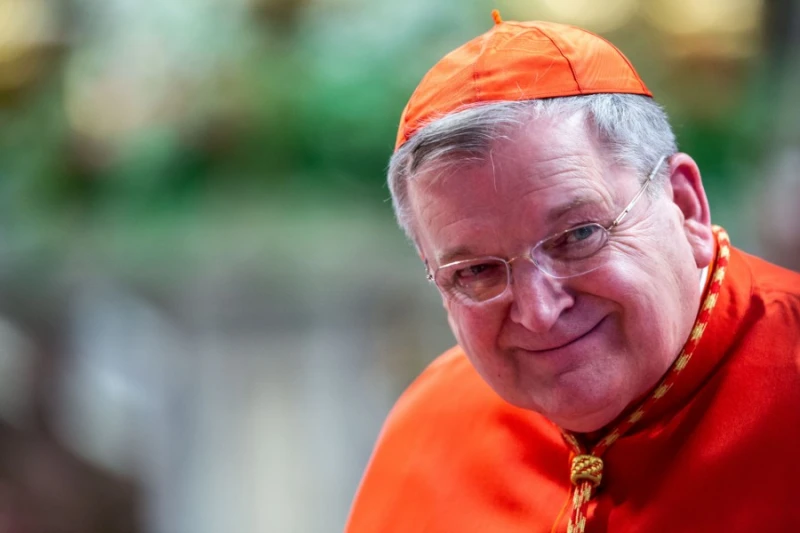
Raymond Leo Cardinal Burke during the Solemnity of Saints Peter and Paul in St. Peter’s Basilica in Vatican City, June 29, 2019. Daniel Ibáñez/CNA
Denver Newsroom, Aug 17, 2021 / 12:06 pm (CNA).
The condition of Raymond Cardinal Burke, who was recently hospitalized with Covid-19, has reportedly deteriorated.
A source who has spoken to someone close to the cardinal told CNA his condition has deteriorated, and the next 48 hours are crucial.
Cardinal Burke’s Twitter account had announced Aug. 14 that he “has been admitted to the hospital with COVID-19 and is being assisted by a ventilator. Doctors are encouraged by his progress. His Eminence faithfully prayed the Rosary for those suffering from the virus. On this Vigil of the Assumption, let us now pray the Rosary for him.”
A report in the St. Louis Post-Dispatch said the cardinal, who lives in Rome and is prefect emeritus of the Apostolic Signatura, became ill while visiting Wisconsin, where he was raised.
Amid rumors that he was seriously ill, the 73-year-old cardinal confirmed Aug. 10 that he had tested positive for Covid-19, tweeting: “Thanks be to God, I am resting comfortably and receiving excellent medical care. Please pray for me as I begin my recovery. Let us trust in Divine Providence. God bless you.”
If you value the news and views Catholic World Report provides, please consider donating to support our efforts. Your contribution will help us continue to make CWR available to all readers worldwide for free, without a subscription. Thank you for your generosity!
Click here for more information on donating to CWR. Click here to sign up for our newsletter.
Washington D.C., Mar 10, 2020 / 05:00 pm (CNA).- As the Coronavirus (COVID-19) spreads in the U.S., one Catholic organization is trying to protect a population that is particularly vulnerable to the spread of contagious illnesses—the city’s… […]
Roger Foley enjoys taste-testing three different kinds of hummus, his favourite food, on the day of a video shoot with Amanda Achtman of the Dying to Meet You project in Canada. The two spoke about Foley’s difficulty accessing quality care for his needs and being offered Medical Assistance in Dying (MAID) “several times.” / Courtesy of Amanda Achtman
CNA Staff, Jun 23, 2024 / 06:00 am (CNA).
Amid ongoing efforts to expand euthanasia in Canada under the name of “medical aid in dying” (MAID), one Ottawa man says he has been offered euthanasia “multiple times” as he struggles with lifelong disabilities and chronic pain from a disease called cerebellar ataxia.
Roger Foley, 49, shared some of his story in a recent video interview with Amanda Achtman of the Dying to Meet You project, which was created to “humanize our conversation on suffering, death, meaning, and hope.” The project seeks to “[restore] our cultural health when it comes to our experiences of death and dying” through speaking engagements and video campaigns.
Roger Foley, a Canadian man with disabilities, says he’s been offered euthanasia “multiple times.”
Listen to him speak out against being devalued as he fights for the support he needs to live. pic.twitter.com/yY8N4NILkS
In the video, the fourth of a series, Foley said he has struggled with subpar medical help in his own home, where he is supposed to be getting quality care. Canada has a nationalized health care system but Foley said that individuals with illnesses are “worked at … not worked with.” He spoke out against being devalued as he fights for the support he needs to live.
In one case, he said, a home worker helped him into his bathtub and then fell asleep in the other room; Foley was left to crawl out of the bathroom on his own. “I reported to the agency, and then he confessed, and the agency, they really didn’t care,” he said.
Asked by Achtman if he has ever been offered euthanasia, Foley said: “Yeah, multiple times.”
“One time, [a doctor] asked me, ‘Do you have any thoughts of self-harm?’ I’m honest with them and tell them I do think about ending my life because of what I’m going through, being prevented from the resources that I need to live safely back at home.”
“From out of nowhere, he just pulls out, ‘Well, if you don’t get self-directing funding, you can always apply for an assisted.’”
Foley said the offers from doctors to help end his life have “completely traumatized me.”
“Now it’s this overlying option where in my situation, when I say I’m suicidal, I’m met with, ‘Well, the hospital has a program to help you with that if you want to end your life.’”
“That didn’t exist before [MAID] was legalized, but now it’s there,” he said. “There is not going to be a second within the rest of my life that I’m not going to have flashbacks to [being offered suicide]. The devaluing of me and all that I am.”
Noting that he’s “not religious,” Foley said: “Saying that it’s just religious persons who oppose euthanasia in society is completely wrong.”
“These people who usually say it, they have an ableist mindset,” he said. “And they look at persons with disabilities and see us as just better off dead and a waste of resources.”
Achtman told CNA there is a need for euthanasia-free health care spaces, not only for protecting the integrity of Catholic institutions but also because many patients — including nonreligious patients like Foley — want to be treated in facilities that do not raise euthanasia with patients.
“Having euthanasia suggested, in a sense, already kills the person. It deflates a person’s sense of confidence that doctors and nurses are going to truly fight for them,” Achtman told CNA. “When euthanasia is suggested ostensibly as one ‘treatment’ option among others, there are all-too-frequently no other real options provided.
She continued: “This is why I always say that a request for euthanasia is not so much an expression of a desire to die as it is an expression of disappointment. Responding to such disappointment with real interventions that are adequate to the person is demanding, but that’s what people deserve. It is wrong to concede or capitulate to a person’s suicidal ideation — instead, every person deserves suicide prevention rather than suicide assistance.”
Roger Foley enjoys taste-testing three different kinds of hummus, his favorite food, on the day of a video shoot with Amanda Achtman of the Dying to Meet You project. The two spoke about Foley’s difficulty accessing quality care for his needs and being offered Medical Assistance in Dying (MAID) “several times.”. Courtesy of Amanda Achtman
Canada has become one of the most permissive countries in the world when it comes to euthanasia. The country first began allowing doctors to help kill terminally ill patients nearing death in 2016; the law was then expanded in 2021 to include patients whose death is not imminent.
In February the country paused a proposal to allow mentally ill individuals access to MAID, with the proposal set to be reconsidered in 2027. Earlier this year, Canadian health researchers alleged that MAID will “save” the Canadian health care system between $34.7 and $136.8 million per year.
A couple in British Columbia is currently suing the provincial government, as well as a Catholic health care provider, after their daughter was denied euthanasia while suffering from a terminal illness. The suit demands that the government remove the religious exemption from the Catholic hospital that protects them from having to offer MAID.
A judge in March, meanwhile, ruled that a woman with autism could be granted her request to die by MAID, overruling efforts by the woman’s father to halt the deadly procedure.
Asked what gives him hope, Foley told Achtman that he aspires one day to “be able to break through [the health care system] and get access to the resources that I need and to live at home with workers who want to work with me and I want to work with them and that we can work as a team.”
“I have a passion to live,” he said. “I don’t want to give up my life.”
Father Patrick Hughes shows how to make a traditional St. Brigid’s Cross in County Cavan, Ireland. / Credit; Courtney Mares/CNA
Rome Newsroom, Feb 1, 2024 / 06:00 am (CNA).
Ireland on Thursday is celebrating the 1,500th anniversary of the death of St. Brigid of Kildare, the Emerald Isle’s female patron saint.
St. Brigid (c. 453–524 A.D.) is credited with pioneering female monastic life in Ireland. Her feast is celebrated on Feb. 1, which became an annual public bank holiday across Ireland last year in her honor.
“St. Brigid was a huge figure of authority in the early Church, baptized by St. Patrick, professed by St. Mel, spiritual adviser to St. Conleth,” Bishop Denis Nulty of Kildare and Leighlin said at a Mass ahead of her feast.
Ireland’s Kildare County has organized lectures, pilgrimages, and many activities in its Brigid 1500 Program to mark the anniversary, including a workshop on how to weave a St. Brigid’s Cross — St. Brigid’s most enduring symbol.
A St. Brigid’s cross is traditionally made out of rushes or reeds freshly pulled from the ground.
Father Patrick Joseph Hughes, a country priest in County Cavan, can make a St. Brigid’s cross from rushes in a matter of minutes.
Hughes told CNA that the story that has been handed down over the years is that St. Brigid was trying to explain to the local chieftain, who did not believe in God, that Jesus was his savior and died on a cross for him. The chieftain did not understand, so she made a cross out of rushes from the ground and presented it to him: “‘Look,’ she said, ‘that’s a cross, and Jesus was stretched out on that for the world.’”
On the eve of the Feast of Saint Brigid, it is tradition in Ireland to make a St. Brigid’s Cross out of rushes.
Last year while we were filming in Ireland, Father Patrick Hughes gave us a quick demonstration of how to make one.
St. Brigid’s Catholic Church in Kildare will kick off the feast day on Feb. 1 with a Mass at 9:15 a.m. offered by Bishop Nulty.
The bishop recently installed St. Brigid’s relics in St. Brigid’s Catholic Church on Jan. 29 as part of the 1,500th anniversary celebrations.
The relics were taken from the bone fragment of St. Brigid’s head, which has been kept in St. John the Baptist Church in Lumiar, Portugal, since three Irish knights brought it there in 1273. The Portuguese church gave the relic to the Brigidine Sisters in Tullow, Ireland, in the 1930s, and they recently gifted it to St. Brigid’s in Kildare.
“Today we have brought her home,” Nulty said. “Obtaining the relic of a saint like Brigid is no easy feat. I visited Lumiar in October 2021 with the singular intention of securing a relic for St. Brigid’s Church. I was privileged then to hold the relic of her head, which is contained in a splendid brass casket. Sadly, I couldn’t squeeze it into my Ryan Air flight bag!”
Notably, the Catholic bishop and female Anglican leaders will also come together for an ecumenical service at 11 a.m. on the feast day at the historic St. Brigid’s Cathedral, built on the site of the ancient hilltop where St. Brigid founded her monastery in the year 480 A.D. The previously Catholic cathedral, consecrated in 1230, is now an Anglican cathedral.
The service will be followed by a “pause for peace,” a minute of silent prayer for peace. St. Brigid was known as a peacemaker. Among the many stories told about St. Brigid, local tradition holds that Brigid gave away her father’s sword in exchange for food for a family suffering from hunger.
The fifth-century abbess St. Brigid is one of Ireland’s three patron saints, along with St. Patrick and St. Columba. Most historians place her birth around the year 450, near the end of St. Patrick’s evangelistic mission.
St. Brigid. Credit: Octave 444, CC BY-SA 4.0, via Wikimedia Commons
It is notoriously hard to establish the historical details of Brigid’s life, but according to one of the more credible biographies of Brigid — Hugh de Blacam’s essay in “The Saints of Ireland” — Brigid was born out of wedlock to a pagan chieftain named Dubthach and a Christian slave woman named Broicsech. The chieftain sold the child’s pregnant mother to a new master but contracted for Brigid to be returned to him eventually.
Brigid was likely baptized as an infant and raised as a Catholic by her mother. Thus, she was well formed in the faith before leaving Broicsech’s slave quarters at around age 10 to live with Dubthach and his wife.
After this, Brigid’s faith grew immensely. She gave generously to the poor and tended to the sick. One story says Brigid once gave away her mother’s entire store of butter, which was later replenished after Brigid prayed.
Once she was released from servitude, she was expected to marry. However, Brigid had no interest in marrying. She went so far as to disfigure her own face and prayed that her beauty be taken from her so no one would want to marry her. Because she refused to change her mind about marriage, she received permission to enter religious life.
Brigid, along with seven friends, is credited with organizing communal consecrated religious life for women in Ireland.
In 480, Brigid founded her monastery in Kildare, which was called “Church of the Oak.” The monastery sat on top of a shrine to a Celtic goddess. Throughout the rest of her life, she established several monasteries across Ireland.
Brigid rooted her life as a nun in prayer, but she also performed substantial manual labor: cloth making, dairy farming, and raising sheep. She also spent time traveling across Ireland founding new houses and building up a uniquely Irish form of monasticism. When she was not traveling, pilgrims made their way to Kildare, seeking the advice of the abbess.
“What were the character traits that defined St. Brigid of Kildare? To mention just a few, she was hospitable, she was a peacemaker, she was a strong woman of faith,” Nulty said.
This is very sad. Cardinal Burke is a good man known for his love of God and the Catholic Church, and being a voice for orthodoxy. I will pray 🙏 for him.
Friday, August 20, 2021
Written by Michael J. Matt | Editor
This just in from an old and highly trusted priest friend who is close to Cardinal Burke:
Dear Friends in Christ,
After a period under a medically induced coma, Card. Burke is steadily improving, no fever, respiration much better, doctors optimistic…His Eminence is expected to leave ICU in the next day or two. Deo Gratias!
God be praised. Please keep praying as His Eminence is not out of the woods yet.
Did he receive Ivermectin + zinc?
I doubt it. Doctors wouldn’t risk being “cancelled” just to save someone’s life.
This is very sad. Cardinal Burke is a good man known for his love of God and the Catholic Church, and being a voice for orthodoxy. I will pray 🙏 for him.
His Eminence appears to be on the road to recovery. Prayers continuing for the Cardinal.
PRAYERS ANSWERED: Cardinal Burke Expected to Leave ICU
Friday, August 20, 2021
Written by Michael J. Matt | Editor
This just in from an old and highly trusted priest friend who is close to Cardinal Burke:
Dear Friends in Christ,
After a period under a medically induced coma, Card. Burke is steadily improving, no fever, respiration much better, doctors optimistic…His Eminence is expected to leave ICU in the next day or two. Deo Gratias!
God be praised. Please keep praying as His Eminence is not out of the woods yet.
God bless and Mary keep our good Cardinal Burke.
