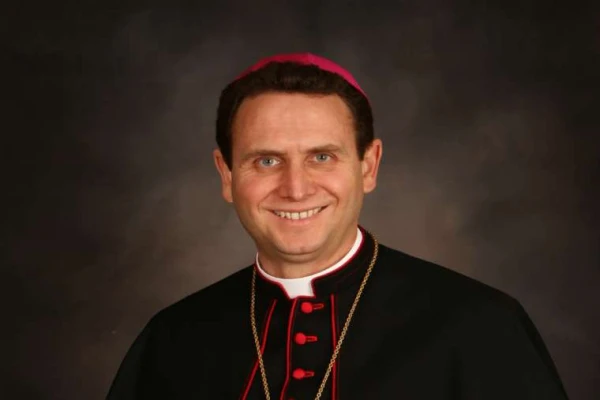
Minneapolis, Minn., Aug 28, 2019 / 04:25 am (CNA).- Bishop Andrew Cozzens became a bishop in the middle of a crisis.
“There was this kind of fire that was burning on the front page of the paper everyday,” Cozzens told CNA, “and then I got this call.”
The call was his appointment as an auxiliary bishop in the Archdiocese of St. Paul and Minneapolis.
Cozzens was appointed to that role just days after a whistleblower leveled charges of misconduct and cover-up against Archbishop John Nienstedt, who eventually resigned from his post amid scandal.
The archdiocese was in a state of chaos, and, Cozzens said, Catholics were in a great deal of pain.
“I was named a bishop at a very unique time, and it was so unique that it was clear to me God had planned it,” Cozzens told CNA.
He told CNA that he knew, from the time he was appointed, “that the Lord was calling me to be a part of healing. I didn’t have any idea what that meant when I heard that word in prayer.”
“Since the beginning,” he said, “I have felt like that’s why God made me a bishop and that’s what he wants me to do, and so I need to help do that.”
If God chose Bishop Cozzens to be a part of the Church’s healing ministry, meeting Gina Barthel was a big part of how that healing ministry would begin.
He remembers when she emailed him, in early 2014. It was just months after he’d become a bishop.
Barthel wrote to Cozzens that she had been a victim of clergy sexual abuse, and that she wanted to tell him her story. He accepted. They met in his office. Bishop Cozzens hadn’t met with many victims of abuse before. But when Gina told her story, he was disturbed. And he wanted to help her find the healing she sought.
“What was most disturbing about her story was the clear abuse of the office of spiritual direction. And since I’m a spiritual director, and have been a spiritual director, I understand how sacred that space is, and so the fact that it was clearly abused was for me the disturbing part,” Cozzens told CNA.
“Basically I knew that it would be very difficult for her to trust anyone, especially a priest or a bishop, so I was grateful that she was willing to share with me. And that was always the goal from the beginning, was to provide her an example of someone she could trust, and let her know that I was available to help her in any way that I could, to help her find healing, but obviously you can’t force those kinds of things.”
Gina Barthel told CNA that she’s found healing – and found Christ – through the Church, and with the help of Cozzens. But, she says, it wasn’t easy.
In 2005, nine years before she contacted Cozzens, Barthel was a novice in a religious community. She hoped to profess vows as a religious sister. In the course of spiritual direction, she told a priest, Fr. Jim Montanaro, OMV, that she had been sexually abused, and how that had impacted her spiritual and emotional life.
Armed with that knowledge, Barthel told CNA, Montanaro began to groom her, and eventually would sexually abuse her.
At first, the priest asked her to spend excessive time alone with him, and then discuss her body with him in sexual ways that made her uncomfortable. He told her, she remembers, that God could use that experience to heal her.
In the summer of 2005, Barthel decided to leave the religious community. She got an apartment in New York. Montanaro reached out to her, and said he wanted to remain her spiritual director.
“I was like, ‘Well that’s awesome because it’s impossible to find a spiritual director, so I don’t even have to look.’”
“So if you can imagine, a girl from Minnesota, who has no interest at all living in New York City, suddenly finding myself living in an apartment. I don’t know anyone except the sisters and what does that equal? I’m lonely. I’m isolated. It was a setup for disaster.”
Soon, she told CNA, she and Montanaro were talking every day.
“And then multiple times a day. And it turned into, at some point, a spiritual adoption. I don’t remember the timetable exactly, but he adopted me as his ‘Principessa’, like Italian for ‘princess’ and I called him ‘Papito.’ Like, ‘little father.’”
“And we would talk at night, and often the conversations at night would turn very sexual,” Barthel told CNA.
She said that over the phone, the priest would encourage her to imagine that the two of them were saints in heaven together. Then he would tell her that they should each strip naked, to be “naked without shame.”
“So it was just this weird, it feels awkward to tell you about it, because it’s creepy, right? So that was happening.”
In 2006, Barthel moved to her home state of Minnesota. She struggled with depression. She was hospitalized with major depressive episodes. And then a friend offered to send her on a pilgrimage, a group trip for which Montanaro would be the chaplain. The priest invited her to visit his home in Boston before the trip began.
“He invited me to come early and I stayed at their house in Boston, and I remember him putting a sign on the door saying: ‘Do not interrupt. Spiritual direction in session.’
“And he turned on music and he’s like, ‘I just want to hold my principessa.’ So there was a lot of holding and touching, but it was not sexual, yet.”
The priest was at least 20 years older than her. But Barthel, struggling with loneliness and depression, said she liked that he was holding her. Still, she said she knew that what was happening wasn’t right.
“I feel like in that circumstance, I was a vulnerable adult, she told CNA. “Because it was like he abused the child inside of me. He wasn’t abusing an equal, adult-adult relationship. Everything was very childlike.”
The next year, Montanaro took Barthel to stay with him at a retreat center in North Dakota and there, she alleges, began a sexual relationship with her.
Barthel told CNA how confused she was. She believed in the Church’s teaching about sexuality, but, she says, she also believed what the priest told her.
“The entire time, he was telling me what was happening was ‘miraculous graces,’” she told CNA. “Like, ‘Jesus is healing you.’ All of the things he was saying we should do were all part of God’s healing plan for me.”
“And the biggest thing I wanted in my entire adult life was to be healed of the sexual abuse that I experienced as a child. And he used that to catapult his agenda to hurt me,” she said.
“Everything was under the guise of healing, Barthel told CNA.
“And even, he was saying, ‘God’s using you to heal me,’” she said.
“So then I felt special like, ‘Well that’s kind of cool, like, it’s mutual. God’s not just using him to heal me, but He’s also using me to heal Papito.’ Like, that’s really special,” she said.
Looking back, Barthel says she can see that Montanaro was using her insecurities to manipulate her. But at the time, she says, she felt confused, and she trusted the priest.
“And I remember asking, ‘Well, do I need to go to confession? Maybe I should go to confession.’ And he always said no. ‘No, we don’t need to go to confession. This is part of God’s will. This isn’t just okay, and it’s not just good, and not just great, it’s holy.’”
The relationship continued until, after a few months, Barthel told Montanaro that it had to end.
She told CNA she realized things were wrong when the priest admitted he hadn’t told his own spiritual director about the sexual relationship.
“He said, ‘Some things are meant to be kept a secret between you and God.’ The minute he said that, my whole world started falling apart,” Barthel said.
She told a priest she trusted about the relationship. That priest called Montanaro and confronted him. Barthel said that Montanaro admitted the whole thing, but seemed to see nothing wrong with the relationship. The priest next called Montanaro’s superiors, and Montanaro was removed from ministry.
A spokesman for the St. Ignatius Province of the Oblates of the Virgin Mary told CNA that the province “first became aware of her allegations relating to Fr. Montanaro in November of 2007, when a priest of the Archdiocese of St. Paul-Minneapolis notified the rector of the retreat house where Fr. Montanaro resided at the time.
“The then-Provincial of the St. Ignatius Province met with Fr. Montanaro on the day he heard of the allegations. Following that meeting, Fr. Montanaro was immediately removed from public ministry and was to cease all contact with that individual.”
“In January of 2008, the Provincial revoked Fr. Montanaro’s priestly faculties, and Montanaro subsequently sought, and obtained, dismissal from the Oblates, followed by laicization from sacred orders from Rome, which was granted in 2010. Montanaro has had no role or ministry with the St. Ignatius Province since then,” the spokesman added.
The spokesman said that at the time Montanaro was removed, the Oblates “began to provide support” for Barthel.
The Oblates, Barthel told CNA, “sent me a couple of checks to help pay my rent because the trauma hit me so hard that I couldn’t work initially. They also sent me a letter offering $15,000 and a year of therapy if I signed one of those letters stating I wouldn’t do anything further.”
“I don’t know what I was more upset about: the fact that they were trying to pay me off to keep me quiet or the fact that they thought I would only need a year of therapy to recover. It’s 12 years later and I’m still in therapy!”
Barthel said it took years of healing before she was prepared to report what had happened to police. When she did, it was too late.
“When I finally built up the courage to go to the police, I missed the statute of limitations by less than a month. That was devastating because it took so much from me to even go to the police. I finally went, I told my whole story, and then I get a call back and it’s the statute of limitation by less than 30 days”
But she was even more devastated, she says, because Montanaro’s community, the Oblates of the Blessed Virgin Mary, have declined to name Montanaro as a sexual abuser.
“One of my big grievances has been why aren’t perpetrators of adults also being listed publicly?”
Barthel told CNA that she has been concerned that Montanaro might groom other women.
The laicized priest now works as a photographer in Massachusetts. He has not responded to multiple attempts by CNA to contact him.
Among the photographs posted on Facebook by the studio where Montanaro works is a series in which several women have posed nude for the camera. The photo captions read “You are ravishing,” and “Next time you think of something beautiful, don’t forget to count yourself in.”
On the website of the studio, Montanaro writes “My biggest satisfaction is capturing the unique beauty of each person who entrusts that privilege to my partners and to me. We love to help people discover (or rediscover) their God-given beauty in a photo session, and fall in love with themselves all over again.”
In March, Barthel wrote to the Oblates.
“I have concern that he could use his credentials of previous pastoral work and education to get a job in any helper position where he would have access to vulnerable adults. While he is no longer able to hurt people using his position of power as a Catholic priest, that doesn’t mean he isn’t still a threat if he has access to vulnerable adults,” she wrote.
“This is a hurdle in my healing journey. I keep thinking, hoping, praying and wishing that someday when I Google his name, it’ll show up that he is a self-admitted abuser of adult women. Yet, to date, I find nothing. It floods me with grief and also adds to my anger that waxes and wanes as I continue to heal. I feel that as long as the Church stays silent on these matters, there is danger the abuse may continue. Who are we trying to protect and why?”
She requested that Montanaro’s self-admission of sexual misconduct be publicly acknowledged by the order.
She told CNA she has yet to hear back from the Oblates about her request.
The Oblates declined to respond to questions from CNA about Barthel’s request.
While Barthel is discouraged, she told CNA that she has not lost her faith.
“I love Jesus, I love the Church. And it’s not easy and my relationship with Jesus and the Church are different now, but in some ways it’s more beautiful than it was before because I’m more dependent upon Him. And I don’t know how to explain it.”
“My deepest healing has all come through adoration,” she said.
Barthel emphasized the role that Cozzens has played in her life. They’ve met together regularly, and prayed together, for years.
“I needed a safe place to allow the rage and pain to unfold,” Barthel told CNA.
“Yes, I did a lot of that in therapy, but the injustice against my soul demanded someone in the Church hierarchy to listen to me, hear my voice, acknowledge my pain and empathize with me. Bishop Cozzens has been that person for me.”
The bishop, she said, “has been the conduit God has chosen to use to bring me back into a free and even deeper relationship with Jesus Christ and His Church.”
“Eucharistic adoration is where I have received the majority of my healing,” she told CNA.
“Bishop Cozzens helped get me to a place to be able to go there and ask Jesus the hard questions and to sit and wait and listen for the answers. That’s the awesome thing about Jesus, if we ask, if we wait, He will speak to us.”
Barthel explained that Cozzens’ role in her life has been invaluable.
“When I first started meeting with him, I was terrified of praying; especially using my imagination which had always been my greatest source of delight in prayer and way of connecting to Jesus through the stories in Scripture. He never pushed, but would give me little tidbits of spiritual encouragement/advice that I could bring with me to Eucharistic adoration. This is what I needed. Someone who could walk with me and understood the danger and risk I was taking to pursue a life of prayer again.”
Cozzens told CNA that he’s learned, through his pastoral relationship with Barthel, what pastoral ministry to victims of abuse requires.
“One of the things that victims of abuse struggle with is going to Church. It’s really hard for them to go to Church. But if you’re a Catholic, you might think that you’re committing a mortal sin, but you just can’t do it because it’s so emotionally difficult for them. So to be gentle and to let them know that God understands the pain they’re going through, and the Church understands that too,” Cozzens said.
“Just to help people walk through that and let them know it’s ok that it takes time, and that God understands what they’re going through. To do that you have to be willing to go through ups and downs with people, because they go through their good moments and their bad moments. But gradually – and it takes time – but gradually the good moments outweigh the bad moments,” he added.
Barthel said she appreciated that understanding.
“Particularly in the beginning, coming back to the sacramental life of the church and prayer was excruciatingly painful, adding the regular breaking news reports of clergy abuse and cover up, there were so many times I wanted to throw the towel in and leave the Catholic Church altogether. While he never encouraged me to leave, he also never tried to convince me to stay. This gave me so much freedom and reminded me that the choice was mine. I needed that freedom and I believe it had a big part in helping me choose to remain Catholic,” she told CNA.
“I just wanted to be heard. I am hurting and I need someone to listen to me, and it needed to be somebody in the Church that I felt like cared.” “And I needed therapy,” she added. “Obviously, like I still go to therapy. “
For his part, Cozzens told CNA that many bishops, in the midst of the Church’s current sexual abuse crisis, have built pastoral relationships with the victims of abuse. But he also acknowledged that some bishops and priests, apprehensive about litigation or negative publicity, have been nervous about their engagement with victims of clerical sexual abuse.
“For me, you just have to put the person ahead of the situation…working with someone who has been hurt…they could turn on me, or be angry with me, or say bad things about me, but that’s the risk we all take if we’re going to be part of Christ’s healing. So I think we all need to be willing to take that risk.”
The bishop said Church officials should be confident about openness to relationships with the victims of abuse, despite the fact that bishops have faced, and continue to face lawsuits, for the Church’s handling of abuse allegations.
“We can’t see these things simply as liability issues. Because you have to see the people who God puts in front of us.”
“Anyone who has been wounded by a priest needs to learn to separate, in their minds, the distinction between what priest did and who God is, and what God does, and how God works. And that’s a very difficult things, that’s why I think priest abuse is the worst kind of abuse, because it can separate a person from the source of healing, who is God,” Cozzens said.
“So we have to try and help them make that distinction. And that usually requires patience and trust.”
Cozzens knows there are many Catholics in pain over the sexual abuse scandals, and that healing does not come easy. That it comes one person at a time. And that bishops have to be willing to walk alongside those hoping to be healed.
Gina Barthel knows her healing journey is not complete. But, she says, she is grateful that Bishop Cozzens is walking alongside her.
 […]
[…]





Leave a Reply