Mattia Villardita, a 28-year-old Italian who dresses up as Spider-Man, attends the general audience at the Vatican, June 23, 2021. / Pablo Esparza/CNA.
Vatican City, Jun 23, 2021 / 05:35 am (CNA).
People attending Pope Francis’ weekly audience on Wednesday, and those following via livestream, were surprised to see sitting among the crowd a man dressed head-to-toe in tight red and blue garb decorated with a silver web.
/ Vatican Media.
Why was Spider-Man at the Vatican?
The man inside the costume is Mattia Villardita, a 28-year-old Italian who dresses up as the comic-book character to visit sick children in hospitals across the country.
“I try to alleviate some of the suffering of hospital patients,” he told CNA.
/ Vatican Media.
Villardita was at the June 23 general audience, held inside San Damaso Courtyard, to meet Pope Francis and to give him his very own Spider-Man mask.
“I’m Catholic and I’m very happy about this experience,” Villardita said afterward, noting that Pope Francis already knew who he was and about his “mission.”
“He told me to take a lot of selfies with the kids in the square,” he said.
/ Hannah Brockhaus/CNA.
Last year, Villardita was made a Cavalier of the Order of Merit of the Italian Republic, an honor conferred on him by the Italian president for his actions as an “everyday hero.”
The real-life Peter Parker told CNA that he has a day job, but he uses his free time to dress up and visit hospitals.
/ Hannah Brockhaus/CNA.
And why Spider-Man?
“It’s my favorite character from when I was a kid,” he explained.
“This all came about from a personal story,” he said. “I was a patient for 19 years at the Gaslini Pediatric Hospital in Genoa, because I was born with a congenital malformation.”
/ Hannah Brockhaus/CNA.
As a child, Villardita underwent multiple surgeries and spent months recovering in hospital rooms.
“And that experience has helped me to help these patients and their families,” he explained.
Villardita launched his project, “Superheroes in the Ward,” two years ago. Some of his friends volunteer with him, also dressed up as popular characters.
/ Hannah Brockhaus/CNA.
And the Spider-Man fan did not let last year’s COVID-19 outbreak slow him down. When Italy went into a strict lockdown, he created a video call service to let children still meet and talk to their favorite superhero.
He made more than 1,400 video calls before returning to the hospitals in person in December.
When he shook hands with Pope Francis, the part-time Spider-Man told him about the suffering of the kids and their families that he sees every day.
The moment “was really, really moving,” he said.
If you value the news and views Catholic World Report provides, please consider donating to support our efforts. Your contribution will help us continue to make CWR available to all readers worldwide for free, without a subscription. Thank you for your generosity!
Click here for more information on donating to CWR. Click here to sign up for our newsletter.
Pope Francis’s tendency to use colorful expressions and abrasive adjectives in commenting on ideas, habits, and practices of which he disapproves has puzzled Catholics for over eight years now. Is this how popes talk? From […]
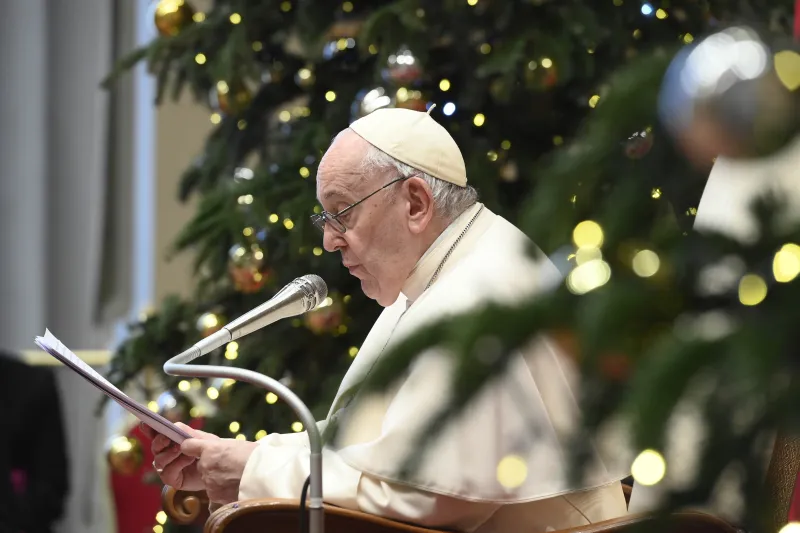
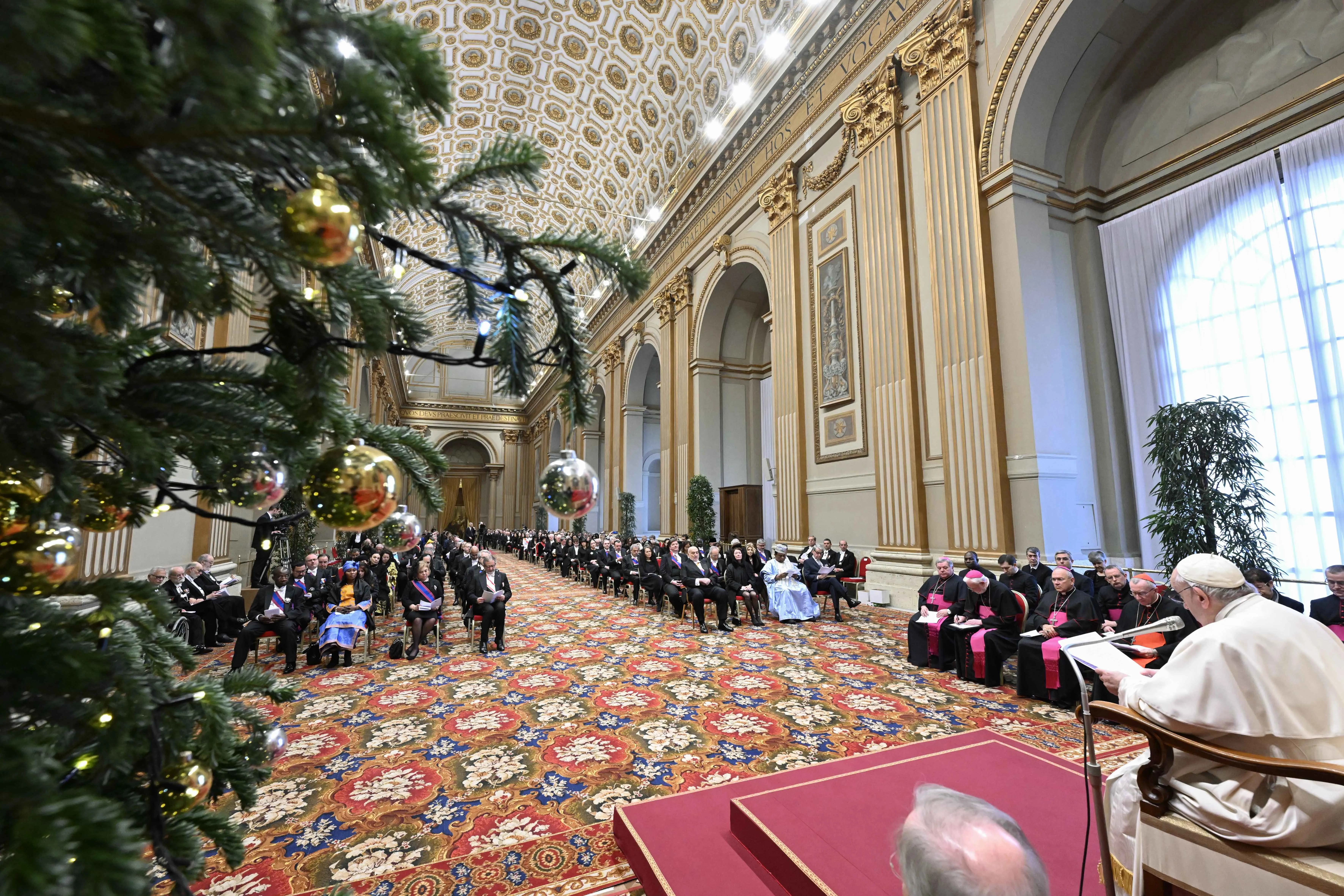
Pope Francis addresses international diplomats to the Holy See on Jan. 9, 2023, in the Vatican’s Blessing Hall. / Vatican Media
Rome Newsroom, Jan 9, 2023 / 06:28 am (CNA).
The global community is engaged in a “third world war” marked by heightened fear, conflict, and risk of nuclear violence, but a recommitment to “truth, justice, solidarity and freedom” can provide a pathway to peace, Pope Francis told international diplomats Monday.
Citing the ongoing war in Ukraine, but also drawing on conflicts in places such as Syria, West Africa, Ethiopia, Israel, Myanmar, and the Korean Peninsula, the Holy Father said this global struggle is being “fought piecemeal,” but is nonetheless interconnected.
“Today the third world war is taking place in a globalized world where conflicts involve only certain areas of the planet direct, but in fact involve them all,” said Pope Francis, speaking in the Vatican’s apostolic palace.
The pope made these remarks as part of his annual address to the diplomatic corps accredited to the Holy See. Pope Francis characterized this speech as “a call for peace in a world that is witnessing heightened divisions and war.”
Pope Francis addresses diplomats to the Holy See in the Blessing Hall at the Vatican on Jan. 9, 2023. Vatican Media
As part of this heightening of tensions, the Pope warned about the increased threat of nuclear warfare, drawing particular concern to the stall in negotiations for the Iran nuclear deal. He told the gathered diplomats that the possession of nuclear weapons is “immoral” and called for an end to a mentality that pursues conflict deterrence through the development of ever-more lethal means of warfare.
“There is a need to change this way of thinking and move toward an integral disarmament, since no peace is possible when instruments of death are proliferating,” the pope said.
In proposing a path towards global peace, the Holy Father drew heavily from Pacem in Terris (“Peace on Earth”), the papal encyclical promulgated by St. John XXIII in 1962. Pope Francis said the conditions which prompted the “good Pope” to issue Pacem in Terris 60 years ago bear a striking similarity to the state of the world today.
In particular, the Holy Father drew from what John XXIII described as the “four fundamental goods” necessary for peace: truth, justice, solidarity, and freedom, values that “serve as the pillars that regulate relationships between individuals and political communities alike.”
Regarding “peace in truth,” the Holy Father underscored the “primary duty” of governments to protect the right to life at every stage of human life.
“Peace requires before all else the defense of life, a good that today is jeopardized not only by conflicts, hunger, and diseases, but all too often in the mother’s womb, through promotion of an alleged ‘right to abortion,’” said Pope Francis, also calling for an end to the death penalty and violence against women.
Speaking of the necessity of religious freedom for peace, the Holy Father noted widespread religious persecution against Christian minorities, but also discrimination in countries where Christianity is a majority religion.
“Religious freedom is also endangered wherever believers see their ability to express their convictions in the life of society restricted in the name of a misguided understanding of inclusiveness,” he said.
Regarding justice, the Holy Father called for a “profound rethinking” of multilateral systems such as the United Nations to make them more effective at responding to conflicts like the war in Ukraine. But he also criticized international bodies for “imposing forms of ideological colonization, especially on poorer countries” and warned of the growing risk of “ideological totalitarianism” that promotes intolerance towards those who dissent from certain positions claimed to represent ‘progress.’”
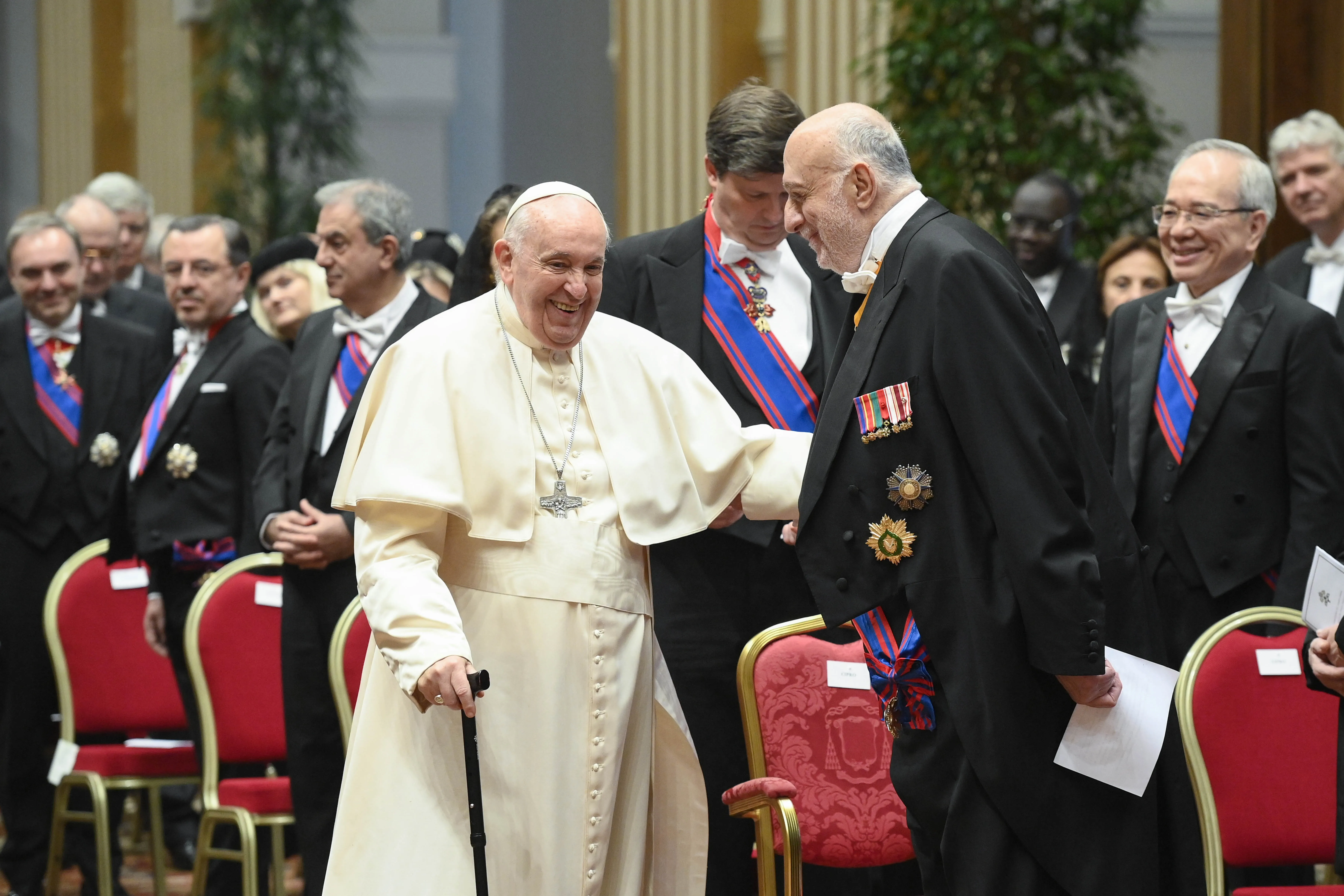
Pope Francis visits with international diplomats accredited to the Holy See on Jan. 9, 2023, at the Vatican. Vatican Media
The Holy Father also spoke of the need to deepen a sense of global solidarity, citing four areas of interconnectedness: immigration, the economy and work, and care for creation,
“The paths of peace are paths of solidarity, for no one can be saved alone. We live in a world interconnected that, in the end, the actions of each have consequences for all.”
Finally, regarding “peace in freedom,” Pope Francis warned of the “weakening of democracy” in many parts of the world, and an increase in political polarization. He said peace is only possible if “in every single community, there does not prevail that culture of oppression and aggression in which our neighbor is regarded as an enemy to attack, rather than a brother or sister to welcome and embrace.”
The Holy Father’s address to the diplomatic corps, which includes representatives of the 91 countries and entities with an embassy chancellery accredited to the Holy See, also served as an opportunity to review diplomatic highlights of the past year and expectations for the year to come.
Milestones included the signing of new bilateral accords with both the Democratic Republic of São Tomé and Príncipe and with the Republic of Kazakhstan. The Holy Father also briefly mentioned the provisional agreement between the Holy See and the People’s Republic of China, first agreed to in 2018 and renewed in 2022 for an additional two years.
“It is my hope that this collaborative relationship can increase, for the benefit of the life of the Catholic Church and that of the Chinese people.”
The next significant marker on the pope’s diplomatic docket: His trip to the Democratic Republic of Congo at the end of the month as a “pilgrim of peace,” followed by a joint visit to South Sudan with the Archbishop of Canterbury and the head of the Presbyterian Church of Scotland.
Vatican City, Jun 13, 2018 / 05:27 am (CNA/EWTN News).- The Vatican announced Wednesday that Pope Francis has named Michigan-native Msgr. Gerald Vincke as the new bishop of the Diocese of Salina, Kan., pulling him from several roles in the diocese of Lansing.
In a June 13 statement on Vincke’s appointment, Bishop Earl Boyea of Lansing said the diocese is “very happy” about the priest’s nomination.
“The priests of our diocese as well as myself will deeply miss our brother priest as he moves into this new ministry,” he said, and voiced his “love and gratitude” to Pope Francis for the appointment.
Vincke “is a fine priest, a man of deep faith in Jesus Christ, and a gentle soul,” he said, adding that Lansing’s loss is Salina’s gain.
Born in Sagisaw, Mich., in 1964, Bishop-elect Vincke is the ninth of ten children and has a degree in public relations and marketing from Ferris State University in Big Rapids.
He underwent philosophical studies at the Thomas More College in Crestview, Ken., before going on to study theology at the Athenaeum Seminary in Cincinnati, Ohio, and at the Sacred Heart Major Seminary in Detroit.
He was ordained a priest for the Diocese of Lansing June 12, 1999, after which he served in various pastoral roles. In 2003 he was named as the diocese’s Director of Seminarians and Vocations Director, roles he held until his 2010 appointment as spiritual director at the Pontifical North American College in Rome.
Vincke was given the title “monsignor” by Pope Benedict XVI in 2012, and in 2015, while still in Rome, he obtained a licentiate in Sacred Theology. The title of his thesis, which places an emphasis on spiritual theology, is “Following the Path of St. John Vianney for the New Evangelization with Evangelii Gaudium as a Guide.”
After returning to Lansing in later on 2015, he was assigned as pastor to Holy Family parish in Grand Blanc. He currently serves on the diocese’s Presbyteral Council and the College of Consultors.
It is a very good idea for this man to dress like spider man.
It is a very bad idea for the Pope to be photographed with him and those pictures to be sent around the world (BTW, with little to no explanation). And there are MANY ways for the Pope to have recognized his work without doing so.


 By




It is a very good idea for this man to dress like spider man.
It is a very bad idea for the Pope to be photographed with him and those pictures to be sent around the world (BTW, with little to no explanation). And there are MANY ways for the Pope to have recognized his work without doing so.