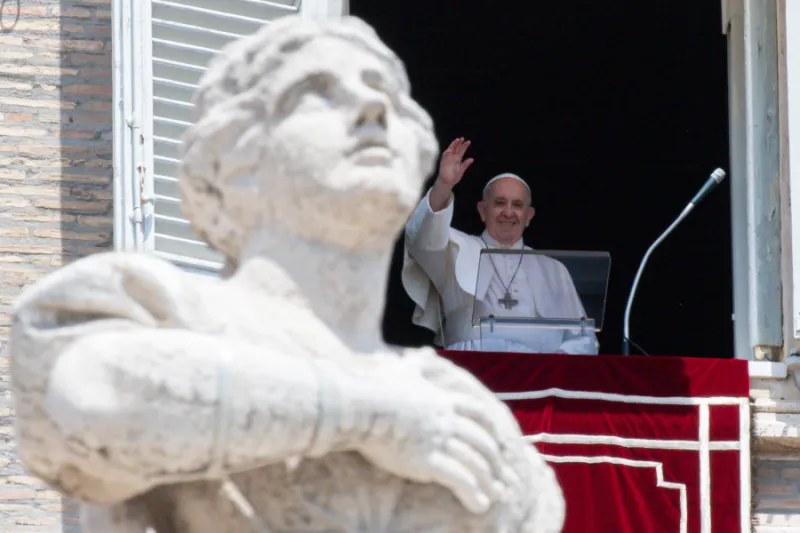
Pope Francis delivers his Angelus address on June 13, 2021. / Vatican Media/CNA
Vatican City, Jun 20, 2021 / 06:05 am (CNA).
In his Angelus message this Sunday, Pope Francis offered a reminder that the Lord wants us to seek his presence in the trials and storms of life.
“How often do we remain fixated on problems rather than going to the Lord and casting our concerns upon him?” the pope asked the pilgrims gathered in St. Peter’s Square on June 20.
“Today, let us ask for the grace of a faith that never tires of seeking the Lord, of knocking at the door of his Heart,” he said.
Speaking from the window of the Vatican’s Apostolic Palace, the pope reflected on the Gospel account of the disciples caught in a storm at sea as Jesus slept on their boat. Filled with fear, the disciples cried out to the Lord, “Teacher, do you not care if we perish?”
Pope Francis said: “Quite often, we too, beaten by the trials of life, have cried out to the Lord: ‘Why do you remain silent and do nothing for me?’”
“Especially when it seems we are sinking, because of love or the project in which we have laid great hopes disappears; or when we are at the mercy of the unrelenting waves of anxiety; or when we feel we are drowning in problems or lost in the middle of the sea of life, with no course and no harbor.”
The pope urged that it is important to remember that even though Jesus was sleeping on the boat during the storm with his disciples, the Lord was there.
“The Lord is there, present. In fact, he expects — so to speak — that we will engage him, to invoke him, to put him at the center of what we are experiencing. His slumber causes us to wake up. Because to be disciples of Jesus it is not enough to believe God is there, that he exists, but we must put ourselves out there with him; we must also raise our voice with him, cry out to him,” he said.
“Today we can ask ourselves: what are the winds that beat against my life? What are the waves that prevent my navigation and endanger my spiritual life, my family life, and my mental health as well? Let us tell all this to Jesus; let us tell him everything,” the pope said. “He wants this; he wants us to grab hold of him to find shelter from the unexpected waves of life.”
After praying the Angelus in Latin, the pope appealed for people in Burma, who are suffering hunger and displacement in the wake of the government’s violent crackdown on people protesting the Feb. 1 coup.
“I join my voice to that of the bishops of Myanmar, who last week launched an appeal calling to the attention of the whole world the harrowing experience of thousands of people in that country who are displaced and are dying of hunger,” the pope said.
The country’s Catholic bishops issued a statement June 11 appealing for peace, a humanitarian corridor in the conflict zones, and respect for the sanctity of places of worship.
The bishops also asked the Catholic dioceses of Burma “to launch into a period of intense prayer, seeking compassion in the hearts of all and peace to this nation” with daily Mass, adoration, and the rosary.
“May the Heart of Christ touch the hearts of all bringing peace to Myanmar,” Pope Francis said.
The pope also marked World Refugee Day, and said that the day is a reminder to “open our hearts to refugees” and to “make their sadness and joys our own.”
“May we learn from their courageous resilience. And so, all together, we will make a more human community grow as one big family,” he said.
Pope Francis commented that this Sunday’s Gospel of the disciples caught in the storm at sea reminded him of the many refugees who travel in boats and cry out to God in their need.
“This is the beginning of our faith: to recognize that alone we are unable to stay afloat; that we need Jesus like sailors need the stars to find their course. Faith begins from believing that we are not enough for ourselves, from feeling in need of God,” he said.
“When we overcome the temptation to close ourselves off, when we overcome the false religiosity that does not want to disturb God, when we cry out to him, he can work wonders in us. It is the gentle and extraordinary power of prayer, which works miracles.”
If you value the news and views Catholic World Report provides, please consider donating to support our efforts. Your contribution will help us continue to make CWR available to all readers worldwide for free, without a subscription. Thank you for your generosity!
Click here for more information on donating to CWR. Click here to sign up for our newsletter.
Vatican City, Jan 16, 2018 / 01:00 pm (CNA/EWTN News).- The conferral of the Vatican’s Order of St. Gregory the Great to Dutch politician and pro-abortion activist Liliane Ploumen was part of an ordinary diplomatic exchange of honorific titles, a… […]
Massachusetts Gov. Maura Healey walks across the campus of St. John’s Prep in Danvers, Massachusetts, on April 9, 2024. / Credit: Screenshot of St. John’s Prep Facebook page last visited April 19, 2024
Boston, Mass., Apr 23, 2024 / 16:45 pm (CNA).
Pro-lifers in the Archdiocese of Boston are criticizing Cardinal Seán O’Malley over two recent appearances at Catholic education events by the pro-abortion governor of Massachusetts.
Earlier this month, Massachusetts Gov. Maura Healey, a Democrat who supports legal and publicly funded abortion and who has taken steps to make abortions easier to obtain, spoke at a fundraiser for The Catholic Schools Foundation, which raises money for Catholic schools in the archdiocese and helps poor students attend.
O’Malley, the archbishop of Boston, is the chairman of the board of trustees of the foundation, though he was in Rome at the time of the gala and did not attend it.
Healey also recently visited a Catholic school north of Boston, speaking to students and answering questions.
C.J. Doyle, executive director of the Catholic Action League of Massachusetts, called Healey’s appearances “a grave scandal.”
“Cardinal O’Malley should be ashamed of himself. Is Maura Healey an inspiring role model for Catholic students?” Doyle said.
Thomas Harvey, chairman of the Massachusetts Alliance to Stop Taxpayer Funded Abortions, called including Healey at the Catholic events “really disgraceful,” and he placed the blame on O’Malley.
“Maura Healey is a huge proponent of killing babies in the womb, in direct defiance of Catholic teaching, and yet here she is being presented to impressionable Catholic students as if she were a Catholic role model,” Harvey told the Register by text. “And the clear message being sent to Catholic students here is that killing babies in the womb is just not that big a deal.”
In June 2004, the U.S. Conference of Catholic Bishops approved a document called “Catholics in Public Life,” which states: “The Catholic community and Catholic institutions should not honor those who act in defiance of our fundamental moral principles. They should not be given awards, honors, or platforms which would suggest support for their actions.”
Terrence Donilon, a spokesman for the Archdiocese of Boston, pointed out that Healey was not an honoree at the gala or during her earlier appearance at the Catholic school.
Since Healey is the governor of the state, Donilon said, Cardinal O’Malley has worked with her “on a number of issues important to Catholics and the wider community,” including public funding for the archdiocese’s charitable work providing “basic needs assistance, job training, child care services, and immigration and refugee assistance to thousands of residents,” as well as building “badly needed affordable housing” and trying “to stem gun violence.”
“At the same time, the cardinal has been a leader in the pro-life movement for over 50 years and his commitment in being a staunch promoter of life is well known and unwavering,” Donilon said.
O’Malley, 79, a Capuchin Franciscan, has frequently attended the March for Life in Washington, D.C., and has spoken at pro-life rallies. Last week, The Boston Globe published a column by O’Malley urging state legislators to oppose a bill that would legalize physician-assisted suicide.
But critics such as Doyle claim that O’Malley during his time as archbishop has seemed to mix easily and uncritically with abortion-supporting Catholic politicians, including the late U.S. Sen. Edward Kennedy (whose funeral Mass he celebrated), the late Boston mayor Thomas Menino, former Boston mayor Marty Walsh, and the current governor, Healey, with whom he co-authored a column in The Boston Globe in September 2017 on immigration.
Donilon, O’Malley’s spokesman, addressing Healey’s participation in The Catholic Schools Foundation gala last week, said that “the governor has been a vocal supporter of Catholic education. … Our Catholic schools save cities and towns hundreds of millions of dollars in education costs. Our families benefit from an outstanding education based in an excellent faith-based environment.”
Gov. Maura Healey speaks to students at St. John’s Prep on April 9, 2024. Credit: Screenshot of St. John’s Prep Facebook page last visited on April 9, 2024.
Who is Maura Healey?
Healey, 53, was elected Massachusetts attorney general in 2014 with an endorsement from Planned Parenthood Advocacy Fund. She served two terms as attorney general before being elected governor of Massachusetts in November 2022.
As an elected official, Healey has frequently supported public policies that clash with Catholic teachings on life and sexuality.
She has verbally attacked pro-life pregnancy centers, steered state government money to private abortion funds, and, in April 2023, quietly arranged for the flagship campus of the state-run University of Massachusetts to purchase 15,000 doses of abortion pills.
Healey’s administration in June 2023 successfully proposed a curriculum framework for public schools that calls for teaching between third and fifth grades “the differences between biological sex and gender identity” and “how one’s outward behavior and appearance does not define one’s gender identity or sexual orientation.”
Healey appeared Thursday, April 11, at the annual gala of The Catholic Schools Foundation at a hotel in Boston.
“So I didn’t have the benefit of going to Catholic school,” Healey said, according to a text of her remarks provided by a spokesman. “My mom went to Catholic school, and my nephew goes to Catholic school; we have priest[s] at the dinner table every Sunday. But I do know, both having been your attorney general and now as your governor, what your work means. And I can see that experience firsthand.”
She also said she wants to find ways “to partner” with the foundation “in the important work that you [are] doing.”
“And I want you to know that, as governor, I value our vibrant mix of education, our public schools, our private schools, and our religious schools,” Healey said.
Two days earlier, on Tuesday, April 9, Healey spent about 50 minutes with a group of 120 students at St. John’s Preparatory High School, a Catholic boys’ school founded by the Xaverian Brothers in Danvers, about 18 miles northeast of Boston, according to a description of the visit published on the school’s website. The school is in the Archdiocese of Boston, though it is not run by the archdiocese.
Healey had never visited the school before, “but it was quickly clear her personal values are closely aligned with those of the Xaverian Brothers,” the school’s write-up states.
Healey emphasized leadership and empathy during her remarks. The governor also told the students that while she believes in civil discourse, “there are some basic values that have kept our society intact,” and she told students they should “call out hate when you see it.”
“We can have differences of opinion on things,” Healey said, according to the school’s write-up, “but, to me, equality has got to abide. Respect for the dignity and worth of each person is something I call on people to really adhere to.”
Robert Joyce, a lawyer and member of the board of the Pro-Life Legal Defense Fund, which provides legal representation for pro-lifers, said that St. John’s Prep last fall turned down an offer he made to provide a pro-life assembly for students featuring a canon lawyer, a physician, and a vocations director. (The head of school, Edward Hardiman, did not respond to requests for comment by deadline.)
Joyce called Healey’s recent appearances at the gala and at the school “abominations for Catholic education.”
“They send the clear message to Catholic students and parents that critical, fundamental precepts of the Catholic faith are not all that important. In simple terms, they declare that protection of innocent unborn life and the defense of traditional marriage are negotiable with these Catholic educators,” Joyce indicated.
Healey is also a featured speaker at the annual Spring Celebration of Catholic Charities Boston scheduled for Wednesday, May 29, at the Boston Harbor Hotel in Boston. O’Malley is expected to receive an award at the event for his work in welcoming immigrants.
Healey and the Catholic Church
Healey does not often talk about religion in public, but she occasionally identifies herself as a Catholic.
In October 2018, when she was state attorney general, she led off a brief column in The Boston Globe with the words: “As a member of law enforcement and as a Catholic …”
In April 2022, when Healey criticized Bishop Robert McManus of Worcester for calling for a Catholic school to take down a rainbow flag, she added, according to MassLive.com: “And I speak as a Catholic …”
In October 2022, during a debate while she was running for governor, Healey used a Catholic reference while defending herself from a claim by her Republican opponent that a bill she had supported effectively legalized infanticide, as the National Catholic Register subsequently reported. “You know, my mom goes to Mass every morning,” Healey said.
Healey is widely thought of as a potential candidate for other offices. She would be an obvious Democratic nominee for U.S. Senate in Massachusetts if either of the two incumbents (both in their 70s) leaves office.
Additionally, just hours before her appearance at The Catholic Schools Foundation gala, Healey participated in an event at Northeastern University in Boston honoring former Massachusetts governor and 1988 Democratic presidential nominee Michael Dukakis. The moderator floated Healey as a potential future candidate for president of the United States, to applause from the audience.
This story was first published by the National Catholic Register, CNA’s sister news partner, and is reprinted here on CNA with permission.
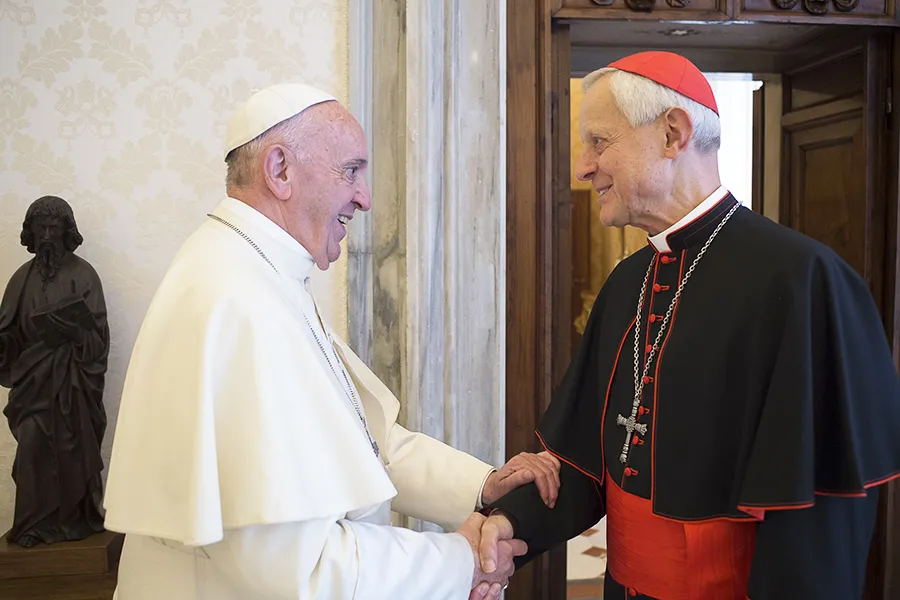
Vatican City, Oct 12, 2018 / 04:01 am (CNA).- Pope Francis accepted the resignation of Washington’s Cardinal Donald Wuerl on Friday, while asking the cardinal to continue leading the Archdiocese of Washington on an interim basis until a permanent successor is appointed.
In a letter to Wuerl obtained by CNA Oct. 12, Pope Francis told the cardinal: “Your renunciation is a sign of your availability and docility to the Spirit who continues to act in his Church.”
“In accepting your resignation, I ask you to remain as Apostolic Administrator of the Archdiocese until the appointment of your successor.”
Wuerl, 77, originally submitted his resignation on Nov. 12, 2015, when he turned 75 years old, as required by canon law.
The pope said Friday that he had also received a Sept. 21 request from Wuerl that his resignation be accepted.
“This request rests on two pillars that have marked and continue to mark your ministry: to seek in all things the greater glory of God and to procure the good of the people entrusted to your care,” Pope Francis wrote.
In the Oct. 12 letter accepting Wuerl’s resignation, Francis defended the cardinal from the widespread criticism he has faced in recent months.
“You have sufficient elements to ‘justify’ your actions and distinguish between what it means to cover up crimes or not to deal with problems, and to commit some mistakes.”
“However, your nobility has led you not to choose this way of defense. Of this, I am proud and thank you.”
“Your renunciation is a sign of your availability and docility to the Spirit who continues to act in his Church,” he added.
In an Oct. 12 statement, Wuerl wrote that “the Holy Father’s decision to provide new leadership to the Archdiocese can allow all of the faithful, clergy, religious and lay, to focus on healing and the future. It permits this local Church to move forward.”
“Once again for any past errors in judgment I apologize and ask for pardon. My resignation is one way to express my great and abiding love for you the people of the Church of Washington.”
The cardinal has been the subject of criticism since late June, when revelations about alleged sexual misconduct on the part of his predecessor, Archbishop Theodore McCarrick, raised questions about what Wuerl knew about McCarrick, and how he responded to that knowledge.
The Aug.14 release of a grand jury report detailing decades of abuse allegations in six Pennsylvania dioceses put under close scrutiny Wuerl’s record as Bishop of Pittsburgh, where he served from 1988 to 2006. Some cases in the report raised concerns that Wuerl had allowed priests accused of abuse to remain in ministry after allegations had been made against them.
Those factors led to calls for Wuerl’s resignation and demonstrations outside of his Washington residence.
After Wuerl made a trip to Rome in late August, media reports said that Pope Francis had instructed the cardinal to consult with Washington clergy about the best way forward for him and the archdiocese.
In a Sept. 11 letter to DC priests written after a private meeting with them, Wuerl said that he would soon meet with the pope to discuss his future, but did not immediately state that he would ask the pope to allow him to resign. A spokesman for Wuerl confirmed to CNA Sept. 12 that the cardinal intended to formally ask Pope Francis to allow him to step down.
It has been widely believed that Wuerl hoped to remain in his position at least until the fall meeting of the U.S. bishops’ conference in November. That session is expected to focus on the fallout of the recent sexual abuse crises, and Wuerl was said to want to play an active part in helping the Church respond.
As apostolic administrator, Wuerl will continue to lead the day-to-day activities of the archdiocese, but will not be permitted to make any major changes.
If a successor is not appointed and installed before Nov. 13, the apostolic administrator will attend the bishops’ conference annual meeting as the representative of the Archdiocese of Washington.
The auxiliary bishops of Washington also released a statement Friday, saying the cardinal’s “pastoral and spiritual leadership in the archdiocese is well appreciated.”
“We believe that Cardinal Wuerl’s decision to request that the Holy Father, Pope Francis, accept the resignation he first offered years ago is a clear manifestation of his love and concern for the people of this archdiocese,” wrote Bishops Mario E. Dorsonville, Roy E. Campbell Jr., and Michael W. Fisher.
Kim Viti Fiorentino, chancellor and general counsel of the Archdiocese of Washington, said in a statement Oct. 12 that the archdiocese has “been profoundly blessed to have this great priest as our archbishop.”
“His final decision to act in favor of the people he loved and served for twelve years is the most eloquent witness to the integrity of his ministry and his legacy,” she continued. “I am truly thankful for his steadfast fidelity and his courageous and sacrificial commitment to the future of the Church in Washington.”
A native of Pittsburgh, Penn., Wuerl studied at the Catholic University of America in Washington, D.C. and at the Pontifical Gregorian University in Rome. He was ordained a priest for the Diocese of Pittsburgh in 1966 and went on to receive a doctorate in 1974.
In the 1990s Wuerl hosted the television program, “The Teaching of Christ.” He also wrote a best-selling adult catechism of the same name, and has since more than 20 other books.
Wuerl was appointed an auxiliary bishop in the Archdiocese of Seattle in 1986, following a Vatican investigation into Seattle’s Archbishop Raymond Hunthausen. Wuerl was charged with special responsibility for five problem areas in the archdiocese: liturgy, the tribunal, priest formation, moral and bioethical issues in Catholic hospitals, and ministry and teaching concerning homosexuality. The appointment generated serious conflict among Hunthausen’s supporters, and Wuerl was relieved of his responsibility in 1987.
He was appointed Bishop of Pittsburgh in 1988. He held this position until he was appointed in May 2006 to head the Archdiocese of Washington. He was named a cardinal by Pope Benedict XVI on Nov. 20, 2010.
Wuerl is a member of several Vatican departments, including the Pontifical Council for Promoting Christian Unity and the Congregation for Bishops.
If the Lord would help instead of doing nothing, maybe that would be good. Handing things over to the Lord doesn’t do anything, in my experience, except delay the inevitable fixing it myself.
You should consider Isaiah chapters 30 and 50. They are accounts of what happens when people take it upon themselves to live life independently of God.






If the Lord would help instead of doing nothing, maybe that would be good. Handing things over to the Lord doesn’t do anything, in my experience, except delay the inevitable fixing it myself.
You should consider Isaiah chapters 30 and 50. They are accounts of what happens when people take it upon themselves to live life independently of God.