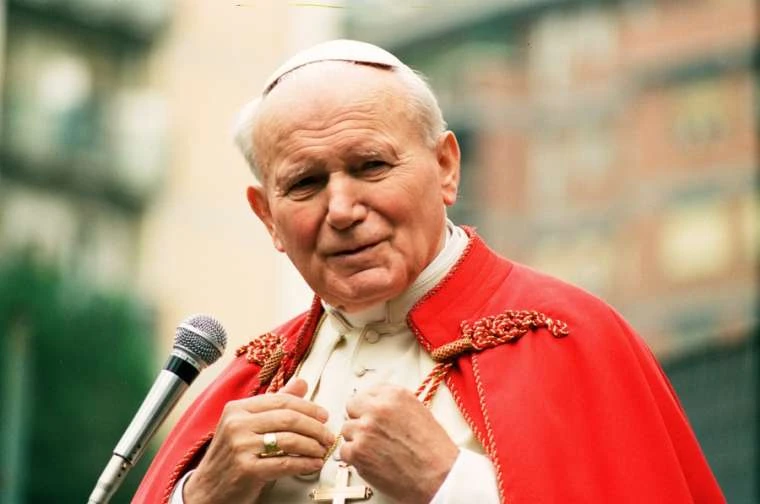
George Weigel lauded John Paul II as “a man of God, a brilliant analyst of the human condition, and a thoroughly lovable human being” on the 101st anniversary of the saint’s birth.
Marking the May 18 anniversary, the papal biographer said that the pope’s teaching remained relevant more than a century after his birth in Wadowice, Poland.
“John Paul II understood that the Great Issue for the future of humanity in the 21st century and beyond was the concept of the human person that would shape culture and society,” said the author of “Witness to Hope,” a monumental biography of the Polish pope issued in 1999.
“Are we merely bundles of morally equivalent desires, and is freedom merely the satisfaction of those desires? Or are we created for a nobler exercise of freedom: the freedom to seek the truths built into the world and into us and to live our lives according to those truths?”
John Paul II, born Karol Wojtyła on May 18, 1920, survived the Nazi occupation of Poland and helped to lead the Church’s resistance to the oppressive communist regime that followed.
Elected pope in 1978, he led the Church for 26 years until his death in 2005. The first non-Italian pope in 455 years, he made more foreign trips than all previous popes combined and issued 14 encyclicals.
“That is the central message that the Church must take to the world, if it is to be the Church of the New Evangelization that John Paul II proclaimed.”
He made the comments in response to questions from the Office for Foreign Communication of the Polish Bishops’ Conference.
The institute was founded at the Angelicum, formally known as the Pontifical University of St. Thomas Aquinas, on the centenary of the saint’s birth in 2020. The future pope studied at the university after the Second World War.
Admissions to the new program begin on John Paul II’s birth anniversary. Teachers will include Rémi Brague, Francis Russell Hittinger, Rowan Williams, and George Weigel.
Speaking to Polish media, Weigel said: “I am eager to be a part of this important initiative, which I hope will help students ‘see’ the world through John Paul II’s ideas and papal teaching, rather than simply looking at him as an exemplary human being.”
“He was that, of course, but he also had an acute analysis of the crisis of civilization today, and that analysis deserves to be carefully studied.”
If you value the news and views Catholic World Report provides, please consider donating to support our efforts. Your contribution will help us continue to make CWR available to all readers worldwide for free, without a subscription. Thank you for your generosity!
Click here for more information on donating to CWR. Click here to sign up for our newsletter.
Pope Francis greets thousands of children and their families as he makes his way through St. Peter’s Square during the first World Children’s Day, Saturday, May 26, 2024. / Credit: Daniel Ibañez/CNA
Vatican City, May 26, 2024 / 13:15 pm (CNA).
After an exuberant kick-off event on Saturday for the first World Children’s Day, Pope Francis gathered together with tens of thousands of children in St. Peter’s Square for Mass on this feast of the Holy Trinity. A piercing early summer sun moved everyone — from nuns to the boys’ choir — to shade their heads with colorful hats.
Thousands gather in St. Peter’s Square in Rome on Saturday, May 26, 2024, for the first World Children’s Day with Pope Francis. Credit: Daniel Ibañez/CNA
The creation of a World Children’s Day was announced by the pope on December 8, 2023, at the midday Angelus. The idea for it was suggested to the pope by a 9-year-old boy in an exchange shortly before World Youth Day in Lisbon.
Among the special guests at the Mass was Italian Prime Minister Giorgia Meloni, who together with her daughter Ginevra, met the Pope briefly before the Mass.
With this first event complete, Francis announced at the end of the festivities today that the next World Children’s Day will be held in September 2026.
Among the special guests at the Mass for the first World Children’s Day was Italian Prime Minister Giorgia Meloni, who together with her daughter Ginevra, met the pope briefly before the Mass on Saturday, May 26, 2024. Credit: Daniel Ibañez/CNA
The One who accompanies us
The Holy Father, smiling and clearly happy to be surrounded by children, completely improvised his homily, making it a brief and memorable lesson on the Holy Trinity.
“Dear boys and girls, we are here to pray together to God,” he began. But then counting on his fingers and enumerating, Father, Son, and Holy Spirit, he asked, “But how many gods are there?”As the crowd answered “one,” the pope praised them and started talking of each of the Persons of the Holy Trinity.
He began with God the Father — “who created us all, who loves us so much” — asking the children how we pray to him. They quickly answered with the “Our Father.”
Pope Francis went on to speak of the second person of the Trinity, after the children called out his name — Jesus — as the one who forgives all of our sins.
When he got to the Holy Spirit, the pope admitted that envisioning this person of the Trinity is more difficult.
“Who is the Holy Spirit? Eh, it is not easy …,” he said.
“Because the Holy Spirit is God, He is within us. We receive the Holy Spirit in Baptism, we receive Him in the Sacraments. The Holy Spirit is the one who accompanies us in life.”
Using this last phrase, the Pope invited the children to repeat the idea a number of times: “He is the one accompanies us in life.”
“He is the one who tells us in our hearts the good things we need to do,” the Pope said, having the kids repeat the phrase again: “He is the one who when we do something wrong rebukes us inside.”
The pope speaks to thousands of children and many others who gathered in St. Peter’s Square on Saturday for the first World Children’s Day on the feast of the Holy Trinity. May 26, 2024. Credit: Daniel Ibañez/CNA
The pope ended the homily thanking the children and also reminding them that “we also have a mother,” asking them how we pray to her. They answered “with the Hail Mary.” The pope encouraged them to pray for parents, for grandparents, and for sick children.
“There are so many sick children beside me” he said, as he indicated the children in wheelchairs near the altar. “Always pray, and especially pray for peace, for there to be no wars.”
Applauding the grandparents
The pope frequently urges young people to seek out their grandparents, and the give-and-take of his homily gave the impression of a beloved grandpa surrounded by his grandkids. He insisted that the kids quiet down for the time of prayer.
When the Mass concluded, and after praying the midday Angelus, the pope summarized the lessons of the homily: “Dear children, Mass is over. And today, we’ve talked about God: God the Father who created the world, God the Son, who redeemed us, and God the Holy Spirit … what did we say about the Holy Spirit? I don’t remember!”
The children needed no further invitation to answer loudly that “the Holy Spirit accompanies us in life.” Joking that he couldn’t hear well, the Pope had them say it again even louder, and then prayed the Glory Be with them.
Pope Francis speaks with a group of children in St. Peter’s Square in Rome during the first World Day of Children on Saturday, May 26, 2024. Credit: Daniel Ibañez/CNA
The pope also asked for a round of applause for all the grandparents, noting that at the Presentation of the Gifts, a grandfather had accompanied a group of children who brought forward the bread and wine.
Dreaming and dragons
After the closing procession, Italian actor Roberto Benigni took the stage for a lively and inspirational monologue that combined good humor and life lessons.
While Benigni is known especially to the English-speaking world for his role in Oscar-winning Life is Beautiful, in Italy he’s also known for his commentaries on important issues, combined with his exuberant humor.
“When I was a boy, I wanted to be pope,” he told the audience.
Urging the children to read — “Kids need to read everything!” — he paraphrased G.K. Chesterton who insisted that fairy tales are important: “Fairy tales do not tell children the dragons exist. Children already know that dragons exist. Fairy tales tell children the dragons can be killed,” Chesterton said.
Italian actor Roberto Benigni speaks at the World Children’s Day in St. Peter’s Square at the Vatican. He took the stage for a lively and inspirational monologue that combined good humor with a call for children to read and to dream. Credit: Daniel Ibañez/CNA
“Dream!” Benigni urged the children. “It’s the most beautiful thing in the world. But I want to tell you a secret. You’ll tell me you know how to dream; you’ll say you just have to close your eyes, sleep, and dream. … No, no. I’ll tell you a secret — to dream, you don’t have to close your eyes. You have to open them! You have to open your eyes, read, write, invent.”
The actor emphasized the need to be peacemakers, saying that the Sermon on the Mount contains “the only good idea” that’s ever been expressed. War is the “most stupid sin,” he lamented.
“War must end,” Benigni insisted, going on to quote a famous author of children’s literature. “You will tell me: That is a dream, it is a fairy tale. Yes, it is, but as Gianni Rodari said, ‘Fairy tales can become reality, they can become true!’”
Paralympics Games 2016, basketball, USA vs. Turkey / A.RICARDO/Shutterstock
Washington D.C., Aug 30, 2021 / 10:01 am (CNA).
A Catholic disability advocate praised an increase of television and media coverage for this year’s Paralympic Games, say… […]
Madrid, Spain, Mar 30, 2017 / 05:40 am (CNA/EWTN News).- A pregnant woman who found her faith in a Spanish prison, refused to give up the name of her Christian catechist to her persecutors, and died for lack of medical care was beatified on Saturday.
“Emilia is a martyr of suffering, because she died some 10 days after giving birth for lack of medical attention, clutching her rosary. She had a chance to apostatize, to betray the one who taught her the faith, but she did not. She’s an example,” Historian Martin Ibarra told CNA.
On March 25, Cardinal Angelo Amato, prefect for the Causes of Saints, beatified Emilia Fernandez and 114 other martyrs of religious persecution during the Spanish Civil War, which lasted from 1936-1939.
Emilia became the first Romani – or Gypsy – woman to be beatified by the Catholic Church.
“Emilia’s life up to 24 years of age was normal for an Andalusian Gypsy woman at the beginning of the century,” Ibarra said. “She devoted herself to her family, her work as a basket maker. She was a hard working woman, a Gypsy and honest.”
She and her husband, Juan Cortes and were imprisoned for trying to prevent Juan from being conscripted into the war.
Although Emilia was pregnant when she went to prison, she did not receive any additional care. Officials assigned her the same insufficient food ration as the rest of the female prisoners.
Emilia “carried her pregnancy in the prison under terrible conditions, and suffered a lot from hunger,” Ibarra said.
It was in prison where she discovered her faith.
“Even though she had been baptized, she never set foot in a church. It was especially through the rosary that her catechist Dolores del Olmo taught her,” Ibarra recounted.
“Every afternoon the female prisoners prayed, even though it was forbidden. Emilia wanted to know more about her faith and she asked Dolores del Olmo to explain it to her. There she realized that she belonged to the Church, and she learned the ‘Our Father,’ the ‘Hail Mary’ and the ‘Glory Be’.”
The warden for the women’s prison, Dolores Salmerón, knew that Emilia and the other prisoners were praying. She offered the woman more food and offered to release her and her husband on one condition: she must reveal the name of whoever taught her to pray.
Emilia refused to betray her catechist and so she was punished with solitary confinement.
A few months later, Emilia gave birth. “Between the cries and sobs, her catechist was saying prayers which Emilia repeated, although she could not continue because of the pain,” Ibarra added.
Dolores del Olmo, her catechist, baptized Emilia’s newborn daughter with the name Angeles. The new mother died 10 days later.
Ibarra is the author of the book “Emilia, the Basket Maker, Martyr of the Rosary,” which tells of her life and death. He said that Emilia’s devotion to the rosary led her to love Jesus Christ more.
“She fulfilled her maternity, risking her life and in fact she died for lack of medical attention,” the historian said. “She died from her sufferings, for being faithful to her faith, for bringing a life into the world and did not give in to her jailer’s desire that she apostatize.”
For Ibarra, Emilia’s beatification shows the vitality of the Church.
“She is a call to hope and responsibility, who teaches us with her life that God is at our side, even in difficulties,” he said. “Emilia went to prison hardly knowing the faith and when she died, she did so as a friend of God. That is beautiful.”
She was beatified in a group of martyrs from Almeria, Spain. They include cathedral dean Father Jose Alvarez-Benavides y de la Torre and 114 companion martyrs: 95 priests, 20 laymen and two women, including Emilia.
Emilia is the first Romani woman to be beatified. The first male Gypsy blessed, Ceferino Giménez Malla, known as El Pelé, was beatified by Saint John Paul II in 1997. He died in the religious persecution of the Spanish Civil War for protecting a priest. Before his persecutors shot him, he held a rosary in his hand and cried out “Long live Christ the King!”
Iberra characterized both Emelia and Ceferino as “martyrs of the rosary” because both of them refused to stop praying it.
“This demonstrates that the Virgin leads us to God. For those two martyrs, she was the Gate of Heaven,” he said.
Leave a Reply
