CNA Staff, Apr 6, 2021 / 07:32 pm (CNA).- The Archdiocese of Los Angeles announced this week that six Catholic elementary schools in the area will close and be consolidated with other schools, due to ongoing financial difficulties exacerbated by the coronavirus pandemic.
“These six schools had been trying to overcome financial challenges long before the pandemic,” said Paul Escala, superintendent of Catholic Schools, according to NBC Los Angeles. Challenges facing the schools include low enrollment, financial difficulties, and a shift in demographics.
“After careful discernment with Archdiocesan and school leadership, the decision was reached to consolidate these schools with nearby schools to create a union that would strengthen the school communities in the area so that all students can continue to receive the quality Catholic education that our schools provide,” Escala said.
At the end of the 2020-21 school year, six elementary schools will close – Assumption, Blessed Sacrament, St. Catherine of Sienna, St. Ferdinand, St. Francis of Assisi, and St. Madeline.
These schools will all be consolidated with other local elementary schools.
The archdiocese noted that, during the current school year, students in Los Angeles Catholics schools outperformed their peers nationally in math and reading.
“Though there have been many challenges and some setbacks, our Catholic school communities have demonstrated resiliency throughout this crisis,”’ said Escala, according to NBC Los Angeles.
“As our Catholic schools welcomed students back, our students were able to celebrate the sacrament of their First Holy Communion something they missed early on in the pandemic,” he said. “Our Catholic schools continue to demonstrate academic performance growth in reading and math in both elementary and high schools. This among so many other accomplishments, is something we can all be proud of.”
If you value the news and views Catholic World Report provides, please consider donating to support our efforts. Your contribution will help us continue to make CWR available to all readers worldwide for free, without a subscription. Thank you for your generosity!
Click here for more information on donating to CWR. Click here to sign up for our newsletter.
St. Louis, Mo., Sep 2, 2022 / 12:50 pm (CNA).
The Department of Veterans Affairs announced Friday that it would begin providing abortions in the case of threats to the life and health of the mother, or in cases of rape or in… […]
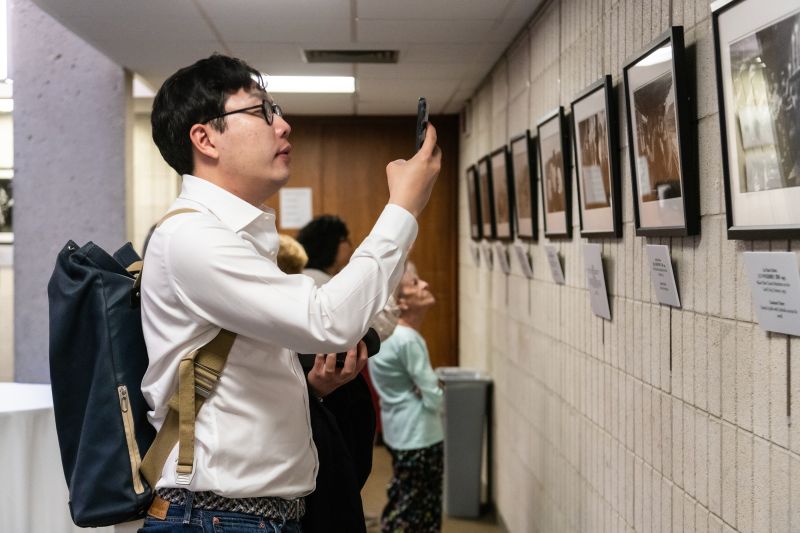
At the opening reception for the Ricci Center’s “On The Road” exhibit in the School of Theology and Ministry Library was held in June 2023. / Credit: Lee Pellegrini
Boston, Mass., Sep 24, 2023 / 09:00 am (CNA).
An exhibition of powerful images documenting the lives of Catholics in rural China is now on view at Boston College, presented by the college’s Ricci Institute for Chinese-Western Cultural History.
“On the Road: The Catholic Faith in China”— which has been extended through Dec. 22 — comprises 60 images taken between 1992 and 1996, when world-renowned photographer Lü Nan traveled on the road through 10 Chinese provinces to document the lives of Catholic villagers. Fifty images are on view at the School of Theology and Ministry (STM) Library Atrium; 10 are displayed at the O’Neill Library Gallery.
One of the most respected photographers in China today, Lü is considered unrivaled in his capacity to capture and reveal human dignity and the poignancy of the human condition, according to exhibition organizers.
“Lü Nan’s corpus of work is very striking,” said Ricci Institute Director M. Antoni J. Ucerler, SJ, a provost’s fellow and associate professor of history. “His focus, with this project and others, is to explore minorities and communities on the margins of Chinese society. Christians in general and Catholics in particular in remote rural areas, from Yunnan to Tibet, are the focus of this collection of photographs.”
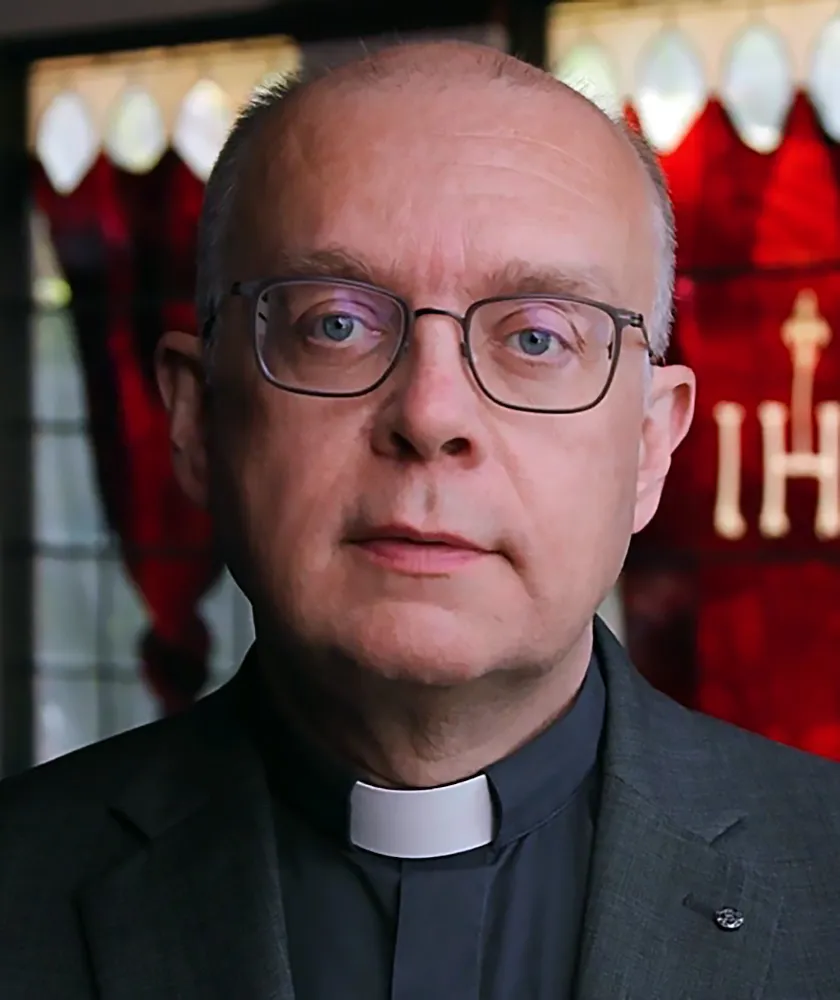
Ricci Institute Director M. Antoni J. Ucerler, SJ. Credit: Photo courtesy of University of San Francisco
Given that the exhibition subject is Christians in China, the Ricci Institute partnered with STM as its primary venue, Ucerler explained, and three STM students co-curated “On the Road.”
Amid the economic and social complexities of the time, “Lü witnessed nothing short of a miracle,” the curators note in an exhibition description: “people of deep faith, despite constant strife in everyday life, on the road to heaven.” This collection — arranged in five categories that depict different aspects of the life and faith of the people he encountered — is his “attempt to convey to the world the miracle he witnessed.”
The Ricci Institute, an internationally recognized research center for the study of Chinese-Western cultural exchange, collaborated on the Boston College display with Michael Agliardo, SJ, director of the U.S.-China Catholic Association in Berkeley, California, and Jamason Chen at Loyola University Chicago. Chen, who often represents and speaks on behalf of his friend Lü, will appear on campus this fall, at a date to be announced, to discuss the exhibition.
“The visual exploration of the profoundly human experiences of these Christian communities in rural China is very specific in terms of time and place. And yet these stark photographs speak eloquently of a common human condition and of the reality of a lived faith across cultures and borders,” Ucerler said.
He described each photograph as “a mini-meditation that invites the viewer to become attentive to and respectful of the message that it is conveying. Each image reveals the complex reality of the Christian faith well beyond the familiar confines of the Western world, while at the same time appealing to universal themes that are part of a shared humanity.”
Following a five-year affiliation with China Pictorial, Lü worked as an independent photographer and produced a trilogy of acclaimed works that made his international reputation. The second comprises the works in this exhibition; many of them have been displayed around the world and have been published in the book “On the Road”(Ignatius Press, 2021). Agliardo assisted Lü in its publication and wrote an afterword to the volume.
“During the period when Lü Nan shot ‘On the Road,’ he visited over 100 church buildings. However, the emphasis of his photographic journey is on how love and faith are practiced in the everyday life of the believers,” according to a description of the book. “His aim is to show that inner divinity is imbued in the everyday life of these believers, and that their time on earth is but a tempering trajectory: Through enduring the trials of life’s fortunes and mishaps, they are able to find true values in divine grace.”
At a campus opening event held last month, Ucerler said a theme that stands out for him is “transcendent hope through a deep faith in the midst of vulnerability.” The co-curators echoed that observation and shared their personal experiences of interacting with the work of the artist. Their reflections and thoughts on the exhibition all underscored the deep faith and hope of those portrayed by the photographer.
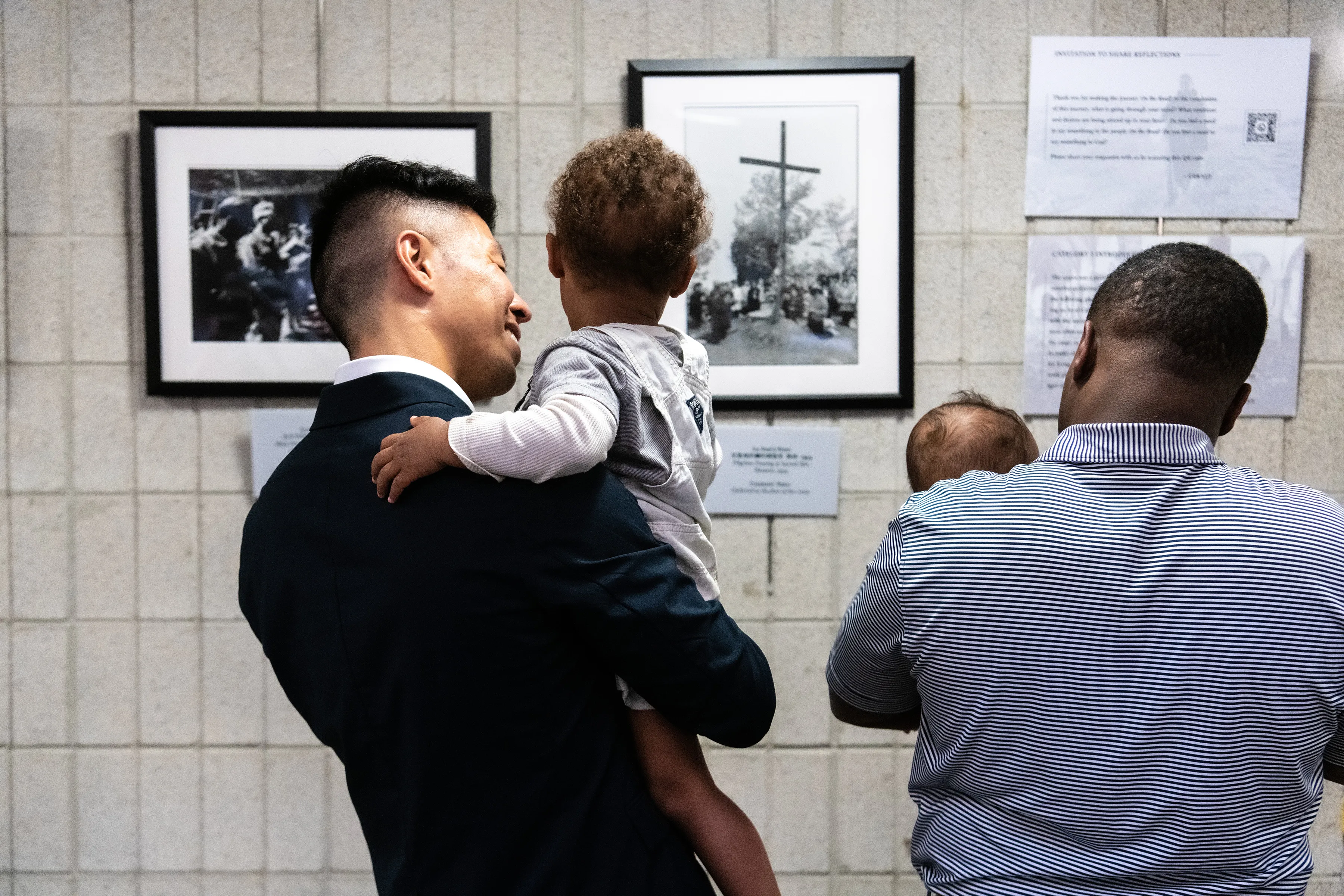
“On the Road: The Catholic Faith in China” exhibit runs through Dec. 22, 2023, at Boston College, presented by the University’s Ricci Institute for Chinese-Western Cultural History. Photo credit: Lee Pellegrini
“The images depicted might be considered austere, showing poverty and suffering,” said co-curator Wen Jie Gerald Lee, MATM/MBA ’23, of Singapore. “But they communicate profound joy, contentment, peace, and purpose in spite of harsh living conditions.”
Ricci Institute intern and co-curator Zhangzhen Liang MTS ‘23 — who was a young girl when Lü visited her Chinese village for this series — hopes “the perseverance and faith expressed in these photos will empower all of us to move forward together, to live a rich and thriving life, and encourage us to become the light of the world.”
Doctoral student and co-curator Shinjae Lee ‘27, whose family moved from China to South Korea, concluded with a quote from Lü: “I hope that by looking into real life I find something fundamentally and enduringly human.”
The curators, who wrote the accompanying wall text, encourage exhibition visitors to record their reactions to these evocative images, by scanning a QR code available as part of the installation. These responses will be shared with other patrons.
“We sincerely hope that those who view this exhibit will experience a common bond with those who are depicted,” Ucerler said, “and allow themselves to be transported to these faraway communities so that they can learn something from their visual witness.”
According to organizers, in addition to Chen’s appearance, other events will be held in conjunction with the exhibition, and the “On the Road” volume is available at a discounted price.
“On the Road: The Catholic Faith in China” is co-sponsored by the Ricci Institute and Boston College Libraries, with funding from the EDS-Stewart Endowment for the Study of Chinese-Western Cultural History at the Ricci Institute.
“Our Catholic schools continue to demonstrate academic performance growth in reading and math in both elementary and high schools. This among so many other accomplishments, is something we can all be proud of.”
Yes, of course, but what do the Catholic schools teach about the Catholic faith? Perhaps the faith isn’t taught. Perhaps the faith is seen as a burdensome time-consuming afterthought.
If the faith is erroneously taught with bias in support of chosen political spectrums, progressive pontiffs or culturally fashionable moralities, the schools are better closed.



“Our Catholic schools continue to demonstrate academic performance growth in reading and math in both elementary and high schools. This among so many other accomplishments, is something we can all be proud of.”
Yes, of course, but what do the Catholic schools teach about the Catholic faith? Perhaps the faith isn’t taught. Perhaps the faith is seen as a burdensome time-consuming afterthought.
If the faith is erroneously taught with bias in support of chosen political spectrums, progressive pontiffs or culturally fashionable moralities, the schools are better closed.
Church institutions cannot survive financially in a world in which liberalism sets the rules.