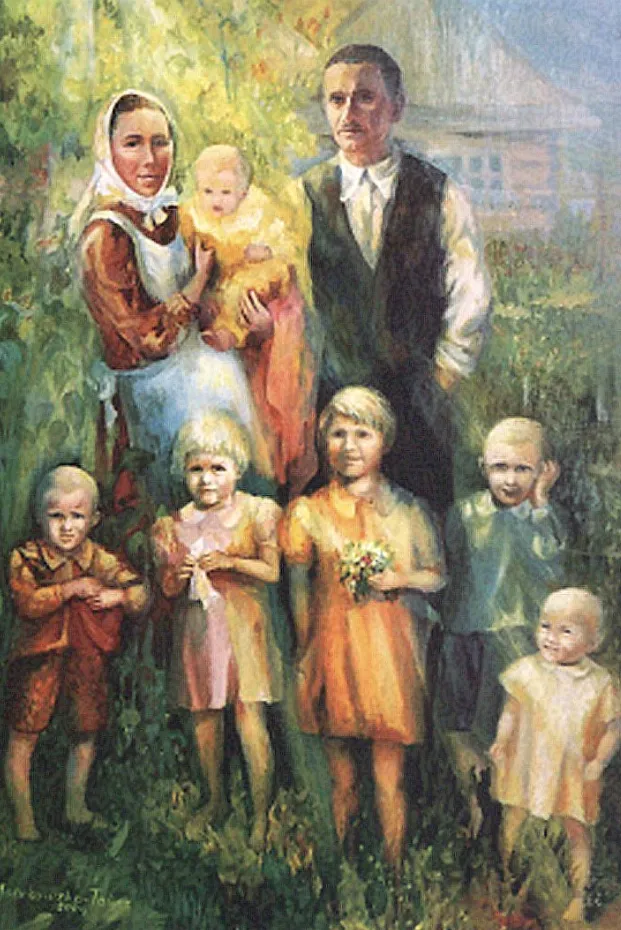
Wiktoria Ulma with six of her children. / Credit: The Ulma Family Museum of Poles Saving Jews in World War II.
CNA Staff, Mar 24, 2021 / 05:00 pm (CNA).- Early on March 24, 1944, a Nazi patrol surrounded the home of Józef and Wiktoria Ulma on the outskirts of the village of Markowa in southeast Poland. They discovered eight Jewish people who had found refuge with the couple and executed them.
The Nazi police then killed the pregnant Wiktoria, who was 32 years old, and her 44-year-old husband. As the couple’s children began to scream at the sight of their murdered parents, the Nazis shot them dead too: Stanisława, 8, Barbara, 7, Władysław, 6, Franciszek, 4, Antoni, 3, and Maria, 2.
It is thought that Wiktoria went into labor during the massacre as a witness later said that he saw a newborn baby beside her body.
Now, 77 years later, the sainthood causes of Józef and Wiktoria — known as the “Good Samaritans of Markowa” — are advancing.
/ The Ulma Family Museum of Poles Saving Jews in World War II
Polish Catholics marked the anniversary of their deaths at a morning Mass in the parish of St. Dorothy in Markowa, in Przemyśl archdiocese. Archbishop Adam Szal of Przemyśl presided.
The archbishop expressed delight at the progress in the causes of the couple, who are currently known as Servants of God, a title used at the start of canonization processes.
“We give thanks for the example of the Ulma family’s life. Their gift of life is a sign for us that sometimes we have to sacrifice our lives to save other people. Today we are asking for the gift of their beatification,” he said.
In his homily, Fr. Witold Burda, postulator of the causes, praised Józef and Wiktoria as a model for Christians.
“The Ulmas put God’s law in the first place every day,” he said.
Referring to surviving photos of the family, he said: “The smile of the children in the photos touches me. These children felt safe, loved by mom and dad.”
/ The Ulma Family Museum of Poles Saving Jews in World War II
Józef and Wiktoria’s causes were launched in 2003 by Pelplin diocese, together with those of other Polish martyrs of World War II. Przemyśl archdiocese took over responsibility for the couple’s causes in 2017.
Their causes — as well as those of their seven children (including one unborn) — have passed the diocese stage and are now pending in Rome. Commissions of the Congregation for the Causes of Saints will examine the causes, seeking evidence of heroic virtue, one of the requirements for beatification.
Speaking before the Mass, Burda said: “In the case of the Ulma family, it is about proving that they were martyred for their faith in Christ, and the persecutors — German gendarmes — deprived them of their lives because of hatred for the faith of the Ulma family or for the virtue resulting from faith, in this case, it is about love of neighbor.”
The positio — a collection of documents making the case for beatification — is first considered by a commission of historians. If they give a positive verdict, the positio goes to a theological commission.
“They, in turn, will investigate whether in the case of the Ulma family we are dealing with three characteristic elements of martyrdom. How the Servants of God died, what led the Ulma family to take Jews under its roof in 1942, and what led the German gendarmes to invade the Ulma farm on March 24, 1944,” Burda explained.
A third commission, consisting of bishops and cardinals, then summarizes the work. If they endorse the positio, the prefect of the Congregation for the Causes of Saints asks the pope to approve a decree of martyrdom.
Burda said that the commission of historians had already met and he believed that its assessment of the positio of the Ulma family would be positive.
Mateusz Szpytma, vice-president of the Institute of National Remembrance and director of the museum, said: “As far as I know … the documentation is currently in the hands of the first of the three Vatican commissions, so it is already at a very good stage.”
Burda noted that devotion to the Ulma family is spreading around the world. Lay people in Padua, Italy, are holding a conference on the family on May 30, and parishes in the United States and the Philippines are asking for pictures with a prayer for beatification.
Burda highlighted the fact that seven of the nine beatification candidates from the Ulma family are children.
Noting that Wiktoria’s unborn child was seen emerging from her body, he said: “The thrilling thing is that you can see here every human being’s deep desire to enjoy life, to come into the world. The Congregation included this unborn, nameless, and unbaptized child in the process.”
If you value the news and views Catholic World Report provides, please consider donating to support our efforts. Your contribution will help us continue to make CWR available to all readers worldwide for free, without a subscription. Thank you for your generosity!
Click here for more information on donating to CWR. Click here to sign up for our newsletter.
The Catholic Cathedral of Limburg in Hesse, Germany. / Credit: Mylius via Wikimedia (GFDL 1.2)
CNA Newsroom, Jul 1, 2024 / 09:45 am (CNA).
Just one day after the news that hundreds of thousands of Catholics left the Church in Germany in 2023, t… […]
Vatican City, Feb 15, 2021 / 11:01 am (CNA).- Pope Francis has praised the courageous witness of the 21 Coptic Orthodox Christians killed by ISIS in 2015, calling them “saints of all Christians.”
The Sisters of St. Joseph of the Apparition cover the altar, just dedicated by the cardinal. The covering of the altar signifies that it is both the place of the Eucharistic sacrifice and the Lord’s table. / Credit: Photo courtesy of the Latin Patriarchate of Jerusalem
Jerusalem, Sep 12, 2024 / 07:00 am (CNA).
On Aug. 31, exactly 100 years after its dedication, the Church of Our Lady of the Ark of the Covenant was reopened for worship on the hill of Kiryat Yearim, nine miles from Jerusalem.
The church, which was closed for four years for restoration work, stands atop the hill overlooking the (Muslim) village of Abu Gosh. From the top, visitors can see Jerusalem.
A view from the hill of Kiryat Yearim, where the Church of Our Lady of the Ark of the Covenant stands. At the foot of the hill lies the Muslim village of Abu Gosh, with Jerusalem visible in the background, a little more than nine miles away. The place, mentioned in the Bible as “Kiriath-Jearim,” held an important role in the history of the Jewish people, as it was here that the Ark of the Covenant rested for about 20 years until King David brought it to Jerusalem. Credit: Marinella Bandini
The place, mentioned in the Bible as “Kiriath-Jearim,” has held an important role in the history of the Jewish people as it was here that the Ark of the Covenant rested after being recovered from the Philistines (see 1 Samuel 6).
The ark contained the two stone tablets on which the Ten Commandments — God’s covenant with the Jewish people — were inscribed and was the sign of God’s presence among his people.
According to the Bible, it was hosted in the house of Abinadab, where it remained for about 20 years (see 1 Samuel 7:1-2) until King David brought it to Jerusalem.
For this reason, even today, the site is visited by many groups of Jews.
A Byzantine basilica was built on the top hill around the fifth century. The current church, the foundation stone of which was laid in 1920, stands on the remains of that building. It was consecrated in 1924 by the then-Latin patriarch of Jerusalem, Luigi Barlassina, and dedicated to Our Lady of the Ark of the Covenant.
The Church of Our Lady of the Ark of the Covenant in Kiryat Yearim (exterior). The church is dedicated to the Virgin Mary, whom Christians also honor with the title of “Ark of the Covenant.” “The covenant of God with his people finds its fulfillment in Jesus Christ, who is no longer just the sign of God’s presence but God himself among us. Mary is the new Ark of the Covenant because she carried Christ himself in her womb,” said Cardinal Pierbattista Pizzaballa, the Latin patriarch of Jerusalem, in his homily. Credit: Marinella Bandini
Cardinal Pierbattista Pizzaballa, the current Latin patriarch of Jerusalem, recently came to the basilica to dedicate its new altar on the occasion of the reopening of the church.
“This reopening is a moment of trust in the future, a desire to start anew, and this is what we need most at this time, when everything around us speaks of death and endings,” he told CNA after the celebration on Aug. 31.
The opening of the doors of the Church of Our Lady of the Ark of the Covenant in Kiryat Yearim on Aug. 31, 2024, for the solemn celebration with the rite of dedication of the altar, presided over by Cardinal Pierbattista Pizzaballa, the Latin patriarch of Jerusalem. Credit: Photo courtesy of the Latin Patriarchate of Jerusalem
“Climbing this mountain, blessed by the presence of the Lord,” he added, “invites us to have a broad and farsighted perspective on events and not to close ourselves off in the dramatic present moment.”
Hosting the event were the Sisters of St. Joseph of the Apparition, a French congregation founded in 1832 by Mother Emilie De Vialar, which owns and operates the church and surrounding property.
The complete details of how the land came to be acquired by the sisters are lost to history, but it centers on one of the order’s sisters who died in 1927. Sister Josephine Rumèbe, who is buried in the church, was reportedly endowed with special mystical gifts and managed to acquire the land on behalf of the sisters. The story goes that she had 5,000 francs at her disposal and sought the help of a clergyman for the purchase. To prevent a competing buyer from acquiring it, the cleric secured the entire hill for 20,372 francs. Miraculously, when Sister Josephine counted the gold coins hidden in her room, the amount matched exactly what she needed.
Cardinal Pierbattista Pizzaballa, the Latin patriarch of Jerusalem, pours the chrism oil on the new altar of the Church of Our Lady of the Ark of the Covenant in Kiryat Yearim. On Aug. 31, 2024, he presided over the solemn Mass with the rite of dedication of the altar, marking the reopening of the church after four years of restoration and maintenance work. Credit: Marinella Bandini
The dedication of the new altar in the basilica took place after the recitation of the creed and chanting of the litanies. The cardinal placed relics in the altar, including that of Mother Emilie De Vialar, who was canonized a saint in 1951. This was followed by the anointing of the altar with chrism oil, the incensing of the altar, the covering of the altar, and the lighting of the altar.
The relics placed inside the new altar of the Church of Our Lady of the Ark of the Covenant in Kiryat Yearim, which was dedicated by Cardinal Pierbattista Pizzaballa, the Latin patriarch of Jerusalem, on Aug. 31, 2024. Among the relics are those of Mother Emilie De Vialar, founder of the Sisters of St. Joseph of the Apparition, the order who owns the church and surrounding property. Credit: Marinella Bandini
“The covenant of God with his people finds its fulfillment in Jesus Christ, who is no longer just the sign of God’s presence but God himself among us. Mary is the new Ark of the Covenant because she carried Christ himself in her womb,” said the cardinal in his homily, inviting the faithful, following the example of the Virgin Mary, to renew their trust in God as the Lord of history and active within history.
Upon entering the church — whose iconographic elements were created by artists from the Ave Center of the Focolare Movement — the eye is drawn to the golden flame emanating from the center of the apse.
Cardinal Pierbattista Pizzaballa, the Latin patriarch of Jerusalem, celebrates the Eucharistic liturgy on the altar he dedicated in the Church of Our Lady of the Ark of the Covenant in Kiryat Yearim on Aug. 31, 2024. Credit: Marinella Bandini
A special decoration that, on one hand, evokes the biblical significance of fire, symbolizing the presence of God, and on the other, is connected to the history of this place and particularly to Sister Josephine’s vision of a “mountain of fire,” holds significance here.
When she was still a young postulant in France, during Eucharistic adoration, Sister Josephine had a vision of flames forming a mountain with Jesus above them instead of the host. The vision then vanished, and only 50 years later, at the time of laying the foundation stone of the church, it was revealed to her that the “mountain of fire” was indeed Kiryat Yearim, which she used to call “the Holy Mountain.”
Sister Valentina Sala, the current provincial of the congregation for the Holy Land, immediately felt a strong connection to this place. She recounted to CNA: “The first time I came here for a few weeks, a sister took me to Kiryat Yearim. I knelt at Sister Josephine’s tomb and prayed to return if that was God’s will.”
Sister Valentina Sala, the current provincial of the congregation of the Sisters of St. Joseph of the Apparition for the Holy Land, prays at the tomb of Sister Josephine Rumèbe, founder of the convent and the church in Kiryat Yearim. “The first time I came here for a few weeks, a sister took me to Kiryat Yearim. I knelt at Sister Josephine’s tomb and prayed to return if that was God’s will,” she recounted to CNA. Credit: Marinella Bandini
On the centenary of the church’s dedication, Sister Valentina also emphasized the significance of this place for her congregation, whose charism is to serve the needs of people through works of charity.
“What is charity work? What people need today is not just health care or education; there is a hunger and thirst for God. We must be able to recognize this need, helping those who come here to listen to his voice. We need places where people can pause and rest with God,” she said.
When the construction of the church was nearly complete, Sister Josephine had a vision of the Virgin Mary, at the top of the church, facing Jerusalem with outstretched arms in a gesture of dispensing grace. A statue now stands above the church to recall that vision, facing away from those entering and directed toward Jerusalem.
“This place, which evokes the covenant, invites us to realign ourselves with God and to be under this blessing,” Sister Valentina concluded.
This is also the meaning of the words she addressed to those present — the vast majority of local faithful from Jerusalem as well as from Galilee — at the end of the Mass.
Hundreds of local faithful from Jerusalem and Galilee attend the solemn Mass with the rite of dedication of the altar, marking the reopening of the Church of Our Lady of the Ark of the Covenant in Kiryat Yearim, on Aug. 31, 2024. A hundred years ago, Sister Josephine Rumèbe of the Sisters of St. Joseph of the Apparition wrote about having seen a vision of “a crowd rushing toward the basilica. I saw priests, sisters of our order, and then men and women of the world who were even more pleasing to God than all the others, holy souls shining like stars.” Credit: Marinella Bandini
“Sister Josephine had already seen you in various visions: ‘I saw a crowd rushing toward the basilica. I saw priests, sisters of our order, and then men and women of the world who were even more pleasing to God than all the others, holy souls shining like stars.’”
She continued: “And what if we are that vision? What if we are that future? Of course, we are! From now on, you will be the ones to bring life to this hill, to this covenant between God and his people. Come, rush, stay, feel at home. There is not only a newly renovated church to see but a Presence to discover: Take the time to dwell with the Lord. What could be more beautiful… Many graces await to be dispensed from here!”







Leave a Reply