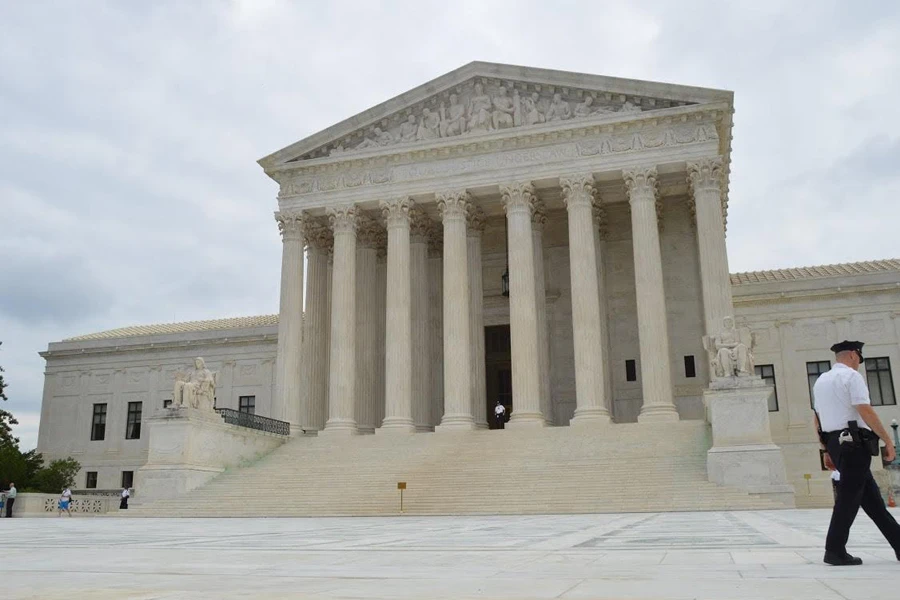
Washington D.C., Jun 26, 2017 / 11:32 am (CNA/EWTN News).- In one of the biggest religious cases of the term, the US Supreme Court on Monday ruled that a church-owned playground can be eligible for a public benefit program.
Chief Justice John Roberts, delivering the opinion of the Court, wrote June 26 that “the exclusion of Trinity Lutheran,” the church at the center of the case, “from a public benefit for which it is otherwise qualified, solely because it is a church, is odious to our Constitution all the same, and cannot stand.”
The decision in Trinity Lutheran Church of Columbia, Inc. v. Comer was about “religious people being treated just like everybody else,” stated Mike Farris, president of Alliance Defending Freedom.
At issue was a playground owned by Trinity Lutheran Church in Columbia, Mo., and operated by the church’s preschool. To resurface the playground for safety reasons, the church had applied for a state reimbursement program that provides rubber surfacing material made from used tires. Trinity Lutheran had ranked the fifth most qualified out of 44 applicants for the program.
The state’s natural resources department ultimately ruled the church ineligible for the program because of its religious status. The Missouri state constitution forbids taxpayer funding of churches. The Eighth U.S. Circuit Court of Appeals sided with the state.
The Supreme Court reversed that ruling and sent it back to the lower courts.
Justices Anthony Kennedy, Samuel Alito, and Elena Kagan joined Chief Justice Roberts’ opinion of the Court that the denial of the church’s eligibility for the program violated the free exercise clause. Justice Stephen Breyer filed an opinion concurring in Chief Justice Roberts’ judgement.
Justices Clarence Thomas and Neil Gorsuch joined the Court’s opinion except for a footnote stating that the decision was about “discrimination based on religious identity with respect to playground resurfacing,” and does not “address religious uses of funding or other forms of discrimination.”
“I worry that some might mistakenly read” the footnote to apply only to “‘playground resurfacing’ cases, or only those with some association with children’s safety or health, or perhaps some other social good we find sufficiently worthy,” Gorsuch wrote.
He added that “the general principles here do not permit discrimination against religious exercise—whether on the playground or anywhere else.”
Justices Sonia Sotomayor and Ruth Bader Ginsburg dissented from the Court’s opinion.
The Church had argued that the new surface would be a safety upgrade for the playground operated by its preschool and used by members of the community during non-school hours.
It was used by both church members and non-members, they insisted, and should not be ruled ineligible for a state benefit program available to other entities just because it is owned by a religious institution.
Opposing the church was the ACLU, which had argued that to make the church eligible for state benefits would be an unconstitutional violation of the establishment clause.
Missouri’s denial of the church, however, “goes too far” under precedents of Supreme Court decisions, Chief Justice Roberts wrote, and “violates the Free Exercise Clause.”
The Missouri law was passed during a time when many other states were passing laws barring public funding of sectarian schools, widely viewed at the time to mean Catholic schools and other religious schools that were not part of the public school system. The laws were modeled after the federal Blaine Amendment, proposed in the 1870s and named after Maine Congressman James Blaine. His amendment was proposed, but never passed by Congress.
In oral arguments in the case, justices also discussed the broader constitutionality of religious groups having access to other public benefits, including a Jewish synagogue requesting a security detail.
Catholic leaders applauded Monday’s ruling.
“The Supreme Court is signaling in this decision that the government must stop its growing hostility towards religion and religious institutions, and that antiquated and anti-Catholic Blaine Amendments should not be used as a weapon to discriminate against people of faith,” Maureen Ferguson, senior policy advisor with The Catholic Association, stated.
“For over a century, Blaine Amendments have enshrined into law discrimination against faith-based charities and schools that form an essential part of American society,” Ashley McGuire, senior fellow with The Catholic Association, stated. “In this case, a state Blaine Amendment was used to justify blacklisting a Christian elementary school from a playground safety program solely on religious grounds.”
“Blaine Amendments are anti-Catholic in their origin, and getting rid of them is more than a century overdue,” she added. “Today’s decision demands a more fair and inclusive approach to government programs meant to serve all people.”
The decision “will have an effect” in the future, David Cortman, senior counsel with Alliance Defending Freedom, who argued the case for the church before the Court in April, said. “Whenever religious people, organizations, see themselves being discriminated against, this case will be the controlling precedent,” he added.
Members of Congress also weighed in on the decision. House Speaker Paul Ryan (R-Wisc.) called it “an important ruling for religious liberty with profound significance for America’s civil society.”
Sen. James Lankford (R-Okla.), co-chair of the Congressional Prayer Caucus and who filed an amicus brief with colleagues on behalf of Trinity Lutheran in the case, stated that “today’s decision affirms the First Amendment right to the free exercise of religion—to have more than just a belief but to live out your faith without discrimination from the government.”
The case was ultimately between the church and the state’s natural resources department. Missouri’s attorney general recused himself in the case.
Missouri’s governor Eric Greitens (R) had already announced that in the future, religious institutions could be eligible for benefit programs of the natural resources department. However, the Court stated on Monday that “that announcement does not moot this case.”
Justice Sonia Sotomayor, in her dissent, stated that “this case is about nothing less” than the relationship “between church and state.”
“The Court today profoundly changes that relationship by holding, for the first time, that the Constitution requires the government to provide public funds directly to a church,” she added. “Its decision slights both our precedents and our history, and its reasoning weakens this country’s longstanding commitment to a separation of church and state beneficial to both.”
In the majority opinion, Chief Justice Roberts acknowledged that “it is true the Department has not criminalized the way Trinity Lutheran worships or told the Church that it cannot subscribe to a certain view of the Gospel.”
“But, as the Department itself acknowledges, the Free Exercise Clause protects against ‘indirect coercion or penalties on the free exercise of religion, not just outright prohibitions.’” And a church being denied participation in public benefits because of its religious character can be such an “indirect coercion” on the free exercise of religion, he continued.
“In this case, there is no dispute that Trinity Lutheran is put to the choice between being a church and receiving a government benefit. The rule is simple: No churches need apply.”
 […]
[…]



Platitudes that are true and worth heeding — but have proved to be an inadequate response over the years and decades.
The archbishop needs to take a solid, no-nonsense, vocal stand on gun control, also.
Jesus the Christ declared:”For out of the heart come evil thoughts–murder, adultery, sexual immorality, theft, false testimony, slander.(Matthew 15:19) One of God’s Moral Laws is “You shall not murder”. As our cultural/society continues to morally decline we can expect more violence…guns, knifes,hatred,prejudice, sexual immoralities/perversions, and slander against one another to increase.
My friend, gun control is not the answer. No matter how many gun regulation laws you pass, it still up the individual to determine whether or not mass shootings occur. People with evil intentions will always find a way to inflict harm on others. What really needs reforming are the morals of the American people: not a further restriction of the right to bear arms.
Eternal rest grant unto them, O lord, and let perpetual light shine upon them. May their souls and all the souls of the faithful departed, through the mercy of God, Rest In Peace. Amen
Despite there being no evidence to suggest that racial animus motivated the Atlanta murders, as even the FBI admits, bishops did not hesitate to imply that it was a factor. On the other hand, in the Boulder case, there is plenty that points to the perpetrator being a resentful Islamist who hated Americans, yet Archbishop Aquila won’t bring it up. If the shooter is white, attribute the act of violence to racism even if the victims are white or there is little proof of such animus. If the shooter is not white, still blame white racism, prattle on about the need for gun control or increased mental healthcare services or deplore the generic violence of American society. One must know what the talking points are depending on the circumstances. The US bishops have it down pat!
I first learned about the killing of Officer Jeff Talley from the website ODMP.org (stands for Officer Down Memorial Page). One detail included there and not mentioned in other articles about the killing spree was that Officer Talley’s parents are still alive. My heart goes out to his wife and seven children, but most of all to his parents. It is against the law of nature that parents outlive their children. I cannot imagine their grief. To donate to his family, go to https://www.gofundme.com/f/fundraiser-officer-eric-talleys-surviving-family. May he rest in peace.